
The previous post closed with a perhaps outrageous claim to have noticed something that specialised music critics have not. But the point is not difficult to argue. Let’s look again at the extract from the score I printed in the previous post.
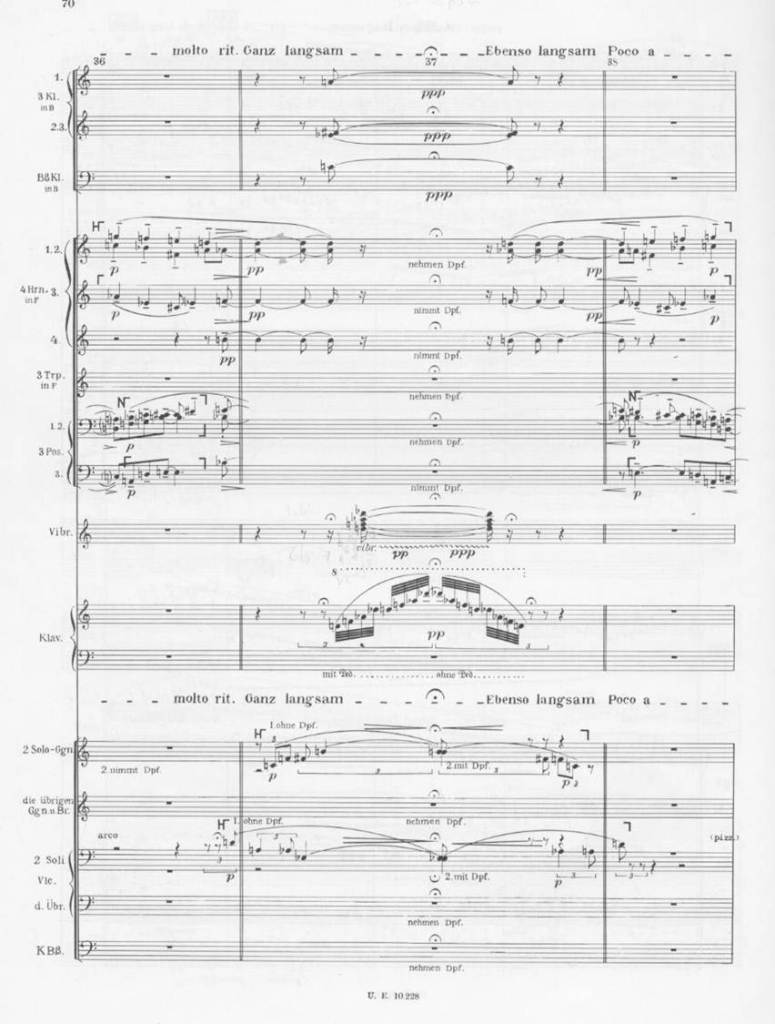
Notice the directions nehmen Dpf in the middle of the page – put the mutes on. For the music is played backwards with all possible instruments muted. This signals a difference from the first half, an addition subtle on the page but decidedly audible in performance. To an audience listening as opposed to a reader reading, that is, with the remediation of the text through the technologies of musical instruments from the printed visual to the aural, the palindrome does not signal a suspension of the arrow of time. Rather, it emphasises time’s passage by highlighting difference in similarity.
This is certainly the case with the narrative palindrome that Berg creates. By the last scene, when the husbands start returning and taking their revenge, we in the audience have been so well trained by the patterns in the opera that we know the narrative law. And we are given a choice. Do we simply accept the law as an inevitable given, as part of the human condition, or do we rebel against its violent inflexibility? Do we want this structure to be enacted?
I want the ending to be different. I want Lulu to escape Jack and for the self-sacrificing Countess to study law and fight for women’s rights. I do not want men to take revenge, as by this time I, though a man, have come to see Lulu as a human being. I want transcendence from my own gendered, socialised subject position, I want the cycle of suffering to be broken. My engagement with the performance and its technologies (as opposed to just with the technologies of print) has caused me to distance myself from a community of people who automatically assume the rightness of the lex talionis.
Alternatively, if I do want it – and parts of me do, confiteor – I am encouraged to ask myself about the moral stature of my sadistic misogynistic desire, my conservative desire to remain within a community of vengeance.
Lulu in the final scene puts my progeessive and conservative desires in dialogue with one another.
By listening to and watching, by experiencing a performance on stage, I, already split, have also become linked to Lulu. If the title of the opera follows the tradition of naming a work after the solitary protagonist like Tosca and Fidelio – it’s not Tristan und Isolde, or A Village Romeo and Juliet ‑ I nonetheless supply both the conjunction the missing adjunct: Lulu and me. Who of these is the angel, who the demon? Am I Jack or Lulu or both? The and here is not, as I’ve already explained in a previous post, a simple conjunction: it is an implied copula fot it suggests identity through linkage. Lulu and me suggests that I am Jack or Lulu or both?
In this last part, I turn to one of the many recurrent passages that is never subject to palindromic treatment, the coda to the sonata form associated with Dr Schön, Lulu’s third husband. This is the music of Lulu’s desire to be loved by Dr Schön, the man she wanted to be married to at the start. She wants him to recognise her as a valid human being. She wants him to recognise that she is. It’s all she’s ever wanted, as she says in one of the terrible quarrels they have. The first time the musical passage appears, she recalls her childhood as a street urchin and thief in spoken words that ensure the audience understands them:
“ ‘My husband’… If I belong to anyone in this world, I belong to you. Without you, I don’t know where I’d be. You took me by the hand, you gave me food and clothes, even though I was trying to steal your watch. Do you think I can forget that?”

Memory binds Lulu to Dr Schön: she can’t forget. And indeed, it is the power of memory that binds me to Lulu as I watch that last scene when Schön returns as Jack. I remember her story when this music returns, and that is why I partly become her.
What does Lulu give me in that memory? She does not give food and clothes. Instead she gives me the story of her life, an Other to my own. And then, to complicate the act of generosity that art always involves, the actress who plays Lulu gives me her labour and her skill. If successful, this is a gift beyond price, signalled by the ecstatic applause at the end of a performance which pays the artist beyond her fee, an act of recognition all of us who have performed need and know in our flesh more than in our pockets.
Now, though no previous critic has pointed this out, I think it clear that Lulu’s gratitude music owes a debt to the very first motif in Wagner’s Tristan und Isolde. The first four notes have the same intervals but are played backwards and upside down, the whole filtered through the emotional and orchestral lens of late Mahler (itself deriving from Wagner).
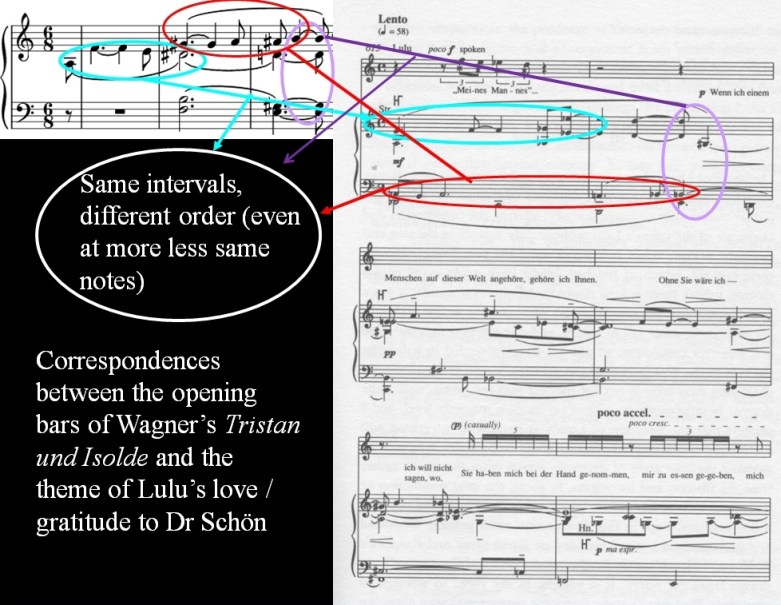
Lulu’s music of gratitude and love is by no means the music of absolute modernity and abstraction from history. Its reworking of Wagner declares itself to be very firmly within tradition, within a historical community of texts: Berg and Wagner, not Berg in splendid isolation. The reworking is a memory and acknowledgement of history, of community, of society — and therefore necessarily of ideology. The music of gratitude can even be said to acknowledge its debt by mirroring back its donor: Wagner is acknowledged as the source. This is exophoric reference, an intertextual repetition. It is not the abstract kind of repetition without ideology that Adorno and his followers have praised. It is an and of textual community.
My point is that repetition, even the retrograde of the palindrome, does not necessarily mean timelessness, the absolute of utter novelty that is the orthodox claim of high modernity, or a refusal of ethical intervention into society that is pure deixis. On the contrary: repetition of the intertextual kind (and there are many such in Berg) and even palindromic repetition, necessarily imply memory, a coupling of the past to the present that enables future action.
I remember and I am reminded of Lulu’s gratitude to Schön and her desire to be recognised by him every time this music recurs. Its last appearance is in her conversation with Jack, the reincarnated Schön, when it is conjoined effortlessly with the music of Lulu’s beauty that we first hear when she is presented by an animal tamer in the Prologue. Jack and Lulu discuss money: he, rather than she now, takes more and more in incremental demands, an inversion of her financial dependence on Schön – except that he takes everything. (“Gib mir das ganze” – “Give me everything” – In Gottes Namen” – “In God’s name” replies she, as if acknowledging the operation of Biblical lex talionis)
When Jack stabs Lulu we have been reminded he is killing a human being who only wants to be loved as she is. When he kills the Countess we have been reminded, and afterwards in her Wagnerian Liebestod will be reminded again, that he is killing a human being who only wants to live for others. Our Weinigerian misogyny at this moment will be pressured by our affective involvement, by our feeling for and with Lulu and the Countess.
That sounds very sentimental. Indeed it is, in the eighteenth- and nineteenth-century sense. This is a political tradition of sentiment that in the nineteenth century was practiced especially by women for the sake of women and other oppressed people – Harriet Beecher Stowe’s Uncle Tom’s Cabin is perhaps the most famous and impactful example of its deployment. Ouida operated within it, as did the American mass-market abolitionist and proto-feminist novelist E.D.E.N. Southworth. Better known today is the political sentimentality of Dickens.
This is not the sentimental tradition of, say, Violetta or Mimi – those archetypal operatic women who are thrown away when used up, who die of consumption literally and metaphorically and whose voluptuous deaths we uncritically enjoy so much, as we are reminded by Catherine Clement in her famous 1979 book on Opera and the Undoing of Women. That is the version of commercial sentimentality that Adorno hated. Instead, we are talking of a use of emotion to stir the audience to political action. Such action may stem from a humanistic ideology that not so long ago it was the fashion to excoriate and altogether repudiate. But at least action is possible (indeed necessary) in that ideology.
We also have to ask if Adorno’s belief in the possibility of escape from ideology and the personal is actually only a blindness to the very material conditions which permit that belief. After all, Universal Edition, Lulu’s publishers, were and remain a very canny publishing house as moiled in capitalism as any Hollywood studio. Adorno’s argument depended on a printed text produced by Universal to show how Berg was unideological and passive, resistant to action. My main issue with him here is not blindness to the capitalist materiality of what enabled his anti-capitalist praise of inaction and formal perfection, nor his praise for the hard, the difficult, the challenging, the unpopular, but his rejection of the sentimental through praise of the abstracted and neglect of performance.
Sentimentally, I refuse to be either abstracted or mono-media.
To move us to action a link must be made with us. And this is the conjunction-copula that binds the work of art to us. Lulu’s escape from ideological constraint, pace Adorno, lies not in its abstraction of structure and a purity of absolute decontextualised modernity. That idea relies on the media technology of printed scores, itself a product of industrial modernity of which Adorno was the salesman of a specific sector. Instead, opera, when it is successful, like theatre in general, offers us the conjunction-copula – the verbal force of and – of Carmen and Don Jose, Lulu and Dr Schön, murdered and murderer, actor and audience, popular and elite, text and performance, even the Angels and Demons with which we began.
I stand with Cixous in her remarks on opera and theatre. A performance of Lulu offers the time of pity in its examination of the uncertain differences coupled and defined by a conjunction, the messy relation of memory, of today and yesterday, of the popular and exclusive, of men and women, of Angels and Demons, of Conservative Communities and New Possibilities, Others and Us.
And is not a simple parataxis devoid of force; it is a part of speech that, when examined, can and should result in calls to action. It is in this sense that and can be a copula (pace Adorno here).
What that action will be depends on the force of both strictly verbal copula and conjunction that our stories, our art, our ethical commitment can generate.


 Prof Andrew King
1 Comment