Characters from Ouida: A Song Cycle for Voice and String Quartet (2026)

Andrew King

Watch/ Listen to the series on YouTube


Oscar Wilde called Ouida (born Louise Ramé, 1839–1908) “the high priestess of the Impossible.” She was one of the Victorian era’s most commercially successful, and most morally suspect, novelist of sensation and sensuousness, despised and imitated by the literati and read by millions in English and translation — and she is the subject of my new song cycle, Characters from Ouida, for voice and string quartet.

The cycle sets six excerpts from Ouida’s prose fiction, spanning the 1860s to the 1880s: peasant girls, working class men, poets, social butterflies, actors, acrobats, queens and lovers, each caught in a moment of collision with systems that would exploit, consume, or indifferently discard them.

Musically, the cycle moves through a wide range of registers and references, from contemporary art-music to Golden Age Hollywood Musical brightness, through Puccini-esque grief and a satirical waltz, a furious Bartókian tarantella, tangled sensual ecstasy recalling Gesualdo, a bare torch-song line: in short, a self-aware mash of styles from art and popular musics — a parallel to Ouida’s own stylistic mashups.

Together, the songs ask, often with humour and always with irony, how far art can witness suffering without only profiting from it, how time alters perception and moral; responsibility, and, of course, how music might find an equivalent for Ouida’s peculiar, forceful clarity and stylistic mashup. How, in short, can we communicate musically in 2026 to as wide an audience as Ouida did while engaging rigorously with vital intellectual questions?

The texts are only lightly adapted from Ouida’s originals (mostly cut, rather than rewritten) to make them singable and to sharpen the dramatic situation. With one obvious exception, the images below that signal the characters are AI-generated, each modelled on a Victorian or near-contemporary painter whose style suits the scene.

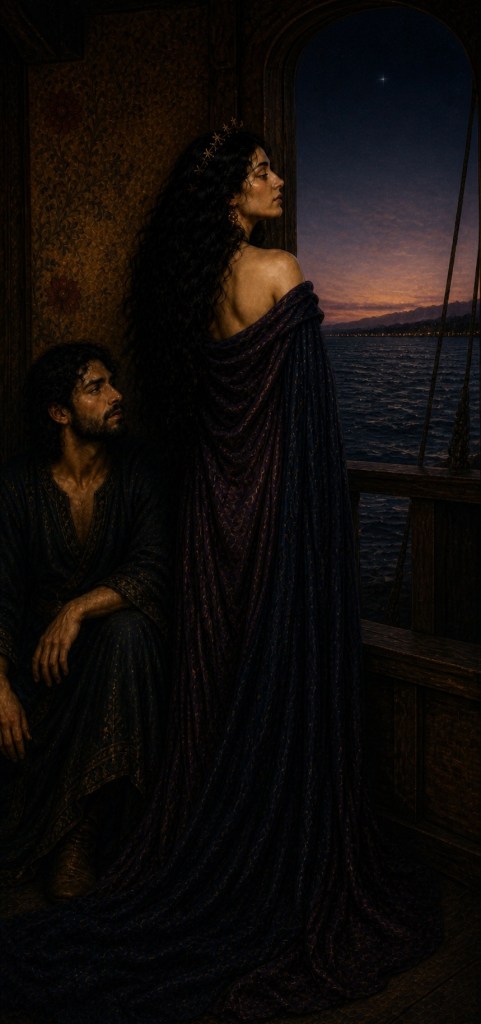
The YouTube videos I made to illustrate the songs use art with a Creative Commons license or photographs I have taken myself, along with at most two AI generated images to help visualise the characters. The image that heads this post is a collective AI-generated portrait of the characters, grown older after the experience of their stories, as if they were visiting Ouida’s grave today.

Scores are available on request, including piano versions. All the songs are for medium voice and performable by either mezzo or baritone, but the first choice is given below and recorded on YouTube with CantAI and either MuseScore Berlin First Chairs or MuseScore solo strings.

1. Bébée and the Sun (Youtube)

Mezzo-soprano (or baritone) and string quartet · c. 8 minutes
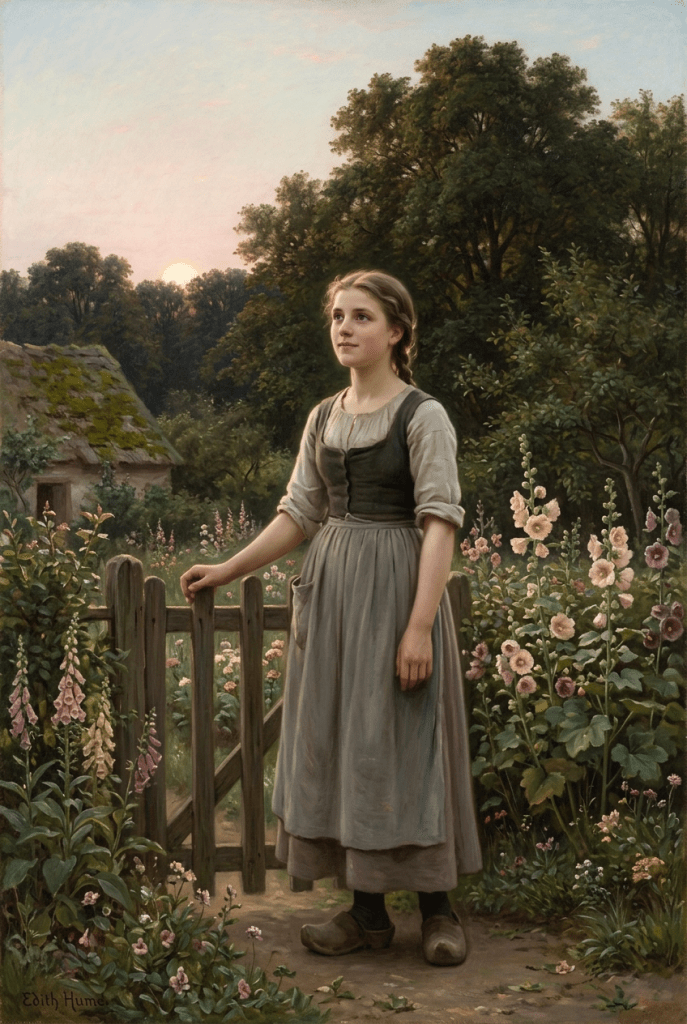
Bebee and the Sun – in the style of the Victorian popular artists Edith Hume

An innocent and ignorant peasant girl greets the sunrise, certain that the painter who has discovered her is about to take her to Paris to be educated. We already know — as the indifferent Sun already knows — that it will end badly. The song opens with a moment of innocence before the fall, but even the innocence is compromised through its use of the commercial language of Golden Age Musicals. The Sun, representing the inflexible laws of both nature and story-telling, occupies much darker and more static territory.

For performers: Darkly opening, the song seems just another late-twentieth/ early twenty-first-century art-music lament using harmonics, arpeggii on open strings and sul ponticello, over a sustained trill the player is instructed to pay with major or minor seconds at will (a recurring feature of the songs). This banality soon transforms into another one: a bright, diatonic D major, with trills now doing obvious, charming illustrative work. Bebée’s address to the Sun ends and the trills return before the narrator imagines what the impersonal Sun would tell her if it cared to. Its words are imagined as a cold hymn-like central section over which the trill constantly hovers. The dark music returns before the narrator bursts out with a passionate version of the hymn combined with the girl’s music – and repurposed arpeggii – briefly pointing out that pleasure is still valuable even though it does not last. The piece ends with the alien inflexibility of the Sun.

The real demand of the song is the depiction of the various characters and the management of the narrative arc: the performers have to sustain wide-eyed sincerity when depicting Bebée, through the cold music of the Sun, to the passionate refusal of the narrator to commit to hopelessness, even while they know that time passes and consumes everything.

Source: Ouida’s Two Little Wooden Shoes (1871).


2. Crispin and Hilarion (Youtube)

Baritone (or mezzo-soprano) and string quartet · c. 6 minutes
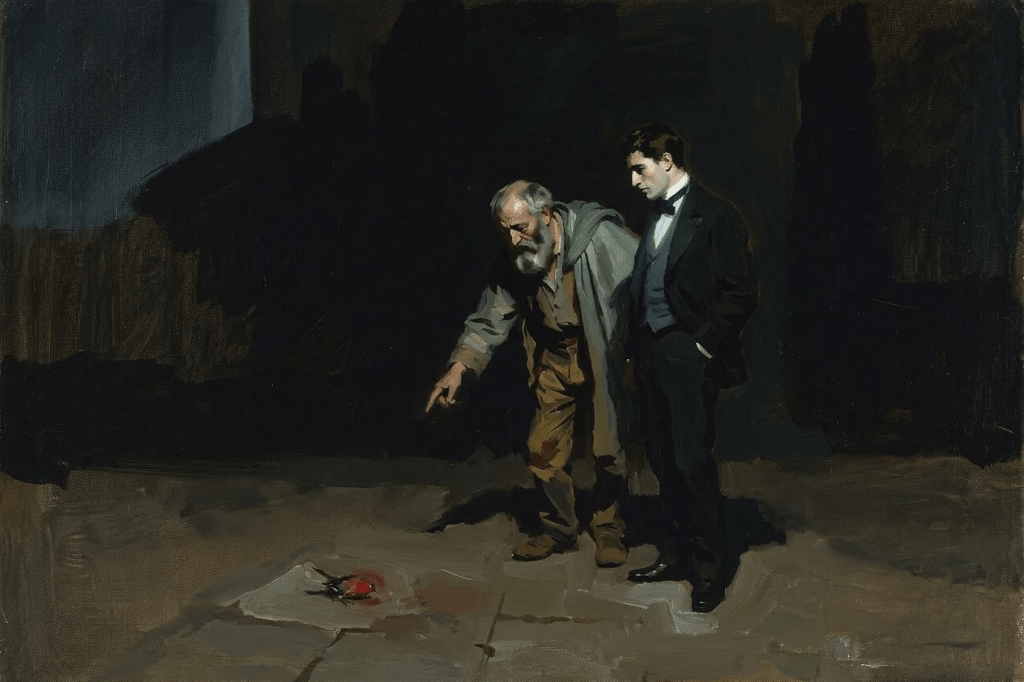
Crispin and Hilarion, in the style of the Macchiaioli

A poor cobbler confronts a celebrated, decadent poet over a dead bird fallen from a market stall as they walk through Rome at night, and turns the moment into an accusation: you destroy what you touch, call it art and do not care. One of the cycle’s hardest emotional hits but which  also questions the emotional payoff: for whose benefit do we enjoy the depiction of women’s pain?

For performers: Simple writing and the most spartan writing in the set with a clear diatonic focus on E-flat minor, interrupted by what appears at first as unmotivated chromaticism but which the closing pages reveal to be a quotation of Puccini’s Crisantemi – for isn’t Puccini the arch-poet who profited from making us feel women’s pain? The performance challenge is beauty of sustained line for all instruments and voice while again maintaining a clear sense of the architecture, and for the singer the articulation of two points of view, that of the sympathetic working-class man Crispin, the narrator of almost all the song, who desperately but also in a controlled manner tries to make his interlocutor take pity on his victim, and Hilarion, the youthful decadent poet who, like the Sun in the previous song, just does not care.

Source: Ouida’s Ariadne (1877).


3. Lady Dolly (YouTube)

Mezzo-soprano (or baritone) and string quartet · c. 5 minutes
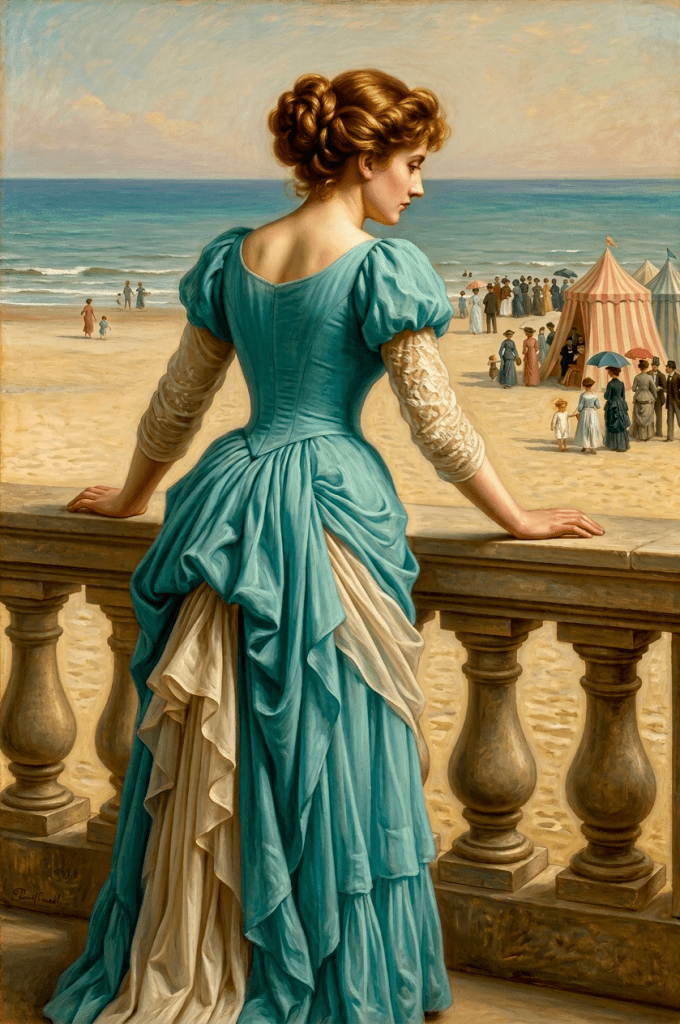
Lady Dolly (Dorothy Vandedecken), modelled on another Dorothy, Lord Leighton’s muse, Dorothy Dene)

A vain, glamorous, mercenary woman of 34 runs gleefully through everything that makes her happy on holidfay at Trouville — gambling, gossip, a rival’s bad dress sense — to avoid thinking about the imminent arrival of her sixteen-year-old daughter. Her solution: marry the girl off immediately, before her own beauty has time to fade by comparison. But will that strategy work?

For performers: pure comic theatre, and probably the most immediately enjoyable piece in the cycle to perform. The lines dart through a magpie’s nest of quotation — Johann Strauss, Lehár, Verdi, Tchaikovsky, a sliver of Wagner’s forging motif (for her most potent weapon, her wardrobe), a flash of The Merry Widow when Lady Dolly extracts about a state secret. The song rewards a mezzo with strong comic timing and the agility to pivot character within a phrase. It ends somewhere between a laugh and a wince. A gift of a character study for anyone who enjoys playing monstrous people charmingly, and fun for the quartet to dialogue with and assist the singer.

Source: Ouida’s Moths (1880).


4. Pascarel (YouTube)

Baritone (or mezzo-soprano) and string quartet · c. 5 minutes
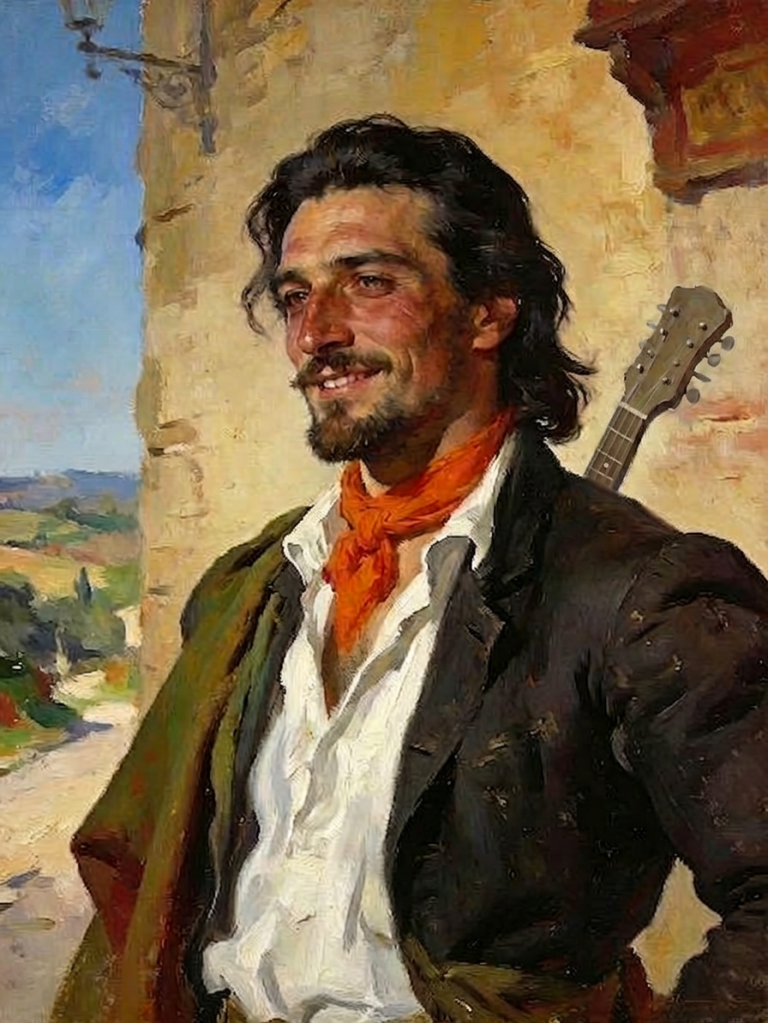
Pascarel with a red scarf signalling his commitment to the Risorgimento – commitment to the theatre of politics

A swaggering, misogynistic charmer with a guitar and a grudge, Pascarèl, leader of a troupe of travelling actors in 1850s Italy, hits back at a snobbish young aristocrat who has dismissed his profession as beneath her. What he gives her instead is one of the great defences of the actor’s trade in Victorian fiction, here depicted, though, as an exaggerated and macho claim: despised as a “wooden doll,” yet the only thing that allows the poor a few hours’ escape into “the sunlit paradise where genius dwells.”

For performers: A pizzica tarantella — the dance once prescribed to cure women of hysteria, here performed by the man inflicting it — drives the quartet through an energetic 12/8, including passages imitating strummed guitars, where players can display energetic virtuosity and variation of tone much easier to p[lay than it sounds. Structurally it keeps wrongfooting expectation: hinting at a caballeta, the song offers no straightforward strophic return, but contrapuntal games, a tonal tug-of-war between G and E that isn’t resolved until the final bars, and a folk-tarantella episode that collides head-on with the main pizzica rhythm before both end together, pizzica against pizzicato. High virtuosic payoff for both singer and quartet, and another real audience-pleaser — funny, threatening, and a little frightening by turns. Challenges for the singer include a chromatic line, rhythmic precision, demands for different voice colours, great acting skills and, at the end, a struggle with the quartet getting over-excited.

Source: Ouida’s Pascarèl (1873), her travelogue-novel of Italian unification.


5. Idalia

Mezzo-soprano (or baritone) and string quartet · c. 7 minutes

Idalia and her lover, vaguely in the manner of Rossetti

A revolutionary queen sails by moonlight toward home with the man who loves her and is plainly more interested in the beauty of the evening than in him. One of Ouida’s most purely sensuous heroines, entirely absorbed in the pleasures of the moment. Do we care what happens next?

For performers: the still point of the cycle, and a deliberate contrast to the energetic theatricality preceding it: a continuous, hypnotic 6/8 perpetuum mobile that depicts the ship’s unstoppable but gentle onward motion. Seeking the equivalent in sound of Dante Gabriele Rossetti’s aesthetic turn to painting before Raphael, the song is built from a study of Gesualdo, but treated as a chain of vertical chords rather than counterpoint. Less about drama than sustained, voluptuous tone: long, unbroken phrases over richly chromatic but consistently soft-grained string writing. A sensuous, sinuous movement between the cycle’s more extroverted numbers, it asks for control and sustained legato rather than virtuosic display.

Source: Ouida’s Idalia (1867).


6. Interlude at Ouida’s Grave, Bagni di Lucca

String quartet (no voice) · c. 7 minutes
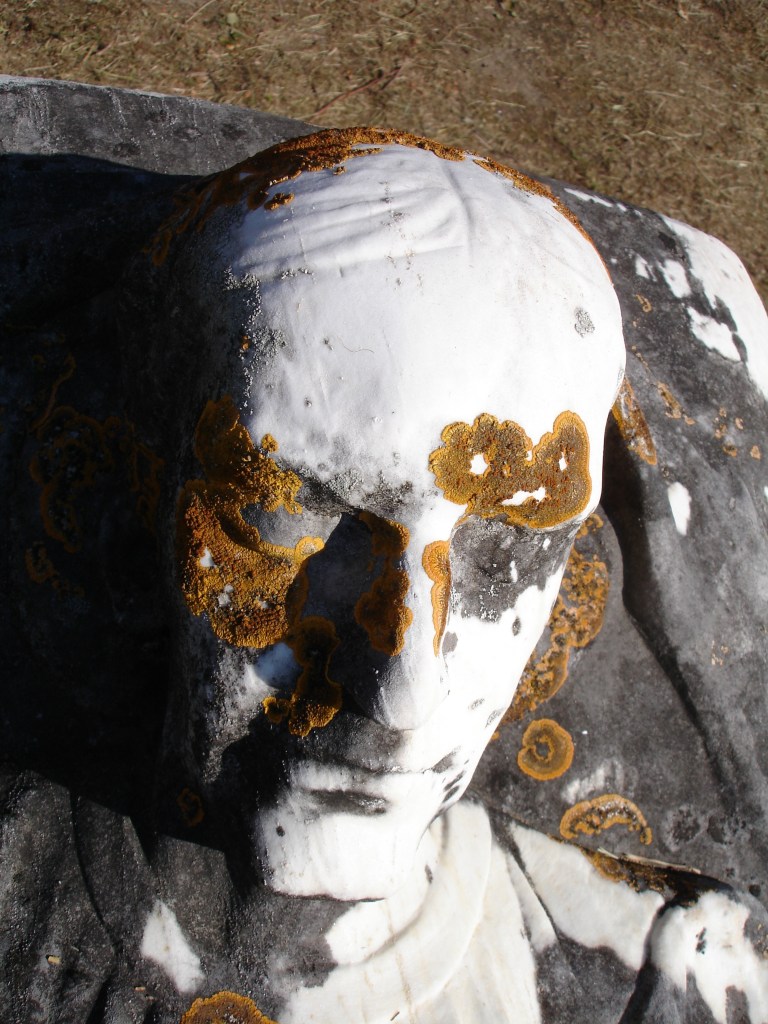
Ouida’s gravestone (2012) before restoration

A visit to Ouida’s grave in Bagni di Lucca and a meditation on the passing of time bring together themes – both musical and intellectual – from all the preceding songs. In the ticking of a clock and a bright cloud hides the ghost of a key motif of 4 or sometimes 5 notes heard in almost all the songs straight, inverted, retrograde or distributed: sympathy or connection with others. The texture coalesces into a semi-predictable early-twentieth-century dirge built on the characters’ themes before the clock returns  – and metamorphoses into a 4-bar groove over which the characters return in popular twenty-first-century guise, older and more experienced after their stories. They disappear amidst the trills from the first movement. The music of the inflexible Sun seems about to close the piece until the clock returns one last time with another, gentle, surprise.

For performers:

A  sure success with audiences and a showcase for a quartet happy in radically different styles and methods of playing which are yet intuitive and grateful to play. Balance and interaction are key throughout and there are passages that requires player choice and an invitation (not instruction) to improvise. Sustained harmonics in chords merge into rich polyphonic lines in lower registers, then open into variations of the same themes from the songs in a deliberately crowd-pleasing and ear-wormy style. Clarity of architecture is of the utmost priority. The last 9 bars ask performers, while playing their instruments, to foot tap a rhythm distributed over the quartet, showcasing their coherence as a working group in a surprising but simple and effective way. Would work as an independent piece, though its impact would be stronger as an integral part of the cycle.


7. Pipistrello

Baritone (or mezzo-soprano) and string quartet · c. 2 minutes (forthcoming on YouTube)
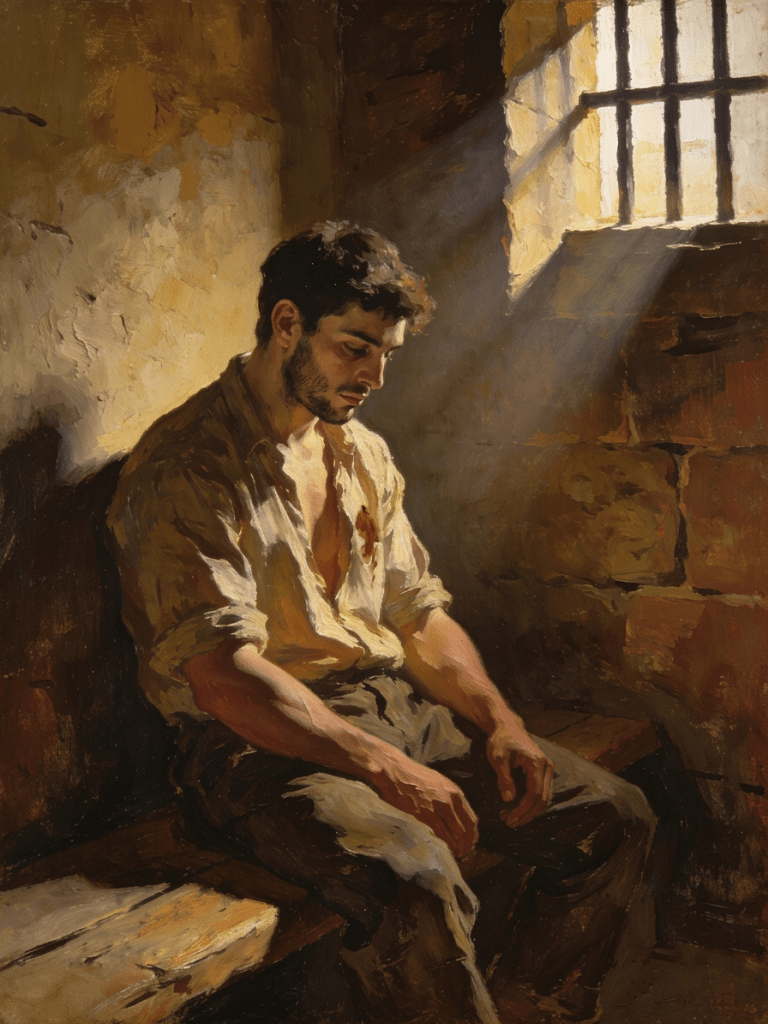
Pipistrello in the style of the Macchiaioli

An acrobat awaiting execution reflects on the glance that ruined his life — a moment of love so sudden it cost a child his life, and which results in a murder he didn’t mean to commit. The bleakest backstory in the cycle, delivered with disarming plainness, and yet with a hint of hope in our continued need for social action.

For performers: by far the shortest and simplest song in the set — fundamentally a slow groove of 4 descending steps echoing the groove of the Interlude, under an intimate vocal line, ideal as a closer or encore (its intension within the cycle). Its single dramatic event, the fatal glance and the child’s fall, is compressed into a brief, vivid contrasting episode in the middle before the song returns to its plain opening line. Minimal technical demands beyond clean, unforced lyricism and the ability to shift mood abruptly and back again. A small piece with an outsized impact at the end of a programme, especially after the intensity of the previous visit to a grave.

Source: Ouida’s “Pipistrello” (1880).

email:profandrewking@gmail.com

Angels and Demons: Lulu and the Copula Act 1

In 2010 I organised a conference on Angels and Demons at Canterbury Christ Church University. This resulted in a  special number of Critical Survey on the topic in 2011. Keen to promote my colleagues’ work rather than mine in the limited space available, I never expanded and published the paper at the conference that I had only a few days to prepare for when a speaker was forced to withdraw. I had to use what was close to me as a person physically, intellectually and emotionally: that shows!

The other papers looked at the first and last words of the title. Typically for me, I examined the smallest, neglected word: the ‘and’ of the title.

Here it is, more or less as delivered, in three parts.

Angels and Demons: Lulu and the Copula

Act 1

Nothing like beginning at the end, especially the end of Alban Berg’s unfinished opera Lulu, and a double murder by Jack the Ripper of someone we hear described as an “angel” and of the woman in love with her, a personification of the New Woman, the Countess Geschwitz, who plans to leave the garret to go to university to study law and fight for women’s rights.

NB CONTENT WARNING for violence : from the 1979 Chereau production of the completed three-act version

The important point is that this scene, the last from the opera, pretty unequivocally suggests that men really don’t like women!  Men murderers of angels really are devils, aren’t they? 

From the way the countess’s decision to fight for women’s rights is thwarted by her murder, you may have decided already that Jack is a representative figure of something beyond himself, perhaps standing for the general category “misogynistic, conservative, reactionary man”. Certainly the idea that Jack represents the revenge of men  on uppity women is a very common interpretation. For some critics, the work even becomes the tragedy not of Lulu, but of men who are forced to violence by such women (not a conclusion I agree with I should add).

And then the music… this isn’t just any old double murder of women by a man, of course, but a double murder in the 1930s high modernist opera by Alban Berg: Lulu, a work championed (and criticised) by no less an enemy of mass culture than Theodore Adorno.

One might well ask whether the demon is not Jack the casual murderer of would-be liberated New Women, or even women who supposedly make men behave in violent ways,  but exclusive avant-garde texts like Lulu. After all, everyone knows who Jack the Ripper is – he has generated a vast amount of material dedicated to him. We might say he has a vast fan base. We even go on Jack the Ripper tours in London’s East End. Jack is popular.  Berg’s Lulu, by contrast, is hardly the Glaswegian singer who won the 1969 Eurovision  Song Context with “Boom Bang-a-Bang“. It’s “hard”, difficult, unpleasant; this Lulu doesn’t follow the musical rules we are familiar with.

Yet it’s clear just from the inclusion of the figure of Jack that the opera attempts to take on board the violent hierarchy of popular and exclusive. For the conjunction “and” can be used in various senses – inclusion yes, but also to signal (and perhaps interrogate) a hierarchy of difference: good and evil, man and woman, angel and demon. In questioning the hierarchy of popular and exclusive as well as the other binaries I’ve just mentioned, Lulu is like many operas of the period, such as Ernst Krenek’s Johnny spielt auf, or several of Franz Schreker’s operas (perhaps most of all Die Gezeichneten). Certainly in some places it reworks then-popular dance forms, jazz rhythms and instrumental colourings.  Lulu even takes on the film industry – already dominated by Hollywood by the time the opera was being written between 1927 and 1935. A performance of Lulu as Berg wrote it has a film at its very centre, a 3-minute action-packed short very different from Pabst’s lingeringly aesthetic film on the same subject as the opera, Pandora’s Box of 1928, starring the wonderful Louise Brooks. Despite the claims of a few breathless writers, even the Pabst film was never “popular” in any sense. When it premiered in Berlin in January 1929, it was almost entirely ignored in the excitement of the new “talkies” that were grabbing public attention in Europe and America. Brooks herself was slashed by the critics. It took until the 1950s for the film to be appreciated by the cognoscenti in the art house. Unlike the retellings of the tale and figure that Karen Littau and Shelley Berc have detailed for us, the Lulu I’m writing of here has never been popular for all its engagement with elements of the popular. Does that mean that I, as a historian of popular narrative, cannot or should not engage with it? Is it heretical of me to do so?

Like Pabst, Berg based his work on a pair of plays by the fin-de-siècle German playwright Frank Wedekind, Earth Spirit and Pandora’s Box which Wedekind worked on between 1892 and 1913. Many of the music critics who discuss the opera love the music. It is a highly ingenious form of dodecaphony and parades the signs of exclusive distinction that require long training to decode.  But they regard the Wedekind plays as belonging on the junk heap of literature, too low for the sacred realms of opera. What was Berg doing when he chose to set this shabby little shocker that sold out to contemporary bourgeois notions of the femme fatale and comprised a collage of the vulgar misogynistic commonplaces that Otto Weininger systematised in his 1902 Sex and Character? Wedekind’s Lulu plays seem uncannily to agree with Weiniger’s fantasy that Woman has no ethics, logic or soul and therefore can only see with a blank stare, that Woman is totally materialistic and has no spiritual or intellectual side. It’s all wonderfully summed up in a notorious quotation from Weininger, “Man possesses sexual organs, her sexual organs possess Woman.” The New Woman we see murdered at the end, who plans to go to university to study law so that she can fight for women’s rights was, so her beloved Lulu tells her, half a man. Lulu herself can be regarded only too easily as the quintessence of Weinigerian Woman, as a one-sentence narration of her life will demonstrate. Having started as a child prostitute and thief, Lulu goes through three husbands, murders the last of them, escapes from prison through the machinations of her lesbian friend, runs off to Paris with the son of her third husband, and ends in a London garret as a prostitute.

Wedekind wrote his original version as Die Büchse des Pandora, ein Monstretragödie (“Pandora’s Box, a Monster Tragedy”)  between 1892 and 1894 as a single 5-acter, monstrous both in length and subject matter. If you thought the ending in the opera was shocking, in the original Jack the Ripper explicitly knifes out Lulu’s genitals and fantasises about how much the London Medical Club will pay for them. Partly because of this ending, Wedekind’s publisher thought the Monstretragödie would provoke prosecution for obscenity. He therefore persuaded Wedekind to publish just the first three acts of his play which dealt with Lulu’s marriage to each of her three husbands. Subsequent versions of the play which Wedekind wrote (including splitting the original 5 acts into 2 plays) attempted to negotiate a path between the censors and desire for popularity through sensation. Berg condensed his opera from the published two-play version – we know from a surviving seating plan that he went to a private performance of the second play in 1905 and that this performance and its paratexts influenced him. By recombining the two plays, therefore, Berg was returning them to their original structural integrity.

To me just as shocking as the murders is the number of music critics who choose to ignore what they regard as an unworthy text to concentrate instead on analysing the fabulous intricacy of the music – Adorno amongst them. What is at stake in this violent excision of words? This what the other parts of this blog will seek to answer.

(to be continued)

Angels and Demons: Lulu and the Copula Act 3

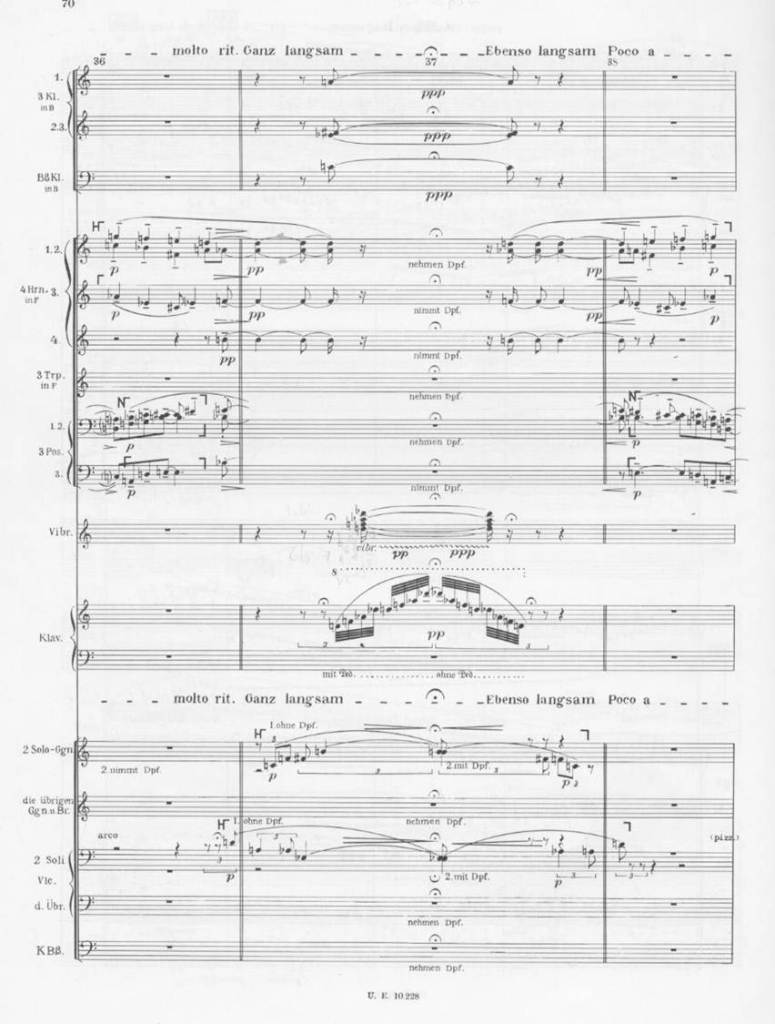
The previous post closed with a perhaps outrageous claim to have noticed something that specialised music critics have not. But the point is not difficult to argue. Let’s look again at the extract from the score I printed in the previous post.

Lulu centre again – but note the direction to the performers to put mutes on their instruments, and the fade of the vibraphone from pp (very quiet) to ppp (extremely quiet)

Notice the directions nehmen Dpf in the middle of the page – put the mutes on. For the music is played backwards with all possible instruments muted. This signals a difference from the first half, an addition subtle on the page but decidedly audible in performance. To an audience listening as opposed to a reader reading, that is, with the remediation of the text through the technologies of musical instruments from the printed visual to the aural, the palindrome does not signal a suspension of the arrow of time. Rather, it emphasises time’s passage by highlighting difference in similarity.

This is certainly the case with the narrative palindrome that Berg creates. By the last scene, when the husbands start returning and taking their revenge, we in the audience have been so well trained by the patterns in the opera that we know the narrative law.  And we are given a choice. Do we simply accept the law as an inevitable given, as part of the human condition, or do we rebel against its violent inflexibility? Do we want this structure to be enacted?

I want the ending to be different. I want Lulu to escape Jack and for the self-sacrificing Countess to study law and fight for women’s rights. I do not want men to take revenge, as by this time I, though a man, have come to see Lulu as a human being. I want transcendence from my own gendered, socialised subject position, I want the cycle of suffering to be broken. My engagement with the performance and its technologies (as opposed to just with the technologies of print) has caused me to distance myself from a community of people who automatically assume the rightness of the lex talionis.

Alternatively, if I do want it – and parts of me do, confiteor – I am encouraged to ask myself about the moral stature of my sadistic misogynistic desire, my conservative desire to remain within a community of vengeance.

Lulu in the final scene puts my progeessive and conservative desires in dialogue with one another.

By listening to and watching, by experiencing a performance on stage, I, already split, have also become linked to Lulu. If the title of the opera follows the tradition of naming a work after the solitary protagonist like Tosca and Fidelio – it’s not Tristan und Isolde, or A Village Romeo and Juliet ‑ I nonetheless supply both the conjunction the missing adjunct: Lulu and me. Who of these is the angel, who the demon? Am I Jack or Lulu or both? The and here is not, as I’ve already explained in a previous post, a simple conjunction: it is an implied copula fot it suggests identity through linkage. Lulu and me suggests that I am Jack or Lulu or both?

In this last part, I turn to one of the many recurrent passages that is never subject to palindromic treatment, the coda to the sonata form associated with Dr Schön,  Lulu’s third husband. This is the music of Lulu’s desire to be loved by Dr Schön, the man she wanted to be married to at the start. She wants him to recognise her as a valid human being. She wants him to recognise that she is. It’s all she’s ever wanted, as she says in one of the terrible quarrels they have. The first time the musical passage appears, she recalls her childhood as a street urchin and thief in spoken words that ensure the audience understands them:

“ ‘My husband’… If I belong to anyone in this world, I belong to you. Without you, I don’t know where I’d be. You took me by the hand, you gave me food and clothes, even though I was trying to steal your watch. Do you think I can forget that?”

Alban Berg, Lulu, vocal score, Universal Edition, 1936: 81 (“Coda der Sonata”)

Memory binds Lulu to Dr Schön: she can’t forget. And indeed, it is the power of memory that binds me to Lulu as I watch that last scene when Schön returns as Jack. I remember her story when this music returns, and that is why I partly become her.

What does Lulu give me in that memory? She does not give food and clothes. Instead she gives me the story of her life, an Other to my own. And then, to complicate the act of generosity that art always involves, the actress who plays Lulu gives me her labour and her skill. If successful, this is a gift beyond price, signalled by the ecstatic applause at the end of a performance which pays the artist beyond her fee, an act of recognition all of us who have performed need and know in our flesh more than in our pockets.

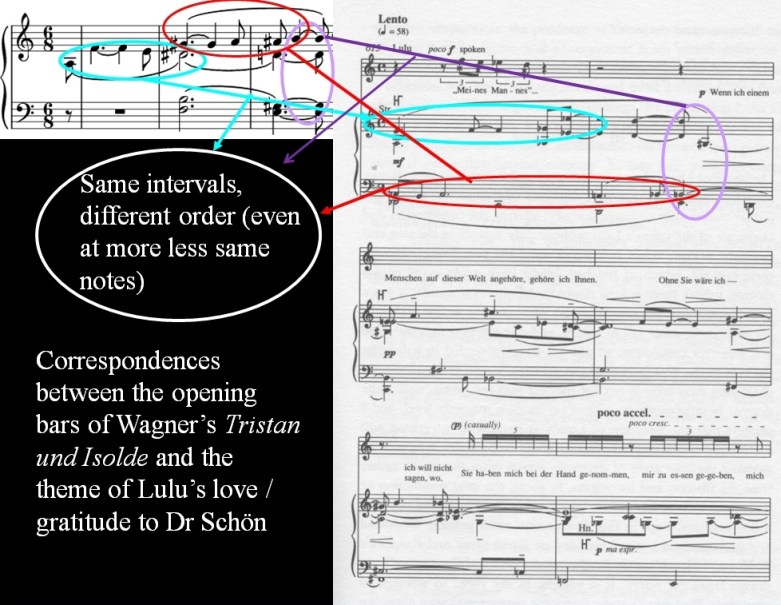
Now, though no previous critic has pointed this out, I think it clear that Lulu’s gratitude  music owes a debt to the very first motif in Wagner’s Tristan und Isolde. The first four notes have the same intervals but are played backwards and upside down, the whole filtered through the emotional and orchestral lens of late Mahler (itself deriving from Wagner).

How the opening bars of Wagner’s Tristan und Isolde become the theme of the heroine’s Gratitude/ Love in Berg’s Lulu

Lulu’s music of gratitude and love is by no means the music of absolute modernity and abstraction from history. Its reworking of Wagner declares itself to be very firmly within tradition, within a historical community of texts: Berg and Wagner, not Berg in splendid isolation. The reworking is a memory and acknowledgement of history, of community, of society — and therefore necessarily of ideology. The music of gratitude can even be said to acknowledge its debt by mirroring back its donor: Wagner is acknowledged as the source. This is exophoric reference, an intertextual repetition. It is not the abstract kind of repetition without ideology that Adorno and his followers have praised. It is an and of textual community.

My point is that repetition, even the retrograde of the palindrome, does not necessarily mean timelessness, the absolute of utter novelty that is the orthodox claim of high modernity, or a refusal of ethical intervention into society that is pure deixis. On the contrary:  repetition of the intertextual kind (and there are many such in Berg) and even palindromic repetition, necessarily imply memory, a coupling of the past to the present that enables future action.

I remember and I am reminded of Lulu’s gratitude to Schön and her desire to be recognised by him every time this music recurs.  Its last appearance is in her conversation with Jack, the reincarnated Schön, when it is conjoined effortlessly with the music of Lulu’s beauty that we first hear when she is presented by an animal tamer in the Prologue. Jack and Lulu discuss money: he, rather than she now, takes more and more in incremental demands, an inversion of her financial dependence on Schön – except that he takes everything. (“Gib mir das ganze” – “Give me everything” –  In Gottes Namen” – “In God’s name” replies she, as if acknowledging the operation of Biblical lex talionis)

When Jack stabs Lulu we have been reminded he is killing a human being who only wants to be loved as she is. When he kills the Countess we have been reminded, and afterwards in her Wagnerian Liebestod will be reminded again, that he is killing a human being who only wants to live for others. Our Weinigerian misogyny at this moment will be pressured by our affective involvement, by our feeling for and with Lulu and the Countess.

That sounds very sentimental. Indeed it is, in the eighteenth- and nineteenth-century sense. This is a political tradition of sentiment that in the nineteenth century was practiced especially by women for the sake of women and other oppressed people – Harriet Beecher Stowe’s Uncle Tom’s Cabin is perhaps the most famous and impactful example of its deployment. Ouida operated within it, as did the American mass-market abolitionist and proto-feminist novelist E.D.E.N. Southworth. Better known today is the political sentimentality of Dickens.

This is not the sentimental tradition of, say, Violetta or Mimi – those archetypal operatic women who are thrown away when used up, who die of consumption literally and metaphorically and whose voluptuous deaths we uncritically enjoy so much, as we are reminded by Catherine Clement in her famous 1979 book on Opera and the Undoing of Women. That is the version of commercial sentimentality that Adorno hated. Instead, we are talking of a use of emotion to stir the audience to political action. Such action may stem from a humanistic ideology that not so long ago it was the fashion to excoriate and altogether repudiate. But at least action is possible (indeed necessary) in that ideology.

We also have to ask if Adorno’s belief in the possibility of escape from ideology and the personal is actually only a blindness to the very material conditions which permit that belief. After all, Universal Edition, Lulu’s publishers, were and remain a very canny publishing house as moiled in capitalism as any Hollywood studio. Adorno’s argument depended on a printed text produced by Universal to  show how Berg was unideological and passive, resistant to action. My main issue with him here is not blindness to the capitalist materiality of what enabled his anti-capitalist praise of inaction and formal perfection, nor his praise for the hard, the difficult, the challenging, the unpopular, but his rejection of the sentimental through praise of the abstracted and neglect of performance.

Sentimentally, I refuse to be either abstracted or mono-media.

To move us to action a link must be made with  us.  And this is the conjunction-copula that binds the work of art to us. Lulu’s escape from ideological constraint, pace Adorno, lies not in its abstraction of structure and a purity of absolute decontextualised modernity. That idea relies on the media technology of printed scores, itself a product of industrial modernity of which Adorno was the salesman of a specific sector. Instead, opera, when it is successful, like theatre in general, offers us the conjunction-copula – the verbal force of and – of Carmen and Don Jose, Lulu and Dr Schön, murdered and murderer, actor and audience, popular and elite, text and performance, even the Angels and Demons with which we began.

I stand with Cixous in her remarks on opera and theatre. A performance of Lulu offers the time of pity in its examination of the uncertain differences coupled and defined by a conjunction, the messy relation of memory, of today and yesterday, of the popular and exclusive, of men and women, of Angels and Demons, of Conservative Communities and New Possibilities, Others and Us.

And is not a simple parataxis devoid of force; it is a part of speech that, when examined, can and should result in calls to action. It is in this sense that and can be a copula (pace Adorno here).

What that action will be depends on the force of both strictly verbal copula and conjunction that our stories, our art, our ethical commitment can generate.

Christine Schafer as Lulu in prison, from the centre of the central film in the 1997 Glyndeborne production,

Angels and Demons: Lulu and the Copula Act 2

I ended the previous post with a reference to Adorno’s appreciation of Lulu. I’ll return to Adorno later. Before I do, I want to remark on a particular structural element the critics find more fascinating than any other:  Berg’s obsession with palindromes in Lulu – music that runs forwards and then backwards.

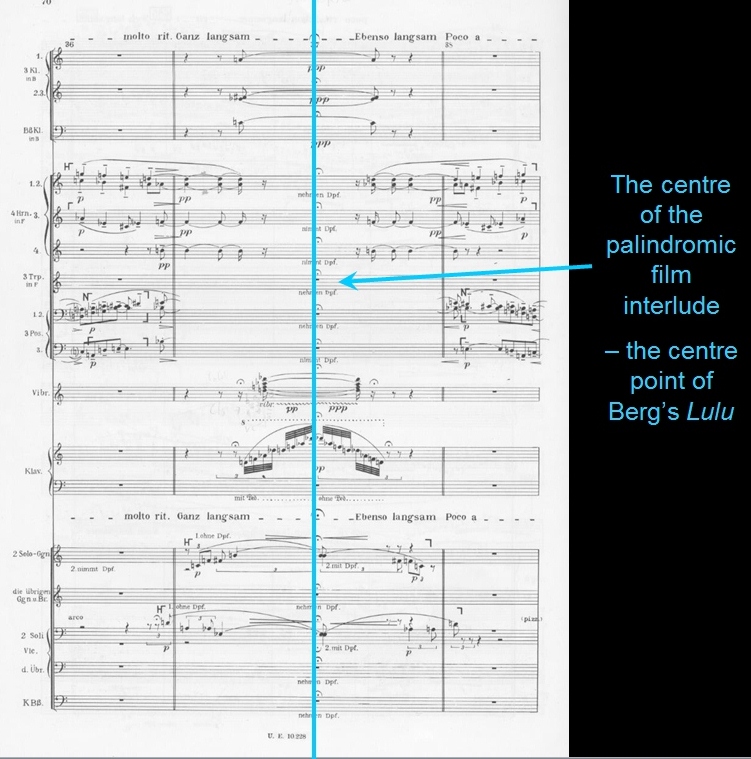
Perhaps the example most commented on is the film interlude right at the centre of the opera.  Where I’ve inserted the blue line in the figure is indeed the opera’s exact centre – you don’t need to be able to read music to see how the musical lines go up and then down.

The centre point of the entire opera

Lulu’s palindromes are narrative as well as musical. Berg’s screenplay for the 3 minute film at the heart of the opera very clearly organises its narrative palindromically.

He stuck very closely to Wedekind’s original text, though he had to cut it down by 4/5ths. The cuts are significant: they make the whole work structurally tauter, emphasising the text’s repetitions and balances which appeared in the original but by no means as starkly. Most important of all are Berg’s alteratiibs to them final scene: Berg turns it into a recapitulation of the first half of the opera, that is, the whole of Wedekind’s first play. By now Lulu is reduced to plying her trade as a prostitute in London, accompanied by her 3rd husband’s son and the seedy old Schigolch, a hanger on who may or may not be her father. In the Wedekind, she has 4 clients, the last of which is Jack. In the Berg she has only 3 – the virgin university lecturer is cut – and each of these 3 is a reincarnation of one of Lulu’s husbands. Each client has the same music as the relevant husband and is, so Berg directs, to be sung by the same singer.

Now this emphasis on musical recapitulation and double roles means that everything after the mid point of the opera takes on what George Perle in his magisterial study of the opera calls a déjà vu quality. Indeed, and the musical symmetries and taut structure to me seem to bind the characters into a machine-like helplessness.

In terms of narrative justice – and justice is staged at the heart of the opera with Lulu’s filmed trial  –  the plot is governed by the retributive and symmetrical  lex talionis of Deuteronomy — an eye for an eye. A cold, simple and inflexible justice. Lulu kills and is killed, an active is balanced by a passive verb.

That’s how the story ends.

The narrative, judicial conjunction here becomes a copula marking a predicate,  a cause and effect of equivalent force: and marks the balance of a palindrome.

End of story?

Although Adorno never mentions the lex talionis, acceptance that this is the way of the world is what some of his praises of Berg suggest. Berg refuses the happy end of commercial texts – that happy end which may not always be happy for the characters but which suggests catharsis for the audience, or the possibility of hope for a better future – or even, as Adorno devastatingly suggests in his analysis of Hollywood film in some aphorisms from the 1920s in Quasi Una Fantasia (pp. 49-50), the minimal happiness which lies in the audience’s knowledge that happiness is not for them (“the old mother who sheds tears at someone else’s wedding, blissfully conscious of the happiness she has missed”). Berg, for Adorno, looks on the human condition objectively and not sentimentally (i.e. commercially); Berg does not impose his subjective response to the narratives he presents in either of his two operas. It is this, along with the music’s extreme complexity and ingenious logic that renders Berg able to escape the constraints of his society’s ideology. Adorno’s is a huge and important claim – for how far is it possible for any of us to escape ideology? What of the gender and sexuality conventions that Berg, following Wedekind, exploits for his theatre piece – the tragic half-man lesbian or the sex-obsessed Woman? Is this not ideology?

Adorno has, however, to admit that Berg sided with the lost, and that in this  Lulu is similar to Berg’s earlier opera Wozzeck. But Wozzeck, said Adorno, quoting Berg himself,  could easily put its first bar after its last and the whole tragedy could happen all over again. The narrative is an endless cycle of suffering with no possibility of escape. No answers are given, just deixis – a pointing out of the human condition into which no intervention is possible, and through which there can be no transcendence or real catharsis. Alban Berg was passive, stresses Adorno, not assertive, and it is his siding with  non-action that allows him to escape ideology. This is good, for action is, according to Adorno, always geared towards making a population act in a certain way, and therefore must of necessity be ideological.

The palindrome in such an understanding contrasts with ideology by suggesting a self-contained universe beyond the arrow of time we experience in the phenomenal world – the critic John Covach has suggested that for Berg the palindrome represented a timeless heaven deriving ultimately from a Swedenborgian description in one of Balzac’s lesser-known  novels. This is perfectly consonant with the mystical leanings of the musical circle Berg moved in ‑ and of course it matches Adorno’s promotion of Berg as offering a non-active refuge from the evil of a world that could produce the ideology of Nazism.

There are two things that interest me in these claims. Yes, I love tracing the music’s formal complexity – it has all the charm of a musical puzzle and a practical rhetorical lesson for my own compositions (how did Berg derive that chord or instrumental line from his musical materials?). In either case, its analysis is a very abstract activity indeed, like maths. But it’s of course very dependent upon my access to a very particular mediated version of the music – the printed score.

To print I can return again and again – abstracted from society, abstracted from death and the onward rush of time. This is a characteristic of the medium of print, as envisaged in the very first image of a printing press known to us. Death takes away the men, but the books and printing press remain.

The earliest known illustration of a printing press, from the Dance of Death, Lyons, 1499

Adorno’s vision of abstraction from ideology depends, it seems to me, on a particular organisation of the media industry, which enables the stable reproduction of very complex printed musical instructions – to write them out by hand would require literally years and, as all students of media history know, would generate an unstable text. Abstraction from ideology in reality depends on the ideologically bound material practice – the labour – of the profitable publishing of an iterated, stable text.

There is another issue too: my relationship to music that this printed medium enables has also allowed me to confirm how the large scale palindromes aren’t by any means exact. How dare I say this when so many critics have not remarked on it?

(to be continued)

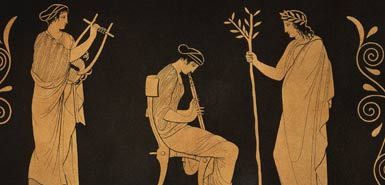
From the Greek Anthology

Concert programme 4 June 1988, Club Voltaire, Catania
Yesterday I came across an old cassette tape of a concert I gave at the Club Voltaire in Catania, Sicily on the 4th of June 1988. What a shock to hear this after amost 40 years!
The first half comprised a selection of pieces by Scriabin, while the second half comprised a piano suite I composed myself “From the Greek Anthology”.
The concert was very kindly recorded informally by a friend and the sound quality is very poor, especially of the first half. Here indeed are only the first few seconds of that first half, displaying a rather voluptuous approach to Scriabin’s sound world. The rest of the recording of this part is like mud and not worth reproducing here. For some reason the second half was recorded in much better quality, if hardly professional.

[/audio]

from the University of Tasmania http://eprints.utas.edu.au/8712/
The second half of the concert comprised a set of nine short portraits of friends and acquaintances, imagined as though poems from the collection of often scurrilous as well as grave epigrams, the “Greek Anthology“. The suite was written in a playful code that makes reference to a host of works in the orchestral and operatic repertoire (with some piano music too). While conveying secret messages, I also wanted to bridge the popular and the elite through postmodernist mash-ups, emphasising the sensuous and physical side of performance with violent contrasts and virtuoso techniques, mobilised by lucid – even very strict – musical form.
As I explained in the notes I wrote to accompany the concert, I wanted to emulate in sound the poetic techniques of the Greek Anthology and the centos of late antiquity which happily – and often very cleverly – used ready-made phrases borrowed from previous poetry. Their work was also the precipitate out of – and glue between – friends, neighbours and enemies. I wanted to create a personal, situated, non-institutional, occasional art like theirs. I was also aware at the same time that if I was to write musical epigrams, I would necessarily strip people of their complexity and reduce them to types (I was thinking of Theophrastus at this stage). In that respect my pieces were satiric even when they appear most sentimental and sympathetic.
Now I can see these pieces as normative and utopian, even moralistic: there was in them an element of criticism, a desire to correct. Now I would prioritise their stories over ther Theophrastian “character”. I wonder, rather, what happened to the addressees – to the princess whose extraordinary beauty could not hide her terrified grasp on love which she hoped would prevent her falling into the abyss, a terror all too clear in her nightmare of being smothered by bees that I’ve tried to represent in the piece dedicated to her. What happened to the braggart soldier to whom she clung as though to a branch over the abyss, even while knowing he could not stop her falling? Did the feigned vestal live out the comfortable life of public virtue she craved as much as private sensual indulgence? Philosopher 1 I have discovered turned to analysis of the surface of things, eschewing all depth, as I predicted here. The failed stoic, alas, I know now had a far stronger pull to a minor key than I presented, but I caught him at a good time and this is a happy memorial of that. The lady lives on as charming as ever, but philosopher 2 – what was or still is the story there? As for the curse tablet, the body it referred to is quite forgotten.

from http://www.sott.net/article/178457-Sound-of-long-lost-Ancient-Greek-instruments-recreated-by-computer-experts
A single file of the whole second half of the concert would be too large to upload, so here it is in two parts along with some notes. First,the 5 pieces to “Defixio” (just over 8 minutes). The opening has an unfortunate hum, but that becomes inaudible very soon.

[/audio]

from http://www.metmuseum.org/toah/works-of-art/56.171.38
1) To a philosopher 1 – a pale, still, very disciplined piece in Gm /B flat which nonetheless can’t avoid sentimentality even if it aspires to do so. Aspiring higher and higher, it keeps falling back. It’s strictly based on the first four notes of Holst’s chaste “Venus” from the Planets suite played in a variety of combinations and sequences (even the final chord comprises the notes played simultaneously).
2) To a feigned vestal – a passionate but entirely conventional – even banal – answer in E flat to the first piece, as if they were a couple unable to talk together. Most of “To a feigned vestal” is based on two themes, each from Strauss operas: the first subject is Arabella in search of “the right man” and the second Christine (from Intermezzo) who dreams of a glamorous alternative to her workaholic husband. They are woven together in a mini-sonata form whose coda quotes a coquettish version of the heroine’s theme from a third opera by Strauss, Salome, before an inconclusive end (a bland version of the terrible dissonance at figure 361 at the climax to Salome), broken into by …
3) To a married lady / matron– a bad-tempered, quixotic and querulous piece, whose main theme is a slow, cabaret-Satie-esque waltz in G minor, which tries to cheer up, but which eventually collapses into the funeral march from “The Farewell” from Mahler’s Das Lied von der Erde. The piece ends with a nod to Debussy’s Jeux. This was a portrait of my dear friend Nini Floreale, who died in 2005.

Red figure vase in British Museum from Classical Art Research Centre, University of Oxford, http://www.beazley.ox.ac.uk/tools/pottery/painters/keypieces/redfigure/meidias.htm
4) To a failed stoic – another passionate torrent of notes, this time based on Scriabin’s opus 11 C minor Prelude, of which, turned very definitely into C major, only the melodic shape remains. Other key references are to the theme of redemption in Wagner’s Ring and the interrupted cadence from the final , happy, movement of Mahler VII, whose key it shares. Structurally reminiscent of 1) – an A-A form – it is also a solar answer to (or aspiration for) 3). The two pieces share an interest with two adjacent notes at key moments, though used for different purposes. The failed stoic is fact a portrait of my friend Lawrence Razavi of whom I have fond memories not for his problematic research on genetics (long before genetics were fashionable) but for his passionate and humane engagement in art. The piece is counterposed by….
5) To the infernal powers / Defixio. A defixio was for the ancient Romans a lead tablet on which a curse was inscribed before being thrown into a sacred spring. I tried to create the sound of hellish water bubbling up from the underworld at midnight using chords I found originally in the funeral march from Prokofiev’s Romeo and Juliet; the melody by contrast is a dark parody of the main theme of Debussy’s sensuous waltz, La plus que lente, for of course this is a curse by a frustrated lover on a faithless or unobtainable beloved. The melodic line eventually gets trapped within the devil’s interval – the tritone – and the curse comes true, with terrifying consequences, even if it ends in B flat major. An A-B form.
Here are pieces 6-9 (9 minutes).

[/audio]
6) To a lady. In the nonchalent, carefree style of popular songs of the early twentieth century – Scott Joplin’s “The Entertainer” is nearby. The melodic line is, though, built up of a host of references to other music, from Stravinsky’s Firebird and Scriabin’s Sonata no 5 to Puccini’s Madama Butterfly. Another simple strophic form, this time centred on G major.

Red figure vase, from http://www.library.csi.cuny.edu/archives/siias/artifacts/project12.html
7) To a princess. A mirror of the first piece in its compositional technique and an echo of 5) in its sound world, this seeks to represent the nightmare of the princess smothered by bees. What the bees represent is suggested by how the piece is obsessively based on the first two bars of Wagner’s Tristan and Isolde (which becomes clear only towards the very end, when it is quoted in recognisable form). On the whole though the notes of Tristan are jammed together in extreme dissonance, the last chord comprising all the notes of the two bars played simultaneously in the bass (except for the previous pathetic rising 6th). There is also a passing and rather hopeless reference to the Falcon’s warning cry from Strauss’s Die Frau ohne Schatten – and a Messiaen-esque ornithological screetch towards the end still based on the Tristan semitone cluster. A-B-A. Atonal with hints of F minor.
8) To a braggart soldier. A mirror of the second (and again in E flat), but even more empty of content, whose main melodic line is built on a simple descending scale. There is mock-military version of Wagner’s Siegfried which even falls short in its final phrase (a rising 5th instead of a 6th), some Beethoven III shoehorned into march tempo, a moment from the apocalyptic 4th movement of Mahler VI, and lots of gesture without content on one note – the musical equivalent of hot air or a military side drum – that eventually peters out because it has nowhere to go. A-B-A but something of a mess in its determination to aurally manspread.

from http://www.metmuseum.org/toah/works-of-art/56.171.38
9) To a philosopher 2. The Siegfried-derived theme is taken up again (but now quietly in A minor – as far as possible from the soldier), in a style distantly recalling the Poulenc of “L’aube” from Les animaux modeles and Parsifal). The opening chords from the second movement of Dvorak’s New World Symphony move the piece into the atonal B section and quotations from Berg – the Lulu Erdgeist motiv and “Wir arme Leute” (“We poor people”) from Wozzeck. The climax cadence is a version of the defixio chord. This resolves into the A section again, now more insistently repeated in a slow march (the soldier is not as Other as the philosopher thinks). The A-B dialectic is repeated until the New World chords eventually break free into the coda, a tiny syncopated dance that soon ends back with the New World chords calling for new ways of thinking — while at the same time recalling the devil’s tritone of the defixio. The chords fill out, eventually sounding simultaneously, clusters of the black notes of the piano beating rhythmically high up while all the white ones reverberate in the air after a double glissando from middle C simultaneously up and down to cover the length of the keyboard.
And finally the encore (3 minutes).

[/audio]

a drunken, ecstatic reveller, from http://commons.wikimedia.org/wiki/File:Komast_Louvre_F125.jpg
This was my rather over-excited and not entirely accurate version of the famous Scriabin Etude opus 12 no 8 – except with even more notes tumbling over the keyboard than in the already full original. I always justified such excess to myself on the grounds that Scriabin used his piano scores as palimpsests for improvisation. My musically purist friends just thought all this sort of thing vulgar, and always made sure I knew it – so much for postmodern dissolution of aesthetic value in 1988. Now I think they were right.