

Andrew King
Watch/ Listen to the series on YouTube
Ouida (Marie Louise Ramé, 1839–1908) was one of the most popular novelists of the nineteenth century, her emotionally uninhibited fiction reaching audiences that more decorous writers never touched.
Characters from Ouida recovers some of her most vivid creations to ask what it means to be a character both in the moment of performance and in the passage of time, change and death, rhythm, pitch and silence.
The cycle draws on a wide variety of musical languages — from the ironic opulence of Richard Strauss, the lyricism of Puccini, the lucid textures of Ravel and Britten to operetta, musicals and jazz as well as contemporary composers like Juhi Bansal and Lera Auerbach — to create music that is rigorously structured and immediately communicative: tragic, funny, terrifying, sentimental, voluptuous, reflective.
Each piece is an act of characterisation. Quartet and voice do not illustrate: they embody, offering chamber musicians and singers interested in character acting a sustained dramatic and technical challenge. The result is music theatre where multiple traditions meet: intellectually serious, direct, yet unafraid of the complexity of what it means to perform, to depict, to be a human being facing the inevitability of the changes time brings.
The texts are only lightly adapted from Ouida’s originals (mostly cut, rather than rewritten) to make them singable and to sharpen the dramatic situation. With one obvious exception, the images below that signal the characters are AI-generated, each modelled on a Victorian or near-contemporary painter whose style suits the scene.
The YouTube videos I made to illustrate the songs use art with a Creative Commons license or photographs I have taken myself, along with at most two AI generated images to help visualise the characters. The image that heads this post is a collective AI-generated portrait of the characters, grown older after the experience of their stories, as if they were visiting Ouida’s grave today (see movement 6 below).
Scores are available on request, including piano versions. All the songs are for medium voice and performable by either mezzo or baritone, but the first choice is given below and recorded on YouTube with CantAI and either MuseScore Berlin First Chairs or MuseScore solo strings.
1. Bébée and the Sun (Youtube – music video with illustrative images)
Mezzo-soprano (or baritone) and string quartet · c. 8 minutes
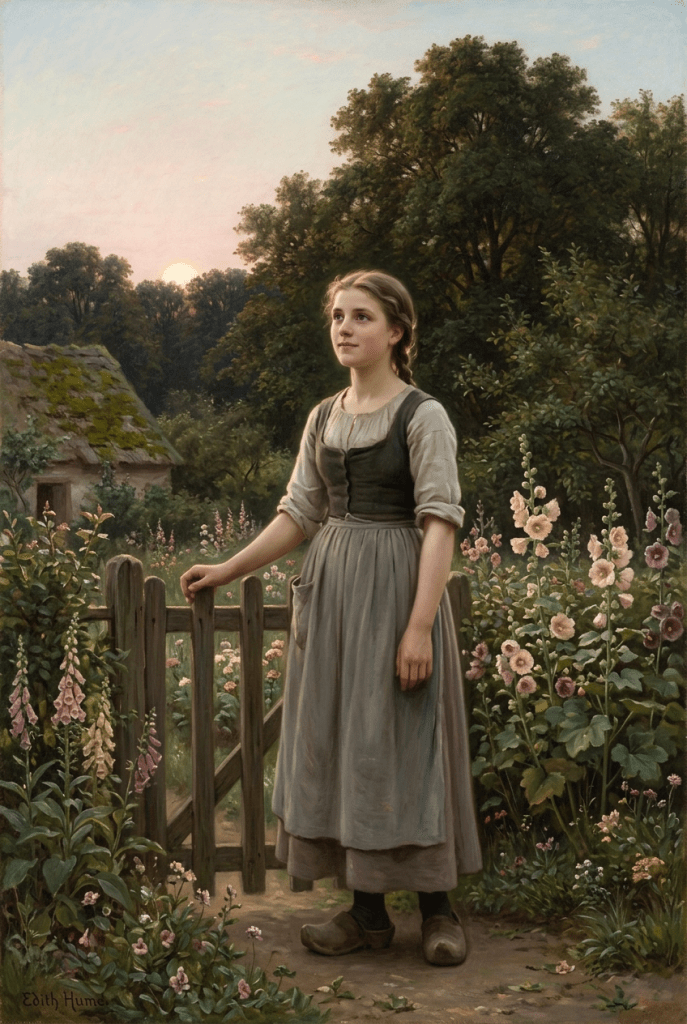
An innocent and ignorant peasant girl greets the sunrise, certain that the painter who has discovered her is about to take her to Paris to be educated. We already know — as the indifferent Sun already knows — that it will end badly. The song sets the agenda for everything that follows, juxtaposing strongly contrasting styles and introducing literary and musical themes that will recur, not least the inflexibility of the passing of time: the narrative laws of commerce and exploitation presented as a law of nature as inevitable as the sun rising and falling. The song opens with a moment of innocence before an inevitable fall. But, as Ouida well knew, even the innocence is compromised through its commercial stereotyping (in this case, the use of the commercial language of Golden Age Musicals). The Sun, representing the inflexible laws of both nature and commercial story-telling, occupies much darker and more static territory. But not everything is hopeless.
For performers: Starting from the basic alternation of tones in a trill without defined rhythm the song continues with harmonics and arpeggii on open strings in aleatoric fashion, followed by a sul ponticello set of cadences and a scattering of quartertones in the dark. Rhythm slowly emerges and emerges into a marked contrast: a bright, diatonic D major, with trills now doing obvious, charming illustrative work (the trill’s ambiguity recurs in all the songs). Bebée’s address to the Sun ends and the static trills and string sounds return and the narrator reflects on the coldly impersonal nature of the Sun. They imagine what the Sun would tell Bebée if it cared to in a hymn-like central section over which the trill constantly hovers. The dark music returns before a briefly explosive sunrise and the narrator bursts out with a passionate version of the hymn combined with Bebée’s music briefly pointing out that pleasure is valuable even though it does not last. The piece ends nonetheless with the alien inflexibility of the Sun and the fragmented cold cadences of the hymn with which, we now realise, the song had began.
The main demand of the song is the depiction of the various characters – Bebee, the Sun as imagined, plus the narrator whose personality only emerges towards the end. The instruction of the score is “naive without irony.” The performers have to sustain wide-eyed sincerity when depicting Bebée, transition to the cold music of the Sun and then to the passionate refusal of the narrator to commit to hopelessness, even while s/he knows that time passes and consumes everything. Technical demands for the players include limited aleatory, harmonic glissandi, some double-stopping, sul ponticello and sul tasto passages, and some trills sustained over many bars. The singer in this song needs chant-like alternation of very few notes which contrast with expressive melisma within a range of C#4-F#5; the majority of the song, however, lies in the middle range (F4-D5).
Source: Ouida’s Two Little Wooden Shoes (1871).
2. Crispin and Hilarion (Youtube)
Baritone (or mezzo-soprano) and string quartet · c. 6 minutes
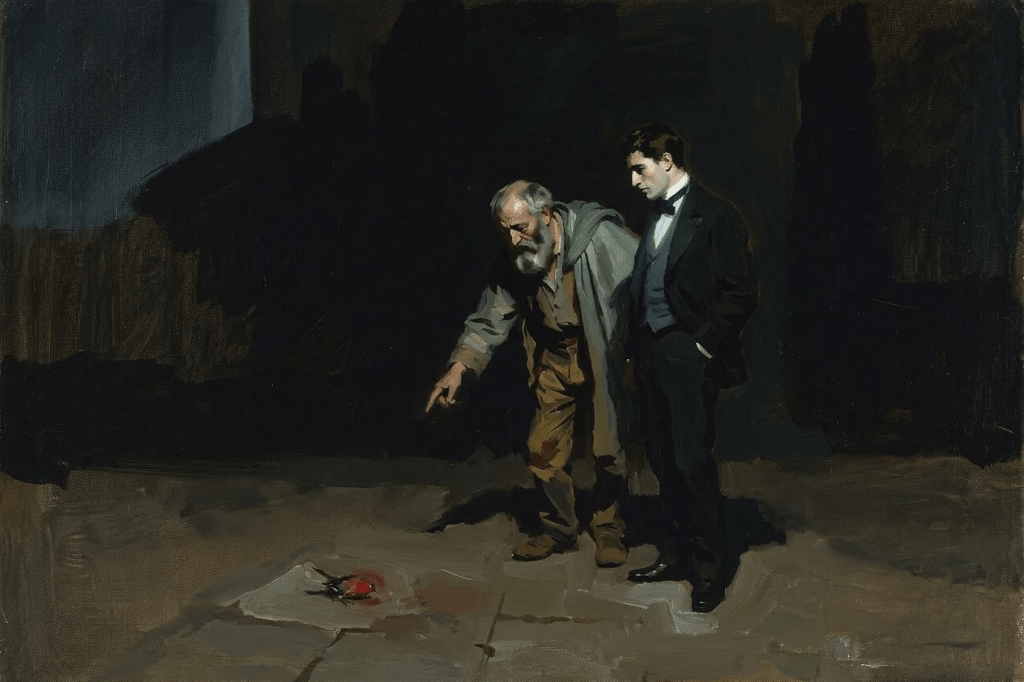
A poor cobbler confronts a wealthy, decadent poet over a dead bird fallen from a market stall as they walk through Rome at night. He turns the moment into an accusation: you destroy what you touch, call it art and do not care; you have seduced woman I brought up as my daughter and have now abandoned her. The poet remains indifferent.
One of the cycle’s hardest emotional hits that also questions that hit: for whose benefit do we enjoy the description of women’s pain by men? The cobbler wants to make poet care: but, in typical Ouida fashion, he is also asking whether we really care too, or whether our reaction is simply enjoyable sentimentality.
For performers: Simple writing – the most spartan in the set – with a clear diatonic focus on E minor, interrupted by what appears at first as unmotivated chromaticism but which the closing pages reveal to stem from a quotation of Puccini’s Crisantemi (Puccini as a key artist who profited from making us feel women’s pain). The performance challenge in this song is beauty of sustained line for both instruments and voice while maintaining a clear sense of the architecture. There should be little difficulty in any of the parts.
The singer must articulate two points of view, that of the sympathetic Crispin, the working-class narrator of almost all the song, who desperately but also in a controlled manner tries to make his interlocutor take pity on his victim, and Hilarion, the youthful decadent poet who, like the Sun in the previous song, just does not care. The singer mostly hovers around (in the baritonal form here) F3-B3 with a high preponderance of conversational stepped notes, through the full range is C3 – D4.
The quartet finally utters what Crispin, the social inferior of the two, dare not directly, a bitter anger and sorrow, before it is quickly brought under control. Trills and tremolos figure in this song only in the world of Hilarion.
Source: Ouida’s Ariadne (1877).
3. Lady Dolly (YouTube)
Mezzo-soprano (or baritone) and string quartet · c. 5 minutes
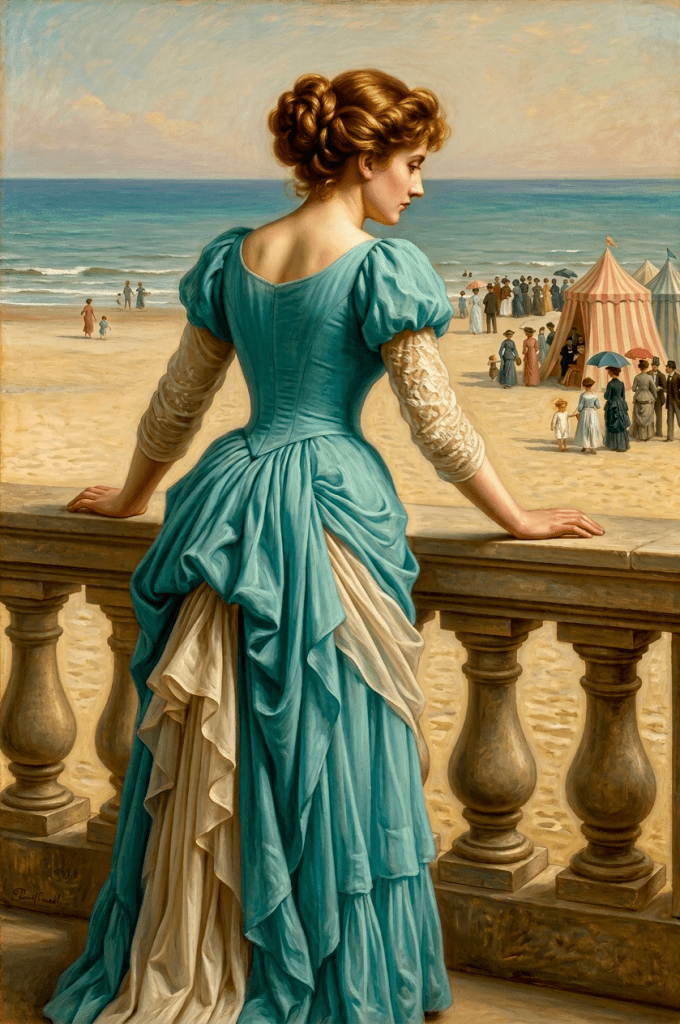
A vain, glamorous, mercenary woman of 34 runs gleefully through everything that makes her happy on holiday at a fashionable French resort — gambling, gossip, a rival’s bad dress sense, political scandal, men looking at her — to avoid thinking about the imminent arrival of her sixteen-year-old daughter who will make her look old by comparison. Her solution: marry the girl off immediately, before her own beauty has time to fade by comparison. But will that strategy work?
For performers: pure comic theatre, and probably the most immediately enjoyable piece in the cycle. The waltz darts through a magpie’s nest of quotations — Johann Strauss, Lehár, Verdi, Tchaikovsky, Wagner’s forging motif (for Dolly’s most potent weapon, her wardrobe), a flash of The Merry Widow when Lady Dolly extracts a state secret. The song rewards a mezzo with strong comic timing and the agility to pivot character within a phrase: a gift of a character study for anyone who enjoys playing monstrous people charmingly. Range B3-F#5; some dramatic/ comic leaps both up and down, with skips and rapid enunciation (mainly through stepped notes in the middle register). Few special effects for the quartet beyond some double stops, brief artificial harmonics and glissandi; the main challenge is to dialogue with and assist the singer. The main difficulty is ensuring razor-sharp timing within the expressive rubato the voice requires.
Source: Ouida’s Moths (1880).
4. Pascarel (YouTube)
Baritone (or mezzo-soprano) and string quartet · c. 5 minutes
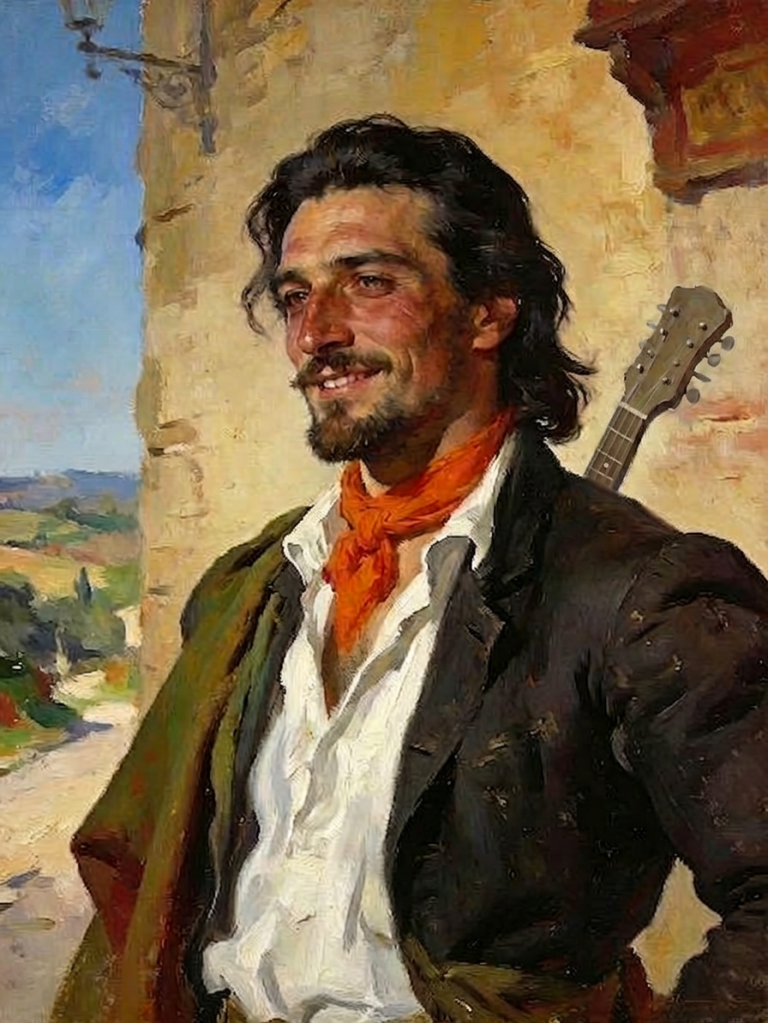
A man-spreading answer to the previous: a swaggering, misogynistic charmer with a guitar and a grudge, Pascarèl, leader of a troupe of travelling actors in 1850s Italy, hits back at a snobbish young aristocrat who has dismissed his profession as beneath her. His reply is one of the great defences of the actor’s trade in Victorian fiction, here depicted as an exaggerated and macho claim: Pascarèl says that he may be despised as a “wooden doll,” yet he is the only thing that allows the poor a few hours’ escape into “the sunlit paradise where genius dwells” – which involves the theatre of politics and war as much as the politics of theatre.
While Pascarèl is a Florentine actor, soldier and (eventually) politician in the novel, the music draws on Naples both for its driving rhythms and, towards the end, a gentle folksong: it performs “Italianicity” rather than striving for any authenticity, just as Pascarèl performs masculinity (and Lady Dolly performs femininity in the previous). Just before the end, the cold aleatoric music of the Sun returns, before Pascarèl brutally brushes it off.
For performers: A pizzica tarantella drives the quartet through an energetic 12/8 where players can display energetic virtuosity and variation of tone easier to play than it sounds. High virtuosic payoff for both singer and quartet, and another real audience-pleaser — funny, threatening, and seductive by turns. Challenges for the singer include a densely chromatic line, the need for rhythmic precision and rapid-fire diction, demands for different voice colours, and, towards the end, rhythmic finger snaps (“body percussion”) while singing. The string players are given glissandi, harmonics, hammered double stopping, sul ponticello, col legno, etc. and require rhythmic precision at high speeds.
Source: Ouida’s Pascarèl (1873).
5. Idalia (Youtube)
Mezzo-soprano (or baritone) and string quartet · c. 8 minutes
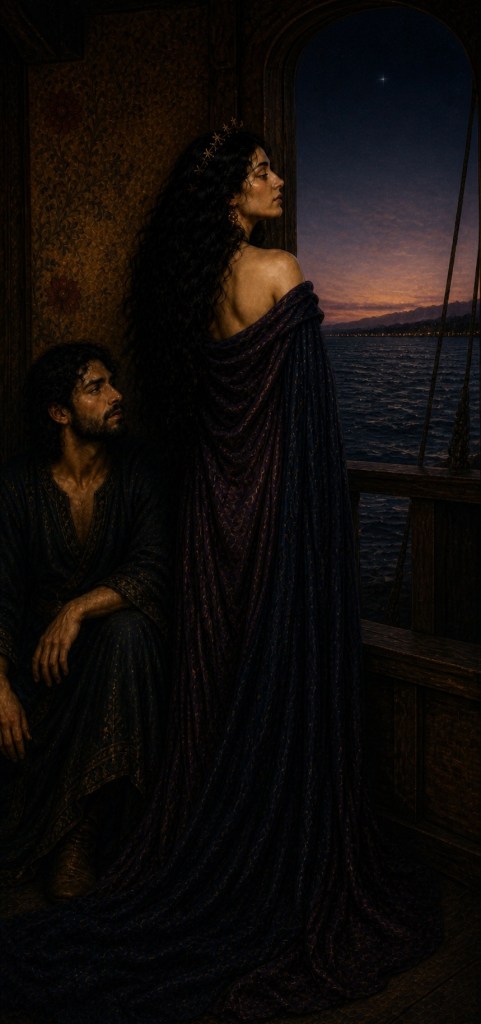
A complete contrast with the preceding: a revolutionary queen longing for liberty sails by moonlight across the calm Mediterranean toward home with the man who loves her – and she is plainly more interested in the beauty of the evening than in him. Idalia is one of Ouida’s most purely sensuous and romantic heroines, entirely absorbed in the pleasures of the moment depicted in prose influenced by Shelley and Keats. Do we care what happens next as they sail off into the distance and the morning, or can we simply revel in the moment like her?
Seeking the equivalent in sound of Dante Gabriele Rossetti’s aesthetic turn to painting before Raphael, the song was written after a study of Gesualdo, a scandalous late sixteenth-century composer and nobleman, his dissonant counterpoint treated as a chain of vertical chords. Ouida herself often referred to renaissance Italian artists and musicians. Even though his life story could come out of one of her novels, she never refers to Gesualdo. She would not have heard of him since before the twentieth century his music was considered so outrageously dissonant it was never performed. Here I have sought to transform the dissonances he exploited to depict anguish into calm delight.
For performers: the still point of the cycle, and a deliberate contrast to the two energetic songs preceding it: a hypnotic 6/8 perpetuum mobile that depicts the ship’s unstoppable but gentle onward motion. The piece is less about drama and its development over time than momentary voluptuous tone: fragments of melody come and go over richly chromatic, variously coloured but consistently soft-grained string writing. It asks for control and sustained legato rather than virtuosic display. Effects are subtle: gentle pizzicato, harmonics, sul tasto. The voice generally moves step-wise over a restricted range of D4 to D#5, often in scalar fashion, with a concentration in the lower voice that rarely rises above a mezzo piano.
Source: Ouida’s Idalia (1867).
6. Interlude at Ouida’s Grave, Bagni di Lucca (Youtube)
String quartet (no voice) · c. 7 minutes
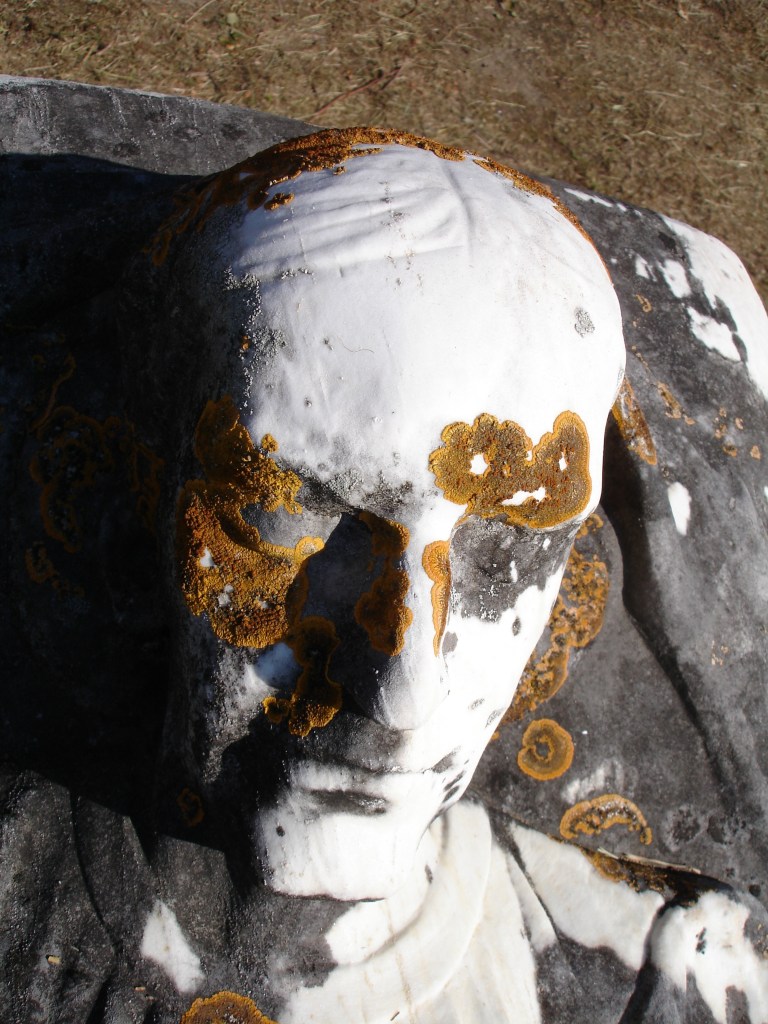
A visit to Ouida’s grave in Bagni di Lucca and a meditation on the passing of time bring together themes both musical and intellectual from all the preceding songs. In the ticking of a clock and a bright cloud hides the ghost of a key motif heard in all the songs: sympathy or connection with others. The texture coalesces into an early-twentieth-century dirge built on variants of the characters’ themes before the clock returns – only to metamorphose into a 4-bar groove over which the characters return in popular twenty-first-century guise, older and more experienced after their stories – and deliberately crowd-pleasing. They evaporate amidst the trills from the first movement. The music of the inflexible Sun seems about to close the piece until the clock returns one last time with another, gentle, surprise.
For performers:
A sure success with audiences and a showcase for a quartet happy in radically different styles and methods of playing. Balance and interaction are key throughout and there are passages that requires player choice (the Sun also returns) and an invitation to improvise within generic and melodic limits. Sustained harmonics, trills, violent double stopping, glissandi – almost all the plating techniques of the previous movements return, modified and extended. Tempos need to be very flexible at times, at others machine-like. The last 9 bars employ body percussion again, performable either by the string players as foot-taps or by the singer as finger-snaps, claps or foot-taps. Would work as an independent piece, though its impact is much stronger as an integral part of the cycle.
7. Pipistrello (YouTube)
Baritone (or mezzo-soprano) and string quartet · c. 2 minutes
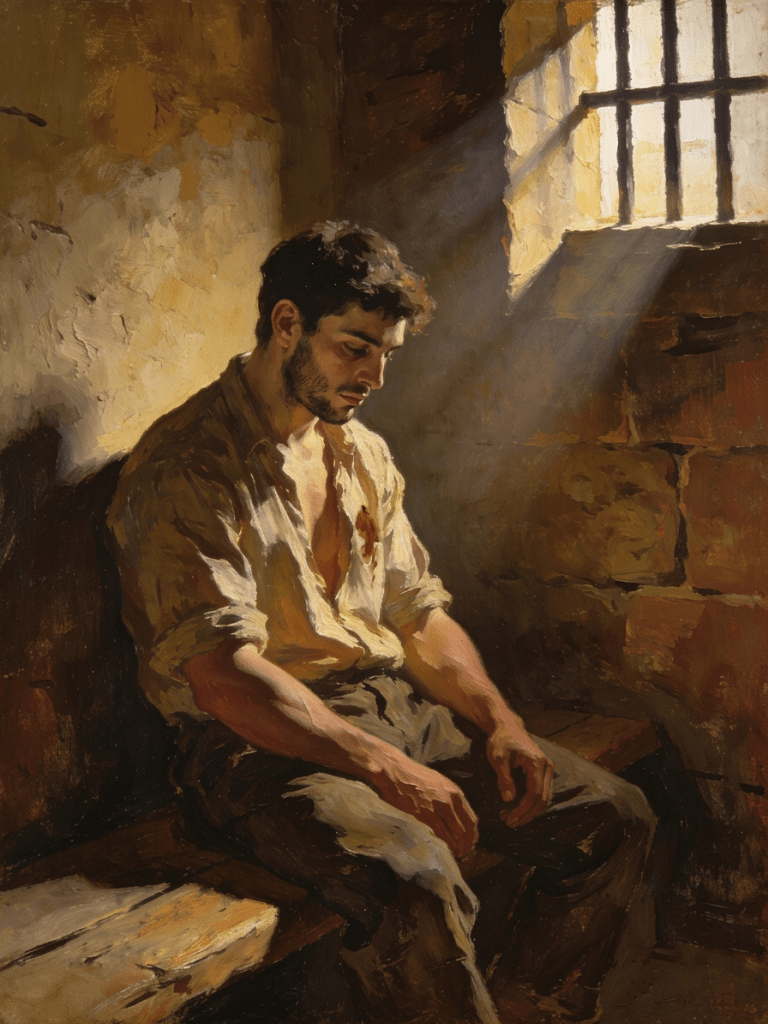
A young acrobat awaiting execution reflects on the glance that ruined his life: a moment of love so sudden it cost a child his life, and results in a murder Pipistrello didn’t mean to commit.
A brief postscript to the cycle, delivered with disarming C-major plainness, and with a hint of hope in our continued need for social action. It is a brief envoi that takes on new resonance at the end of the journey the cycle has taken us through, reframing one last time the interplay of the highest and lowest open strings of the violin, E and G, that all the songs have been concerned and closed with.
For performers: by far the shortest and simplest song in the set, “Pipistrello” is fundamentally a slow groove of 4 descending tonal steps echoing the groove of the Interlude, under an intimate, confessional, meditative vocal line. Its single dramatic event, the fatal glance and the child’s fall, is compressed into a brief, vivid contrasting episode in Dflat before the song returns to its plain opening line, which resolves in the end into C major.
There are minimal technical demands for either player or voice beyond clean, unforced lyricism and the ability to shift mood abruptly and back again. Voice range just over an octave (B3-C5), with a preponderance in the lower voice, sung piano or mezzo-piano. For the strings, sustained notes on the lower strings with a brief eruption to the upper, plus melodic commentary on the voice for the violins. The narrative must be very clear, the strings playing a decidedly supporting role to the voice.
A small piece with an outsized impact at the end of the cycle, that despite its brevity and simplicity, brings together its most vital themes and musical gestures.
Source: Ouida’s “Pipistrello” (1880).


