Roland Barthes, Camera Lucida: a Study Guide. Annotations 2

A continuation of notes on Camera Lucida to help elucidate the text. Part 1 of the notes can be found here, while the general introduction giving brief contextual notes can be found here.

Part II: Section 25 (page 63)

Carefully compare the opening of section 1. What more do you learn about the purpose of this book here?

65

Barthes’s conception of “hysteria” is very Lacanian. A hysterical symptom (e.g. fantasy pains in a limb which has been amputated) is a mark of mourning for the lost state of plenitude and bodily integrity. It relates to the form of the body as it is imagined (imaged – seen – by the mind) not the body as it is or seen by others.

67: beginning of section 28

Note: the position of this section corresponds closely to the “Golden Mean” (media aurea). Find out what the “Golden Mean” is. Why might it be important here?

70

Another of the several references to Marcel Proust’s A la recherche du temps perdu. (1913-1927). Note the many similarities with Camera lucida.

»  The Proust is written as an interior monologue in the first person and is in many respects autobiographical, tracing the gradual self-awareness of the narrator.

»  The novel is concerned with seeking the buried memory released by everyday incidents (the famous madeleines – a kind of biscuit – that start the whole story off). Time is a key concept, both as a destroyer and as producer of memory. The sequence of time is perceived in the light of the theories of the French philosopher Henri Bergson, whom Proust admired, (and which are also heavily influential on psychoanalysis). Time is not psychologically measurable by the clock or calendar: sometimes it goes fast or slow, and maybe not in a straight line (since moments from the past can suddenly emerge and have a huge effect many years later without ever having emerged before). Moments of the past and the present have equal reality.

»  Proust also explored subconscious motivations, and the irrationality of human behaviour, particularly in relation to love.

73

Labyrinth – The princess of Crete, Ariadne, is in love with the hero Theseus, sent to the island as part of the annual human sacrifice to the monstrous Minotaur who lives in a labyrinth deep underground. Ariadne helps Theseus kill the Minotaur by supplying him with a thread by means of which he can find his way out of the labyrinth.

74

What does Barthes resist in the definitions of the “Family” he refers to here?

What connection (again!) is made here with the “image”?

76 – under cover of method

What terms you have read about before (at length) do the binary opposites “banality” and “singularity” recall?

77

noeme – Greek philosophical term for “concept” or “mental image” that is derived from sensory experience and so is not “pure thought”: Barthes is probably thinking of Aristotle.

78

What is the difference between cinema and the photograph here?

80

note how the language of resurrection, which has already appeared earlier, begins to become more common – how stressed is it?

Albertian perspective – Alberti, Leon Battista (1404-1472), Italian architect and writer, who was the first important art theorist of the Renaissance. Developing the work on mathematical laws of linear perspective which the architect Brunelleschi had studied, he wrote a treatise called Della Pittura (On painting; 1436) which set down the laws of perspective for the painters of his own and succeeding generations until the late nineteenth century.

Sontag, Susan – famous American critic of film, photography and cultural theory and an expert on Barthes (she actually edited The Barthes Reader in 1987, a selection of texts by Roland Barthes, from which Camera Lucida is interestingly omitted). She is most famous for her 1964 essay on “camp” which propelled her to international fame. And which already showed the traces of Barthes’ influence.

84

Bouvard and Péchuchet – 2 comic characters in a novel by Flaubert that Barthes has mentioned in many of his works as types of the stupid and pedestrian bourgeois (they are one of the leitmotifs that artfully characterise Barthes’ oeuvre as an oeuvre). What is his attitude to wards them in Camera Lucida?

85-87

How is language different from the Photograph?

88

thesis – a statement concerning reality

physis – nature in pure form, reality itself – important term in Greek philosophy and tragedy.

How does Barthes define “realism” here?

89-90

What is the distinction Barthes is making between cinema and photography here?

93

“History” as a discipline that depends on research in archives, evaluating different forms of evidence etc. is regarded as having an origin in the nineteenth century. Before that “histories” were chronicles, anecdotes (more or less fabricated) or genealogies used to prove the legitimacy of kings and princes. Barthes regards all history (irrespective of when or where it was written) as ideologically motivated. On p. 94 Michelet, a nineteenth-century historian and one of the founders of the historical method, will be mentioned. Barthes had written extensively about his ideological presuppositions in an earlier book.

96

Donald Winnicott: British paediatrician who analysed the effects of maternal deprivation in children: the catastrophe Barthes refers to is the absence or death of a mother figure in early childhood.

97

compares the religious meditation in solitude – devotio moderna – in the Middle Ages with the solitary perusal of photos today

98

What does Barthes mean when he says that only in private is his image “free to abolish itself”? (see above also pp. 10-15 on the pose)

99

compare p. 5. In fact the structure of this book can be compared to an elaborate musical form (cf. p. 27 which provides a clue). Part 2 has been recapitulating and developing part 1. Some recapitulations are more obvious than others.

100

Golaud & Mélisande. A reference to the Belgian Maeterlinck’s symbolist play (which the French composer Debussy turned to his only complete opera) Pelléas et Mélisande. Golaud finds Mélisande in a wood and marries her, in love with her beauty (her image). She never says where she comes from or who she is beyond her name, or whether or not she and Pelléas (Golaud’s half-brother) had an affair or not. At the end of the opera/play, she becomes pure image, a dead body, without ever saying anything to confirm or deny Golaud’s suspicions about her.

102

“no one is ever anything but a copy of a copy, real or mental” – where have you heard or read (something like) this before?

105

What is the Photograph able to reveal now?

How is this the corpus that Barthes has been trying to assemble?

106

The camera lucida was a more sophisticated later development than the camera obscura (see p. 10). It allowed the painter to see simultaneously the subject painted and the image projected onto the canvas. Barthes (of course) is correct historically in linking the camera lucida to the photogaphc camera: Henry Fox Talbot, an artist and one of the pioneers of Photograph, tried to use chemical means to fix the images projected by his camera lucida.

(how many pages before the end is this term introduced? How many after the beginning did you find camera obscura ?)

108-110

Strangely at this extremely late stage a new term is introduced. Which concept /term does it recall – and vaporize?

Masks – where have you read about masks in this book before?

111

another difference between film and photography?

113

Kristeva, Julia – Bulgarian who defected to France in the 1960s and has become one of the most notable psychoanalysts and literary critics of the century. La verité folle refers to her article “Le vréel” published first in 1979 – just before Camera Lucida was written (translated as “The True-Real” in The Kristeva Reader ed. Toril Moi 1986). The article concerns the idea that a sign can be linked simply to another sign without any reference to its referent (i.e. the thing it refers to). So “cow” would not refer to an animal but may simply be linked to another signifier, say, “wit” which might be connected to “time” which might be associated with “egg-cup” to produce the “sentence” “cow wit time egg-cup”. Obviously this is meaningless according to conventional logic since it refers to nothing at all. However, mysticism and madness might find a kind of truth in it. In terms of image, hallucinations work in the same way (p. 114). (Note that for Kristeva, Barthes, Derrida and Foucault madness is often a positive value since it is interpreted as a resistance to the violence of the patriarchal culture of the twentieth century. Following Lacan, these thinkers often consider madness as the result of an overwhelming confrontation with reality – against which most of us build elaborate and “rational” defence systems). You may like to compare it to Baudrillard’s notion of “simulation” too: how are they the same and different?

117

ecmnesic – “a form of partial amnesia, in which the memory of events prior to a particular period in the patient’s life is preserved in its entirety, whereas the memory of events subsequent to that period is completely abolished” (see footnote to p. 250 in the Penguin ed. of Freud’s Studies on Hysteria – though Freud took the term from a French psychiatrist, Pitres)

119

ecstasy – “exit from the self” – according to many religious traditions union with God. Of which concept is it a variant?
Roland Barthes, Camera Lucida: a Study Guide Annotations 1

The following notes are intended to help the reader understand Barthes’ references, technical terms, themes. The previous post provides very briefly the context for this text.

The page numbers below refer to the translation of La chambre claire by Richard Howard, Jonathan Cape (now Macmillan), 1982.

page 4

Barthes needs a “corpus” or collection of texts in order to classify them, which is the basis of scientific understanding. NB. Word-play corpus/ corpse/ [dead] body. The term “body” and all cognates are one of the main strands that weave in and out of this text.

Tuché – the psychoanalyst Jacques Lacan borrows this term from the ancient Greek philosopher Aristotle, for whom it means “chance” or “accident”: the point is that reality is accidental and has no “meaning” or narrative – it just “is”. The following references to Buddhism and to the English mystical commentator Alan Watts are all connected to this idea.

5

antiphon – the first of the many musical references that Barthes uses in this text: look out for others. What may be the function of such references?

8

mathesis – mental discipline, knowledge or science

9

eidolon – Greek word for “image”, “likeness”, but also “spectre” or “ghost”. Note the large number of words with the same root eid– that appear in this text. “Idol” (which is etymologically connected to eidolon) with its erotic and religious connotations does not appear, but seems to be hovering just out of sight like a ghost…

terms you need to remember the meanings of in this work:

What is the Operator? __________________________________________________

What is the Spectator?__________________________________________________

What is the Spectrum?__________________________________________________

NB the word-play spectacle/ spectre throughout

10

camera obscura – an arrangements of lenses and mirrors in a darkened room or box invented in the sixteenth century. Artists used it to project images onto canvas on which they would base their pictures. Note how Barthes introduces the idea of the camera lucida by means of a kind of a binary opposite, the camera obscura.

12

zero degree – a reference to Barthes’ own first published volume Writing Degree Zero (orig. 1953 as Le degré zéro de l’écriture) – “degree zero” here means “without meaning”, “purely for and in itself”.

14

parenthesis – see note to page 20 below

15

eidos – According to Plato the “eidos” is the real image of something (usually translated in English as “Idea”). It exists in the realm of the eternal and so is not perceptible by the senses. In Husserl (see note to p. 20) it means the same as “essence”, which can be arrived at by pure consciousness. I’m not sure which sense is uppermost in Camera Lucida.

16

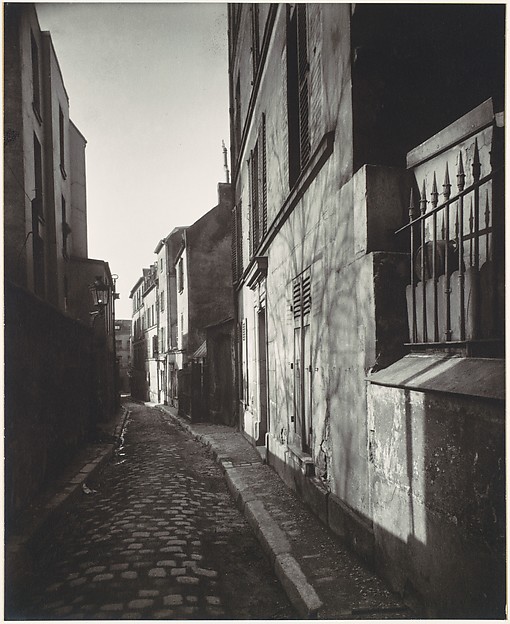
Rue St. Rustique, Montmartre


Atget, (Jean) Eugène Auguste (1856-1927), French photographer, now recognised as one of the major figures in the history of photography. In about 1898 Atget began his photographic career; within a decade he had produced some of his most impressive documentary series on Parisian life—tradespeople, architecture, shop windows, parks, cafés, and markets. He’s most famous for his pictures of empty Paris streets.

Rue St. Rustique by Atget,  March 1922

20

The task of phenomenology is to study essences, such as the essence of emotions. Although Husserl, the founder of phenomenology, never gave up his early interest in essences, he later held that only the essences of certain special conscious structures should be studied by phenomenology. As formulated by Husserl after 1910, phenomenology is the study of the structures of consciousness that enable consciousness to refer to objects outside itself. This study requires reflection on the contents of the mind to the exclusion of everything else. Because the mind can be directed towards non-existent as well as real objects, Husserl noted that phenomenological reflection does not presuppose that anything exists, but rather amounts to a “bracketing of existence” (compare the “parenthesis” Barthes refers to on page 14), that is, it sets aside the question of the real existence of the contemplated object.

What Husserl discovered when he contemplated the contents of his mind were such acts as remembering, desiring, and perceiving and the abstract content of these acts, which Husserl called meanings. These meanings, he claimed, enabled an act to be directed towards an object under a certain aspect; and such directedness, called intentionality, he held to be the essence of consciousness. Transcendental phenomenology, according to Husserl, was the study of the basic components of the meanings that make intentionality possible. Later, in Cartesian Meditations (1931; trans. 1960), he introduced genetic phenomenology, which he defined as the study of how these meanings are built up in the course of experience.

NB the author of the book that Camera Lucida is in homage to (Sartre) was key in the introduction of phenomenology to France during Barthes’ youth.

25

Greuze, Jean-Baptiste (1725-1805), French painter. He studied art in Lyon and in Paris, where he became a leading genre painter who concentrated on sentimental moralistic scenes and portraits.

The Village Betrothal by Greuze

26 – 7 and many pages following  concern two of the most cited terms from Camera Lucida

  • The studium of a photograph comprises those aspects that we learn to appreciate through enculturation. We ourselves bring “studium” to a photograph. It is part of our consciousness.
  • The punctum of a photograph comprises those aspects that wound or puncture us like Cupid’s arrow. Beyond our conscious control, the “punctum” seems to leap out of the photograph into us. The same points don’t always continue to wound us.

33

What is surprising about the connections made with photography on this page? Can you relate it to film?

36

“noise” (“in cybernetics”) here = interference or static that surrounds a radio signal and makes it less clear

What does Barthes mean when he writes, “Is not the very capacity to perceive the political and moral meaning of a face a class deviation?” (it should become clearer if you read the few sentences following that one). Do you think what he says is true? Why?

40

fantasmatic – producing fantasies

NB the recurring theme of the “Mother” – is it related here to the studium or the punctum?

What is a “unary photograph”?

40-41

Do you find Barthes’ refusal to regard Robert Mapplethorpe’s photographs as merely pornographic and unary convincing? Why (not)?

45

metonymy – substitution of attribute or associated object for the thing itself. In Lacan such substitution of one object for another marks the movement of desire along a chain (we desire one thing, then another, then another…). Metonymy is a structure that enables the psychoanalyst to follow the chain of the analysand’s desire and thereby to understand his/her unconscious. The punctum as metonymic is thus clearly marked as beyond the conscious control of either the Spectator or the Operator. (cf. Derrida’s supplement – this is referred to on p. 47).

47

myth of Orpheus –  Orpheus was the mythical musician who tried to bring his beloved back from the dead. The gods of the underworld permitted this so long as he did not look behind him towards his beloved who was following him.

49

satori – a Japanese term that means “enlightenment” and “nothingness”. Barthes had written a book on Japan: The Empire of Signs. (see also later the reference to the haiku, a very strict Japanese verse form of 17 syllables)

pages 55-6

What are the differences, according to Barthes, between cinema and photography?

58-9

….and the pornographic and erotic?

60

Palinode = recantation or “a singing over again”. It also means a retraction of a thesis. But it also recalls Palinurus, a character who, right at the end of Vergil’s Aeneid Book V, falls overboard just before the hero Aeneas lands his fleet in Italy (his destination) and descends into the underworld to meet his dead father. Palinurus is commonly interpreted as the necessary human sacrifice for a journey to the land of the dead. Aeneas meets him in the underworld and promises him a magnificent monument even though his body is lost for ever: a tomb without a corpse = a sign without a meaning. NB cf. also Socrates’ recantation in Plato’s Phaedrus.

Now move on to the next post for the rest of the notes.

Roland Barthes, Camera Lucida: a Study Guide. Before Reading the text

Introductory Remarks

before reading Camera Lucida

What follows in this and the following 2 posts comprises material I’ve found helpful to students to whom I’ve taught this text. The posts consists of a brief introduction to remind students of the context within which Camera Lucida needs to be read, followed by two posts of annotations that explain the references and highlight terms important to remember. Were Camera Lucida out of copyright, it would be a wonderful project to generate a proper intertext with students along these lines.
Note that this is not at all a summary such as can be found on the relevant Wikipedia page or by Kasia Houlihan. It is rather a guide to reading what can seem an opaque text.
There are fewer images than usual in this and the following posts for the very reason that Camera Lucida concerns images and how we react to them.

Camera Lucida is Barthes’ last work and is in many ways a summa of poststructuralist theory. It is a summa of Barthes’s life and work too. It was written after the death of his mother and before he died (perhaps committed suicide) in a traffic accident. It is Barthes at his most stylistically virtuosic and moving, a marriage of extreme aesthetic sensibility and emotion. Much concerned with “image”, a key concept in analyses of postmodernism, it also combines theory and fiction, “science” with autobiography.

Here are a few of the tenets of post-structuralism relevant to Camera Lucida. What’s important is that Camera Lucida identifies them, plays along with them so as to make them seem like “rules” — and then breaks those rules and shows their inadequacy in the very act of applying them so as almost to come up the other side and return to what looks at times like a sentimental humanism.

Þ      Images, like symbols in general, always mark the absence of the object they refer to. This idea derives from Lacanian psychoanalysis (which has influenced a great deal of French post-structuralism). We only need a symbol or image for something when we don’t have it itself (why look at a photo of your beloved when s/he is standing before you?)

Þ The effect that the object is present when we see an image of it is therefore illusory. The effect is found not only in emotional thought (when we look with delight at the photograph of an absent beloved and imagine that he or she is here with us now or that we are there with them) but also in what is supposedly pure rationality, philosophy. This is the fallacious “metaphysics of presence” that according to Derrida has bedevilled Western thought since Plato.

Þ The “full meaning” of something is the effect that we really and completely know what symbols or words (or a series of words) mean. This is the verbal equivalent of imagining that our beloved is present when we see a photograph of him or her. Since this is an illusion, according to post-structuralism, we cannot know what anything means completely. For that reason we cannot talk of the “essences” of anything or anyone (“The essence of Man is to….” “The essence of Woman is to…” “The essence of Photography is….”) or talk in vast generalised statements without qualifying them very specifically.

Þ Assuming that full meaning always eludes us can also lead to a kind of giggly naughtiness with words that is supposed to make the reader aware that the same set of symbols can mean many different things simultaneously. Thus we find lots of puns, and other kinds of word play that are not representable in sound but only graphically.

You’ll soon find that Camera Lucida is no ordinary theoretical text. For a start the word “I” appears on the very first page. It tells a story indirectly like some kind of experimental novel. If you treat it as a fictional text, the following questions become relevant.

  • Who is the “hero”?
  • What is he trying to do?
  • What is his quest?
  • How self-aware is he?
  • What does “working through” mean (in psychoanalytic terms)? What is the hero “working through”? Does he succeed?

Camera Lucida refers to many other texts (as all texts do) but it seems to me that one of its most obvious palimpsests [1] is the classical Roman poet Vergil’s epic poem the Aeneid.

To judge the truth of this

  1. compare the number of books in the Aeneid with the number of sections in the Barthes
  2. consider the position and meaning of the word “palinode” in Camera Lucida (see the notes in the next posts for where this occurs)
  3. above all, compare the story-line of Camera Lucida with Book VI of the Aeneid

The Aeneid is both an epic and a poem. Try bringing the techniques you have learnt for reading poetry (extreme attention to detail, style and structure) to reading Camera Lucida.

NB another classical text you may like to read in conjunction with Camera Lucida is Plato’s Phaedrus – available online at http://classics.mit.edu/Plato/phaedrus.html.

The comments and observations in the following posts are my own (though of course derived from a variety of sources). They do not claim in any way to be authoritative or complete. All I have done is to supply indications regarding some texts to which Camera Lucida refers more or less explicitly, together with suggestions about how the work may be read (drawing attention to word-plays, recurrent terms, themes, etc.).

There is no reason for there to be only one answer to any of the questions: many are there to help you by pointing out terms whose meaning readers of Camera Lucida will need to remember to read the rest fluently.

The next post will explain references, suggest certain terms be noted and remembered so as to help with following the argument, and offer questions to reflect on.


[1] A palimpsest was in medieval times a manuscript that had been cleaned of writing so that new writing could be placed upon it. In modern literary terminology it refers to a kind of sub-text that lies underneath a text and to which it makes reference, usually covert and indirect.

Hollywood’s Grandmas Part 3

There is no sustained recent work on either Harriet or Leon Lewis, although there is a brief post on the both at http://www.ulib.niu.edu/badndp/lewis_leon.html and another on Leon (whose real name was Julius Warren Lewis) at John Adcock’s Yesterday’s Papers site.  Harriet has not benefited from the recent revival of Southworth and other American women writers. Most of the information about her in my London Journal book therefore came from the letters in the Bonner file in the New York Public Library. Brief obituaries of Harriet appear on 21 May 1878 in The New York Times (p.1), and The New York Herald (p.5) and a particularly affectionate one in the New York Ledger itself (4 June 1878, p. 4), largely devoted to reproducing extracts from Harriet’s last letter to her editor Robert Bonner, with whom she entertained a very good relationship.

Leon and Harriet had married in 1856 when she was 15 and he 23 with already a very colourful career behind him. Leon was to run off with another 15 year old soon after Harriet died, aged 37, of a botched gynaecological operation). The copious letters from Harriet and Leon suggest that Leon blusteringly carried on the business and squandered their money while she laboured over the novels – including some under his name.

Yet it is a letter from Leon to Bonner that is particularly interesting for its revelations of how American writers dealt with the transatlantic market.

9 April 1873

Dear Mr Bonner

We hasten to return by first mail the London letter and to reply to the question with which you accompany it.

You refused us the proofs 4 years ago, saying (in substance) to Mrs L. that if she were to have them she would be likely to give undue prominence to the thought as to how the stories would suit over there, etc. (which, by the way, was a mistaken estimate of her character).

We or you or all of us have consequently had some $1500 or $2000 yearly less income during the period named than we might have had. Mr Johnson, of the London Journal, and others have repeatedly written to us to this effect, but we never replied to more than one in ten, and then only to say (you having refused us proofs) that they were not at our disposal, etc.

The next thing in order of course were offers for original stories – i.e. for manuscripts – but a like answer was returned, although the offers made exceeded any sums that had ever been paid anywhere by anybody for anything in the line of stories.

And under this state of things it became a question with Sunday English publishers as to which of them would derive the most benefit from republishing from the regular Monday Ledger Mrs L.’s stories.

That is a race of printers of which we do not propose to constitute ourselves the time-keepers. We can do no less, however, than except Mr. Johnson, of the Journal, from the general condemnation. True, he reprinted the stories without authority and without paying for them – (since he could’nt [sic] have them for pay) – but he has done so under certain conditions which command attention from their rarity:

1st – He has given the name of Mrs L. and even given her a standing qualification of “celebrated American authoress”

2nd – The London Journal is of ten times more literary importance and pecuniary value than all the rest of the story papers of the British Empire kingdom [sic] put together. The sum of $3,750,000 (£750,000) has been vainly offered for it to our own certain knowledge. [Here an unidentified extract from a book or magazine is pasted into the letter claiming the excellence of The London Journal. The sum Leon quotes is absurd]

3rd – During our stay in London in ’71, (as we must have told you upon our return) Mr Johnson called upon us at Morley’s [Hotel], offered us every civility, private boxes at theatres, invitations and introductions, etc. and upon the last day of our stay pressed upon Mrs. L a roll of bank [sic] of England notes, as an acknowledgement of the good he had derived from the stories, even in the face of sharing them with everybody else and under all the adverse circumstances – at which time he renewed his offers for proofs, as also for stories written expressly for him.

And now is this Mr Fiske [Amos Kidder Fiske (1842-1921), editor of the American fiction paper, The Boston Globe] more to you than we are that you should “aid and abet” him with the proofs you have so expressly refused to us, and so drag our names into a wretched squawk of a paper that could not possibly last three months, and during this period exist only in obscene contempt? After all you have been to us and we to you – after all we know of your heart and brain – we shall require your written declaration of preference in favour of Mr. F. before we will believe it!

Excuse scratches. We write in haste to catch the mail.

Ever yours,

Leon and Harriet Lewis

For all Leon’s protestations, The London Journal must have been supplied with advance copy of Harriet’s novels since 1869 (when Leon had first asked Bonner for proofs of her novels). Even more consistently than Southworth novels, Harriet’s appear in the New York Ledger and The London Journal at the distance of only a few weeks at most – anyone could work out that for that to happen advance sheets must have been sent across the ocean. No wonder Leon doesn’t want to be a timekeeper in what he calls the “race of printers” – Bonner no doubt had already made his calculations and come to the logical conclusions.

Leon’s also anxious to redefine the tag he claims The London Journal gave to Harriet. This was – he’s right – placed under her name in all of her novels  until Edda’s Birthright, published in The London Journal and the Ledger 3 months after Leon wrote the letter transcribed above. But the tag of “celebrated American authoress” was only part of a longer notice. What the notice actually said was that The London Journal’s was “[t]he only edition in this country sanctioned by this celebrated American authoress”. The full tag was less a celebration of Harriet than an assertion of right.

The tag had been prompted in the first instance by the appearance of Lewis novels in The London Reader, a magazine run by no less than George Stiff, the former owner of The London Journal, from right next door. While almost all London Reader serials are anonymous and with altered titles and sometimes names of principal characters changed, it’s hard to trace the originals, yet it had carried novels with Leon’s signature in 1866-7 (The House of Secrets, 4 August 1866 – 12 January 1867) and in mid-1867, followed by one with Harriet’s, The Golden Hope. More recently, the Reader had somehow published The Hampton Mystery, a version of Harriet’s first novel in The London Journal, The Double Life; Or, The Hampton Mystery a fortnight earlier than the magazine which was published literally next door, The London Journal – which was, it seems, now forced into declaring that it alone had the only sanctioned edition. Since the original had been published in America at exactly the same date as in Reader, it was impossible for Stiff to obtain a copy and put it into print by anything other than advance sheets. Later, Harriet’s Tressilian Court (1871) will likewise appear in The London Reader a week before The London Journal’s version, and Lady Chetwynd’s Spectre (1873) at exactly the same time.

What’s happening here? One possibility is that Stiff was raiding the mail intended for his former magazine and now rival next door. While he’d certainly done this sort of thing before, there are other possibilities too.

It is clear from the Bonner letters that Leon was a spendthrift and a gambler. After Harriet had procured fame and a good deal of money for them both since first appearing in the Ledger in 1862 (aged 15 and already married to Leon), he had sunk very deeply into debt. Bonner, who was clearly very fond of Harriet, kept lending the Lewises money which she would pay back by writing several serials simultaneously for him under both her and Leon’s name (romances under hers, adventure stories under his): eighty-one numbers spread over five novels managed to pay off $6075 at half rates. It seems to me very likely that the Lewises sent The London Journal AND The London Reader – and quite possibly other magazines that I have yet to discover –  advance copies of Harriet’s works to increase their already huge but always insufficient income.

What I’ve hoped to show in this and the previous blog posts is that in the cases of these three women – May Agnes Fleming, E.D.E.N. Southworth and Harriet Lewis – one cannot talk of “piracy” in the sense of a foreign publisher robbing an author. Two of the women had “exclusive” contracts with their American publishers which they broke quite legally by dealing also with publishers in Britain. Even when apparently straight piracy occurred, as with some novels by Southworth and Fleming, the writers still benefited from this in the end.

As we have come to realise more and more, nineteenth-century women writers were by no means all victims of a male publishing establishment. These three indeed, through translation, achieved a global circulation far beyond the transatlantic anglophone axis that I have focussed on here. In that sense they prefigure Hollywood by a good two generations – they are Hollywood’s grandmas indeed. The implications of that must await another set of posts.

Hollywood’s Grandmas Part 2

In 1855, Robert Bonner of the New York Ledger (NYL) started serialising “Fanny Fern” (Sara Payton Willis). He advertised that she was paid  $100 per column so that readers could gauge the exact amount she got paid – and could value her writing accordingly. It was at this point that sales – and the profits – of the NYL rose to unprecedented heights. This sent a clear signal across the Atlantic that America, with whom a copyright agreement still did not exist, could now provide rich and proven fodder for the cheap periodical market. The result was that The Family Herald pirated Fanny Fern’s two serial novels from NYL in 1855-6 and other papers widely plagiarised and imitated her columns.

portrait of Southworth from Sarah J. Hale, ed. Woman’s Record (1853), p. 794; also 1855 ed. from http://www.librarycompany.org/ women/portraits/southworth.htm

The London Journal, The Family Herald’s main rival, didn’t want to publish the same thing at the same time and so researched the American mass market. It discovered a tale called The Lost Heiress that the Saturday Evening Post had just published. The London Journal started running it a month after Fanny Fern’s novel had begun in The Family Herald, having changed the title from The Lost Heiress to The True and False Heiress. It published the serial anonymously until its very last episode, when it revealed the author to be E.D.E.N. Southworth. The serial was apparently very successful.

Back in America, this was noticed by Robert Bonner who invited Southworth to write exclusively for the New York Ledger. She started her series of exclusive” novels for him in 1857 and became one of the most widely read and reprinted authors of the entire nineteenth century. This in turn caused the Ledger’s sales to rise ever higher and The London Journal and other penny periodicals to print more of her stories.

As for why I’ve put 1883 as the terminus of my study you may think that’s curious when copyright plays such an important part in my narrative and the US started regulating international copyright in 1891. But two of the authors I’m focussing on were dead by then – and there are reasons why Southworth appeared in the British mass market periodical much less after 1868. When in 1883 The London Journal made the serious mistake of trying to serialise Zola and lost a large number of readers, they chose to rescue the situation by serialising a Harriet Lewis novel even though she had died 5 years previously. What the original of that novel is I haven’t been able to establish. But I can say that as far as I been able to discover, it hadn’t been published in Britain before and that her name was considered a remedy for the ills of declining circulation. It’s possible of course that she never wrote the London Journal serial: they might have only added her famous name to it. Be that as it may,  what appear in Britain are only reprints of works by these three women. 1883 therefore marks a watershed insofar as works new to the market are concerned.

The above is all background to the question I really want to address in these three blog posts which is whether the literary property of these American women was “pirated” – stolen morally (if even if such action was legal) – by the British periodicals.

To answer the question is actually rather difficult, for it depends partly on the definition of the term “piracy” and partly on information that is lacking. There is little doubt that Uncle Tom’s Cabin and Fanny Fern’s writings were pirated in Britain in the same way that the French novels of Sue and Dumas had been in the 1840s. But the cases of the writers I’m talking of present complications.

While I only want to talk of the three novelists in The London Journal I’ve mentioned, May Agnes Fleming, EDEN Southworth and Harriet Lewis, they will provide varied examples of how American women writers were not simply melodramatic victims of wicked men in Europe. Rather I’ve found that, unlike Isabel Archer in Henry James’s Portrait of a Lady they could actually benefit from and actively manipulate the system of transatlantic cultural exchange.

image from http://content.lib.sfu.ca/cdm/ singleitem/collection/ ceww/id/385/rec/18

First then, May Agnes Fleming. Her first two novels in The London Journal were pirated in a quite straightforward sense, yet this surprisingly worked to her advantage. In 1868, Fleming had signed an exclusive contract with the Philadelphia fiction weekly Saturday Night. The following year The London Journal took from it a novel originally called The Heiress of Glengower, renaming it The Sister’s Crime and publishing it anonymously. Several papers in America pirated it in return, unaware that it was already copyright in America. It was so popular that when it was legally stopped in the American papers, a “bidding war” for the author resulted. The outcome was victory for Fleming: she accepted the offer of the New York Weekly which immediately tripled her income, later signed a contract that gave her 15% royalties on the sales of her novels in volume format, and, from 1872, made an arrangement to send The London Journal advance sheets for £12 per instalment. Altogether, this gave her $10,000 a year. She didn’t do too badly out that initial piracy.

E.D.E.N. Southworth’s relation with The London Journal was even more complicated. Her first three novels in the magazine were pretty certainly pirated and, like Mrs Stowe before her, she came to England to stop this – for residence in Britain gave copyright protection. However, in the year Southworth came, 1859, although she was under exclusive contract to Robert Bonner, she must have arranged to give advance sheets of her most famous novel, The Hidden Hand, to the former owner of The London Journal, George Stiff, as it appeared in another magazine of his, The Guide, only a week after it came out in the New York Ledger. When Stiff rebought The London Journal he continued his relationship with her. The next year, 1860, The London Journal would publish two more novels by Southworth again only a week after their New York appearance. Hypocritically, in an open letter to readers of the Ledger (10 March 1860) Southworth had just complained about being plagiarised in Britain . In 1861, a novel of hers even appeared in London before it came out in New York (Eudora).

Sailing ever closer to the wind, she wrote Captain Rock’s Pet especially for The London Journal. After this, none of her novels appear in it for two years. Stiff had again sold The London Journal and instead, some of her novels appear in his new magazine, the London Reader anonymously. The next Southworth novel in The London Journal, Sylvia (1864), was probably pirated, as it is a version of Hickory Hall, a serial that had appeared in the National Era in 1850. But such is impossible in the case of her next three novels in The London Journal, Left Alone, The Manhater and The Malediction. These again all appear either a week before or a week after they are printed in the Ledger. Southworth’s last novel in The London Journal, The Double Life (1869), is a version of another National Era serial from twenty years previously, which may again suggest piracy. Perhaps Bonner prevented her from sending more advance sheets. Southworth wrote a particularly strong declaration of loyalty to him dated 12 January 1869, which may be read as finally accepting that she really was under exclusive contract to him. Perhaps it is because of this that The London Journal turned to another and younger New York Ledger staple, also under supposedly exclusive contract to Robert Bonner, Harriet Lewis.

Hollywood’s Grandmas Part 1

An enormous amount of work has been done on the global circulation of culture via electric and electronic media, but it’s becoming realised more and more that there was a set of narratives and imagery shared globally in the nineteenth century too. What I want to do over the next few blog posts is to mark the commercial importance of serial novels by American women writers to a specific but huge sector of British mass-market fiction between 1855 and 1883.

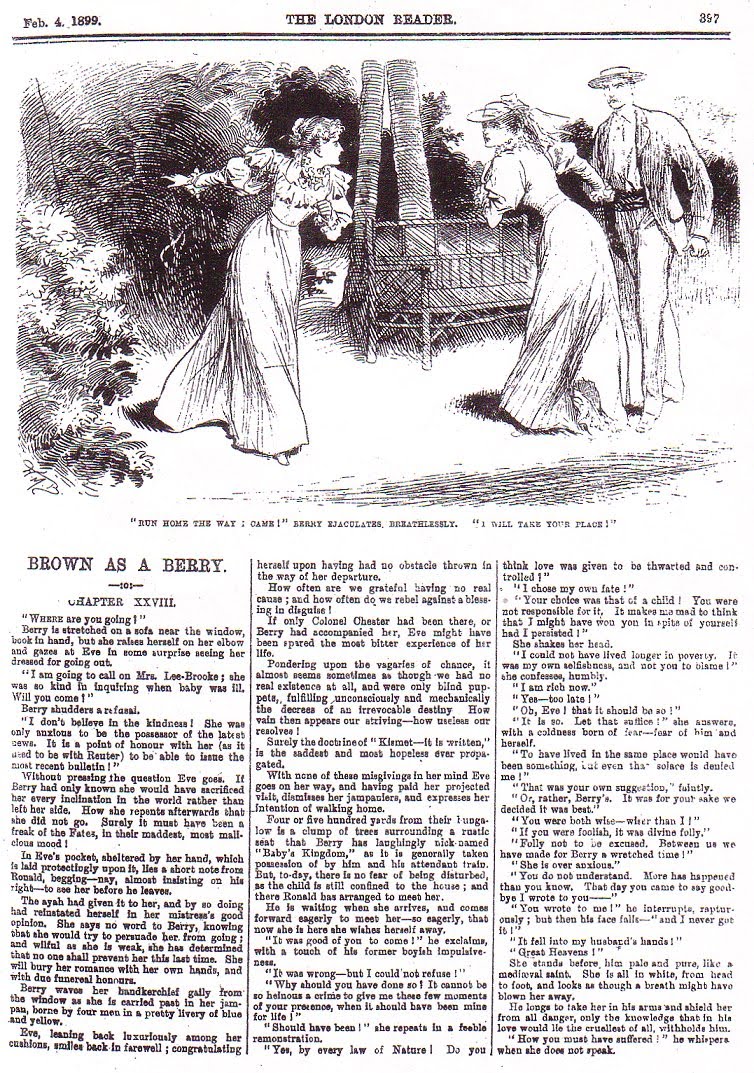
from The London Reader 1899; my thanks to John Adcock's splendid blog for this image

Key to the idea of “commercial importance” is whether the stories these women wrote were pirated or paid for by the British publishing industry. As we know from Dickens, the issue of transatlantic piracy was very important to writers. American publishers waiting at the dockside for new British books could produce an edition almost within hours, as they did in 1823 with Sir Walter Scott’s Peveril of the Peak. In the absence of international copyright agreements, the British author usually received nothing, although Harper Brothers, for instance, paid considerable royalties to Dickens and Macaulay, among others, and later on in the century Lippincott was generous to British authors he published, including Ouida. Accounts of British pirating of American serials commonly refer to how about 1.5 million copies of Uncle Tom’s Cabin were published in Britain without Harriet Beecher Stowe’s consent, but not much else. In fact there was a huge trans-Atlantic exchange.

I’m not going to write about well-known cases here. Furthermore, rather than talking of the piracy of books (quite expensive at the time) , I’ll focus on serials in cheap fiction magazines. Instead of the high-profit-per-unit-sold model which books operated on, penny periodicals made profit through the quantity sold. Most mid-nineteenth-century British mass-market fiction was published according to the latter model in penny weeklies such as The Family Herald, The London Journal, Reynolds’s Miscellany, The London Reader and so forth. America had its analogues in 4 cent weeklies such as the New York Ledger and the Philadelphia-based Saturday Evening Post. The circulation of all these magazines was enormous, with sales in the 1850s and 60s of 500,000 each (Dickens at his most popular, remember, managed 40,000). Given the usual calculations that are used to calculate readership from sales, in 1860 just the three best-selling magazines amounted to a 50% penetration of the entire population of Britain. Given that then the literacy rate in Britain was around 60%, that means that c. 83% of the literate population of Britain was reading one of these three magazines. The analogous American magazines had comparable sales figures, though given the much higher literacy and population of American – some 31 million as opposed to 19 million in 1860 – their percentage penetration was actually rather lower, if still hugely significant.

Example of a typical cover page of The London Journal

If what I’m saying is not as well-known as it should be it’s because, despite a few academic studies (most recently of American women writers), there are no bibliographical guides or descriptions of any of these periodicals. Some are available through ProQuest’s Periodical Archives Online but one still needs a bibliographical map to find one’s way around. Unless one knows what to look for one cannot find it.  Hence the importance of aids such as the Victorian Fiction Research Guides.

The points I am making come out specifically of my bibliographical mapping of primarily the British mass-market: what I found was that I also needed maps of the American and even Australian mass markets too. A focus on one does not give an adequate picture of how the market operated.

That said, in the British market there was a quite strict form of market segmentation along national lines. While some penny periodicals such as Bow Bells, Reynolds’s Miscellany and The Family Herald gave consumers mainly home-grown British fiction, there was another set that from 1855 offered stories written primarily by a mixture of American women and British men. This set comprises three closely related magazines: The London Journal, its offshoot The Guide, and its rival from 1862 The 7 Days Journal renamed in 1863 as The London Reader. These published a very large number of serials by three American women authors: E.D.E.N. Southworth, Harriet Lewis and May Agnes Fleming. The London Journal alone published 237 serials of various lengths – some in fact lasting only a few episodes. At least 50 of these serials, all of them long (and sometimes very long), were by 4 American women: 2 were by Caroline Lee Hentz in the mid 1850s, 13 by Southworth between 1855-1868, at least 22 serials by Harriet Lewis between 1868 and 1883, and at least 13 by May Agnes Fleming over the same period (I say at least as some are not attributed and others which are given signatures I haven’t been able to trace elsewhere).

While Southworth and Fleming have recently become visible again through the work of Nina Baym, Lorraine McMullen and others, it is Lewis in fact who has the largest number of novels published in this market sector as a whole, not just in The London Journal though she is most dominant there. Indeed, there is not a single number of The London Journal without one of her serials for 12 years from 1868, a succession of tales halted only by her death. When I discovered from perusal of her letters that she wrote a large number of serials that appeared under husband’s name Leon and his pseudonym “Illion Costellano”, her market share rose even higher.

The Uncle Tom mania in Britain over 1851-2 is well known and Louis James has pointed out the importance of American fiction in the 1830s British mass market. Susan Warner’s Wide Wide World (December 1850) and later Queechy (1852) had considerable sales on both sides of the Atlantic. Maria Cummins’s The Lamplighter created a sensation in 1854 with sales of 40,000 in its first 8 weeks and 70,000 in its first year. But it’s 1855 that is the key date for the beginning of a sustained massive import of American women writers into the British mass-market periodical. That year Margaret Oliphant realised the potency of American fiction in the “sensation” market and the Saturday Review commented on the popularity of American women writers early the following year.

There are several reasons for stressing 1855.

First, there had been recent changes in the law of copyright in Britain. In the 1840s, France had been seen as leading the way in mass-market periodical fiction, and British publishers mercilessly pirated French serials. The economics of mass-market publishing in Britain meant that there was no money to pay authors much: publishing translations of French works already known to sell well was a much safer speculation than publishing work that was untried in the market. But in 1852, there was a change in the copyright agreement with France. Now no longer could publishers in Britain simply take and translate a French work without paying the author. Fortunately, this was also the period when home-grown British writers such as J.F. Smith, Percy B. St John and Pierce Egan the Younger were selling so well there was enough profit on sales to pay them quite well, but of course it was still more profitable to publish works you didn’t have to pay for – and that would also sell well. The problem was now where to find them.

The Summer of 1871: Ouida and Wiertz

continued from previous blogs on Ouida and Mario and Ouida and Bulwer Lytton

When Ouida stopped in Brussels her encounter with the paintings of the recently deceased Antoine Wiertz provoked her into an explicit and public aesthetic statement. In a previously overlooked article in the shilling monthly London Society, Ouida offers a portrait of Wiertz as ‘the ideal artist … [whose] life was consecrated to one passion, and that passion—Art.’

The major concern for Ouida in this essay is conventionally Ruskinian – an interesting departure from her satirical view of Ruskin and Ruskinianism in her early two-part short tale “Beatrice Boville” . Her target is the deleterious effect on art of industrialisation and commercialisation. Only the artist who gives in to them will gain public acclaim she  says. But public acclaim is by no means the most important criterion of value. Wiertz remains unknown and created no school, says Ouida, because, believing that ‘gold was the murderer of art,’  and ‘a cancer in the breast of humanity’ (‘un cancer [sic] au sein de l’humanité’), he refused to enter the commercial and industrial marketplace. ‘Exalted on the heights of a superhuman purity of purpose and idealism of belief, he had no common bond of connection with the sheer materialism and venal practices of the modern world.’ Wiertz was an anachronistic figure, having more in common, Ouida continues, with the artisanal aims and practices of Italian renaissance artists and of Rubens than with an era in which ‘the colours are bought ready-mixed, the oils are indifferent, the varnishes are adulterated…’  Out of time and out of place, his whole life was a martyrdom. Indeed, Ouida ends her essay with what appears to be a facile comparison of Wiertz to the type of all martyrs, Christ.

They say that when he lay there, lifeless, the peace refused to him throughout his arduous years came on him at the last; and that when the summer sunrise streamed through the ivy shadows of his casement in the glory of the morning, his face was as the face of his Christ ‑ his Christ, who brake asunder the bonds of the grave and rose triumphant in the power of God.

Antoine Wiertz, Triomphe du Christ

Is Ouida simply promoting in commercially commonplace terms an artist who refused to do so himself – in other words treating Wiertz as the very object of commerce that he refused to become in life? She is doing that, of course. She presumably is getting paid for this article (unlike for her letter to the Morning Post  I mentioned in a  previous blog) but she is also imagining a Wiertz that has created himself in the image of his own art.

In Ouida’s vision he has managed to overcome after death the alienation from his labour that he had increasingly felt in the last part of his life: in death he returned to become what Ouida regarded as one of his own best art works, the earlier Triomphe de Christ. To show that, Ouida has drawn for us a word picture of his head that Wiertz himself, the artist of horrible decapitations, might have painted had he stuck to his original principles.

Throughout the second half of her article, Ouida criticises late Wiertz for too great an emphasis on the horrible. Instead, she says, Wiertz should have concentrated on the ‘intrinsically beautiful by proportion, by colouring, and by meaning’ as he had done in his earlier works. It is as if her conclusion were restoring to Wiertz the self Ouida felt he should have been. In some senses too, Ouida’s most famous short story, ‘A Dog of Flanders’ which dates from this time, is also a gift to Wiertz of his lost identity: the underdog hero Nello, like Wiertz, came from a very poor background, was self-taught and, when he came to Antwerp, was ‘entranced and subjugated’ by the Rubens altarpieces in Onze-Lieve-Vrouwekathedraal in Antwerp. In this sense “The Dog of Flanders”, like the article, is an analogue of the ivory cigarette case she threw to Mario. She is trying to interpret and give meaning to powerful feelings that art has aroused.

Ouida is conjuring from the dead an anti-sensationalist, anti-commercial aesthetic of the romantic period, where the pen or brush mediates a sincere relation between body and text, and the individual imagination is given priority and autonomy.  Of course in these “restitutions” she’s thinking about herself and the purpose of her own art. Why write about passion? From the early short stories she had excoriated the use of other people to satisfy  one’s own ends and feelings – a conventional enough condemnation of selfish passion. Real love always means accepting the other for what they are and if necessary standing and holding back.  Hitherto, even in the novel about the revolutionary heroine Idalia, the personal had triumphed over the political.

Yet the three encounters I have outlined in these three posts – with Mario, with Bulwer-Lytton and with Wiertz – combined with our knowledge of what comes next – the political and aesthetic celebration of a unified Italy in her next novel– suggest that  Ouida was turning towards and looking backwards to a political, communitarian romanticism as an alternative to a purely commercial art, seeking to give it the gift of life that the Judas kiss of selfish commercialism had betrayed. Was this one the elements in that complex of factors that guided Ouida towards Italy in 1871?

Oscar Wilde certainly recognised Ouida’s romantic lineage in a review of her novel Guilderoy in 1889:

Ouida is the last of the romantics. She belongs to the school of Bulwer Lytton and George Sand, though she may lack the learning of the one and the sincerity of the other. She tries to make passion, imagination, and poetry part of fiction. She still believes in heroes and in heroines. She is florid and fervent and fanciful. Yet even she, the high priestess of the impossible, is affected by her age….

His attribution to Ouida of affiliation to Sand and Bulwer is certainly correct. Jane Jordan (“The English George Sand? Ouida the French Novel and Late Victorian Literary Censorship”, Anglistica Pisana VI/i (2009): 107-16) has discussed the former, as have I, and the three encounters I have described suggest the latter and more.

But is there also  a fourth encounter in 1871, one with a ghostly revenant that has left only indirect and indistinct traces? All I dare remark for now is that William Rossetti’s edition of the Complete Poetical Works of Shelley had come out with Moxon in 1870 – followed famously by Mathilde Blind’s corrections in the Westminster Review – and that 20 years later Ouida was to publish a long article praising Shelley as the best romantic poet because, according to her, he had “the sentiment and passion of [Italy’s] natural beauty” — and because love underlay his vehement political engagement, just as she was to portray the hero and heroine’s in her next novel, the lyric prose poem in praise of Italy, Pascarel. Did Ouida encounter Shelley too in the Summer of 1871, and was this yet another coal in the steam engine that transported her south?  Just as with her enthusiasm for Mario, Ouida would not have been alone in responding to Shelley’s paeans to the visual and narrative pleasures of Italy such as  Julian and Maddalo, a poem much praised by Rossetti in his preface, for

How beautiful is sunset, when the glow
Of Heaven descends upon a  land like thee,
Thou Paradise of exiles, Italy!

The Summer of 1871: Ouida and Bulwer Lytton

(continuation of earlier post on Ouida and Mario in the Summer of 1871)

What “Art” was and its relation to her writing were very much on Ouida’s mind in mid-1871.

We know from surviving letters that in the early summer Ouida had become concerned with the discussions around a proposed Dogs Act which would give any summary court powers over the destruction of stray, dangerous and rabid dogs. Determined to block the passage of this Act, in early June, having already been told that he liked her work, Ouida contacted Edward Bulwer-Lytton to elicit his support. He wrote her a kindly response and thereupon she invited him to visit her at the Langham Hotel where she had lived with her mother since 1867. He came several times, much to her delight.

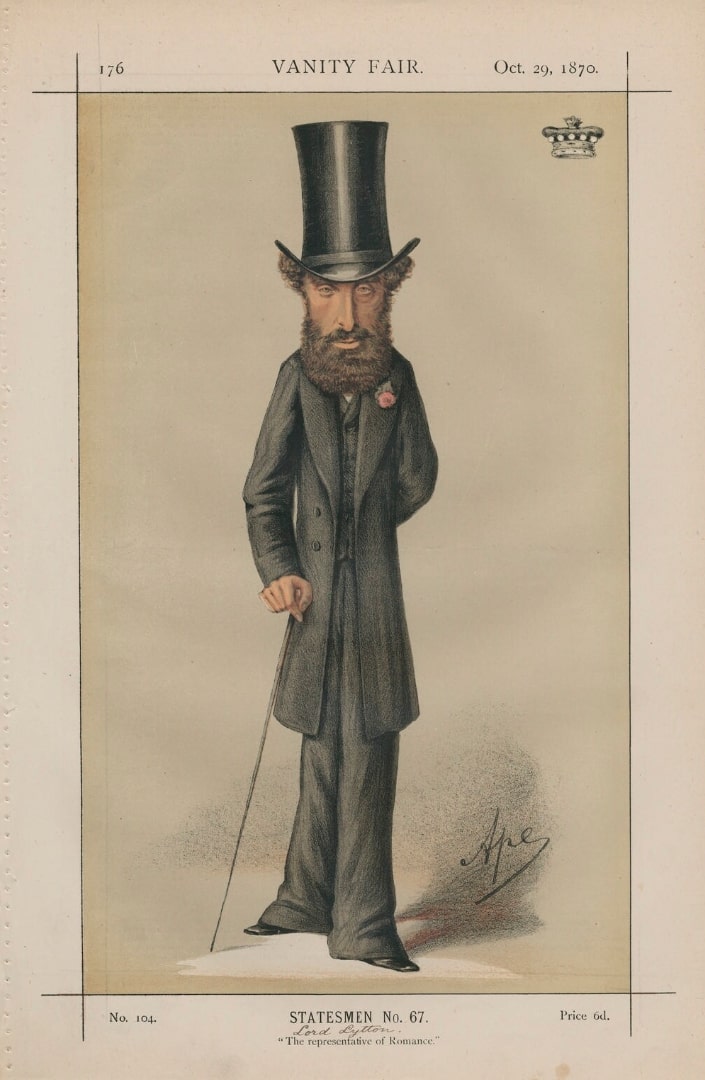
Edward Bulwer Lytton in a Vanity Fair caricature, 1870

Bulwer-Lytton was a key figure in the development of popular fiction. His help to Mary Braddon is well documented, and, though to a much more limited extent, he acted as Ouida’s mentor as well. After she had left London for her tour of the continent, he wrote Ouida a long but positive critique of her latest novel Folle Farine. His letter does not survive, but Ouida’s response to it does. She wrote it at the Hotel de York, Spa (Belgium), the hotel Baedeker and Bradshaw recommended for English visitors to this already faded (though still respectable) resort. Ouida’s letter is keen to associate her novel with ‘Art’ by attributing it aesthetic value through the conventional eighteenth-century criteria of ‘judgement’ and ‘sympathy’ (I always think of Elinor and Marianne in Austen’s 1811 Sense and Sensibility when I think of those). Ouida ends by justifying her exploration of painful emotion and unconventional sexual arrangements as ‘Art’ and the duty of the artist.

It would be terrible to me to think that I had wrought an injury to any Soul, but it always seems to me that the artist has one duty that he must place before all ‑‑ i.e. to seek earnestly for the truth with all his strength & as he beholds it so to endeavour to set it forth.

She was in November to write to Isabel Burton (wife of the explorer, diplomat, orientalist Richard) and, the following year, to the conservative politician, poet and literary patron Lord Houghton that Folle-Farine should indeed be considered primarily as ‘Art’. Whether this was a retrospective judgement supported by the favourable reviews that compared the Folle-Farine‘s ‘art’ to that of ‘our pre-Raphaelite painters’ or whether the novel had been written intentionally as an ‘Art’ (as opposed to commercial) novel remains unclear. Even though an artist figures very prominently as a heartless Lovelacean seducer in the novel, the nature of art  is not substantially discussed in it compared to in Ouida’s novels of the 1870s. Likewise in her response to Bulwer, Ouida doesn’t set out an aesthetic credo beyond saying that in her view the artist should always try to represent the truth  without causing  “injury to any Soul” – an unambitious and generic programme. As mentioned in a previous blog, for Folle-Farine Ouida had managed to get £900 out of her publisher Chapman – considerably more than she had received for her earlier novels. Ouida certainly knew about the hard cash aspects of art, but her letters suggest that she was at this stage just wondering about what other symbolic systems art might be involved in.

There is another letter that needs to be mentioned here too, a previously unnoticed one from Ouida in the press. On 12 June 1871, the Morning Post published a letter to the Editor from her in response to an article supporting the Dogs Act that had appeared in the paper the previous week. Ouida wrote that while the Morning Post’s position was a very reasoned stance, she wished to add that ‘the emotional side of the subject is one which may be most fairly taken into consideration’ – for dogs are friends who can teach us ‘lessons of faith and fealty.’ Ouida must have been proud of this letter for she sent a cutting of it to Bulwer Lytton. The basis of the letter’s argumentation is the binary of  “reason” and “emotion”. It is not too great a leap to match this both to the “judgement” and “sympathy” opposition in Ouida’s later letter to Bulwer and to the sentimental tradition of writing in general whereby the sharing of emotions is regarded as a way to form communities.  The purpose of “Art” in this understanding is indeed to forge communities through “sympathy” – common feeling – with the “truth” arrived at through reason/ judgement. To forge a community is necessarily a political act which involves ethics. Ouida is trying to forge a community around an ethical cause and thereby cause political change.

It is not I think too far to claim that we see in this brief letter to the Post Ouida publishing for the first time with a purpose beyond the commercial, and also beyond the economic interests of herself and her family. She may not have found a reason for her ‘Art’ yet, but she has found, on a miniature scale, a reason for writing: to change society for what she believed was the better by appeal to common emotions without thought of payment. A week before the collective ecstasy of Mario’s last performance, Ouida’s explicit political and economic engagement had begun.

An encounter in Brussels would very soon sharpen the edge of her desire for something in her aesthetic and economic life beyond hard cash.

(concluded here)

The String of Pearls and Space

Space and The String of Pearls

(continued from previous post on The String of Pearls)

That The String of Pearls is set in and around Fleet Street – the main street for the production of newspapers and therefore one of the main centres of knowledge production and circulation at this time – is unsurprisingly significant.  It’s a street that connects the financial centre and the centre of government, the City and Westminster, and the markets of Smithfield and Spitalfields to the rich West End. It’s also a centre of gravity for information and spins it off throughout London and elsewhere through its daily distribition of news.

Given the importance of voyages and ships in this story, it is fair to remark that not only does the street run parallel to the river but that it is a parallel to the river. Through it flows not water but information, residents, tourists and money. The parallel to the river is not that far-fetched — after all, it is named after the Fleet, the once notorious sewer/ river that Eliza was thrown into at the beginning of The Mysteries of London.

If the previous discussion of the economics of money and information in a previous post be followed through – that Sweeney Todd is himself a blockage of the flow of information – then we will note that it was around where his shop was located that one of the most infamous blockages of traffic in London stood for most of the nineteenth cnetury. This was Temple Bar, “a gateway”, so Wikipedia tells us,  “that marked the point where Fleet Street, City of London becomes the Strand, Westminster“.  It was removed in 1878. An informative website is dedicated to it. There we learn Temple Bar’s rather gory history. During the first half of the eighteenth century the heads of traitors were displayed on it, set on iron spikes which protruded from the top of the main arch. Although this had ceased by the time of Sweeney Todd, its horrible history is very suggestive.  Temple Bar was removed in 1878 because it caused too many problems for the progress of law. The Royal Courts of Justice and the Temple were close by and the arch caused too much interruption to the flow of traffic to and from these key seats of British law. By the time the story was written (and when it was set) this blockage was still present of coyrse. The idea that Sweeney Todd and Temple Bar are both blockers of information flow  is a wonderfully evocative metaphorical connection between real and fictional space! It may seem far-fetched but it can be thought of  as an example of the kind of dream logic of association that fiction, according to psychoanalysis, operates on.

The Temple plays an important, if fundamentally ineffectual, part of The String of Pearls.  Mrs Lovett’s clients in her shop are mainly lawyers. In her shop they become unwitting cannibals. They feed off human flesh as though they were vampires (Varney the Vampyre, a text influential on Dracula,  was another Edward Lloyd serial and if Helen Small is to be believed, it was written by the same man). But lawyers aren’t condemned as immoral bloodsuckers (as they are in, say, Dickens’s Bleak House) so much as represented as foolish victims of their own animal appetites. Mrs Lovett excites them by flaunting her charms as she sells, combining sexual desire with greed for food. Besides her special pies she makes them want her special “smiles”. The system – here the organisation of space that puts them into contact with Mrs Lovett’s smiles and pies – is bigger than they are. It’s that that makes them into cannibals. They just can’t resist. The same goes for Sweeney’s poor assistant Tobias, who becomes a barber’s assistant because he’s a failed lawyer, and who is forgiven little but for stopping to buy a pie from Mrs Lovett. He’s not a willing nor witting cannibal and certainly isn’t condemned – on the contrary, we are supposed to feel very sorry for him.

What do the lawyers (and Tobias) get in Mrs Lovett’s pieshop? Pies, smiles – but also information: they go there to gossip. Lawyers were and are knowledge workers who depend on and control the flow of information. Mrs Lovett’s retail space is positioned in exactly the right place and way for them to do that. They are carefully corralled within the horse-shoe of her counter and never allowed beyond it. Of course she doesn’t want them to go behind it in case they discover her secret. This is a form  of negative information control. But their corralled cannibalism also gives them the opportunity to pause for gossip and the production of knowledge. Their information exchange and production is, paradocically, predicated on Mrs Lovett’s control of their ignorance of the exploitation and consumption (at one remove) of other people. They don’t know about the farmers who have come from the country to Smithfield to sell their cattle, who have made a profit and who, murdered by Sweeney Todd, give up their profits, their valuable canes and hats, to his store rooms and secret drawer (Sweeney is not one to reinvest or speculate like Eugene/ Mortimer in The Mysteries of London i.e. he doesn’t put what he’s taken back into circulation). The String of Pearls to that extent is like those attempts today to expose the working conditions in sweat-shops where the cheap clothes we just must have are made, or the conditions that animals are kept in for the food we think we have a right to eat. The novel is thrilling and the story has survived so long  because it deals with a topic perennial to capitalism: the ethical choices all consumers make, often in ignorance of how what we want is made. In the novel this is figured as the difference between street-level consumption in the shop and the terrible underground manufactory. Another organisation of space therefore.

Sweeney Todd stores his stolen treasures upstairs, in the private spaces where the public don’t go. It’s the equivalent of Eliza’s boudoir in The Mysteries of London in which she stores her real identity. Sweeney’s “boudoir” (the word isn’t used of course) likewise contains the evidence of his thefts and murders — this is, his real identity defined by his real activities.

Vertical space therefore is organised in three: the basement reality of manufacture and storage of consumed remains, street level where the story goes on, and the upepr storeys of the house where the reality of identity is hidden away. Only on street level can circulation take place.

A Scandal in Bohemia

Summary of Class Conclusions (I’ll write up a discursive version as soon as possible – I’m only putting this up temporarily to help you compare Conan Doyle’s original “A Scandal in Bohemia” with A Scandal in Belgravia (BBC1, 2011).

Space

•Irene has own space – own house (very different from earlier women) Bryony Lodge, Serpentine Avenue – Garden of Eden – Eve? Serpent? •She manipulates space outside – New Woman – identity not just tied to home •She hides in public space (she inverts the secret spaces) •Fluid – more equal •Sherlock Holmes city not zoned so rigorously as Mysteries of London •Sherlock’s area – the homosocial masculine space of 221B information sharing – he can invade her space but not she his (she can only get to outside the door) •The gendering of space

Gender

•Is Irene’s femininity viewed differently than if SH himself had narrated it (SH has low opinion of women’s wit- until end)?  •Watson’s masculine narrative control •Professional masculinity v aristocratic –Intellectual and goal oriented v. wealth and objectification of the world –Irene chooses professional •Irene likes freedom of dressing as a man •The Woman = her name? What Sherlock believes a woman should be, the only one worth mentioning • The Woman V . women  (contradiction)

Economics

•Opposite of Sweeney Todd –Money is only a means to achieving satisfaction – •Sherlock wants to be paid the picture not money •The price of information is desire [what does this mean? It’s a wonderfully ambiguous phrase!] •Economics also = control of circ of info •Reputation as information •Value depends on satisfaction not the labour that goes into it