International History of Magazines 2: Italy

ITALY

As in other European countries, magazine publication in Italy was begun in order to disseminate the ideas of elite groups, in the Italian case a process closely allied to the Catholic Church, at least initially. Unlike in France and Britain, there was no single capital city as, like Germany, Italy was divided up into many different states. For this reason magazines tended to be local productions.  In 1668 the quarterly Giornale de’ Letterati was launched by Francesco Nazzari, a professor of philosophy at La Sapienza University, Rome, and also president of the papal college concerned with propagation of the faith, De Propaganda Fide. Very soon other cities set up similar publications. The most activity took place in Venice where there was already a thriving print industry.

While as in the rest of Europe, elite magazines, including ladies’ fashion magazines inspired by French models, were being published in the eighteenth century, the mass-market press took off later than elsewhere largely due to restrictions on the market caused by Italy’s fragmentation into different states, and by low literacy rates. There was huge variation in density of readership: Ottino (1875, p. 11) noted that in 1864 the vast majority of newspapers and magazines were published and circulated in the North East quadrant of Torino, Milano, Firenze and Genova. Undertakings such as Sonzogno’s sumptuous and loss-making L’Illustrazione Universale (1864-1867) and its cheaper and much more popular analogue the Emporio pittoresco (1864-1889) were risky, and only after unification in 1871 did the markets begin to open to magazines in a sustained way, the most successful magazine being Treves’ L’Illustrazione italiana (1875-1962).  Magazines such as the Nuova Antologia (1865-) and the Rassegna nazionale (1879-1952) became influential in seeking to promote the idea of a single Italy, and politicians such as Bonghi steered their contents to suit their policies. The magazine press was never as rich and diverse as in Germany, France, Britain or the USA, not least because until the twentieth century literacy rates and standards of living were comparatively low. Only in the twentieth century did the history of Italian periodicals become more similar to that of the rest of Europe, its family-run businesses gradually undergoing a series of mergers until they were absorbed into huge media conglomerates.

Even less than in France, Germany and Britain, little attention has been paid to the national history of magazines. As so often, the researcher needs to glean what she can from surveys of the national press as a whole. These, as in the rest of Europe, began to appear in the mid nineteenth century (see Ottino below), and in 1894 Piccioni’s ground breaking Giornalismo Letterario appeared (q.v.). But it was only with Castronuovo and Tranfaglia’s work from the 1970s (q.v.) that sustained academic work on press history began. As in other European countries, press directories have been compiled since the nineteenth century: the earliest is probably the Elenco dei giornali che si pubblicano nel Regno d’Italia (Torino-Firenze-Venezia: Bocca-Loescher-Munster). It is undated but the preface declares that it was compiled as a result of the unification of Italy and clues date it almost certainly to 1869. Alternatively, one may turn to  studies of publishing history more broadly, though as late as the 1990s it was possible for Turi (q.v.) to lament the scarcity of more than antiquarian or local studies. Of particular interest for Italian scholars of the press have been early literary magazines (and the literary magazine in general) and the Fascist period. A good deal of work remains to be done on the nineteenth-century magazine, including the trade and professional periodicals which Ottino listed in considerable numbers.

OVERVIEWS

Bertacchini, Renato. 1980. Le riviste del novecento. Introduzione e guida allo studio dei periodici italiani: Storia, Ideologia e Cultura. Firenze: Le Monnier

This useful guide to literary magazines from 1880 to the early 1970s is organised chronologically and offers descriptions of individual publications (some prioritised over others very markedly) along with background context, and bibliographies. There is almost nothing on production history, the focus being on the ideological role of the magazines.

Castronovo, Valerio and Nicola Tranfaglia. Eds. 1976-2002, Storia della stampa italiana, Roma-Bari: Laterza, 10 vols.

The starting point for any detailed historical study of the Italian press must be Castronuovo’s epic project that traces its  history from its beginnings to 2000. Magazines appear repeatedly in this account, but the main focus is on the newspaper press and politics.

Franchini, Silvia. 2002. Editori, lettrici e stampa di moda: giornali di moda e di famiglia a Milano dal Corriere delle dame agli editori dell’Italia unita. Milano: FrancoAngeli [sic]

A readable and well-researched illustrated history of women’s magazines from 1804 to 1870 using a materialist methodology in the Anglo-American tradition. The extensive bibliography, and the methodological introduction, are useful for the historical study of Italian magazines in general.

Hallamore Caesar, Ann, Gabriella Romani, Jennifer Burns. eds. 2011. The Printed Media in Fin-de-siècle Italy. Publishers, Writers and Readers. Oxford. Legenda.

While not all the essays in this collection focus on magazines, several highlight the importance of (especially) high culture, avant-garde magazines, such as the Florentine Il Regno, La Voce, Lacerba and the more famous Futurist Poesia.

Mondello, Elisabetta. Gli anni delle riviste. Le riviste letterarie dal 1945 agli ammi ottanta. Lecce: Millella.

A useful volume, similar in format to those produced by the Greenwood Press. It offers a substantial discursive introductory history followed by descriptive accounts of 172 literary magazines organised alphabetically. Despite the chronological constraints suggested by the title, there are descriptions of magazines from earlier in the century as well.

Mondello, Elisabetta. 2912. L’Avventura delle riviste: Periodicai e giornali letterari del Novecento. Roma: edizioni Robin

While seeming to trace again the work of Bertacchini (q.v.) Mondello offers a newer view by highlighting the role of periodicals directed at women. The volume concentrates on the first half of the century, the remaining 50 years comprised into one relatively brief final chapter (cf Mondello, 1985, q.v) . Again the approach is on ideology rather than on data concerning material production or dissemination.

Ottino, Giuseppe. 1875. La stampa periodica, il commercio dei libri e la tipografia in Italia, Milano, Libreria-Editrice Brigola.

Organised around a list of magazines and newspapers with much the same information as in a contemporary British press directory, this also contains two useful essays on the history and current state of the Italian periodical press, along with a bibliography of relevant works organised by place. The project to map the current condition of the Italian press was originally commissioned by the Associazione tipografica-libreria italiana in 1870.

Piccioni, Luigi. 1894. Il Giornalismo letterario in Italia: Saggio storico-critico. Torino-Roma: Ermanno Loescher

Surprisingly, given its date, this is an accessible place to start a study of early Italian magazines, with useful indexes and bibliographies and brief accounts of a large number of magazines (which, of course, needs to be checked against more recent studies). Projected as the first of a multivolume series, the others never appeared.  Piccioni, however, went on to become one of the most authoritative writers on Italian journalism history, on which he published mainly journal articles.

Turi, Gabriele. ed 1997 Storia dell’editoria nell’Italia contemporanea. Milano: Giunti editore

Inspired by Chartier and Martin’s Histoire de l‘édition française, this is an ambitious multi-authored book that covers Italy’s publishing history from its beginnings to the 1990s in a series of essays. Magazines are often mentioned though the index will need to be used to find specific titles.

DATABASES

Biblioteca Digitale Toscana http://159.213.233.182/TecaRicerca/home.jsp

A clunky database containing 65 magazines and newspapers from various Tuscan libraries. It is not full-text searchable, the searches being restricted to titles and (some) authors. Users need to know in advance of searching the date of what they are looking for and also in what periodical. Searches bring the user to folders organised by year and then date. The user can then download individual issues one by one.

Biblioteca Nazionale di Firenze, di Roma http://www.bncf.firenze.sbn.it/pagina.php?id=47&rigamenu=Periodici; http://www.bncrm.librari.beniculturali.it/index.php?it/32/biblioteca-digitale

The library site claims to have digitised millions of pages since the 1980s, with especial attention to periodicals but most are currently (September 2015) unavailable because of the reorganisation of the site. The Italian National Library of Rome likewise () promises the imminent appearance of digitised periodicals but nothing is yet available.

CIRCE: Catalogo Informatico Riviste Culturali Europee. http://circe.lett.unitn.it/main_page.html

CIRCE is a database of European “cultural magazines” set up and maintained by staff at the University of Trento. It does not offer digital facsimiles as yet so much as descriptions and content indexes of literary, musical and artistic magazines.

International Bibliography for the Study of Magazines 1: France

Recently I’ve been thinking about how hard it is to do transnational comparative research on periodicals, so I’ve started to compile a series of guides to the study of magazines in various countries. Since they’ll all be in one place, it should be easier the follow up lines of enquiry across countries. I have to say I have found the enterprise really fascinating!

Here’s the first, on French Periodicals.

France, along with Britain and Germany, is one of the points of origin of the magazine form and the history of French magazines runs in parallel and dialogue with its two neighbours. It is distinct, however, in its early phase by its centralisation, domination by just three titles and its generally literary orientation: the learned Journal des Savants (1665-), the literary and more gossipy Mercure galant (1672-1825; Mercure de France after 1724) and the (eventually) government-controlled news magazine the Gazette (de France) (1631-1915). In the eighteenth century, the press began to diversify: the Recueil périodique d’observations de médecine, de chirurgie et de pharmacie (1754-1793 ) is the first medical magazine, Courier de la Mode ou Journal du gout (1768-770) was the first women’s magazine and so on. In the nineteenth century French women’s and satirical magazines like Le Moniteur de la mode (1843-1913)  and Le Charivari (1832-1937) especially were global inspirations, though literary journals like the Revue des deux Mondes (1829-) were also extremely influential. The “Golden Age” of magazines is generally considered to occur between the Paris Commune and the First World War (1871-1914), when illustrated news magazines such as the Petit Journal (1863-1944) attained circulations of over a million.  Histories of the French press emerged at the same time as in Britain, in the mid-nineteenth century. Hatin’s Histoire politique et littéraire de la presse en France of 1859 is deservedly famous, but it also signals the course of French press historiography even more than its British analogues by focussing on newspapers and high-status literary magazines: the sustained history of popular French magazine has had to wait to be written until the late twentieth century.


REFERENCE

Devreux, Lise and Philippe Mezzasalma, eds. 2011. Des sources pour l’histoire de la presse: guide. Paris, Bibliothèque Nationale

An authoritative guide to the press holdings of the Bibliothèque Nationale from its earliest journals to the electronic magazines of today, it covers the laws, economy and technology of the (mainly newspaper) press in detail. Of especial value is the very extensive bibliography. Magazine history is much more prominent than in Bellanger (q.v.).

Place, Jean-Michel, and André Vasseur. Bibliographie des revues et journaux littéraires des XIXe et XXe Siècles. 3 vols. Paris: J.M. Place, 1973–77.

Place and Vasseur’s valuable bibliography covers the years 1840–1930 for a select number of both famous and lesser-known French literary periodicals, with facsimiles of cover pages, an introduction to each journal, and full bibliographic descriptions, which include information about the editors, contributors, and physical characteristics of each periodical, along with a table of contents for each issue. It also includes an invaluable index of names.

OVERVIEWS OF PERIODS, GENRES, PLACES

Albert, Pierre. 1970. Histoire de la Presse. Paris: Presses Universitaires de France

This small volume, one of the popular Que-sais-je? series, is useful as a starting point for a press history of France compared with (mainly) England and Germany (the USA has a few pages devoted to it). Though magazines figure hardly at all, and there is little detail, the volume has the virtue of summarising the overarching conditions of the press within which magazines operated.

Bellanger, Claude, Jacques Godechot, Pierre Guiral and Fernand Terrou, eds. 1969. Histoire générale de la presse française. 5 vols. Paris: Presses Universitaires de France.

The standard history of the French press from its beginning to the 1960s. A monumental undertaking, these volumes all freely mix newspapers and magazines, though the stress is on politics and newspapers. While attention is certainly given to technology, circulation and genre, an emphasis characteristic of French press history, is on the development of press law.

Eveno, Patrick. 2012. Histoire de la presse française de Théophraste Renaudot à la revolution numérique. Paris: Flammarion.

A lavishly illustrated volume, this popular history of the French press from its beginnings with Renaudot’s Gazette in 1631 offers a surprising amount of illuminating material. Most of the volume is spent on the late nineteenth and twentieth century press. Magazines play a part in the narrative, but the main utility of the volume is for high-quality background information.

Forsdick, Charles and Andy Stafford, eds. 2013. La Revue: the Twentieth-Century Periodical in French. Oxford, Bern, Berlin, Bruxelles, Frankfurt am Main, New York, Wien Peter Lang.

Acknowledging the dearth of studies of French magazines as magazines, this collection seeks to remedy that with 19 essays, mostly in English but some in French, centred on individual, mainly niche, magazines. Notably, there is a chapter on the history of French-language magazines in Mauritius.

Kalifa, Dominique, Phillipe Régnier, Marie-Ève Thérenty, Allain Vallant, eds. 2011. La Civilisation du journal: Histoire culturelle et littéraire de la presse française au XIXe siècle. Paris: Nouveau Monde.

At almost 1800 pages and with 116 essays (many like long encyclopedia entries) by 60 contributors, this volume is to the study of French periodicals what the Dictionary of Nineteenth-Century Journalism (q.v.) aspired to do for British: push periodical writing to the forefront of nineteenth-century studies. While it is not restricted to magazines, magazines play a very large role here. This is certainly the obvious place to start for a study of the nineteenth-century French magazine, though the emphasis is decidedly literary rather than technological or economic.

Mesche, Rachel. 2013. Having it all in the Belle Epoque: How French Magazines invented the Modern Woman. Stanford, CA: Stanfird University Press.

Despite the sensationalist title, this is a well-researched study of the dialogue between magazines, literary production and feminism, focussing on two photographic magazines aimed at women La Vie Heureuse (The Happy Life, 1902-1917) and Femina (1901-1954)

DATABASES

Bulletin des Bibliothèques de France (BBF), http://bbf.enssib.fr.

The Bulletin provides much useful information on new bibliographies, digital projects, and academic articles about bibliographic issue. The site includes the entire back catalogue of the BBF revue since its beginnings in 1956.

Dictionnaire des journaux 1600-1789 and Dictionnaire des journalistes 1600-1789 http://dictionnaire-journaux.gazettes18e.fr/ and http://dictionnaire-journalistes.gazettes18e.fr/

Two related open-access reference sources, the equivalent of the pay-walled Waterloo Indexes to nineteenth-century British and Irish periodicals, these are updates of paper versions published first in 1974 and subsequently. Links to digital facsimiles are provided where these exist, and there are extremely useful and informative welcome pages outlining the scope of the Dictionnaires. This is an essential resource for the study of early magazines in France.

Gallica, http://gallica.bnf.fr

A massive, user-friendly open-access digitization project sponsored by the Bibliothèque Nationale de France, Gallica includes many periodicals. Usefully, it links up to other digital holdings, such as the Bibliothèque numérique de Roubaix (an online local history archive), and provides brief background information on individual daily newspapers as well as periodical and press history.

Système universitaire de documentation (SUDOC)   http://www.sudoc.abes.fr

SUDOC is the online union catalogue of French university libraries. It includes Myriade, a union catalogue of 250,000 periodical titles in French libraries and archive centres, including 2,000 non-university institutions, such as municipal libraries. Not digitized it is invaluable as a finding aid.

Journaux de la Revolution de 1848

This database, available as part of Gale Cengage’s (q.v.) Archives Unbound, and thus available only to subscribing institutions, offers fully text searchable facsimiles of newspaper and magazine titles published in France 1848-1852.

Persée. http://www.persee.fr/

An open-access site, this offers text-searchable access to over 170 collections comprising some 530,000 documents, including facsimiles of numerous learned journals in French such as the Journal des Savants (from 1910 to today) . The earliest material dates from 1840, though the main focus is on twentieth and twenty-first century materials..


Matrimonial Ads in the Victorian Press: Fantasy, Imagination, Story, Life

“Honest, Thick-Skinned Advertisements for Goods”?

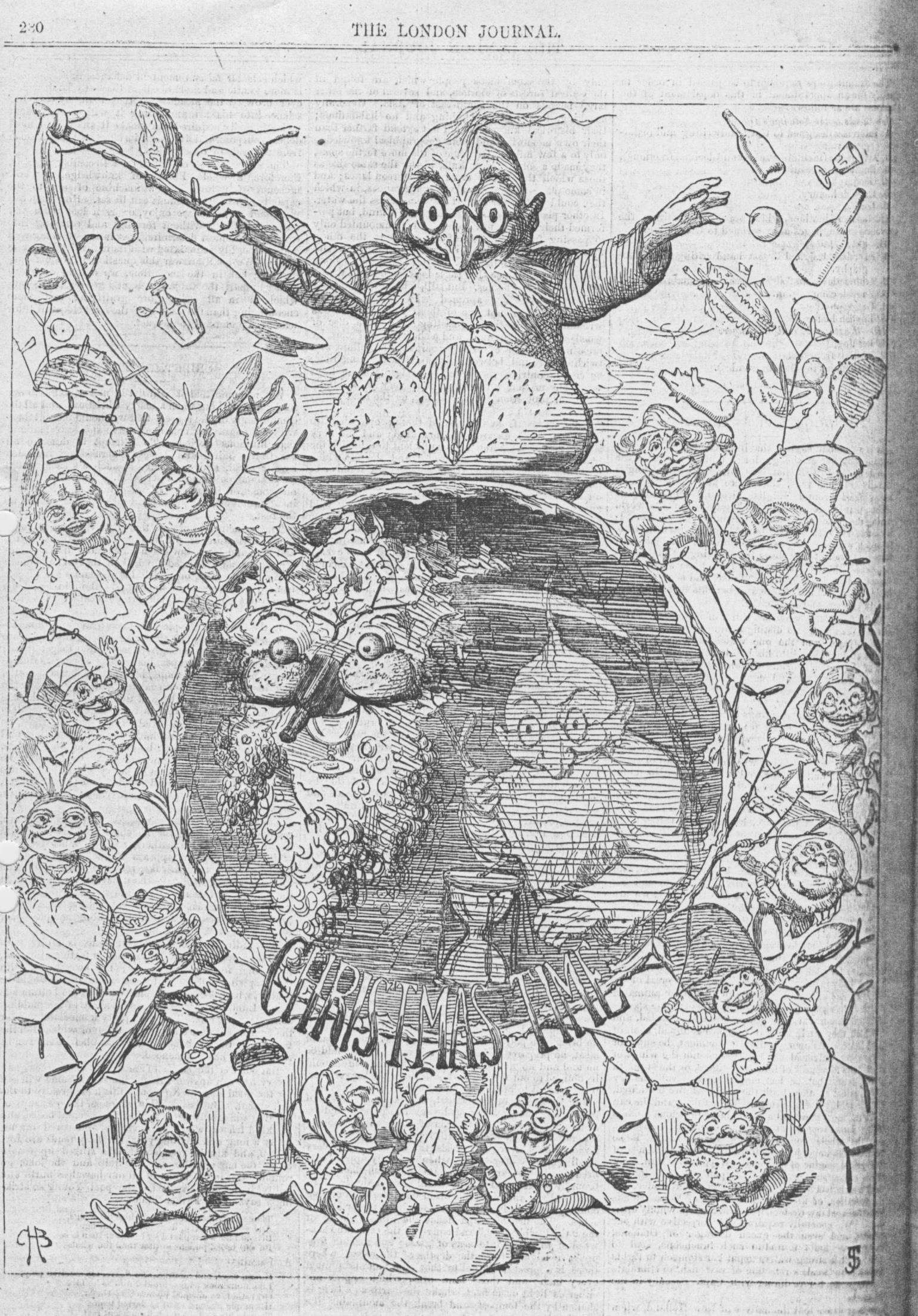
Relationships, relationships… : an illustration to The Will and the Way by J.F. Smith in The London Journal 5 March 1853

W.D. a tall, dark, young man, with £200 per annum, derived from an investment in the funds, would like to have a fair-complexioned young wife; he has just returned from Italy, but does not admire the dark beauties of that land of poetry and song.

MARIA C., of Wavertree, who resides with a cross old aunt, is desirous to join her fate with that of a medical man; she wants a comfortable domestic home; she is a good housekeeper, and not afraid of labour, having kept her late father’s house without a servant; she is not a child but “fat, fair and forty” with a fine complexion, splendid and perfect set of teeth, also beautiful hands and small feet. She has £64-a year now, and will have £500 on the death of her aged aunt.

(both from “Notices to Correspondence,” The London Journal, 5 March 1853, p. 416)

Who of us hasn’t, if we’re honest, scanned what not so long ago were the “Personals” in newspapers? I certainly used to and no doubt would today if I happened to come across them  (now you have to make an effort by going to specialised websites – the pleasures of chance encounters in the press are altogether rarer). Weren’t the personals wonderful invitations to fantasy? What would X be like? Would I like them? Would they like me? Are they like me? What a funny ad! – what kind of person would answer that? etc etc

If the above two quotations from the penny fiction weekly London Journal are anything to go by,  it seems the fantasies of Victorians were rather different from ours. They assume marriage is less about romantic love or sex than comfortable domestic arrangements. The fantasy concerns a better life obtained through the synergistic pooling of resources, whether those resources be money,  labour, or looks. W.D.’s main selling points are his £200 a year and – perhaps for some – commitment to his home country; Maria C. supplements her offer of £64 a year with the prospect of an additional £500, commitment to hard work, experience of managing a household – and, her father being dead, no interfering relatives (remember Lady Audley’s sponging father?).

To read them like that is to read them as  “honest, thick-skinned advertisements for goods” as the Spectator put it in a review of the later (and very successful) magazine entirely devoted to matrimonial ads, the Matrimonial News (1870-1895).

Of course, one can easily weave stories about these two — though, even if imaginary,  I hesitate to call them fantasies.

Perhaps W.D. was on the rebound, jilted by an Italian beauty he had encountered in Florence,  Venice or Naples. £200 is a fair amount to to live on but not enough to keep a carriage or horses: why doesn’t he declare other possibilities of income such as training for the law? He’s probably feckless and superficial, a Shallow Hal who only wants a blonde. Or perhaps he is an Artist who lives only for Beauty. Ah! Now there’s an idea for a novel plot! Ouida might well have used it (except that in 1853 she was only 14 and had six years to go before her first tale was published). Still, one thinks of Folle Farine in 1871 (not one of Ouida’s sunniest – W.D. in this novel would be a heartless monster!)

From “Notices to Correspondents,” The London Journal, 5 March 1853, p. 416.

As for Maria C. from  Wavertree – why does she want a medical man? Is she ill? £64 a year and £500 on the death of an aunt, a father with no servants, based in a Liverpool suburb — not a promising social or financial additional asset for a physician. Despite her fair hair, in no substantive sense is she Rosamond Vincey in George Eliot’s Middlemarch!  But maybe a surgeon would find Maria useful, for surgeons in the 1850s, although they were fighting for status,  were still associated with trade. Or perhaps an apothecary would do? Interestingly, I can’t think of a novel plot in which Maria C.’s story might have appeared in this period. One can imagine a naturalist novel by Gissing where her story could be told, but in the early 1850s the heroines were young and beautiful. A Punch cartoon might feature her as a harridan man-chaser, Dickens might parody her in Pickwick Papers as Rachael Wardle or Mrs Bardell, but Maria C. is just not narratable in fiction of this period, at least not in a way which would give her a decent interior life. She has no voice in print other than what she herself gives it – a remarkable achievement on her part.

I’ve recently been reading Jennifer Phegley’s very entertaining Courtship and Marriage in Victorian England (2011) and (not for the first time) was struck by the imaginative possibilities of these ads that she discusses so well (click here for a fun lecture by by Jennifer delivered in Kansas in February 2012)

While the ads don’t seem to link directly to novels of the period, it’s interesting   that it seems a reflex for us to decode them –  extend them  – flesh them out – by trying (and perhaps failing) to link them to such novels.

I’m reminded of Lisa Zunshine’s contention in Why We Read Fiction: Theory of Mind and the Novel that however we may be trained in academia to treat texts as dead objects, we keep wanting to animate them by ascribing to them a spirit, an identity, a personhood of which they are symptoms. And isn’t  trying to connect the matrimonial ads to novels in some curious way a bizarre instance of that, as if the novels were more alive than the ad? We don’t know W.D.’s or Maria C’s real stories, so we have to turn in a really bizarre way to something we consider the next best thing: the Victorian novel.

This is a far cry from the fantasies inspired by the personals of the late twentieth century: they prompt a different set of questions and today offer different, retrospective solutions, that, however imaginary, are, well, not fantasies so much as wishes that dead words on paper or screen that bore little or no relation to the material lives of real people might, perhaps once, have been the stories and memories instinct with life and breath.

For a light-hearted little video on matrimonial ads from the BBC, see my discussion with the wonderful Lucy Worseley here.

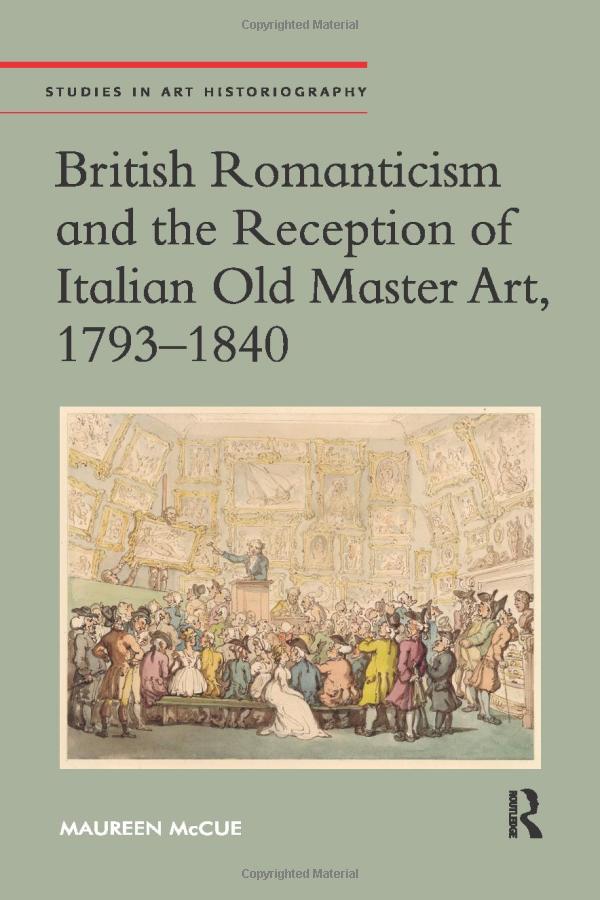
Book Review: British Romanticism and the Reception of Italian Old Master Art 1793-1840

This was published in Reception – https://doi.org/10.5325/reception.8.1.0113 – but they never told me. Hence my posting of it here (with added images)

Maureen McCue
British Romanticism and the Reception of Italian Old Master Art 1793-1840
Farnham, UK/ Burlington VT: Ashgate, November 2014.
204 pages
$109.95
ISBN: 978-1-4094-6832-5

How does one study the reception of art work? As we know from the work of Caroline Burdett (19 (2011) www.19.bbk.ac.uk) and others, in the early part of the twentieth century Vernon Lee scrutinised and recorded the physical responses to paintings of her lover Kit Anstruther-Thomson: a direct scrutiny of scrutiny’s effects that Lee then translated into words. Starting from this empirical position, Lee claimed in her 1912 Beauty and Ugliness that memories and associations caused unconscious changes in posture and breathing: the “reception” she sought to systematise and map was a bodily one. It scandalised contemporaries – the New York Times review is now notorious – but if the horrified critics of 1912 had been able to read Maureen McCue’s well-written study of how some of the major Romantics reacted to Italian Old Masters, they would have been able to appreciate how Lee’s emphasis on the physical had a very respectable genealogy in canonical poets and prose writers of the Romantic period.

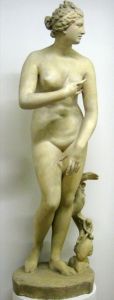
The Venus de Medici, which provoked strong responses from Byron and Hazlitt

Comprising four chapters with a substantial Introduction and a brief recapitulatory Conclusion, British Romanticism and the Reception of Italian Old Master Art 1793-1840 covers the tensions involved in appreciating Italian art from the early Renaissance and afterwards from the perspective of the mainly male educated middle classes in the first decades of the nineteenth century (“Old Masters” McCue helpfully defines as paintings from Giotto to Guido Reni). The volume also deals with the changing nature of the arbiters as well as the rules of taste, the effect of Old Masters on literary texts, especially by Shelley, Byron and Hazlitt, and above all on the poem Italy (1822 and revised substantially in 1830) by the fascinating and influential Dissenting banker and poet, Samuel Rogers, to which an entire chapter is devoted. Other authors several times referred to but quite briefly discussed include Mary Shelley, Madame de Staël, Lessing, Hazlitt’s contemporary the art critic P.G. Patmore, Anna Jameson, Lady Morgan, William Roscoe and Wordsworth. Much more unexpectedly, Pierce Egan the Elder, the author of the racy Life in London, receives a few interesting pages too.

McCue begins by anchoring the well-known idea that Italy came to be regarded as “a land of the imagination … a country which has all but become a work of art in itself” (p. 1) in the wake of the Napoleonic wars. England began to see itself as the protector of Italy and of its art treasures in the face of Napoleon’s depredations. The import of Italian art into London, which was considerable, could at this point be justified as an act of curatorship. Such raiding could also be sanctioned by acts of appreciation – of newly refined forms of perception as described and recommended by literary texts – and it is these latter that McCue is mostly concerned with. Her description of Hazlitt’s stress on “gusto” – the body’s response to an art work – prefigures Vernon Lee’s, though one need hardly look for a single point of origin, as Hazlitt’s focus on corporeal reaction was by no means unique. It also had, as McCue reminds us in her first chapter, a political dimension. For the aristocratic Grand Tourist in the eighteenth century, art had had a grand moral lesson that required a considerable education to appreciate: he needed to know both “the mechanical aspects of art, such as perspective and composition” (p. 27) and the usually Biblical or classical narrative subject matter. The approach was in other words resolutely intellectual. Attending to art’s direct effects on the body on the other hand had a decidedly political edge, for by moving the spotlight from the intellect to the body a role was given in aesthetic appreciation to those without the specialist education of the aristocrat. All the responder needed to do was verbalise as imaginatively as possible his or her feelings aroused by the art work. Art, in other words was, at least in theory, democratised.

That McCue does not entirely fall for this oversimplification (after all, Hazlitt did think one needed to be of unusual sensibility properly to appreciate art)  is one of the instructive pleasures of this volume. Instead, McCue foregrounds the commercial, religious and cultural interests that always inflect perception when it is filtered through words.
Although McCue devotes by far the greater number of words to male writers, the question of women’s perception of art is also raised at several points (the most sustained passage comprising a discussion of Anna Jameson’s Diary of an Ennuyée on pp. 72-76). This focus on men is a pity in these days of renewed attention to women’s writing. One looks in vain for discussion of L.E.L’s Improvisatrice or Hemans’ “Restoration of Works of Art to Italy” or “Properzia Rossi for example.

In any study of reception one must have a very clear idea of who is doing the receiving where, when and how. McCue’s study is split on this notion of the specificity of response in ways typical of older literary history. On the one hand she is very precise in that she assiduously employs the citational apparatus we were all taught as undergraduates, focussing on authors rather than publishers or periodicals. In this system we are told who wrote the words and when the volume in which the researcher found them was published. Attention to the actual material forms through which the reception of Old Masters was disseminated in the Romantic period would, however, have revealed some surprises.

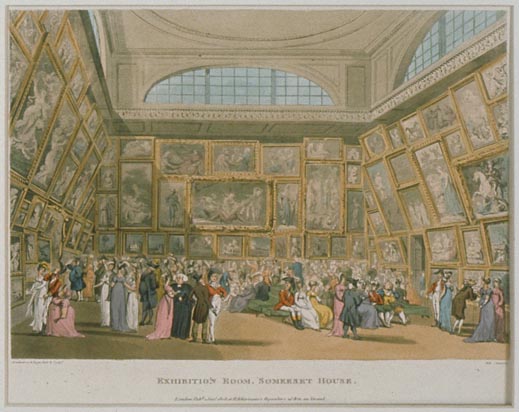
John Hill, Exhibition Room, Somerset House, from Ackerman, The Microcosm of London, 1808 http://www.gac.culture.gov.uk/work.aspx?obj=13068

First of all, despite titling her volume “British Romanticism”, Britain turns out to mean “England”. There is no differentiation between Scotland and England (and certainly not Wales or Ireland). In fact, what “British” means predominantly is London, for it was there that all of the primary texts that McCue discusses were published. There is no reference to material published in newspapers or periodicals outside London, not even to that alternative centre of early-nineteenth-century periodical culture, Edinburgh. McCue does seem aware of this at times, but the metropolitan orientation of the volume could have been made more explicit, not necessarily in the title, but in the Introduction (which is in many other ways excellent).

The trouble is that while McCue several times claims she is alive to the importance of the “periodical press” and “print culture”, she doesn’t follow this through. The index lists 29 occurrences of these two terms but, alas, what the page numbers in the index refer to are just occurrences rather than discussions or methodological procedures. In short, “periodicals” and “print culture” are gestured towards. They are not ways of thinking about material that are truly activated (see for example the description of annuals on pages 133-4 derived from a secondary source rather than perusal of the texts themselves). In order to understand the who, what, where and why of reception, I should have liked so much to know, for instance, exactly where and when the Hazlitt essays repeatedly quoted were originally published, and what the significance of those places of publication were. We may be told that Hazlitt’s Sketches of the Principal Picture Galleries in England (1824) were originally published in the London Magazine and the New Monthly over 1822-1823 (see p. 85), but nothing is made of the different and overlapping readerships of those periodicals. The bibliography indeed only lists Howe’s Complete Works of William Hazlitt in 21 volumes.

McCue is well aware that the art periodical was just forming in the period the book covers. Yet detailed examination of that early art press would have added considerably to her argument, and not least helped to specify the audience that was being affected by the new ways of seeing that her volume so ably describes. If Charles Taylor’s Artist’s Repository and Drawing Magazine (1785–95), only just falls within its historical purview, the volume could have considered the Artist (1807–09), the Annals of the Fine Arts (1816–20 – this gets the briefest mention), the Magazine of the Fine Arts (1821) or the Library of the Fine Arts (1831–34). The hugely influential Rudolph Ackermann is referred to in passing twice, but careful perusal of his lavishly illustrated and beautifully printed Repository of Arts, Literature, Fashions, Manufactures, &c (1809–29) would have helped a good deal in specifying the audience for, say, Rogers’s Italy (see the discussion of it in Ackermann’s Repository, 1 August 1828, pp. 94-97 – a volume available online). Attention to pricing, distribution and circulation of such materials might have contributed to the avoidance of vague terms such as a “significantly wider public” for art (p. 130). For where did this public live? What else did it read? What was its demographic profile? The problem lies perhaps in the restricted secondary material consulted on romantic and nineteenth-century periodicals. The important work of Parker, Stewart, Simonson and Higgins are cited, it is true, but it is a pity that their subtle thinking about periodicals and print culture is not really mobilised.

A final point which situates my own response to this volume as that of a periodicals specialist in 2015 who has access to fast broadband and to major electronic resources which to most lie behind hefty paywalls: there is little visible use in the volume of online resources beyond a few bibliographical references to Eighteenth-Century Collections Online. There is no sign at all of the several methodologies that Digital Humanities have alerted us to over the past few years, such as quantitative distant reading or data visualisation (all of which, when used judiciously, can help gauge and specify who may be receiving what, when, where and how). This to me is a great pity, as such methodologies seem to point to one of the futures of reception studies. Claims to representing an entire culture, such as Britain 1793-1840, based on a few texts by authors who are on the whole institutionally sanctioned (or at least recognised), a procedure that we can trace back to the Enlightenment, is becoming increasingly untenable.

If the previous paragraphs sound very critical, they are only meant to identify my situation vis-à-vis the volume more precisely, and as a result my reception of it. If one accepts the validity of the book’s methodological procedures – those of a largely pre-digital and traditional literary study of how encounters with Italian Old Master Art by mainly well-known authors were translated into words – I happily affirm that this is, without doubt, an eminently readable, well-argued and fine example, replete with aperçus useful for anyone interested in romantic period aesthetics. To that extent, I recommend it. Unfairly, I know, I clench my fists, frown and bite my lip for it to be more, since I feel it could have been. Vernon Lee would no doubt have a field day if she could scrutinise me now. More importantly, though, let’s see where McCue takes us in future.

From the Greek Anthology

Concert programme 4 June 1988, Club Voltaire, Catania
Yesterday I came across an old cassette tape of a concert I gave at the Club Voltaire in Catania, Sicily on the 4th of June 1988. What a shock to hear this after amost 40 years!
The first half comprised a selection of pieces by Scriabin, while the second half comprised a piano suite I composed myself “From the Greek Anthology”.
The concert was very kindly recorded informally by a friend and the sound quality is very poor, especially of the first half. Here indeed are only the first few seconds of that first half, displaying a rather voluptuous approach to Scriabin’s sound world. The rest of the recording of this part is like mud and not worth reproducing here. For some reason the second half was recorded in much better quality, if hardly professional.

[/audio]

from the University of Tasmania http://eprints.utas.edu.au/8712/
The second half of the concert comprised a set of nine short portraits of friends and acquaintances, imagined as though poems from the collection of often scurrilous as well as grave epigrams, the “Greek Anthology“. The suite was written in a playful code that makes reference to a host of works in the orchestral and operatic repertoire (with some piano music too). While conveying secret messages, I also wanted to bridge the popular and the elite through postmodernist mash-ups, emphasising the sensuous and physical side of performance with violent contrasts and virtuoso techniques, mobilised by lucid – even very strict – musical form.
As I explained in the notes I wrote to accompany the concert, I wanted to emulate in sound the poetic techniques of the Greek Anthology and the centos of late antiquity which happily – and often very cleverly – used ready-made phrases borrowed from previous poetry. Their work was also the precipitate out of – and glue between – friends, neighbours and enemies. I wanted to create a personal, situated, non-institutional, occasional art like theirs. I was also aware at the same time that if I was to write musical epigrams, I would necessarily strip people of their complexity and reduce them to types (I was thinking of Theophrastus at this stage). In that respect my pieces were satiric even when they appear most sentimental and sympathetic.
Now I can see these pieces as normative and utopian, even moralistic: there was in them an element of criticism, a desire to correct. Now I would prioritise their stories over ther Theophrastian “character”. I wonder, rather, what happened to the addressees – to the princess whose extraordinary beauty could not hide her terrified grasp on love which she hoped would prevent her falling into the abyss, a terror all too clear in her nightmare of being smothered by bees that I’ve tried to represent in the piece dedicated to her. What happened to the braggart soldier to whom she clung as though to a branch over the abyss, even while knowing he could not stop her falling? Did the feigned vestal live out the comfortable life of public virtue she craved as much as private sensual indulgence? Philosopher 1 I have discovered turned to analysis of the surface of things, eschewing all depth, as I predicted here. The failed stoic, alas, I know now had a far stronger pull to a minor key than I presented, but I caught him at a good time and this is a happy memorial of that. The lady lives on as charming as ever, but philosopher 2 – what was or still is the story there? As for the curse tablet, the body it referred to is quite forgotten.

from http://www.sott.net/article/178457-Sound-of-long-lost-Ancient-Greek-instruments-recreated-by-computer-experts
A single file of the whole second half of the concert would be too large to upload, so here it is in two parts along with some notes. First,the 5 pieces to “Defixio” (just over 8 minutes). The opening has an unfortunate hum, but that becomes inaudible very soon.

[/audio]

from http://www.metmuseum.org/toah/works-of-art/56.171.38
1) To a philosopher 1 – a pale, still, very disciplined piece in Gm /B flat which nonetheless can’t avoid sentimentality even if it aspires to do so. Aspiring higher and higher, it keeps falling back. It’s strictly based on the first four notes of Holst’s chaste “Venus” from the Planets suite played in a variety of combinations and sequences (even the final chord comprises the notes played simultaneously).
2) To a feigned vestal – a passionate but entirely conventional – even banal – answer in E flat to the first piece, as if they were a couple unable to talk together. Most of “To a feigned vestal” is based on two themes, each from Strauss operas: the first subject is Arabella in search of “the right man” and the second Christine (from Intermezzo) who dreams of a glamorous alternative to her workaholic husband. They are woven together in a mini-sonata form whose coda quotes a coquettish version of the heroine’s theme from a third opera by Strauss, Salome, before an inconclusive end (a bland version of the terrible dissonance at figure 361 at the climax to Salome), broken into by …
3) To a married lady / matron– a bad-tempered, quixotic and querulous piece, whose main theme is a slow, cabaret-Satie-esque waltz in G minor, which tries to cheer up, but which eventually collapses into the funeral march from “The Farewell” from Mahler’s Das Lied von der Erde. The piece ends with a nod to Debussy’s Jeux. This was a portrait of my dear friend Nini Floreale, who died in 2005.

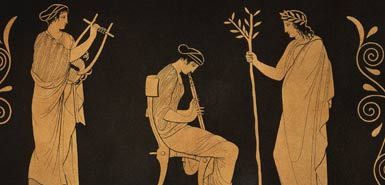
Red figure vase in British Museum from Classical Art Research Centre, University of Oxford, http://www.beazley.ox.ac.uk/tools/pottery/painters/keypieces/redfigure/meidias.htm
4) To a failed stoic – another passionate torrent of notes, this time based on Scriabin’s opus 11 C minor Prelude, of which, turned very definitely into C major, only the melodic shape remains. Other key references are to the theme of redemption in Wagner’s Ring and the interrupted cadence from the final , happy, movement of Mahler VII, whose key it shares. Structurally reminiscent of 1) – an A-A form – it is also a solar answer to (or aspiration for) 3). The two pieces share an interest with two adjacent notes at key moments, though used for different purposes. The failed stoic is fact a portrait of my friend Lawrence Razavi of whom I have fond memories not for his problematic research on genetics (long before genetics were fashionable) but for his passionate and humane engagement in art. The piece is counterposed by….
5) To the infernal powers / Defixio. A defixio was for the ancient Romans a lead tablet on which a curse was inscribed before being thrown into a sacred spring. I tried to create the sound of hellish water bubbling up from the underworld at midnight using chords I found originally in the funeral march from Prokofiev’s Romeo and Juliet; the melody by contrast is a dark parody of the main theme of Debussy’s sensuous waltz, La plus que lente, for of course this is a curse by a frustrated lover on a faithless or unobtainable beloved. The melodic line eventually gets trapped within the devil’s interval – the tritone – and the curse comes true, with terrifying consequences, even if it ends in B flat major. An A-B form.
Here are pieces 6-9 (9 minutes).

[/audio]
6) To a lady. In the nonchalent, carefree style of popular songs of the early twentieth century – Scott Joplin’s “The Entertainer” is nearby. The melodic line is, though, built up of a host of references to other music, from Stravinsky’s Firebird and Scriabin’s Sonata no 5 to Puccini’s Madama Butterfly. Another simple strophic form, this time centred on G major.

Red figure vase, from http://www.library.csi.cuny.edu/archives/siias/artifacts/project12.html
7) To a princess. A mirror of the first piece in its compositional technique and an echo of 5) in its sound world, this seeks to represent the nightmare of the princess smothered by bees. What the bees represent is suggested by how the piece is obsessively based on the first two bars of Wagner’s Tristan and Isolde (which becomes clear only towards the very end, when it is quoted in recognisable form). On the whole though the notes of Tristan are jammed together in extreme dissonance, the last chord comprising all the notes of the two bars played simultaneously in the bass (except for the previous pathetic rising 6th). There is also a passing and rather hopeless reference to the Falcon’s warning cry from Strauss’s Die Frau ohne Schatten – and a Messiaen-esque ornithological screetch towards the end still based on the Tristan semitone cluster. A-B-A. Atonal with hints of F minor.
8) To a braggart soldier. A mirror of the second (and again in E flat), but even more empty of content, whose main melodic line is built on a simple descending scale. There is mock-military version of Wagner’s Siegfried which even falls short in its final phrase (a rising 5th instead of a 6th), some Beethoven III shoehorned into march tempo, a moment from the apocalyptic 4th movement of Mahler VI, and lots of gesture without content on one note – the musical equivalent of hot air or a military side drum – that eventually peters out because it has nowhere to go. A-B-A but something of a mess in its determination to aurally manspread.

from http://www.metmuseum.org/toah/works-of-art/56.171.38
9) To a philosopher 2. The Siegfried-derived theme is taken up again (but now quietly in A minor – as far as possible from the soldier), in a style distantly recalling the Poulenc of “L’aube” from Les animaux modeles and Parsifal). The opening chords from the second movement of Dvorak’s New World Symphony move the piece into the atonal B section and quotations from Berg – the Lulu Erdgeist motiv and “Wir arme Leute” (“We poor people”) from Wozzeck. The climax cadence is a version of the defixio chord. This resolves into the A section again, now more insistently repeated in a slow march (the soldier is not as Other as the philosopher thinks). The A-B dialectic is repeated until the New World chords eventually break free into the coda, a tiny syncopated dance that soon ends back with the New World chords calling for new ways of thinking — while at the same time recalling the devil’s tritone of the defixio. The chords fill out, eventually sounding simultaneously, clusters of the black notes of the piano beating rhythmically high up while all the white ones reverberate in the air after a double glissando from middle C simultaneously up and down to cover the length of the keyboard.
And finally the encore (3 minutes).

[/audio]

a drunken, ecstatic reveller, from http://commons.wikimedia.org/wiki/File:Komast_Louvre_F125.jpg
This was my rather over-excited and not entirely accurate version of the famous Scriabin Etude opus 12 no 8 – except with even more notes tumbling over the keyboard than in the already full original. I always justified such excess to myself on the grounds that Scriabin used his piano scores as palimpsests for improvisation. My musically purist friends just thought all this sort of thing vulgar, and always made sure I knew it – so much for postmodern dissolution of aesthetic value in 1988. Now I think they were right.

Teaching, pasticceria, and the purposes of education.

What is university education?

What is university teaching? What is its purpose? What should it be?

If the questions have preoccupied many of us in the UK even before students started to be conceptualised as customers, they were recently brought back to me anew and with unusual clarity, as for the first time for some years I was privileged to teach, in an unfamiliar setting, students of a kind who had been through a very different education system from my students in the UK.

Over ten days in November I was lucky to teach six 2-hour sessions at the University of Macerata to 1st year undergraduates, and 1st year MA (“magistrale”) students in Languages in the Department of Humanities.

The sessions were divided equally between three longer courses, two on the nineteenth-century novel and one on modernist women’s poetry. Unlike in the UK, there are neither elaborate course booklets nor dedicated virtual learning environments such as Moodle   or Blackboard; rather there are basic directions to the students about what set the set texts are and what the general aims of the course are, as follows:

(1st year MA ) http://docenti.unimc.it/silvana.colella/courses/2014/13256 and http://docenti.unimc.it/marina.camboni/courses/2013/12192

1st year undergraduate http://docenti.unimc.it/silvana.colella/courses/2011/9153

Such elegant indications of course content give the teacher great flexibility and, importantly, the ability to keep absolutely up to date by changing research questions and incorporating new material as it emerges during the teaching year – which of course it will do, produced either by the teacher herself or by other academics. This also means it is easy to insert sessions such as mine even after the course has started.

Naturally, I tried to make connections between what I understood to be the focus of the extant courses and my own concerns and expertise, without risking overlap or duplication of material. Talking to the usual teachers of the courses was helpful. But at the same time, the sessions were (in theory at least) open to the public. The result was inevitably something of a mash-up, and had to offer something attractive. Hence the rather sensationalist titles.

1. IF IT DOESN’T HURT IT ISN’T REAL: REALISM, DICKENS, JOURNALISM

2. SEX AND THE CITY: VICTORIAN WOMEN, POWER, PERIODICALS AND SHOPPING

3. NEW WOMEN, NEW PUBLISHING? WOMEN AND PRINT CULTURE 1890-1914

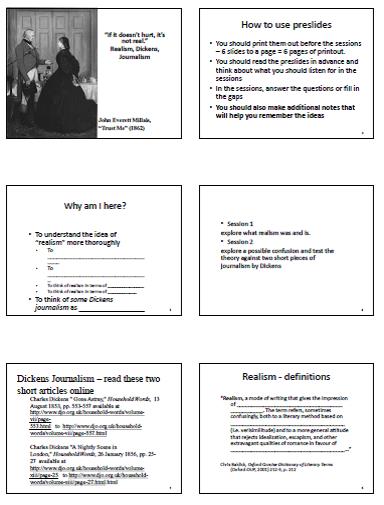
Example of page 1 of a “preslide”

The fact that the sessions were to be delivered in English to non-native speakers was another issue. I sought to deal with this by making available in advance what I called “preslides” in the “Teaching documents” section of my academia.edu site and /or on the usual professor’s university site: the usual prof informed the students orally in class that they should download the preslides and read them carefully along with the set texts, electronic copies of which I also provided. The preslides were designed to help students take notes. They comprised PDF versions of black and white PowerPoint slides stripped almost entirely of images, 6 slides to a page, and asked questions and provided quotations with gaps where key words should be. They were based on, but certainly not identical to, the much more elaborate PowerPoint slides I showed in class (these were also made available to students after the sessions, again in PDF, 6 slides to a page, on my academia.edu page).

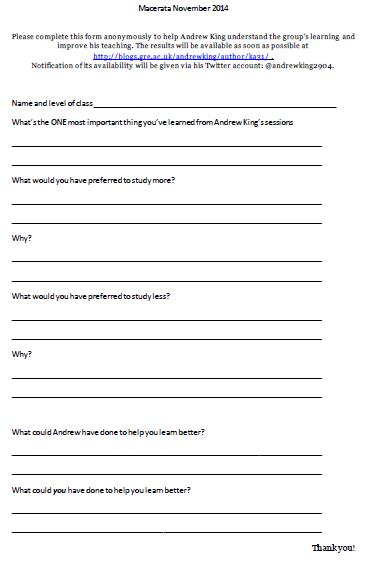
Since I knew the sessions would not be examined, there was no obvious way that I could properly test the effectiveness of my teaching of the class overall (I always think of exams as testing the teaching as much as the learning). As is my wont, I planned abundant interaction from which I would normally be able gauge a class’s understanding, but I also knew that Italian students were not used to this and would probably be shy. I therefore devised a questionnaire for the students to fill in at the end of my time with them (that is, at the end of the second of the two-hour sessions). Such questionnaires are of course always double edged; they not only inform the researcher of the results, but inform the person completing the questionnaire, in this case making the students reflect on what they really had got out of the sessions and how they could get more out of future ones.

I had 35 responses from the 1st year undergraduate class, and 22 from the first MA class, and 9 from the second (31 MA responses in total). It was quite wonderful to see the students take this questionnaire very seriously – it seems, from talking to them afterwards, that they are not used to doing this kind of thing, and that is why they spent so much time thinking about it, no matter how much I insisted it was not a test.

Of course one wants to find out what the students think of one – hence my immediate turn to the question of what I could have done better.  Almost of them were embarrassingly positive in their responses to “What could Andrew have done to help you learn better?”, especially the 1st years. “Involving” (= “coinvolgente”?) occurred in 8 of the 35 1st year responses (28%), “catch our attention” in 3 others, along with numerous generic positives.

“he was very involving, so he couldn’t have done anything more to help me learn better than this”

“it was a fantastic and involving lesson! The slides were useful and the explanation was clear”

“he was very involving and funny in his lesson”

There were just 4 suggestions for improved teaching: more on Dickens (x 2) and talk more slowly (x 2). I was delighted that only two students asked for the latter, as it meant that, for the vast majority, the care I had taken over oral delivery – speed, choice of Latinate vocabulary – had paid off.

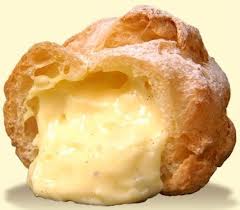
The MA students were slightly – but only slightly – less positive on the same question. 11 wrote “nothing” and there were in addition 13 superlatives. There were, however, 8 suggestions for how I could have improved: more history (x 1); more on the concept of satire (x 1) which in retrospect I agree would have very useful (thank you to whoever wrote this – excellent idea!); don’t wait for responses from the class but just give the answer (x 1 – sorry, but my pedagogic tradition wants you to think for yourselves, not be choux buns – beignets – which I stuff with crème Chantilly!). Two wanted more time to discuss the texts, one of these two sensibly suggesting that what turned out to be a 4 hour session be split over two days. One wanted more videos (we saw just one – a Youtube video of the controversial Royal Opera performance of Salome, with Nadja Michaels, naked executioner and very bloody head). I’m a bit sceptical of this given the time constraints and the purpose of the aim of the session, but I take much more seriously the remark of another that “he could have spent more time on some extracts we’ve quickly seen”. This was echoed by another who wanted to concentrate on fewer texts (and indeed by the one who wanted more time in general). For what I had forgotten was the sheer difficulty of nineteenth-century prose and poetry for second-language learners – not only its unfamiliar vocabulary and syntax, but also its cultural references. I was treating them like UK MA students and that was very unfair of me. I really should have put myself in their shoes (as opposed to choux).

What’s the ONE most important thing you’ve learned from Andrew King’s sessions?

“That learning literature is not about studying in books but getting into the text and asking yourself questions and trying to give answers”
“I hadn’t thought it possible to find advertising language in literary works”
“There’s no limit to desire”
“Realism is a contract between author and reader which demands trust”
“Realism is still dominant in Britain today”

The biggest surprise to me, though, was the variety of the responses to the first two questions. Of the 35 1st year responses to the first question “What’s the ONE most important thing you’ve learned,” 28 wrote something about realism (6 were very specific on realism as a contract between reader and text; while 7 more were also specific in a variety of ways; the remainder more generic – e.g. “I’ve learned better realism in a more specific way”). The real delights lay in the 7 alternative responses, two of which are cited above; two others showed a delight in semiotic theory and in the problem of refusing value judgements in literary discussion. A great deal of variety was evinced in the responses to the second question, that concerning what students wanted more of (these don’t add up to 35 as not everyone wrote something – 10 wrote “nothing” while others left a blank; a very few wrote more than one thing). It’s easier to present the results in tabular form:

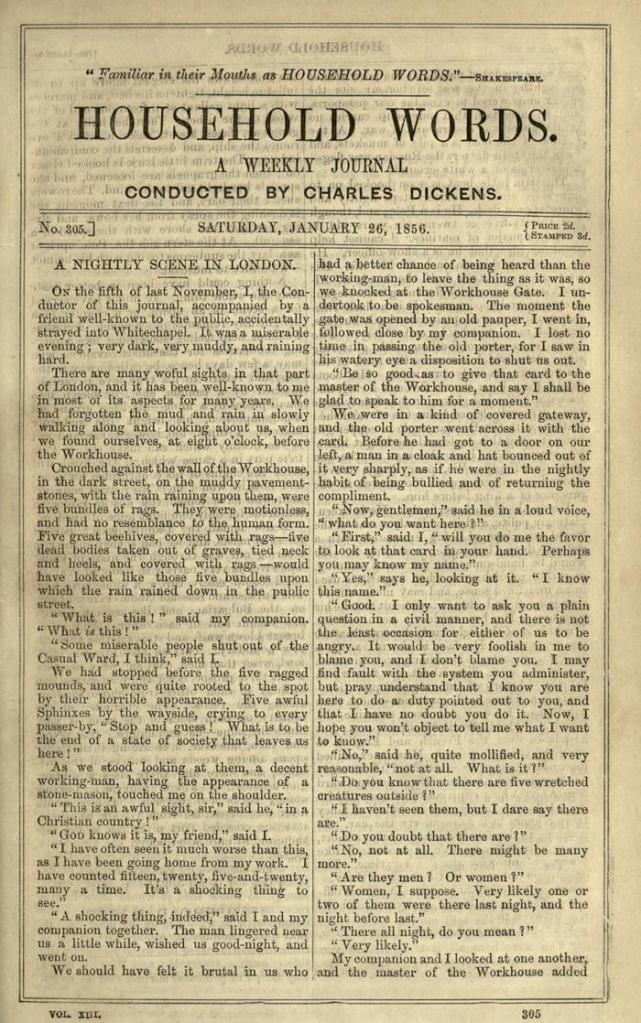
Household Words
  • Dickens (x 6);
  • historical context of various types (x 6);
  • Victorian art (x 4);
  • literary context (x 3);
  • realism and crime (x 1);
  • theory (x 1);
  • effects of journalism and literature on lower classes (x 1);
  • realism (! x 1);
  • comparison of British realism with Italian verismo (x 1);
  • close reading (x 1)
  • There’s no pleasing a class completely of course. For in response to the question about what the students wanted to study less and why, 9 of the First Years didn’t want Dickens at all as they thought him “boring”; 5 found the theory of realism too hard; 1 wanted less history and 1 didn’t see the relevance of looking at the details of Victorian art. The rest said “nothing” or similar, or left the question blank.

    Rather than look at Dickens journalism then, I should perhaps have looked at some short and simple contemporary newspaper articles, perhaps culled from the British Newspaper Archive. I should certainly have omitted the part of the lecture most interesting to me, the part concerning semiotic theory and realism’s aspirations faithfully to represent the world. Yet the students were perhaps right: I wonder now if that part is just me being clever, playing a kind of cadenza, with surprising trills and scales and leaps over the intellectual keyboard. It may be ingenious and of course it IS thematically integrated  – but removing it won’t weaken the overall argument. The students helped me realise that while it is integrated it is not integral. I shall accordingly drop that section in future.

    Thank you 1st years at Macerata!

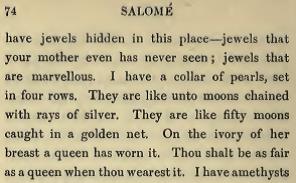
    Herod seeks to persuade Salome of the value of his pearls, using techniques derived from contemporary advertising

    Although less effusive in their praise, the 31 MA students also wished to change less: 5 said they wanted less history, 1 wanted less on women in print. This ties in with students’ desire to focus more on the texts (though on individual questionnaires there was not necessarily a correspondence). In short, I concluded that the MA students wanted help with reading strategies. I don’t think it was just a question of not understanding syntax and lexis but of interpretative frameworks and how to test these frameworks against specific texts through close reading. I sought to remedy this in the last session with the MA students, in which I offered a framework and pretty rigorously tried to apply it to texts and historical data. Explicit feedback from 5 of the 9 students in this session suggested that that worked, but of course there is a severe limit on what it is possible to teach in such a short time. Any significant development of reading strategies requires, I think, at least 20 hours of contact time.

    While I am a great believer that questionnaires which indirectly ask students to reflect on their learning have great pedagogic value, perhaps the most valuable of all is the last question: “What could you have done to help you learn better”? The undergraduate class was actually delightfully talkative and responsive, but still 7 wrote that they could have been less shy and talked more. No fewer than 19 confessed that they should have prepared in advance(about 55%) , including printing out the preslides; 10 wrote that they should have paid more attention, including two who said they should have slept the night before and 1 who, with charming candour, admitted that she should have turned off her iphone and not read messages from friends! The MA students were much more tentative and perhaps alarmed by this question: in the first, larger, of the MA classes, a slightly smaller proportion (50%) said they should have prepared for the class, but a larger proportion (25% as opposed to 20%) said they should have talked more in class. One said that the texts couldn’t be unzipped and another said that s/he should have come to both sessions, not just the second. In the second MA class, of the 9 students, no fewer than 8 said they should have come prepared; no-one said they should have talked more as in fact the smaller group did encourage more interaction.

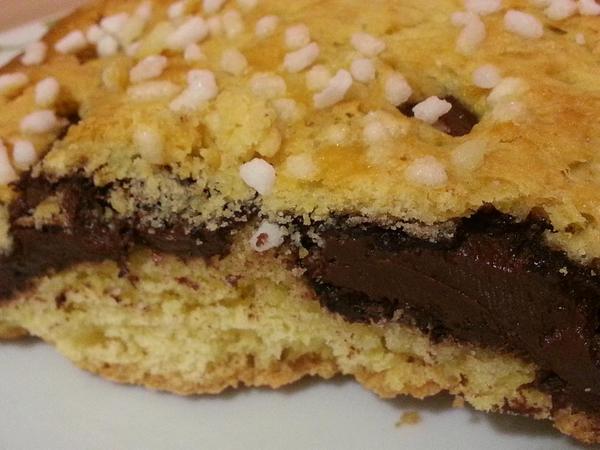
    crostata di castagne (chestnut tart)

    What wasn’t captured by the questionnaire, but which I think very important indeed, was the pleasure I felt as a teacher of such socially skilled and charming students. There was a great deal of social stroking of the teacher. From my shoes, this is a great danger, whose nature is visible in the apparent difficulty students had in arriving at conclusions based on evidence independently of the teacher. I found at times compelled to make ridiculous statements to try to get the students to contradict me, even to the point of confusing the gender of the people they saw on the screen. It was hard to get them to dare to draw their own conclusions without a clear guide from me! This was especially notable amongst the larger MA group, who seemed to have been very thoroughly socialised into agreeing with what they perceive to be authority at the expense of evidence.

    This certainly does NOT occur only in Italy: the rather exasperated account of an American university teacher here shows that. But I do think that it Italy it is performed with an unusual charm and subtlety. Perhaps it is even connected with the form the students’ self-criticism took (I am interpreting “I should have talked more/ prepared better ” as what they thought I as authority figure wanted them to do). It may also be connected with a short but significant discussion with the first years on the differences between the breakfast news shows on television in Italy and the UK, 1Mattina on RAI1 and its UK equivalent, BBC Breakfast. While we agreed that both involved evidence-based reasoning and the maintenance of human relations and, importantly, of social hierarchy, the balance seemed to be in favour of the latter in Italy. In other words, hierarchy determines knowledge more than disinterested reasoning. This leads me on to a speculation about the different social functions of education in Italy and the UK.

    Does the teacher in Italy perform less the part of a model of how to draw conclusions from evidence than that of a master patissier who creates and fills beignets and other delightful pastries? An important role that of the pastry chef. I’m a great fan of beignets as well as crostate and ciambelloni maceratesi – but I do worry about how delightful it is to consume them. My concern is not with my waistline in this context. Rather, if students treat themselves as beignets that teachers fill or bake, my worry is who will use them up, and for what end? Do students perhaps need to be taught to be more rebarbative, less consumable, more overtly and independently critical of authority, more self-moving, rather than taught to sit on a shelf oozing charm and creme Chantilly, resigned to their fate? Do students need careful and phased training in specific skills of independent problem identification and solving rather than stuffing with information?

    But then, putting myself in their shoes, I wonder if such a powerful focus on distanced, rational problem-solving is really a life-skill that is, or will be, useful for students in their cultural context which is very different from mine? Am I fetishising problem-solving too absolutely, too glibly? Perhaps in the lived experience of their day-to-day lives, social skills of a very particular kind are more necessary — charming consumability to ensure cooperation and loyalty from authority and colleagues, and resignation in the face of opposition to one’s needs and demands.

    Is, after all, the best Italian translation of “education” perhaps not what the dictionaries tell us — istruzione or formazione? Maybe, even though we learnt it long ago as a “false friend” meaning “politeness,” it is educazione ?  Is this what teaching as pasticceria would mean?

    That’s not for me to decide. I remain an outsider to Italy, still wearing my battered old British shoes, even while delighting in the many charms of Italian choux. It would be irresponsible of me to do other than raise such questions, not least because, alas, I have to confess that my pastry has always been on the heavy side. Though I’m a bit better at the picante.

    The Vicissitudes of Biography; or, how to welcome an Other

    Draft of a talk for the University of Macerata to a general audience at 11am on the 11th of November 2014. The elaborate PowerPoint, contrapuntal with and not duplicative of these words, can be found here, along with a spoken word recording of the presentation.

    frontispiece to Elizabeth Lee, Ouida: a Memoir (Methuen, 1914)
    opposite p. 89 in Elizabeth Lee, Ouida: a Memoir (Methuen, 1914)

    The Vicissitudes of Biography; or, how to welcome an Other

    Le vicissitudini del raccontare una vita; o come accogliere un Altro

    Almost everyone I meet asks me what I am doing in Macerata. To those in the street I give a simple linear answer: a guest of the new Collegio Matteo Ricci at the University, I’m finishing a biography of the nineteenth-century popular author Ouida,  planning a European networking project with colleagues here, and exchanging ideas about teaching and curriculum design (a reflection on which can be found here) .

    But I think you here, kind enough to host me in the University and to welcome me in this splendid nineteenth-century aula, deserve something more than that plain list. And it’s the relation of welcome and biography that I want to spend these few minutes thinking about with you.

    In 1908, shortly after Ouida had died in Viareggio after almost 40 years in Tuscany, a woman journalist from New York, a Miss Welch, wrote to an old soldier, now retired and staying in Viareggio, to ask if he could help her with information or letters about this woman author whose works sold by the million all over the world. He replied that, yes, he had known Ouida when he was in the military and, yes, he had renewed her acquaintance recently and exchanged a number of letters with her, and, yes, he would let Miss Welch see these letters. However, he warned, writing the life of Ouida would be very difficult. This wasn’t because of a paucity of information but because of the peculiar qualities the biographer of Ouida would require. Chief amongst these qualities would be what he thought was an already outmoded sense of chivalry towards the subject.

    In his next letter to Miss Welch he changed his mind: he wouldn’t let her see the letters after all. Knowing Ouida’s hatred of biographies and the publication of private lives in general, he wanted to respect her wishes. Though he doesn’t say this in so many words, it’s clear that he feared Miss Welch would not treat Ouida chivalrously.

    Miss Welch never wrote the biography.1st volume-length biography of Ouida: by Elizabeth Lee (Methuen, 1914) After the many, many obituaries of Ouida after her death on 25 January 1908, the first substantial volume-form biography was published in 1914 by Elizabeth Lee, the sister of the editor of the British Dictionary of National Biography.  This was followed by three more full-length biographies, the most recent of which appeared in 1957.

    But the old soldier’s warning still appertains 106 years after it was written. We might regard the term “chivalry” as problematically patronising today, but we can and should think about the moral issues of biography, of writing or telling a life.  To do that, I’m prompted here by something  we have learnt, through what I think of as “Mediterranean” theory, to call over the last 20 years hospitality but which we might well call “welcome” or accoglienza. I’m not going to explore the delightfully tortuous paths of Derrida’s thinking  on hospitality here, now, in this welcoming aula,  or the way it interacts in dialogue with his interlocutor Anne Dufourmantelle, but rather, inspired by his work, to think about the vicissitudes — the perils, pains and transformations — of writing a life.

    If we have learnt anything from Derrida, we know that there are many and contradictory ways to write — many ways to approach an Other. I can for example use the life of another to celebrate myself, to parade him or her like a jewel on a breast or on my cuffs or, demonstrating my ouida silver crestacquaintance with her as one of my possessions, to flash her as a claim to my status in a defined community. So, for example, I could write a biography merely to forward my career,  or to claim membership of a specific elite — let’s call them humanities academics — by using the life to promote a specific ideology, or to fulfill a publishing contract. I can do that efficiently, careless of the specific nature of the Other. We’ve all read biographies like that.

    We can also “welcome” the Other through biographical rituals, helping them cross the threshold in ways that long use has sanctioned. We can think of these rituals as conventions or characteristics of a genre. I have followed this ritual route myself, as in my chapter last year on the publishing history of Ouida:

    Marie Louise Ramé was born on 1 January 1839 to Susan Sutton and Louis Ramé in her maternal grandmother’s house, 1 Union Terrace, in the small provincial English market town of Bury St Edmund’s. Nominally a French teacher, her father was rarely en famille … 

    Andrew King, “Ouida 1839-1908: Quantity, Aesthetics, Politics” in Ouida and Victorian Popular Culture, ed. Jane Jordan and Andrew King, Ashgate, 2013: 13-36, p. 13.

    But those are both very egocentric welcomes, the first using lives as things, as exchangable commodities (a life in return for a measurable amount of status or pay), the second, ritualistic, incorporating the Other, or perhaps making the life fit our dimensions and rules as Procrustes stretched or chopped the bodies of his guests to make them fit his bed – the biographer as butcher indeed. To those extents, both are problematic. Neither truly welcomes the life of the Other.

    How then would we rightly welcome a life?

    First of all, it wouldn’t mean the exclusion of the previous parading of the Other I’ve just seemed to reject. How terrible if we were not proud to be seen in the company of the Other! It wouldn’t mean rejecting the Other as jewel, or even as exchangeable object in a social transaction, ideological or commercial. Neither would it mean a refusal of form, though one would hope it not Procrustean.  But it would mean, in addition to and in excess of those, recognising the Other as other — taking the trouble to find out how this person is different from me and from my social groups.

    In life, we can ask our guests what they need in ways direct or subtle – and guests can tell us even before we ask; in writing a life of the dead, in welcoming a stranger into our community from not only another place but another time, we cannot ask directly. They not only do not speak the same language as us, they do not speak at all, as Ouida well knew and feared — that was why she hated biography. But we needn’t give up in the face of her opposition. We must, to write a life, learn to read the signs of demand and desire without being able to ask, and without too much imposition. That in turn requires a plan and clear methodology that while organised and strategic, must seek to accommodate, to welcome, to be open to alterity and the unexpected. Without those one cannot expect to see Otherness.  And here lie the vicissitudes: the pains and the transformations.

    If these points are relevant to the writing of all lives and all welcomes we give, what are the specific requirements of Ouida’s? Apart from my own short accounts of Ouida of course (!) – the longest just 10, 000 words –  previous biographies have all been problematic.

    The best is the first, issued in 1914 by Elizabeth Lee. Since many of the players in Ouida’s life were still alive, both fear of libel and a sense of chivalry to the living as well as dead forced Lee to conceal a good deal. It also meant that she was unclear as to many of her sources, several of which are untraceable, and that she placed Ouida in her context only superficially. Nonetheless, we can see that within the limits of fear and chivalry, Lee did at least try to be responsible to her subject.

    The three subsequent major biographies are all, however, examples of treating the other as object—I’ll not name them here because I don’t want to give them the oxygen of publicity. They essentially treat her like this Punch cartoon from 1881.

    Punch 28 August 1881
    Punch 28 August 1881

    For them Ouida is nothing more than a figure of fun, a bag of bright feathers with no hat to put them on, all extravagance and no substance. The three biographies are very amusing and for that reason have been very influential from the Wikipedia entry on Ouida to the first monograph devoted to Ouida’s novels which came out in 2008. But they mistranscribe letters, misspell key names and alter evidence for comic effect just as the Punch cartoon does (Ouida never smoked for example).  For them Ouida remains a thing, an object of ridicule, a piece of meat, a way of extracting money by amusing audiences. There’s no chivalry and certainly no hospitable treatment of Ouida as a welcomed Other or, to use Derrida’s term in On Hospitality, a  foreigner (starniero, étranger).

    Like many of the best known women writers of the nineteenth-century, George Eliot and Mary Braddon for example, Ouida was not pretty or conventional. But unlike most of them, neither was she accommodating or charming. Nor did she have a man to help her transact business. She was very assertive, outspoken, as this quotation from the introduction to an 1888 Italian translation to some of her short stories shows.

    Si direbbe che Ouida è invasa dalla mania di proclamare ai quattro venti l’infamia di quella classe [mondana], di palesare che tutto, in essa, è fango, orpello, ignavia, ipocrisia, e che quanto havvi di più cretino ed ingiusto pullula in quelle alte sfere ove  … le tignuole rodono l’ermellino e il mondo bacia il lebbroso sulle due guancie.

    “Memini” « Appunti critici » in Affreschi ed altri racconti di Ouida, Milano: Treves, 1888: v-xix, p.xi.

    What “Memini” could have said, had s/he written 20 years later, was that Ouida refused to respect money, wrote tirelessly in favour of political individualism, animal rights, and the conservation of old buildings. She mercilessly denounced capitalism, militarism and masculine performance, told political leaders that terrorism was their own fault, complained bitterly that Italy had failed to live up to the ideals of the risorgimento, dared to give voice to the poor and exploited, and had a keen sense of the aesthetic, the creation and conservation of which she held up as a necessary moral alternative to the violences of war and greed. Anticipating Bhutan, she extolled gross national happiness over gross national product.

    She wrote the first known novel in which a divorced woman ends happily unmarried living with her lover – Moths curiously is the only novel of her 40 in Macerata libraries.  She wrote in both her published works and private letters of unorthodox sexual preferences and practices from male homosexuality to female masochism, and refused to condemn any except when lack of consent and discretion were involved. She solidified the term ‘New Woman‘ to describe the calls for women’s work, political and artistic representation in the 1890s.

    A liberal perhaps like the dominant norm amongst humanities academics in the west? She sounds like one of us.

    But then not: Ouida hated the New Woman for her hypocrisy in calling for a freedom that she thought would enslave others. Ouida was also anti-Semitic and often misogynistic. She hated doctors, medical intervention and scientific progress in general; she hated democracy as tending to a dull level of conformity. She championed instead an aristocracy of intellect and land – but only as long as both the landed and intellectual aristocrat was cultured, refined and responsible (rather like the hero in her last, unfinished, novel Helianthus).

    Ouida could never have been my friend. I disagree with her solutions to the problems she saw and indeed some of what she saw as problems. And she would have been hell to work with as a colleague. She remains very different from me.

    But that doesn’t mean I can’t listen to her carefully and try to understand this very other person, above all seeking the right questions to ask: what do you really need to be understood today, here, now? What do you really want? How can I encourage you to tell me so that I do not silence you with the violence either of my desires or of my parade, or cut you on the butcher’s bed of convention, ritual or ridicule? This attempt to listen through the static of the day for the voices and requirements of the dead, this attempt to become an Echo as opposed to a Narcissus — this certainly invites vicissitudes: misfortunes because the project is inevitably fraught, fated to imperfection and sacrifice on both sides, but also, I dare hope, vicissitudes in the sense of transformations both of the past and of the present, and hence a new path into the future.

    So what am I doing at Macerata? Besides writing bids with my esteemed colleagues here, teaching and exchanging ideas, trying to answer these difficult questions, variants of which, despite their vicissitudes, we all answer, consciously or not, every day, in our own ways.

    Cooking a PhD, 1997 style

    I’ve just discovered in an old file a jeu d’esprit I wrote for the British Council Family’s Association (BCFA) Magazine in 1997 while I was a PhD student studying in London and living in Warsaw. While it reads as quaintly old-fashioned now – the universe was very different 20 years ago – I know some colleagues will appreciate its mix of cooking and academic research. It even has a few footnotes. So…

    mrs beeton dessertsPART-TIME PuDding; or, advice from the kitschen

    a confection written over the Christmas festivities,

     over-indulgence in which may go some way to explaining it

    To follow up the controversial article that appeared some months ago on representational cooking, the following may be of interest to readers of the BCFA Magazine.

    Life is often difficult for a BC spouse who has had to give up career, family, friends and the local Sainsbury’s for the greater benefit of the Beloved Company, or even for the company of the beloved. One of the many ways this deprivation has been made bearable for me has been retraining in the rather drastic form of a PhD – pronounced “PuD” by some of those who know my culinary pretensions.

    Since 1994 I’ve been collecting ingredients and stirring them all up in the hope that a further degree will emerge towards the end of 1997. In other words I’ve been PuDding. I’ve had to do this part-time and by distance, living in Warsaw and studying in Birkbeck College, London. I can’t say my PuD has been an easy dish to cook so far, even with BC financial help with the fees. It’s not a Delia cooking-by-numbers, more a Jane Grigson where the quantities and ingredients have been blanked out, but the arcane references left in. Goodness knows the pleasures I have already savoured though – profoundly intellectual of course you understand.

    My research concerns popular Victorian culture. I’ve been reading best-sellers from the 1840s to 1880s, pouring over fashion illustrations from the 1860s, licking my lips at accounts of the Great Exhibition and Crimean War, and suddenly, after long, fruitless, and always cakeless, searching in libraries that smell like old dry toast, serendipitously lighting on the element that binds the sauce and gives unity to the dish…

    Mrs Beeton cold entrees
    Mrs Beeton cold entrees

    Mrs Beeton’s menus and my material may occasionally be on the heavy side but each has its own particular delights. Believe me. I’ve tried both. Sometimes simultaneously. But my research is actually more typical of post-modern present-day “New British” cooking than Mrs B’s huge repasts based mainly on local food-stuffs. Today we want freshly imported lemon-grass and star-fruit, not half a pig from the friendly farmer down the hill and a churn of cream from the dairy maid. Just as in Warsaw it’s impossible to get fresh lemon grass when most you need it [1], so it is impossible to get the materials for my research. My supervisor at Birkbeck seemed to realise this only too well at our first interview. In order to prove my commitment she demanded I return to London every 3 weeks to see her and collect fresh ingredients (or was it materials?). It took some persuading to cut this down to three times a year and the promise of written work twice as often. To effect this I went to the registrar and explained my situation. It was only by his being – shall we say – “sympathetic” that I was enabled to begin at all. Let this be a lesson to us. Go through admin. if you have problems enrolling in a course. These days university administrators want your money. Use their greed for your own reasons, just we cooks play on the greed of our guests for representational purposes!

    The London Journal Christmas issue 1858 - lots to eat and drink here
    The London Journal Christmas issue 1858 – lots to eat and drink here

    As for my materials, well, just as you can take dried lemon grass (a pallid simulacrum of the real thing) from Chiswick Sainsbury’s to Warsaw, so you can spend a fortune on blotchy photocopies (of non-copyright works) and on books. If you find that you need cardamom and not lemon-grass after all, you’ve got problems until you come to the UK next time. Of course, you can order that special ingredient from specialist firms[2], but it will almost certainly arrive after that particular dinner for the vice-rector. It’s not the predictable that catches you out but the inspired pinch of spice for that extraordinarily rich footnote you just know will make all the difference to the course (I seem to be getting a little mixed up between cooking and research here…).

    Several options face you when the empty space on the shelf catches in your throat. Firstly, suicide, like Vatel when the fish didn’t arrive. When you have been weaned off that by the thought of the smiling eyes and delicious lips of your beloved, as ready to consume your blanquette as comment on your latest chapter, you are left with less operatic possibilities: 2) make an entirely different dish/ chapter; 3) experiment with what you do have and hope you cook up something that will pass mustard; 4) substitute caraway for cardamom, George Eliot for George Lewes, and pray that everyone will have a cold and be unable to notice anything anyway.

    Option 4) is not advised. You may be able to count on the cold in Poland and the UK this winter, but not on colds. After all, guests / supervisors may have been in training before and for your offering, intent on bringing to your creation their critical faculties at the acutest pitch. Whether they have done this to catch you out, thinking you a rookie cookie, or because your reputation as a culinary Vivienne Westwood precedes you, is quite irrelevant. Option 4) remains a high-risk strategy. It is only advised when the subtly altered confection has been approved in advance by your most critical tester/taster, who should ideally be your beloved. S/he will no doubt recommend additions and subtractions, as is the duty of beloveds. In which case you will be following Option 3) anyway, not Option 4), and you should copyright your invention before someone else does. Remember the golden rule of culinary and academic hygiene: throw out what you are unsure of then copyright the rest!

    Probably the most effective cause of indigestion I have found though is not scarcity of ingredients, but the difference in tastes each culture has. Thai influence may have been a sign of a Refined Tongue amongst the London chattering classes two years ago, but it may still be a wally taste in Walbzych. What if everyone who comes to dinner from Krakow hates coconut milk – but you know you’re only practising on them for a slightly out-of-date supervisor who lives in Camden Square?

    There is only one answer. Bilocationism. You have to do what medieval saints found easy. You have to be in two places at once, the place of your research and the place where you live. You daren’t go positively Polish as the Taster/Tester who controls your life in London won’t like it; you can’t cut yourself off from your local culture and refuse to deride Derrida, as you risk isolation and alienation. You have to do the impossible: you have to become something of a cow, with two stomachs. But since you have to be a saint too, so you become a Holy Cow.mrs beeton cuts of beef

    This is the only way of dealing with the indigestion caused by PuDding.

    Not everyone finds sacred cowishness entirely to their liking. My beloved endures my beastly metamorphoses by perpetually looking forward to the new frock she will buy to wear at the presentation of my PuD to the world. And then dinner at the River Cafe in Hammersmith[3]. Poor dear! She deserves them after years of being force-fed Victorian best-sellers and spinach timbales. But will she still fit into a size 8?

    We mustn’t think of things like that or allow such thoughts to occur to our beloveds. Instead we must keep dangling the carrot (or preferably tarte tatin aux poires or papaya and vanilla bavarois rubané) in front of those sensory organs we ourselves have delicately attuned, whenever they demand the real PuDding before it’s done.

    After all, as I tell her, who cares about triple-decker doctorates at a time when edible chocolate body-paint has been the best-selling product on the British Christmas market? The proof of the PuDding must lie in the eating.

    Bon appetit for 1997!

    [1] Doesn’t Delia drive you nuts with her assumption that a super-Sainsbury’s is just down the road? For that reason the post-war books by Elizabeth David are more useful, as they give you alternatives if basil isn’t in the market when it’s colder there than in your freezer.

    [2] Dillon’s, Blackwell’s, or if you need out-of-print arts material, the London Library.

    [3] Recently voted the best Italian restaurant in the world.

    Reading the Olympics 3: the Discobolos Redivivus (1936)

    Olympia image
    Olympia image

    If the previous story of the American student was rather benign, I’m not so sure about Leni Riefenstahl’s quite marvellous 1938 film of the 1936 “Nazi Olympics”. It’s a film that has been claimed rightly as establishing the modern grammar and vocabulary of the moving imagery of sports: cameras were mounted beneath balloons, on rafts, in trenches, on rowing boats, under water  and under saddles to try to capture the kinaesthetic – indeed the kino-aesthetic, or movement aesthetic  – of the struggle towards perfection that governs the overall narrative of the film.

    The film opens with a trumpet fanfare calling out into darkness, followed by a short title sequence announcing that the film is a record of the 1936 Olympics. There ensues a long slow sequence of mists and stone over which the camera roves as if searching for something. Eventually the Acropolis is revealed , along with stone statues of Greek deities, male  and female, over which the camera slithers and slides in a langorous eroticism while the soundtrack offers slow chromatic harmonies and fragments of melody recalling the “degenerate” music (Entartete Musik) of, say, Schreker of the 1910s and 1920s.

    After 7 minutes the camera comes to rest on – of course – the discobolos, which Riefenstahl, a female Pygmalion,  brings to life in a gender inversion interesting to all students of late nineteenth- and twentieth-century gender.  This is the moment when Riefenstahl breathes into stone so that it becomes flesh, and simultaneously into photography so that it becomes cinematography – kinomatography. This is the moment when stillness becomes action, when Myron’s supposed dream of capturing movement is finally realised. We have had to wait 2500 years for this to be accomplished and it is a woman film director who has had the audacity and vision to do it. Simultaneously, the music shifts to diatonicism with a clear rhythmic pulse and melodic structure, and even at times an almost Orffian folksiness: we have arrived at a form of music which allows for “progression” from one key to another, of symphonic transformation and narrative.

    leni reifenstahl discobolos
    Leni Reifenstahl discobolos

    Riefenstahl was to use the human discobolos as the cover image of her 1937 book of stills from the  making of the film, reinforcing its iconicity as the symbol of the triumph of flesh over stone, of art over nature, of movement over stasis, of regeneration from degeneration.

    leni reifenstahl discobolos book cover
    leni reifenstahl discobolos book cover

    Reifenstahl is taking on the imagery of the early Olympic posters and celebrity photography, intensifying it, universalising it in the typifying spirit of classical Greece, reminding us of the pan-Greek “international games: note in this regard how the image is a perfect history painting, the figure naked, abstracted from setting and any social reality that can anchor it. If the implications of the very historically situated soundtrack belie this, the figure of the discobolos himself (itself?) was also highly politically charged.

    The Discobolus Palombara, the first copy of this famous sculpture to have been discovered, had been found in 1781 at the Villa Palombara in Rome. In 1937, the year of Reifenstahl’s book Schonheit im Olympischen Kampf, Hitler negotiated to buy it from the Italian state. He eventually succeeded in 1938, the year Olympia was released, when the Italian Minister of Foreign Affairs sold it to him for five million lire. The statue was only returned to Rome in 1948, the year of the first London Olympics. It was clearly on the political agenda for Hitler as a representation of Aryan perfection, and its return in 1948 was an acknowledgement of that which sought to set its ghost to rest.

    To return to the film. After the pygmalionisation of the statue, we are shown a sequence of naked or near naked athletes, male and female, as if the original models for the statues we have previously seen: Riefenstahl has turned the whole world of stone to flesh. The narrative continues now through time as a torch is lit in a ceremony invented for the Nazi Olympics, and it’s carried in relay from Olympia to Berlin. There can be no question in this film that it is Germany that has brought the Olympics to life again. The origin of the Olympic torch in Nazi Germany was hardly commented on in the Uk media before or during the 2012 London Olympics – but its televisual and cinematic potential that Riefenstahl invented was certainly exploited to the full.

    In some ways the film is historically accurate. It was the Germans who “found Olympia” just as it was German scholarship that vectored the ways the classics were understood in the nineteenth century. Germans had first properly excavated the site of Olympia after a half-hearted attempt by the French in 1829. That said, the modern Olympic Games had been international from the start. De Coubertin, the recognised founder of the modern games that we know, was inspired by the muscular Christianity of Arnold of Rugby – he wanted to learn from the English how to improve the French education system for men. And then we must remember the annual Olympic games of Wenlock Edge founded in 1850 by William Penny Brookes  to “promote the moral, physical and intellectual improvement of the inhabitants of the Town and neighbourhood of Wenlock”. De Coubertin certainly knew of these games and was in touch with Brookes.

    Riefenstahl deleted all that international history, sucking it out of the imagery. Instead she inscribed the games into a quite wonderful aesthetic narrative, a striving for perfection, a struggle for beauty – beauty in struggle (Schonheit im Kampf ) – that had, in its modern form, in a specifically German genealogy. Now Kampf (“struggle” or “battle”) is highlighted by Riefenstahl in her title. It is a term that recalls German romanticism, Nietzsche and, of course, Hitler.  There is much debate over whether the film conveys Nazi ideology. Whether it does or not overall remains to me uncertain, but there are certainly elements that are impossible to ignore (as in the imagery of the discobolos and the stress on Kampf). In the 2nd part of the film, though, there is an increasing tendency for the events to become a celebration of male physical perfection beyond any idea of nationality or race.

    There is a huge amount that can be said about this film, but I want to spend these last few minutes by pointing out not just its easily perceptible  Darwinian evolutionary narrative and its linkage to Nietzschean ideas of the ubermensch – both utterly predictable – but a faith in transcendence of the body through technology that again has its roots in German romanticism – above all in music with its emphasis on the modern technology of sound to create sublime effects. It is modern technology that enables the transformation of stone into flesh, stasis into kinesis.

    First let’s consider the opening sequences of the 2nd part of the film,  (“Festival of Beauty”) set in the Olympic village. After an establishing shot, we move from plants to slime on water and then through a series of animals increasing in size and strength until we meet a herd of Aryan men training in the woods and cavorting in the sauna and in the woodland  pool – Aryan men swim quite happily in nature: they are casual masters of it while being part of it (a notorious trope we are familiar with from Heidegger). We then see a series of shots of men from other countries which, intercut with shots of animals, more than risks racism. Clearly we have witnessed an evolutionary progression that mirrors the inspiration of stone to flesh in the first part of the film, along with a visual representation of the risks that degeneration back into less evolved nature may remain with us.

    Olympia diver
    Olympia diver

    This evolutionary narrative is halted for most of the film but is meant to register for the next hour or so, casting the Olympics as an evolutionary struggle for existence. It returns and  comes to a climax in the famous diving sequence (1.20.00 onwards here — or here separated from rest of film).  The soundtrack now seems to recast in serious vein the hilariously camp waltz of the superman in Richard Strauss’s ironic symphonic commentary on Nietszche’s Also Sprach Zarathustra. In combination with Riefenstahl’s dazzling visual editing it makes men fly.

    We have arrived, at the end of the film, to the divine Ubermench, a condition to which all participants in the Games strive. Here, as indeed elsewhere in the second part of the film, the competitors are stripped of nationality and indeed of individuality as they return to the abstract forms of the gods that Riefenstahl had started with. Flesh is now rendered sublime, borne by air not earth.

    Olympia end
    Olympia end

    In the epilogue that succeeds the sky divers (1.25.00 here), Riefenstahl will progress beyond the earthy mists and the stones, the ruins of classical antiquity, beyond the materiality of nations and of the human body, beyond even the clouds as (1.27.27) national flags will bow down to the pure light of technology. Is the sun shining down or are the searchlights shining up? Either and both: the Light is one. Reifenstahl will fling us beyond the body to the utopia of the machine, to a beyond where in fact it’s the German cinema with its powers of light projection and light play – precisely, Lichtspiel – and manipulation of the image that is in absolute control. Even the human voice will have ceased in the Valhalla-like soundtrack so that the technology of German musical instruments will lead us upward and on (zieht uns hinan as the final words of Goethe’s Faust puts it), just as in the perorations of Beethoven 9 or Wagner’s Ring , or – banned though this music might have been by the Nazis – of Mahler 2 or 8, where instruments alone, musical machinery, propel us into the technological sublime.

    No longer throwing a discus into an uncertain future – how far and where will it go? – here Germany, the destination of the Olympic flame, now extinguished,  projects light and sound so far that it seems to receive it. Project, reject come to have no meaning in the final scenes of the film: space and time dissolve and become one, as in the land of the grail in Wagner’s Parsifal (cf. Wolfgang Wagner’s comments on the setting of Parsifal). Sublimity and aesthetic deconstruction avant la lettre rewrite classical antiquity to empty the aesthetic object of specificity, an aim quite in line with traditional art historical understandings.  All this through the wondrous technology and art of Germany – and a woman Pygmalion.

    And isn’t it through the lens of the technological sublime that the games are presented to us today as mediated spectacle? Spectacles come in many forms, but isn’t the dominant visual image we are presented with that of  heroic and mainly masculine sublimity? Of course women are prominent too now, but there is little doubt about the sex that remains in charge. This is not subtext but the text itself. This is why the discobolos seemed so very right at the outset.

    Perhaps, though, instead of Myron’s discobolus,  this photograph of Riefenstahl directing her visual technology of sublimity might be an alternative image to underwrite the Olympics, lending a poster for a study day on the Games a genealogy less “pure”, less masculinist — and more obviously troubling.

    Leni Riefstahl directing
    Leni Riefenstahl directing


    Reading the Olympics: the Discobolos 1

    Reading the Olympics Study Day programme
    Reading the Olympics Study Day programme

    The following trio of blogs comprises the opening plenary  given at the Reading the Olympics Study Day at the University of Greenwich 7 June 2012.  

     It is a great pleasure and honour to have been invited to speak before you all at Greenwich: it’s the first time I have had the opportunity of doing so since starting 5 weeks ago. Even though this kind of cultural history is hardly my core area of research, I want to seize the opportunity to explore some very basic issues that the title of the event and the programme itself raise about how we study and represent history and gender.

    The text I want to think about is the flyer before you of this very study day itself: “Reading the Olympics”. Trained to be attentive to the paratextual as much as to words, I looked at this flyer and wondered at its quite literal subtext – the image the day’s organisers chose to placed beneath the words, THE image of the Olympics. Why did this image seem so right to me? What affiliations or genealogy does it suggest that make it seem an obvious image to underlie the programme? What is being rewritten or written out (in every sense) so as to make it seem right?

    It is of course the discobolos (or diskobolos or discobolus) of Myron which I recognised from my classical past. What did I know of this statue? What did I know of its association with the Olympics?

    Myron's Discobolus
    Myron’s Discobolos

    The original Greek statue, supposedly by the sculptor Myron, dated from some time around 450-460BC. We know it mainly from a marble Roman copy found in Italy in the eighteenth century; smaller bronze copies have also turned up. It’s famous for having solved a problem in sculpture that the exhibition that opens tonight in the Stephen Lawrence Gallery also addresses (“The Present is a Moment just Passed“). For the statue captures movement through time even while it is, being a  statue, arrested in time. The thrower is about to launch the discus off into an uncertain future.  How far will it go? Where? What will this projection into futurity mean? Victory? Loss? Something else again? And then, who is this man? His nakedness abstracts him from society: we cannot place him other than to say he was almost certainly a Greek free man, not a slave, as only Greek-speaking free men could participate in the Olympic games. He has no name, no individuality. Typically classical, the statue aspires to the type, the idea, not the individual likeness.

    But then, I want to ask, how much has this image to do with the ancient Olympics?  Discus throwing was, it is true, one of the five parts of the ancient Pentathlon (discus, javelin throwing, jumping,  wrestling, running). But it was just one of them and, furthermore, it was practised everywhere in the palaestra as part of a general gymnastic training. There’s nothing about discus throwing  per se which is Olympian.

    Yet here we find discus throwing on the official posters for the 1920 and 1948 Olympic games (the latter more specifically Myron’s).

    1920 Olympics1948 Olympics

    Was a copy of Myron’s statue perhaps found in Olympia to validate our association of the statue with the Games?

    Well, no. All the copies of the Discobolos I know about have been found in Italy: it does not seem to be connected to Olympia it all.


    Only two statues were dug up when the Prussian Ernst Curtius excavated Olympia between 1875 and 1881: a winged Victory and the so called “Hermes of Praxiteles” in which the god holds the baby Dionysos. Despite Hermes’ typically perfect body, this statue is hardly a model of the competitive athletic. The original Olympic games were held in honour of the king of the gods, Zeus, and there is a clear connection of this statue to Zeus. Dionysos’s mother was consumed when her lover Zeus revealed himself to her. Zeus saved the unborn child inside her and gave it to Hermes to take to the nymphs to be nursed and brought  up. Here Hermes has paused on his flight to amuse the infant Dionysos with a charm in his right  hand – now missing.  From the direction of this photo Hermes looks serious, but when seen from the left his face is sad, when from the right, smiling.

    The Hermes of PraxitelesWhy don’t we use this emotionally complex image of surrogate fatherhood as an image for the Olympics? Perhaps because while Hermes’ body is perfect, the statue is hardly a marker of competitive individualism or struggle  that the Olympic Games seem to valorise above all else.

    What’s at stake, then, in using as the icon of international sporting competition a Roman copy of an emotionally blank athlete? I leave that for yourselves to ponder for the moment. What I will say is that the very idea of the discobolos and discus throwing as the embodiment of the Olympics started at the very first international Olympic Games in 1896. I’ll talk a bit about those first Games before going on to discuss briefly the most famous of all movies about the Olympics, Leni Riefenstahl’s amazing 1938 two-parter, Olympia, as a way of setting up and contrasting with the talk that will follow mine, a discussion of the 1948 London Olympics by our colleagues from History.

    Part 2 is here.