My tenure as full-time Professor of English at the University of Greenwich ends today (31 August 2025). Inevitably, I find myself reflecting on what the institution and I have given each other. What follows is a development of a LinkedIn post in July, on the day I handed in the keys to my office.
images of saints with books from Antonio di Ceraiolo, Predella con 9 santi martiri in the sala del Biscione, Cortona MAEC
The Necessary Distance from Distraction
There’s something about institutional life that can make you forget what you actually came to do: the endless small urgencies, the way certain personalities demand so much psychic space (and clock time), the tendency to measure yourself against metrics that don’t capture why the work matters. I spent more time than I’d like to remember caught up in dynamics that, in retrospect, were beside the point.
The sociologist Pierre Bourdieu’s concept of cultural fields illuminates this phenomenon. Academic institutions exist as contested spaces where symbolic capital is constantly negotiated through both overt competition and subtler forms of legitimation. My work on nineteenth-century periodicals has consistently revealed how media markets create similar dynamics of cultural positioning, where producers and consumers engage in complex strategies of distinction and accumulation between them and amongst themselves. The parallels between Victorian periodical production and contemporary academic practice become particularly stark when one experiences both as participant-observer.
But perhaps Bourdieu is not the only theoretical framework that need appertain. I have learnt a lot from thinking about non-capitalist economies, especially from Lewis Hyde’s reflections on “The Gift” and creative responses to the world, and from late Derrida. Indeed, I wonder if learning to notice where our attention is directed, and then to redirect it toward what actually nourishes us is a supplement or inadvertent gift that, if we have the energy and time for reflection, we can receive from corporate work under capitalism. Never interested in territory in ways that some hold close and fight with tooth and tongue and bloody nails for, at first I got upset and actively resisted. But gradually I learnt to become less reactive to those clashes of value that tear and scratch so painfully: competitive individualism versus collaborative community; fetishisation of impersonal quantification versus commitment to real human quality; abstract iron diktats versus the possibilities of vulnerable flesh; sometimes even individual rage and arrogance versus collective solutions – all manifestations of Bourdieusian competitiveness amongst perceived scarcity allied in its most extreme forms with less rational, even darker, factors and fears, shames and loves (for love isn’t always a good thing). The inadvertent gift is not indifference but distance.
Transforming Friction into Purpose
Reaction to such grating abrasion helped energise my determination to offer something new to the discipline and to sustain actively communities of ideas and practice whose people and ethos I genuinely believe in. The Victorian Popular Fiction Association (VPFA) exemplifies this commitment—a scholarly community that really does prioritise intellectual generosity over territorial defensiveness, collaborative inquiry over competitive accumulation, and welcome over exclusion, precisely in line with its commitment to questioning the violence of the canon and to broadening the syllabus.
The courage to commit to holding space for genuine collaboration and intellectual generosity; a renewed conviction that choosing to circulate rather than hoard energy, ideas, opportunities, joy, is not only its own reward but its investment; a clarified rather than just felt belief in the value of economic systems beyond and in addition to the extractive, quantitative and individually accumulative.
This conviction finds concrete expression in projects like BLT19, my digitisation initiative focused on nineteenth-century trade periodicals, to which PhD students, undergraduates and school pupils all contributed. Designed to demonstrate maximum social and academic value for minimal financial investment, and inspired in its conception by the Italian arte povera movement of the 1970s, it challenges the equation of monetary expenditure with scholarly worth. The project embodies a commitment to public access and pedagogical generosity, refusing to accept paywall restrictions as inevitable features of knowledge production.
And resilience, of course. As it turns out, resilience might be less about developing armour or invisibility and more about learning to distinguish signal from noise, turning away and tuning out so as to clear the space for creative joyful thinking without imposition but with clear and realistic acknowledgement of what we need to do to achieve what we really want. Again, not indifference but distance.
The Epistemological Stakes
This distinction between signal and noise carries methodological implications for humanities scholarship more broadly. My work at the intersection of literature, history, media studies and sociology has consistently emphasized unexpected areas of cultural exchange between popular and élite forms, across national and linguistic borders. Such interdisciplinary vision requires precisely the kind of attention management I have learned through institutional experience—the capacity to filter out disciplinary territoriality in favour of substantive intellectual engagement.
The challenge facing contemporary humanities research lies not in defending traditional boundaries but in developing new methods for understanding cultural transmission and transformation. Digital humanities methodologies, quantitative analysis, and data visualisation offer powerful tools for examining reception patterns and cultural circulation at scale. Yet these approaches remain underutilised in many corners of the academy, often due to the very institutional dynamics that privilege familiar over innovative methods, immediately profitable over speculative, the squeaky over the working wheel.
Beyond Extractive Models
It’s well known now that the contemporary university increasingly mirrors the extractive capitalism it ostensibly critiques. Faculty energy is harvested for administrative functions that do not seem to align with substantive educational or research goals. Scholarly labour is commodified through impact metrics that reduce intellectual complexity to quantifiable outputs and gamification. Student debt financing transforms education into a consumer transaction rather than a collaborative inquiry.
Yet within these constraints, alternative practices remain possible. My experience supervising five doctoral completions between 2020-2021, and my current set of six, demonstrates, I hope, how committed mentorship can embody non-extractive pedagogical relations. It’s not for me to claim this, but I hope each supervision relationship was and is based on intellectual generosity and conversation so as to prioritise student development over supervisor advancement, to create space for genuinely new thinking.
Methodological Implications
The experience of academic departure has clarified certain methodological commitments that have emerged from my research practice.
First, the importance of understanding cultural production as fundamentally collective rather than individualistic. My work 30 years ago on the London Journal revealed how seemingly individual authorial voices emerged from complex networks of editors, publishers, contributors, and readers. Contemporary academic authorship functions similarly, despite myths of solitary genius that persist in humanities culture. And today, that collaboration certainly includes AI which must, like all tools and collaborators, be treated respectfully yet critically.
Second, the necessity of attending to economic structures underlying cultural production. My chapter on periodical economics in the Routledge Handbook extended beyond publishers’ accounts to examine broader questions of cultural circulation and value creation, as does an as yet unpublished piece on the transnational economics of periodicals over the last two centuries. Such analysis is essential to my mind for understanding how knowledge production currently functions and how it might be transformed.
Third, the value of crossing geographical and linguistic boundaries in cultural analysis. My early experiences teaching in Italy, Romania and Poland, including leadership of the Crossing Cultures project that introduced gender, class, sexuality and ethnicity studies into Romanian secondary education (and which I’m still proud of for all its many faults – see here ), demonstrated how intellectual frameworks can translate across contexts while remaining attentive to and respectful of cultural specificity.
The Long View
Institutional departure offers a retrospective perspective unavailable during the urgency of daily academic life. Projects like the forthcoming Oxford Handbook to Victorian Popular Fictions represent collaborative achievements impossible within purely extractive models, and it is distance from such models that will more certainly enable its completion.
Such work requires sustained commitment to intellectual community over institutional advancement, to substantive inquiry over tactical positioning. It demands exactly the kind of attention management I have learned through institutional experience: the capacity to distinguish between genuine scholarly long-term priorities and temporary urgencies, between meaningful collaboration and performed collegiality.
The academy’s future depends on whether it can move beyond hasty, extractive models toward regenerative practices that nourish rather than deplete its participants. This transformation requires not just policy changes but fundamental shifts in how we understand scholarly value, institutional purpose, and intellectual community. It demands the courage to commit to genuine collaboration and intellectual generosity, qualities that institutional structures often discourage but which remain essential for meaningful educational and research practice. Above all, it needs the distance and careful attention to distinguish between a claim in a tick box and the realities of intellectual and social practice, and the affects and effects that dissonance and consonance between them can generate.
Gratitude itself functions as a form of intellectual practice. It requires sustained attention to what has been received rather than what has been withheld, to possibilities that have emerged rather than opportunities that have been foreclosed. Such attention, cultivated through the very institutional experiences that seemed to obstruct it, now becomes available for future scholarly and educational endeavours unconstrained by the particular dynamics of any single institutional context.
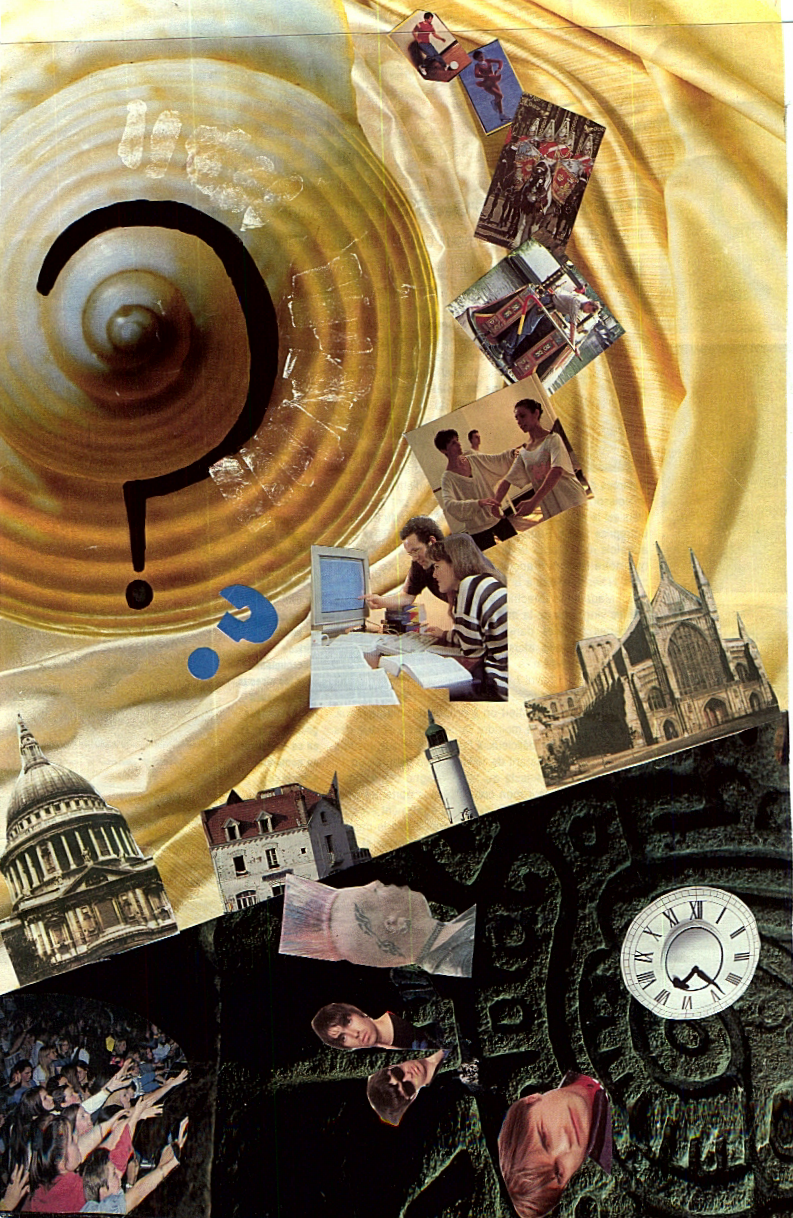
original cover for Crossing Cultures, a collage designed by a school pupil.
What follows is the Introduction to the Teachers’ Book of a British Cultural Studies textbook for 12th grade Romanian students in bilingual schools whose first edition came out in 1998: Crossing Cultures: British Cultural Studies for Romanian Students (Cavallioti Publishing & The British Council, Bucharest, Romania). ISBN 9739840094.
The Teachers Book as well as the Students’ Book were subsequently revised and reprinted several times, and formally adopted by the Romanian Ministry of Education as its official British Studies textbook for a decade.
I was commissioned to produce it by the British Council with the help of a wonderful team of Romanian teachers and academics from across Romania (in alphabetic order: Cornelia Bursuc, Adriana Cichirdan, Liminita Ganea, Zoe Ghita, Prof. Roxana Marinescu, Tunde Minulescu, Mirela Nasaudean), but the Introduction, together with the design and execution of the research project that underlay the textbook, were entirely mine.
A version of the Introduction was published as “Crossing cultures into the Reformă de Ĭnvăţământ Preuniversitar în România: autoritarism socio-politic into capacititaţi intelectuale superioare.” in Dascăl, Reghina, (ed.) Proceedings of the IATEFL-East 98 Conference, Constanţa, Romania, August 1998. Editura Eurobit Timişoara, pp. 257-266. ISBN 9789739441704. This is what is reproduced here. Many thanks to Reghina for allowing its reproduction.
I was supposed to produce a British Studies textbook for use in English-language ‘bilingual schools’ in which subjects were taught in Romanian + another language like English, French, German or Hungarian. But I redirected the project towards cross-cultural studies where Britain was treated as a mirror or Other that could be used by students to help think about their own socially constructed selves.
Crossing Cultures was actually the first textbook in Romania to introduce into Romanian schools the study of class, gender, race and sexuality at a time when homosexuality was still a prisonable offence and ethnic stereotyping was a state-sanctioned norm. It was – for Romanian schools – a very early exponent of critical thinking rather than rote learning.
Both of the places where it was originally published are now very hard to find (they aren’t digitised and the last reprint of Crossing Cultures was 2005). This is why I am posting this here, for reading it again after over 25 years – it was written before I’d even finished my PhD – I still stand by both its rigour and its pretty uncompromising ethical stance (fortunately the Ministry was open to both its stance and its rigour).
The topical references may be very dated, but the commitment to crossing cultures, whatever those cultures may be, remain fast.
Introduction Part 1: Crossing Cultures into the Reforma de Învăţământ Preuniversitar în România
The title of Part 1 of this Introduction may seem a little strange: Crossing Cultures into the Reforma de Învăţământ Preuniversitar în România. The title of a book on British Cultural Studies is transformed into a verb of motion, complete with object, by the simple addition of a preposition and a phrase. What does this mean? How does one “cross cultures into pre-university education reform in Romania”? Who is doing the crossing? How is the crossing to be done? What relation has the book to the Reforma de Învăţământ Preuniversitar în România [“Reform of Pre-University Education in Romania”]?
The following part of the Introduction will seek to answer these questions. It will do so by moving in three stages. First by linking a political with an educational system, then by looking at the idea of cognitive skills, and finally by looking at the implications for evaluation.
1. Autoritarism socio-politic into capacitaţi intelectuale superioare
The title of this first sub-section is perhaps as unexpected as the general heading to Part 1. Firstly, it is almost entirely in Romanian, when one would expect the Notes to a book on British Cultural Studies for Romanian teachers to be in English. Secondly, it sets up a dichotomy from two apparently unconnected fields: a term from political theory (autoritarism socio-politic) is opposed to a term from educational cognitive psychology (capacitaţi intelectuale superioare). Thirdly, one wonders what it has to do with the subject at hand, British Cultural Studies . In using such phrases Crossing Cultures is declaring at the outset that it is trying to live up to its name, crossing the linguistic border which separates English from Romanian. Immediately, it declares that the language which makes it is not a “pure”, but macaronic, impure, hybrid, a cross. It declares its double perspective, Romanian and non, both insider and outsider.
As for the dichotomy itself, it is only the context that may have caused surprised since you will have read of it before in the Plan-cadru [ master plan] drawn up by the Comisia Naţională de Reformă a Planurilor de Învăţământ. Under the rubric Disfuncţiile actualului plan we find the very first sentence:
Din punctul de vedere al filozofie educaţiei, planul actual de învăţămănt exprimă, în esenţă, un univers de valori şi de mentalităţi caracteristice unei culturi dominate de industrialism economic şi de autoritarism socio-politic.
The Plan-cadru goes on further to define the effects of autoritarism socio-politic on the present education system in Romania. Most of what it proposes concerns structural reform – the number of hours each subject is allotted and so forth, but it also stresses the need to reform the practice of teaching itself. There needs to be a move la placarea elevilor în centrul actului educativ, for example, and part of this transition towards student-centred teaching involves progressing beyond the inculcation of facts through memorisation. Instead of simply getting students to memorise and repeat knowledge, teachers need to ask students to do things with knowledge, thus developing what the Plan-cadru calls the “higher intellectual capacities” – capacitati intelectuale superioare.
Yet Crossing Cultures does not simply bow to the authority of the Plan-cadru. That would mean that it remained within what it is trying to get out of, the univers de valori şi de mentalităţi caracteristice unei culturi dominate de industrialism economic şi de autoritarism socio-politic. For the rest of this sub-section we shall compare first what a few other “authorities” say and then compare all this with our own research, thus following standard research practice of finding out what has been written before and then evaluating it against our own evidence.
I shall turn first to a non-Romanian academic visitor to this country. In a paper delivered at Iaşi in 1996 , the chair of ESSE (Professor Bonheim of the University of Cologne), pointed out that the research referred to [by Romanian academics] was almost without exception cited as authoritative rather than questionable; there was as good as no pitting of one scholar against another; and what is written is left unquestioned. He thought such treatment of sources was a “hangover” from the days of dictatorship when “ventilating opinions against the prevailing trend” was dangerous. The problem with such processes is that they leave Romania outside the West. As Bonheim says, such attitudes “might be said to … betray[ ] some elements of marginality”.
So far I have referred to comments from the Ministry of Education and from a foreign academic, and as a final type of “authority” before commenting on what our own research found, I shall refer to the work of a well-known Romanian academic, Prof. Lazăr Vlăsceanu. His chapter on education in the volume Social Policy: Romania in the European Context focuses on what he calls a “chronic quality crisis” in Romanian education. One of the aspects of this crisis is, again, how memorisation of facts are prioritised over what he terms “skills”. He observes, that from the point of view of injecting its pupils with information, the Romanian system is highly effective:
An illustration of this reality is the fact that an average Romanian pupil or student is highly competitive with his or her peers from any developed educational system, very often surpassing them. However, this same positive assertion cannot be made with regard to their abilities to be creative and to solve problems, particularly innovative ones. The Romanian pupil or student can reproduce a great deal but is less able to innovate. Educational policy and practice have required him or her to do nothing more than reproduce knowledge. In the short term, such a student may achieve very good results, but in the long term, he or she will lag behind because his or her skills or abilities for lifelong and innovative education, for acquiring specific learning modalities, will remain undeveloped (pp.302-3).
What all these “authorities” do is set up a dichotomy or binarism between what the ministry calls the “lower” and “higher intellectual capacities” with all the weight of respective values that “lower” and “higher” carry in the west. All connect the “lower” with dictatorial government and the latter, at the very least by strong implication, with democracy. All urge a cultural transition (which is after all the Latin word for “crossing”) from the first to the second, arguing that it is imperative for the Romanian education system to concentrate on the “higher intellectual capacities”. Otherwise Romania will become marginalised through the inability of its inhabitants to adapt to constant change, when such change is the essence of democratic capitalism.
What has this to do with Crossing Cultures, supposedly a book concerned with Britain and things British? The second part of this sub-section will seek to answer this in two ways. Initially, it will give an account of our research into both the teaching and learning of BCS in Romanian bilingual classes of English, then explain the dramatic effect of this research on the material that was piloted and what the book is now.
At the outset, we must say that our micro-research on both the teaching and learning of British Cultural Studies seems to confirm the diagnosis of the education system that we outlined above. In April and May 1998 we conducted a piloting of British Cultural Studies materials amongst 16 teachers of BCS and their students from all over Romania. We asked both teachers and students to fill in three different questionnaires each over this period, making a total of six different questionnaires, three for students and three for teachers. We got a very good response of 14 teachers and an average of about 50% of the estimated number of students in the teachers’ classes (380 replies for the first questionnaire down to 160 for the final one). We asked a large variety of questions, including what they associated with Britain, what their sources of information about Britain were, what they valued in those they considered their most important sources, what their priorities were in learning, and so on.
We found that school textbooks were the overwhelming formers of the image of Britain for these students, followed, at a distance, by British films on Romanian TV, Euronews, MTV and cinema. Of the 29% who said they listened to the World Service, more than 1 in 3 felt it to be key to their understanding of modern Britain. Their use of the media notwithstanding, students’ image-repertoire of Britain was resolutely conservative, “heritage” / historical (in fact, most students who thought they had studied BCS before 12th grade equated it with history). This implied strongly either that the media had little influence, or that the students were decoding cinema and TV along very different lines from how a British person would. Their knowledge was also that of a tourist, almost exclusively of London. Scotland and Scottish stereotypes comprised just 1% of total mentions, and Stonehenge achieved just over that. Northern Ireland was referred to by less than 0.5%, while Wales was mentioned (in passing) once in all of the 380 questionnaires that asked about this.
Stereotypes of the most banal kind overwhelmed any kind of critical awareness, forestalling any form of cultural crossing. Britain was associated with the monarchy and especially with Princess Diana who is thought of in connection with the UK as much as pop music (a recognisable trace of MTV!). But just as often the conventions of British weather recurred: fog and rain or a generalised “bad weather”. None of these were mentioned as often as Shakespeare, while other literary figures achieved just over half Shakespeare’s fame en masse. Most individual authors were referred to just once. The only twentieth-century authors mentioned were James Joyce and Dylan Thomas (one mention each).
Again despite MTV, the Queen and Diana, the gender-image of Britain was predominantly masculine: the historical, literary and musical figures connected with Britain were almost exclusively male (and dead and white).
It rapidly became clear that the vast majority of students, although all from the élite cadre, had an almost entirely non-scientific knowledge of Britain. Exactly as described in general terms above, we found in practice that students depended upon auctoritates (authoritative models) rather than on learning how to judge for themselves. This was particularly clear in students’ statements of what they thought constituted the value of sources. They were particularly concerned with the criterion of “completeness” (textbooks which they said were most important as sources were often cited as “complete”). Logically, this was connected to their model of how textbooks, the media and literature worked. This model offered connections between the sign and referent either in a simple transparent way – the sign was regarded as a window through which one saw an unproblematic and unproblematised reality – or it was idealist – that is, that the media and textbooks were revelatory of a supposed essence of “Britishness”. Only those students who had been to Britain gave any evidence at all of pragmatic learner autonomy: they alone stressed the importance of “seeing with [their] own eyes”.
What was even more surprising was the students’ cognitive dependence upon the Limba engleza textbooks for 11th and 12th grades: the opening of Bleak House for fog; Big Ben; Westminster Bridge and the Houses of Parliament on the cover; Francis Bacon; Keats; Byron; Shakespeare, of course; cathedrals… Students mentioned all these not once but many times. It is therefore no surprise that no British women writers were mentioned by the students (apart from a solitary mention of Jane Austen), since none appear in Limba engleza. There is no reference to women at all: the chronicle of events in Limba engleza (p.169) does not even mention the female franchise in 1918, the single biggest change in voting in British history . Likewise, there is no reference to the ethnic diversity which make up Britain’s most important urban areas.
At the same time we found virtually total confusion about anything to do with the capacitaţi intelectuale superioare. We checked and cross-checked students’ understanding of these in a variety of ways and found almost universal incoherence. It became clear, for example, that students did not understand what it means to decide whether evidence is relevant to the argument, or whether it is true or false (let alone to decide whether it is somewhere in between). Most said they wanted to learn how to do that, but they did not know what it meant. We found too that teachers stressed quite heavily the necessity for students to evaluate data, but at the same time they did not feel they had had much training in doing it themselves. But amongst teachers too there reigned some confusion over what capacitaţi intelectuale superioare comprised and how they could be taught.
It should not have been surprising then if teachers and students did not know what BCS actually was.
We already knew from previous reports that “Britain” had usually been taught to Romanian 12th graders in a mode which is often called “British Life and Institutions” (BLI). Sometimes this mode has been called British Cultural Studies and it is this, we feel, which has led to a great deal of the confusion. BLI is concerned with informing students of what institutions there are in Britain, and frequently with how they developed over the centuries (“institution” may be the monarchy, parliament, universities, the processes of law, family life, and many other things). It was not surprising therefore that students thought “British Cultural Studies” meant history of a certain sort. But more important than that, BLI assumes that its object of study is fixed and knowable: it’s enough to know for BLI the number of MPs in Parliament at any given time, for instance. If any “meaning” is attributed to that number at all, it will be formulated in terms of something vague and magical such as “the growth of democracy”. In other words, if institutions are given “meanings”, they are often freighted with an implicit fetishisation or abstract glorification: “Oxford and Cambridge are the best or most important universities”, or, to quote Limba engleza, “St Paul’s is a masterpiece in the foremost rank of the world’s buildings” (p.21).
While some people may well agree with or voice these opinions, they are after all opinions, not scripture. We are not saying that they are wrong, but that many people will disagree or be indifferent to such statements. BLI does not usually take differing views into account, preferring to assume a “purity of the object”. Accordingly, students can learn “simple truths” by heart – or simply copy them into their atestat papers.
Since we already knew this, our piloted materials tried to get away from BLI’s factory-like reproduction of the Gradgrindean fact . Instead they set up structures which enabled students to discuss issues we thought might interest them, all the while studiously avoiding giving much data input in order to keep Gradgrind out of the classroom. What we found, however, was that these materials did not encourage serious enquiry but rather a form of unstructured “chat” which was little more than EFL fluency practice. These materials did not seem to develop the higher intellectual capacities but rather promote facile anecdotes, not fertilise rational debate but give more life to the déjà connu.
Students and teachers were generous but at the same guarded in their welcome of these materials. They said they enjoyed using them, but…
This “but”, almost always politely hinted at rather than explicit, together with the inferred results of the piloting we mentioned above, caused an entire rethink of the project. We recognised we had taken a path that led only backwards. As a result, anyone involved in the piloting will recognise hardly a single activity that has remained the same. While certainly not BLI, the piloting materials encouraged too great an intellectual freedom. If we are justly harsh and honest with ourselves, we were encouraging a freedom without responsibility, or, in more colourful terms, we were promoting the freedom to be a couch-potato watching well-known cartoon images of Britain flutter unanalysed through semi-consciousness. Our approach did not, as we found, promote British Cultural Studies as a serious educational discipline. Our materials would not enable Romanian students to cross from the margins to the centre, but confine them on the outside with bonds of fatuity.
The methodology and discipline of British Cultural Studies which we hope is that of Crossing Cultures, fits into what the Comisia Naţională proposes, but at the same time is closely matched to the chalk-face reality we discovered pragmatically through our own research. Crossing Cultures thus combines the general imperatives of the ministry with an awareness of the concrete specifics of the subject as it is taught in Romanian bilingual classes today. The rest of this sub-section is devoted to describing some specific ways our research has affected the book.
Knowing that 86% teachers and 48% students have access to British magazines, several optional activities and one obligatory one make use of them .
Since 43% of teachers and 19% of students claim to have access to the internet, and of these 18% and 21% respectively already make use of it to find out about Britain, we sometimes suggest obtaining information from it (though never for obligatory activities). We provide a list of useful internet addresses at the end of the students’ book.
Given the students’ ignorance of British women writers, we include a class on gendering the Canon that takes as an example Christina Rossetti. Such practice of course also takes into account the Plan-cadru’s insistence on the principiu egalitaţii şanselor in giving women students the knowledge that people like them have made a contribution in a field outside the domestic sphere.
Since Diana and the monarchy are popular subjects we give students the opportunity to study them – but from unexpected angles.
Since students know a lot about London tourist sights, we offer no class on London, and approach England tangentially, beginning with the component of the UK that was mentioned least, Wales. Later there will be a class that takes Scotland as a case study for the analysis of national stereotypes and the notion of “founding myths” which have recently created a stir in Romania with the publication of Lucian Boia’s books. Northern Ireland, which was hardly mentioned at all in our survey, gets two classes and offers the opportunity to explore the importance of names and the concept of the “Other”. As for tourism, we do not confirm what students already know by offering a visit to the Tower of London, but we challenge their preconceptions by offering them the chance to study a rather well-known British tourist coming to Cluj and to Bistriţa.
We seek to counter the simplistic assumption that students must obtain a totalising encyclopaedic knowledge of a subject by breaking classes up into groups that study different and often contradictory aspects of the same thing.
Both students and teachers said they were keen on developing ethical skills, and we have given ample opportunity to do this in a profound way, taking ethics to mean not a series of behavioural imperatives and prohibitions, but as a process of relating to and constructing the world. Thus we devote a third of the core-course explicitly to the notion of what it means justly to represent the world.
Unlike the piloted materials, which were designed to allow teachers to create their own syllabus from material undifferentiated in level of difficulty, Crossing Cultures has become structurally developmental, starting from first principles and each class building on what has gone before, until at the end of the year students are in a position to combine and apply concepts in a freer way. Crossing Cultures thus places the emphasis on developing cognitive skills in what the Plan-cadru calls a coherent way.
It also fulfils the Plan-cadru by making inter- and trans-disciplinarity a feature: besides having classes on literature, it has classes on science as well, and even in one case on science and literature. It has been careful find out what students will have studied in earlier grades and to make reference to textbooks students may well possess at home and have used. Furthermore we refer to what they study in 12th grade philosophy and science and call on students to make active use of what they have learnt in those classes.
Crossing Cultures places students at the centre of the learning process by getting them actively to “discover” and debate knowledge, arrive at their own definitions, evaluate the validity of different points of view.
Like the earlier piloted materials, Crossing Cultures is primarily concerned with teaching the higher cognitive skills –the capacitaţi intelectuale superioare and not teaching facts to be replicated. But unlike the piloted materials, it starts at the base of the cognitive pyramid by offering a large amount of up-to-date “knowledge” for students to learn to manipulate. Note that when we write “a large amount of up-to-date knowledge” we do not mean that students need memorise huge amounts of material. On the contrary, knowledge can be given to the students so that they know it only for a short amount of time, or can see it in front of them to refer to. This is the purpose of the often long readings that we offer: they act as temporary banks of knowledge that students can draw on for the purposes of the class only.
Crossing Cultures is opposed to autoritarism socio-politic and the marginalisation that that has caused. Refusing to derive its existence merely from the negative virtue of opposition, however, and thereby fall into the pit of unstructured “chat”, it offers a third way: a positive and disciplined training intended to enable Romanian students confidently to move themselves not only to the centre, but to wherever they wish to go.
As we said at the beginning, Crossing Cultures is a verbal phrase, not just a static title. As such, Crossing Cultures translates the Reforma into the classroom.
What is university teaching? What is its purpose? What should it be?
If the questions have preoccupied many of us in the UK even before students started to be conceptualised as customers, they were recently brought back to me anew and with unusual clarity, as for the first time for some years I was privileged to teach, in an unfamiliar setting, students of a kind who had been through a very different education system from my students in the UK.
Over ten days in November I was lucky to teach six 2-hour sessions at the University of Macerata to 1st year undergraduates, and 1st year MA (“magistrale”) students in Languages in the Department of Humanities.
The sessions were divided equally between three longer courses, two on the nineteenth-century novel and one on modernist women’s poetry. Unlike in the UK, there are neither elaborate course booklets nor dedicated virtual learning environments such as Moodle or Blackboard; rather there are basic directions to the students about what set the set texts are and what the general aims of the course are, as follows:
Such elegant indications of course content give the teacher great flexibility and, importantly, the ability to keep absolutely up to date by changing research questions and incorporating new material as it emerges during the teaching year – which of course it will do, produced either by the teacher herself or by other academics. This also means it is easy to insert sessions such as mine even after the course has started.
Naturally, I tried to make connections between what I understood to be the focus of the extant courses and my own concerns and expertise, without risking overlap or duplication of material. Talking to the usual teachers of the courses was helpful. But at the same time, the sessions were (in theory at least) open to the public. The result was inevitably something of a mash-up, and had to offer something attractive. Hence the rather sensationalist titles.
1. IF IT DOESN’T HURT IT ISN’T REAL: REALISM, DICKENS, JOURNALISM
2. SEX AND THE CITY: VICTORIAN WOMEN, POWER, PERIODICALS AND SHOPPING
3. NEW WOMEN, NEW PUBLISHING? WOMEN AND PRINT CULTURE 1890-1914
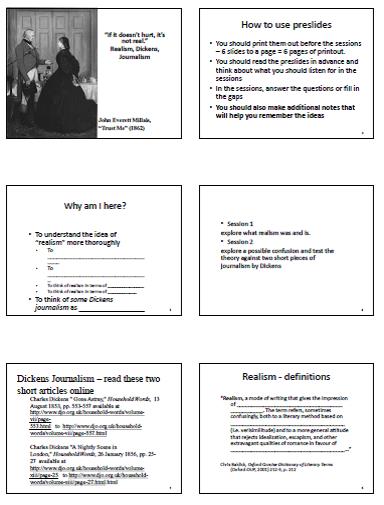
Example of page 1 of a “preslide”
The fact that the sessions were to be delivered in English to non-native speakers was another issue. I sought to deal with this by making available in advance what I called “preslides” in the “Teaching documents” section of my academia.edu site and /or on the usual professor’s university site: the usual prof informed the students orally in class that they should download the preslides and read them carefully along with the set texts, electronic copies of which I also provided. The preslides were designed to help students take notes. They comprised PDF versions of black and white PowerPoint slides stripped almost entirely of images, 6 slides to a page, and asked questions and provided quotations with gaps where key words should be. They were based on, but certainly not identical to, the much more elaborate PowerPoint slides I showed in class (these were also made available to students after the sessions, again in PDF, 6 slides to a page, on my academia.edu page).
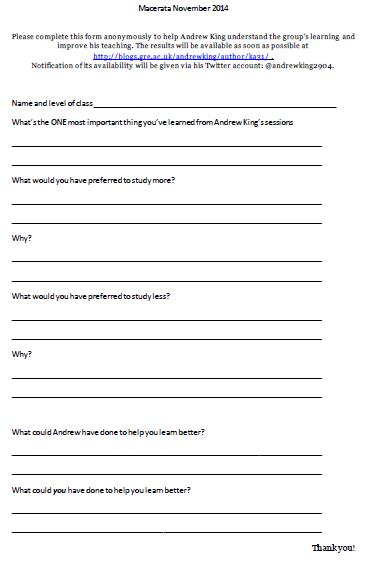
Since I knew the sessions would not be examined, there was no obvious way that I could properly test the effectiveness of my teaching of the class overall (I always think of exams as testing the teaching as much as the learning). As is my wont, I planned abundant interaction from which I would normally be able gauge a class’s understanding, but I also knew that Italian students were not used to this and would probably be shy. I therefore devised a questionnaire for the students to fill in at the end of my time with them (that is, at the end of the second of the two-hour sessions). Such questionnaires are of course always double edged; they not only inform the researcher of the results, but inform the person completing the questionnaire, in this case making the students reflect on what they really had got out of the sessions and how they could get more out of future ones.
I had 35 responses from the 1st year undergraduate class, and 22 from the first MA class, and 9 from the second (31 MA responses in total). It was quite wonderful to see the students take this questionnaire very seriously – it seems, from talking to them afterwards, that they are not used to doing this kind of thing, and that is why they spent so much time thinking about it, no matter how much I insisted it was not a test.
Of course one wants to find out what the students think of one – hence my immediate turn to the question of what I could have done better. Almost of them were embarrassingly positive in their responses to “What could Andrew have done to help you learn better?”, especially the 1st years. “Involving” (= “coinvolgente”?) occurred in 8 of the 35 1st year responses (28%), “catch our attention” in 3 others, along with numerous generic positives.
“he was very involving, so he couldn’t have done anything more to help me learn better than this”
“it was a fantastic and involving lesson! The slides were useful and the explanation was clear”
“he was very involving and funny in his lesson”
There were just 4 suggestions for improved teaching: more on Dickens (x 2) and talk more slowly (x 2). I was delighted that only two students asked for the latter, as it meant that, for the vast majority, the care I had taken over oral delivery – speed, choice of Latinate vocabulary – had paid off.
The MA students were slightly – but only slightly – less positive on the same question. 11 wrote “nothing” and there were in addition 13 superlatives. There were, however, 8 suggestions for how I could have improved: more history (x 1); more on the concept of satire (x 1) which in retrospect I agree would have very useful (thank you to whoever wrote this – excellent idea!); don’t wait for responses from the class but just give the answer (x 1 – sorry, but my pedagogic tradition wants you to think for yourselves, not be choux buns – beignets – which I stuff with crème Chantilly!). Two wanted more time to discuss the texts, one of these two sensibly suggesting that what turned out to be a 4 hour session be split over two days. One wanted more videos (we saw just one – a Youtube video of the controversial Royal Opera performance of Salome, with Nadja Michaels, naked executioner and very bloody head). I’m a bit sceptical of this given the time constraints and the purpose of the aim of the session, but I take much more seriously the remark of another that “he could have spent more time on some extracts we’ve quickly seen”. This was echoed by another who wanted to concentrate on fewer texts (and indeed by the one who wanted more time in general). For what I had forgotten was the sheer difficulty of nineteenth-century prose and poetry for second-language learners – not only its unfamiliar vocabulary and syntax, but also its cultural references. I was treating them like UK MA students and that was very unfair of me. I really should have put myself in their shoes (as opposed to choux).
What’s the ONE most important thing you’ve learned from Andrew King’s sessions?
“That learning literature is not about studying in books but getting into the text and asking yourself questions and trying to give answers”“I hadn’t thought it possible to find advertising language in literary works”“There’s no limit to desire”“Realism is a contract between author and reader which demands trust”“Realism is still dominant in Britain today”
The biggest surprise to me, though, was the variety of the responses to the first two questions. Of the 35 1st year responses to the first question “What’s the ONE most important thing you’ve learned,” 28 wrote something about realism (6 were very specific on realism as a contract between reader and text; while 7 more were also specific in a variety of ways; the remainder more generic – e.g. “I’ve learned better realism in a more specific way”). The real delights lay in the 7 alternative responses, two of which are cited above; two others showed a delight in semiotic theory and in the problem of refusing value judgements in literary discussion. A great deal of variety was evinced in the responses to the second question, that concerning what students wanted more of (these don’t add up to 35 as not everyone wrote something – 10 wrote “nothing” while others left a blank; a very few wrote more than one thing). It’s easier to present the results in tabular form:
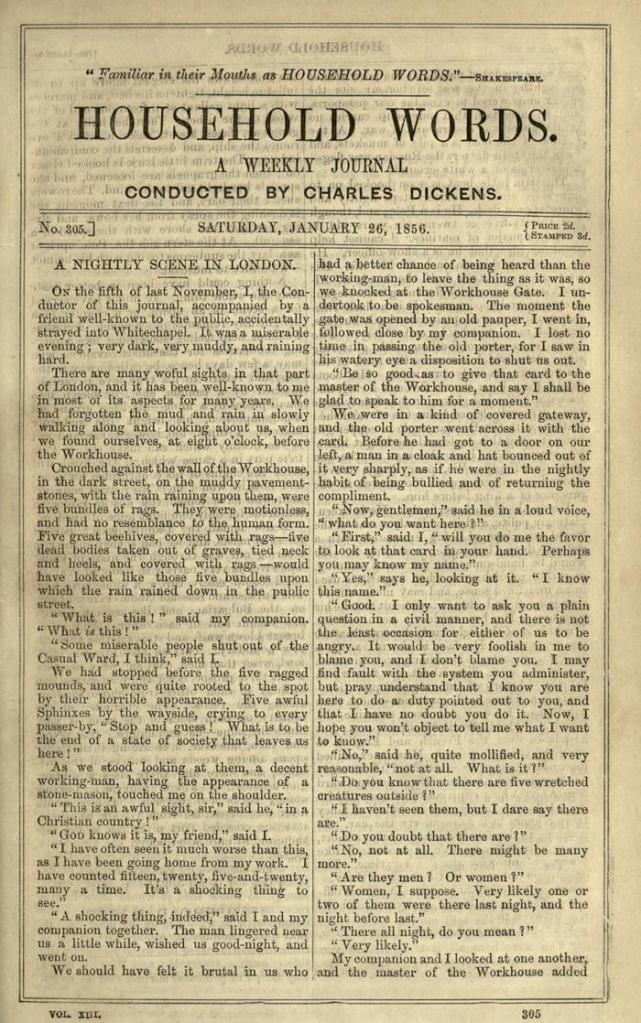
Household Words
Dickens (x 6);
historical context of various types (x 6);
Victorian art (x 4);
literary context (x 3);
realism and crime (x 1);
theory (x 1);
effects of journalism and literature on lower classes (x 1);
realism (! x 1);
comparison of British realism with Italian verismo (x 1);
close reading (x 1)
There’s no pleasing a class completely of course. For in response to the question about what the students wanted to study less and why, 9 of the First Years didn’t want Dickens at all as they thought him “boring”; 5 found the theory of realism too hard; 1 wanted less history and 1 didn’t see the relevance of looking at the details of Victorian art. The rest said “nothing” or similar, or left the question blank.
Rather than look at Dickens journalism then, I should perhaps have looked at some short and simple contemporary newspaper articles, perhaps culled from the British Newspaper Archive. I should certainly have omitted the part of the lecture most interesting to me, the part concerning semiotic theory and realism’s aspirations faithfully to represent the world. Yet the students were perhaps right: I wonder now if that part is just me being clever, playing a kind of cadenza, with surprising trills and scales and leaps over the intellectual keyboard. It may be ingenious and of course it IS thematically integrated – but removing it won’t weaken the overall argument. The students helped me realise that while it is integrated it is not integral. I shall accordingly drop that section in future.
Thank you 1st years at Macerata!
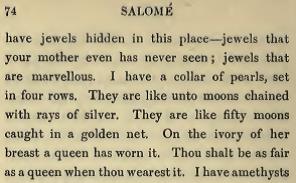
Herod seeks to persuade Salome of the value of his pearls, using techniques derived from contemporary advertising
Although less effusive in their praise, the 31 MA students also wished to change less: 5 said they wanted less history, 1 wanted less on women in print. This ties in with students’ desire to focus more on the texts (though on individual questionnaires there was not necessarily a correspondence). In short, I concluded that the MA students wanted help with readingstrategies. I don’t think it was just a question of not understanding syntax and lexis but of interpretative frameworks and how to test these frameworks against specific texts through close reading. I sought to remedy this in the last session with the MA students, in which I offered a framework and pretty rigorously tried to apply it to texts and historical data. Explicit feedback from 5 of the 9 students in this session suggested that that worked, but of course there is a severe limit on what it is possible to teach in such a short time. Any significant development of reading strategies requires, I think, at least 20 hours of contact time.
While I am a great believer that questionnaires which indirectly ask students to reflect on their learning have great pedagogic value, perhaps the most valuable of all is the last question: “What could youhave done to help you learn better”? The undergraduate class was actually delightfully talkative and responsive, but still 7 wrote that they could have been less shy and talked more. No fewer than 19 confessed that they should have prepared in advance(about 55%) , including printing out the preslides; 10 wrote that they should have paid more attention, including two who said they should have slept the night before and 1 who, with charming candour, admitted that she should have turned off her iphone and not read messages from friends! The MA students were much more tentative and perhaps alarmed by this question: in the first, larger, of the MA classes, a slightly smaller proportion (50%) said they should have prepared for the class, but a larger proportion (25% as opposed to 20%) said they should have talked more in class. One said that the texts couldn’t be unzipped and another said that s/he should have come to both sessions, not just the second. In the second MA class, of the 9 students, no fewer than 8 said they should have come prepared; no-one said they should have talked more as in fact the smaller group did encourage more interaction.
crostata di castagne (chestnut tart)
What wasn’t captured by the questionnaire, but which I think very important indeed, was the pleasure I felt as a teacher of such socially skilled and charming students. There was a great deal of social stroking of the teacher. From my shoes, this is a great danger, whose nature is visible in the apparent difficulty students had in arriving at conclusions based on evidence independently of the teacher. I found at times compelled to make ridiculous statements to try to get the students to contradict me, even to the point of confusing the gender of the people they saw on the screen. It was hard to get them to dare to draw their own conclusions without a clear guide from me! This was especially notable amongst the larger MA group, who seemed to have been very thoroughly socialised into agreeing with what they perceive to be authority at the expense of evidence.
This certainly does NOT occur only in Italy: the rather exasperated account of an American university teacher here shows that. But I do think that it Italy it is performed with an unusual charm and subtlety. Perhaps it is even connected with the form the students’ self-criticism took (I am interpreting “I should have talked more/ prepared better ” as what they thought I as authority figure wanted them to do). It may also be connected with a short but significant discussion with the first years on the differences between the breakfast news shows on television in Italy and the UK, 1Mattina on RAI1 and its UK equivalent, BBC Breakfast. While we agreed that both involved evidence-based reasoning and the maintenance of human relations and, importantly, of social hierarchy, the balance seemed to be in favour of the latter in Italy. In other words, hierarchy determines knowledge more than disinterested reasoning. This leads me on to a speculation about the different social functions of education in Italy and the UK.
Does the teacher in Italy perform less the part of a model of how to draw conclusions from evidence than that of a master patissier who creates and fills beignetsand other delightful pastries? An important role that of the pastry chef. I’m a great fan of beignets as well as crostate and ciambelloni maceratesi – but I do worry about how delightful it is to consume them. My concern is not with my waistline in this context. Rather, if students treat themselves as beignets that teachers fill or bake, my worry is who will use them up, and for what end? Do students perhaps need to be taught to be more rebarbative, less consumable, more overtly and independently critical of authority, more self-moving, rather than taught to sit on a shelf oozing charm and creme Chantilly, resigned to their fate? Do students need careful and phased training in specific skills of independent problem identification and solving rather than stuffing with information?
But then, putting myself in their shoes, I wonder if such a powerful focus on distanced, rational problem-solving is really a life-skill that is, or will be, useful for students in their cultural context which is very different from mine? Am I fetishising problem-solving too absolutely, too glibly? Perhaps in the lived experience of their day-to-day lives, social skills of a very particular kind are more necessary — charming consumability to ensure cooperation and loyalty from authority and colleagues, and resignation in the face of opposition to one’s needs and demands.
Is, after all, the best Italian translation of “education” perhaps not what the dictionaries tell us — istruzione or formazione? Maybe, even though we learnt it long ago as a “false friend” meaning “politeness,” it is educazione ? Is this what teaching as pasticceria would mean?
That’s not for me to decide. I remain an outsider to Italy, still wearing my battered old British shoes, even while delighting in the many charms of Italian choux. It would be irresponsible of me to do other than raise such questions, not least because, alas, I have to confess that my pastry has always been on the heavy side. Though I’m a bit better at the picante.











 Prof Andrew King