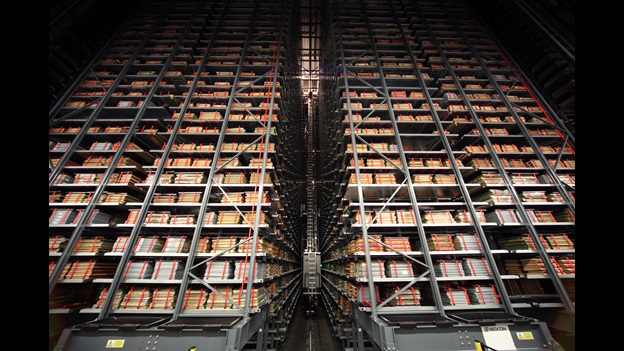
History of the Book in the Twentieth Century Part 2 : Technology, Ownership, Regulation, Distribution

In the previous blog I promised to cover 8 routes through which print history and the twentieth century could be connected. Here are the first 4.
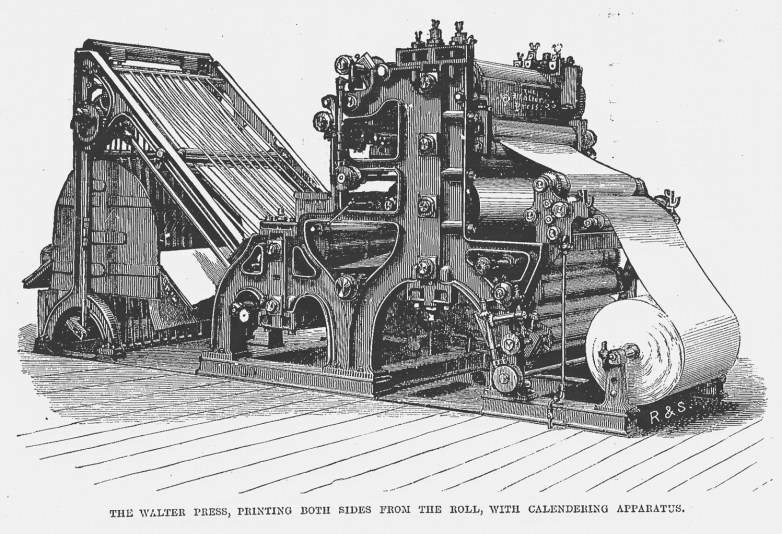
The Walter Press, adopted by The Times in 1866 (from Frank Leslie’s Magazine 1877 – and http://www.ndl.go.jp/exposition/e/data/R/614r.html)

First print technology, that which enables literature to transit from author to reader.

In the 1950s printing machines whose designs dated from the 1850s were still in general use. Yet paradoxically, printing technologies that in some ways are most characteristic of the twentieth century were first developed in the late nineteenth.

The two great revolutions in printing of the years between 1900 and 1950 were linotype and monotype. The Linotype machine was 1st installed on the New York Tribune in 1886; Monotype was invented 3 years later in 1889 but only commercially established in 1897.
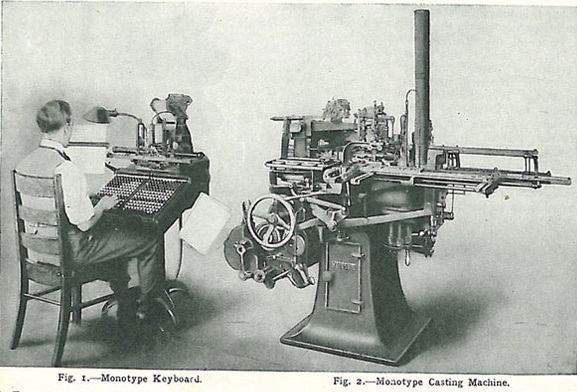
Perhaps you can see from the illustration how monotype employs a paper tape with holes in it as an intermediate storage and transmission technology between the keyboarding and typesetting. The idea derived from looms for weaving cloth interesting enough – the same technology that Charles Babbage used in his mechanical prototype of a computer. These technologies, esp. monotype, tripled the speed at which books could be produced and formed the basis for the revolution that was to happen in the 1930s with Penguin (on which see more later). But even more advanced technologies were invented in the late nineteenth century which were to be used commercially for books only from the 1950s. The 1890s saw patents for devices that set type photographically, but nothing came of them for almost 60 years with the introduction of the Intertype Fotosetter in the USA in 1945. This photographic technology in turn enabled the ever-faster production of books after WWII .

A second way twentieth-century publishing can be said to start in the late nineteenth is not purely technological but concerns conventions of literary property – who owns the text transmitted? I’m referring to the formulation of international copyright, most notably with the Berne Convention of 1885, through which a uniform international system of copyright was initiated. During the course of the twentieth century the convention underwent several modifications, including what is called the Rome revision of 1928 whereby the term of copyright for most types of works became the life of the author plus 50 years. This had in fact already been adopted in 1911 in Britain. In EU countries this has subsequently been modified to 70 years after the death of the author.

Copyright is incredibly important to the publishing industry: it is indeed its cornerstone on which its economics are based, but again with new technologies of the last 60 or so years – starting with photocopying which started to become common in the 1960s – it is undergoing a period of enormous stress. Perhaps in future times the twentieth century  will be characterised as the period of efficient copyright – certainly more efficient than for any time before it, and perhaps after it too.

A third conventional continuity from the nineteenth century concerns censorship, particularly the persistence of the Obscene Publication Act. This dates from 1857 with a famous – or infamous – modification in 1868 that defined obscenity as that which exhibited a tendency to deprave and corrupt those whose minds are open to such immoral influences”. (Justice Cockburn in Regina v. Hicklin, a bookseller in Wolverhampton — see  Victorian Print Media pp. 101-104 for extracts from this and other obscenity  trials). Obviously, this had enormous impact on what could and could not be published in Britain. Lawrence’s open discussion of sex in The Rainbow in 1915 notoriously led to the seizure of 1,011 copies during a police raid on the London offices of the novel’s publisher Methuen. It was banned by Bow Street magistrates after the police solicitor told them that the obscenity in the book “was wrapped up in language which I suppose will be regarded in some quarters as artistic and intellectual effort”.
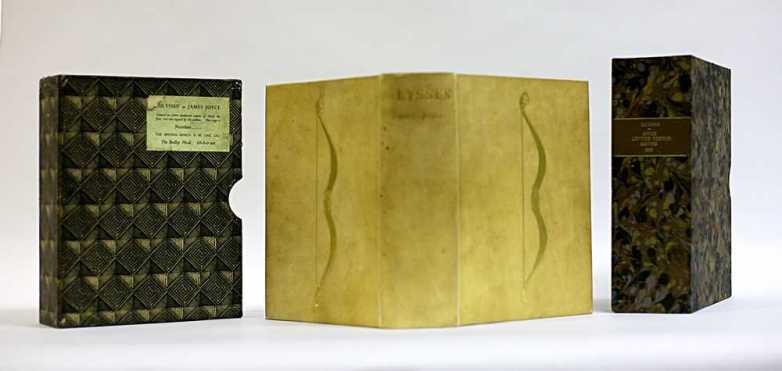
Bodley Head edition of Joyce’s Ulysses, (1936) – from http://antiquesandartireland.com/2010/07/ulysses-first-edition-memorabilia/

Then there’s Joyce’s Ulysses, published in Paris, which was seized by customs officers when it dared cross the channel into Britain (though curiously Bodley Head didn’t get prosecuted for publishing it in Britain in 1936). Radclyffe Hall’s Well of Loneliness had caused its publisher Jonathan Cape to be brought to court in 1928.

In 1959, there was a further and vital modification to the law of obscenity: now the work in question had to be taken “as a whole” and the interests of “science, literature, art of learning” could be adduced to defend a work from the charge of obscenity – “expert opinion” could be called. The following year the case of Regina v. Penguin Books over the publication of the unexpurgated Lady Chatterley’s Lover was a test case of this new law. Penguin won. Since then the question of obscenity has been continually debated, with concern in Britain at least has been far less over literature, however, than with film and video and, more recently again, the internet (see e.g. a recent article in The Guardian).

If then in three major respects twentieth-century publishing seems a continuation of nineteenth, in another it can be said to start perfectly on time on 1 January 1900 with the Net Book Agreement (NBA), signed by members of the then recently formed Publisher’s Association. The NBA concerns distribution. Again its roots go back to the nineteenth century — but it can also be regarded as a decided rupture with it.

The NBA  was designed to prevent booksellers selling at suicidal discount yet price wars had erupted when in 1894 the lending libraries Mudie’s and W.H. Smith’s rebelled against taking three-volume novels. Publishers were forced to publish novels in one volume and more cheaply. This in turn meant that cheap books flooded the market and booksellers sought to undercut one another. Unsurprisingly, this spelled disaster for many booksellers (as well as publishers). Many booksellers went bankrupt. This in turn meant fewer outlets for the retail of books and the consequent risk of a decline in the market because of distribution problems – for if booksellers closed because they had been trying too hard to undercut their competitors how were publishers to get their wares to the consumer? Hence the need that some publishers felt to save booksellers from bankruptcy. The NBA was one solution. Through the NBA, the publisher allowed a trade discount to the bookseller only on condition that the book was sold to the public at not less than its “net published price” as fixed by the publisher. In Britain, a first attempt to introduce the net price principle by booksellers in the 1850s had been condemned to failure by supporters of Free Trade; but in the 1880s it had  been successfully adopted in Germany. Encouraged by this toward the end of the century some British publishers, led by Alexander Macmillan, began to replace the variable discounts they gave to booksellers by fixed prices. To press for the new system, the Associated Booksellers of Great Britain and Ireland had been formed in 1895, and the Publishers Association was created in 1896. These two organizations then worked out the Net Book Agreement.

If the twentieth-century British book trade can be said to be the century of efficient copyright, it is just as much the century of the NBA – indeed it only collapsed in September 1995 through pressure from a complex of sources including rulings by the European courts about what constituted cartels and pressure from the Office of Fair Trading.

The industry itself had also  changed though. The import of cheaper books from the US via Europe because of the strength of the pound, and not least the enormous growth of bookseller retail chains like Blackwell’s, Dillons, and Waterstones which by 1996 had grown to take over 30% of the U.K. market. These chains – in ever-reduced numbers amongst themselves – became the pacesetters in the new deregulated market that emerged in the 1980s. They were able to launch full-scale retail marketing of the sort that had previously only been seen in UK supermarkets, such as price promotions on certain brands (or imprints, in the case of books), loyalty cards and hence database marketing based on analysis of what specific kinds of customers were buying where and when. Regulation (“deregulation”) encouraged the consolidation of the chains:  complaints to the office of Fair Trading by more than 600 small publishers that Waterstone’s was abusing its (dominant) position in the market by seeking greater discounts from publishers were dismissed.  More recently again, of course, Amazon has increased its market share of literary distribution to previously undreamed of heights. Are monopoly, oligopoly and cartels the inevitable end of a deregulated market as we saw in the Hollywood film industry of the 1930s before the Paramount decrees, where the studios controlled distribution, exhibition and production?

Thomas Walker’s The Original 1835

Here is the first of an irregular series describing individual Victorian periodicals that have not received much attention (if any).

The title of the first is The Original. A lively, unillustrated 3d weekly 16-page miscellany (though its first issue comprised 12 pages and its last just 4),  it ran 20 May 1835 – 2 December 1835 for 29 numbers, coming out every Wednesday for 3d and also monthly in a wrapper (its last number, the 4-page issue, cost only a penny). It was published by Henry Renshaw, 356 Strand, London and printed by Ibotson & Palmer, Savoy Street. It was republished several times: an 1850 reprint is available on archive.org.

The Original was directed mainly towards the male upper middle classes “aloof from sect and party” (no.1 p.2), concerned, as its “Preliminary Address” states, with “whatever is most interesting and important in Religion and Politics, in Morals and Manners, and in our Habits and Customs”, leavened with anecdotes and autobiography, in an attempt to raise “the national tone in whatever concerns us socially or individually”.

It was written entirely by Thomas Walker, the son of a Manchester manufacturer and Whig reformer. Walker was born in 1784, gained his B.A. and M.A. from Trinity College, Cambridge, in 1808 and 1811 respectively, and was called to the bar in 1812. In 1829, he became a police magistrate in Lambeth court. Six years later, he began The Original for, he claimed, two reasons. Firstly, it would provide “a constant and interesting stimulus to my faculties of observation and reflection” – in other words, it would act as a kind of public diary – and secondly, it would provide for the reader “an alternative diet of sound and comfortable doctrines blended with innoxious amusement” (“Preliminary Address”). Walker was, however, unable to maintain a constant flow of new material and reprinted material from works he had already published, the most substantial of these being the pamphlet Suggestions for a Constitutional and Efficient Reform in Parochial Government (1834).

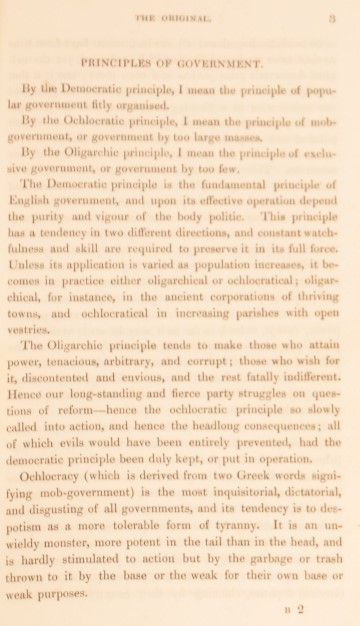
“Principles of Government,” The Original, from issue 1 in the 1850 reprint version

In social and political terms, the periodical criticises both Tories and Whigs in the interest of “Truth”, both being presented as oligarchic at bottom. True democracy, Walker opines, implies attrition of centralised government and devolution to the parish level where future men of state can be trained. Walker is staunchly against the Poor Law and indiscriminate charity of all sorts, positing bad morals on an individual level as the root of poverty in Britain, citing his experience of the courts as evidence. In this sense,  it is a typical Whig/Radical miscellany of the 1830s.

The most famous and influential section of the miscellany in the nineteenth century and beyond was not its political interventions, however,  but a series called (after Walker’s delight in neologisms) “Aristology; or, The Art of Dining”. Beginning in number 13 and continuing until number 22, it received particular favour in the Quarterly Review. It was quickly published separately, starting with a pirate 1837 edition in Philadelphia (The Art of Dining published by E. L Carey and A. Hart). An 1881 British edition is available free online with an introduction by “Felix Summerley” — the pseudonym of no less than Sir Henry Cole, the founder of the Albert Hall, of the Royal College of Music – and of the National School of Cookery — had the rather unlikely suggestion that it become a school textbook. It is possible to see the influence of Brillat-Savarin’s famous Physiologie du Goût (1825) in Walker’s mixture of charming anecdote and pseudo-science. However, recipes are conspicuously lacking: unlike Brillat-Savarin, Walker concentrated on refining the delights of consumption rather than production. His work relates to the gastronomic literature associated with gentlemen’s clubs such as George Vasey’s Illustrations of Eating (1847) and J. Timb’s Hints for the Table (1859) rather than to practical cookbooks such as Esther Copley’s Cottage Comforts (1825), Acton’s Modern Cookery (1845) or Beeton’s Household Management (1861).

To the media historian the most interesting parts of The Original comprise an irregular series of addresses to the reader in which Walker describes in detail his processes of composition in the tone of intimate letters to a friend. This ironic and stylish self-reflexivity is actually, as Walker explains, the result of the pressures of periodical publication: he can’t think of what else to write about except the problem of what to write. Typical of the romantic journalist, this, like the pieces on dining, is a variant of the “subjectified occasionalism” discussed by Carl Schmitt a century ago whereby  “The romantic subject treats the world as an occasion and an opportunity for his romantic productivity” (Schmitt, p. 17). One may disagree with Schmitt’s condemnation that the author may “take any concrete point as a departure and stray into the infinite and incomprehensible – either in an emotionally fervent fashion or in a demonically vicious fashion, depending upon the individuality of the particular romantic” (p. 17) but the widespread attempt to capitalise on – even monetarise – individual bodily experience is certainly characteristic of the time. The political implications of such a valorisation of the individual will be one of the tributaries that feed into individualism (about whose later development in Ouida I have written elsewhere). 

The last issue of The Original comprises mostly an “Address to the Reader” in which Walker begs leave to resume his periodical “the first Wednesday in March”, for “London living and authorship do not go well together”. He had become a celebrity: “My writings have latterly drawn upon me more numerous and cordial invitations than usual.” He was never able to fulfill this promise: after a short illness, he died in Brussels on 20 January the following year.

Relevant Bibliographical resources

Walker, Thomas, The Original, editions 2-4, 1836, 1838, 1850 all published by H. Renshaw. I have not seen the 3rd edition. American editions were published certainly from 1837 e.g. by E.L. Carry & A. Hart in Philadelphia.

Walker, Thomas, The Original, 5th edition, edited and arranged under distinct heads, with additions by William A. Guy, M.B. Cantab, FRS, Renshaw, 1875

Walker, Thomas, Aristology, or The Art of Dining, with Preface and Notes by Felix Summerly (i.e. Sir Henry Cole), G. Bell & Sons: London, 1881 (subsequently, with “The Art of Attaining High Health”, ed. by Philip B. M. Allan, P. Allan & Co.1921; also with a Preface by Brooke Crutchley and illus. by Lynton Lamb, in a limited edition of 500 copies, CUP, 1965)

_______

Brillat-Savarin, Physiologie du gout – 1847 French edition available at Gallica: https://gallica.bnf.fr/ark:/12148/bpt6k1063697 . An 1884 translation can be found at archive.org: https://archive.org/details/b24919494/page/n11/mode/2up

[Hayward, Abraham], review of The Original, Quarterly Review, February 1836 – developed into part of Hayward’s The Art of Dining; or, Gastronomy and Gastronomes, Murray, 1852 (a digital version of the 1883 version is available at here)

Hunter, Lynette, “Proliferating Publications: The Progress of Victorian Cookery Literature”, in Luncheon, Nuncheon and Other Meals: Eating with the Victorians, ed. C. Anne Wilson (Alan Sutton, 1994), 51-70.

Schmitt, Carl, Politische Romantik, 1st edition 1919; 2nd and revised ed. 1925;  trans. as Political Romanticism by Guy Oakes, MIT Press, 1986

Sutton, Charles William, “Walker, Thomas, 1784-1836” in the original DNB: https://en.wikisource.org/wiki/Dictionary_of_National_Biography,1885-1900/Walker,_Thomas(1784-1836) and, in the ODNB [slightly] revised by Mark Clement, at https://doi.org/10.1093/ref:odnb/28513

“The Original 1835-1882” [sic] Waterloo Directory of English Newspapers and Periodicals, vol. V: 3647 (NB information there erroneous, however) (see also online version: https://www.victorianperiodicals.com/series3 )

Ouida and the Parergic 2

Guy_Livingstone frontispiece
US cheap reprint of Guy Livingstone by Routledge (1867) for both US and UK markets

Ouida, of course, from when her first story appeared in Bentley’s (she was just 18), had had to write for money. She knew where the power and money lay, and “mythical swelldom” was one place. In 1857 George Lawrence’s Guy Livingstone had appeared. It went through at least 6 editions by the mid-60s (the image is of an 1867 reprint by Routledge who evidently thought it worthwhile to print – and so establish copyright – in the US as well) and started the cult of the “muscular” hero. Even Dickens had to respond to it  (see Nicholas Shrimpton’s excellent article on Lawrence and the “Muscular School” of heroes in Dickens Quarterly, 29: 2). Lawrence himself was given no less than £1,000 for his novels – a very high sum indeed – by his publisher Tinsley, and Tinsley it was who published in volume form Ouida’s first novel, Held in Bondage in 1863, a novel which combined the dashing muscular school with bigamy and sexual deception, themes newly marketable since Lady Audley’s Secret. Ouida though only managed to get £50 from Tinsley for the rights to publish it (though she did manage to negotiate that he should only keep the copyright for a limited period. Tinsley, rather unpleasantly, wrote that he could have got the complete copyright had he driven a hard bargain). Strathmore followed the same publication pattern, though published, after negotiations, by Chapman and Hall who were now to become Ouida’s regular British publishers. She managed to sell them the short-term copyright for just £75.

Even to get these small sums was an effort. Ouida, a half-foreign woman of 20 from Bury St Edmund’s with no real connections, had to work out a way to make money in the cut-throat male world of London publishing. Hers is in a sense “surplus” labour which has to make itself needed: she is an outsider who has to get in. The solution Ouida seems to have arrived at was to  reflect back to power the image of itself it seemed to like. This is where the concept of parergy starts to become useful.

There is an oft-repeated story that Ouida used the conversations she heard between men at her Langham gatherings for her now most famous novel, Under Two Flags. But, as Jordan demonstrates in her chapter for Ouida and Victorian Popular Culture, Ouida’s knowledge of military life was derived from reading rather than from conversations with military men. Such textual knowledge is legible from her earliest publications, the short stories she had published in Bentley’s in the early 60s, several of which we can read today as devastatingly critiquing male pomposity exemplified by the soldier (e.g. “Little Grand and the Marchioness”). But they can also be read as simply amusing in their accounts of masculinity. That they concern “mythical swelldom” as opposed to what the male critics regarded as reality is key: Ouida doesn’t get it quite “right” i.e. she presents the men from the outside, exposing men’s little blind spots and tricks of evasion. At this stage, that doesn’t matter: for the critics these deviations – these failures to adhere to the powerful norm – are a laugh, “brilliant nothings”.

By the mid 60s Ouida’s prices had risen slightly. Over 186566 she received £6 per monthly instalment for Under Two Flags in the British Army and Navy Review, a monthly to which she had contributed a series of stories and non-fiction articles on military matters since July 1864. Just as Braddon’s Lady Audley’s Secret was left incomplete in its first manifestation as a serial in the twopenny weekly Robin GoodfellowUnder Two Flags was unfinished when the British Army and Navy Review folded in June 1866. Bentley had taken over the Review in December 1865 but failed to save it. He later refused to publish the novel in volume format on the advice of his reader Geraldine Jewsbury who concluded that ‘the story would sell but … you would lower the character of your house if you accept it’.  Ouida wrote to another potential publisher, Frederick Chapman, a few months later claiming that the premature termination of the serial had left ‘military men’ waiting ‘with intense impatience’ to read the end. Her sales pitch to Chapman worked, for he published it as a triple-decker in November the following year. The American publisher Lippincott gave her £300 ‘by trade courtesy’ for his one-volume edition, and the continental publisher Tauchnitz brought it out in 1871. Three years later, Ouida was to sell her copyright outright to Chapman for less than £150.

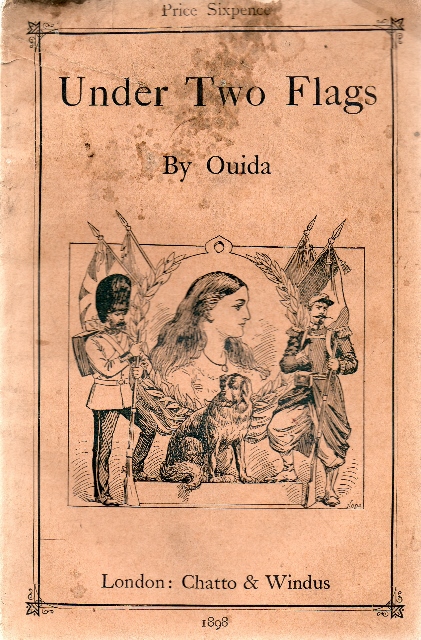
This was to prove a costly mistake for, contrary to what has been claimed, the novel was initially only moderately successful. Its real success came in the 1890s when it sold in enormous numbers in cheap editions: Chatto and Windus, who bought the copyright from Chapman in 1876 as part of their vigorous expansion policy, were to print around 700,000 copies. Ouida got nothing from this. No wonder she was to write to her solictor in November 1884 that “Chatto & Chapman are two rogues who play into each other’s hands to keep down prices like the publisher in ‘Pendennis.’” Men still ruled the publishing industry, as they rule the wider media today.

By the 1890s, then, Ouida’s fiction has migrated downmarket. Interestingly, the penny papers do not treat her with the same attitude as the up-market expensive magazines and newspapers. On the contrary, for them she is “the leading female novelist of England” who has

“no rival in passionate eloquence, and the pathetic, emotional power by which she can change the lowly and the sinning into a glorified humanity, and lift up and ennoble and sanctify even the rudest nature by some one divine gem of supreme manifestation of sacrificial love” .

Bow Bells 17 January 1890

By this time, too, she had herself become comically wicked in that market. Unlike with the negative high-culture reviews of the 1870s and 1880s, this is surely a marketing ploy which positions Ouida as safely transgressive: her eccentricity is part of her scandalous appeal. One can have one’s desires enacted by someone else on the page without ever having to confess them as one’s own. Ouida is contained: once again we don’t have to read her seriously.

To return once again to parergy.

Parergy is not dismissal de haut en bas by critics who claim to know better – it is not a weapon in a cultural war that the powerful wield. It is a wheedling weapon of the disempowered, a demand to be heard which knows it will fail, an attempt to participate in power while knowing that the odds are stacked against it. Is this what Ouida does in her early work?

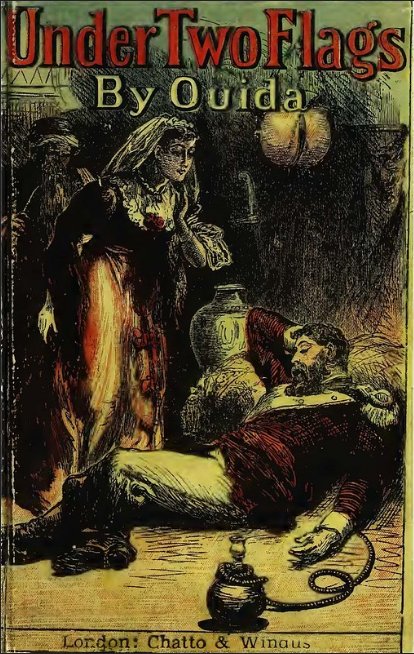
Under Two Flags, Chatto & Windus, 1909 yellowback. Lady Venetia visits Beauty. The viewer looks at a woman looking at a passive man: a popular inversion of the male gaze?

I don’t think Ouida’s imitations of the “Muscular School” fail in an unambiguous way so much as lay that school open to the possibility of ridicule or parody:  they depart from it certainly, exposing its weaknesses and limitations and hidden assumptions. We are never allowed to forget that the hero of Under Two Flags is nicknamed “Beauty” and that he’s much more interested in his horse and his male friend “Angel” than in the heroine Cigarette or the paragon Lady Venetia or the actress he keeps (powerfully objectified as merely “the Zu-Zu” ) or his aristocratic mistress with the absurdly accurate name “Guenevere”. The women Beauty has a relationship with are all part of the appearance of masculinity. Even Beauty’s affair with Lady Guenevere is part of the system of masculine show: everyone knows about it and yet, in that complex game of respectability, at the same time they pretend they don’t. In any case, we are shown how this affair adds a potency to Beauty’s allure.

How are we to take this exposure of the structuring of masculine power and image? Is it a flattering celebration or a merciless critique?

If the parergic can be found in Ouida it is gendered:  excluded from literary-economic power, she mirrors back those representations of masculinity which generate it, while at the same time departing from them by the acuteness of her vision and anxiety as an outsider.

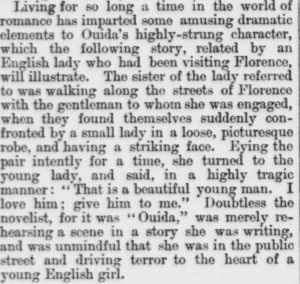
It is very different from the non-gendered, generic parergy I located in the 1840s. If anything, that kind can still be found in the penny paper reviews of the 1890s – think of the rather strained description of Ouida in Bow Bells, with its anxious determination to dazzle with rhetorical devices (most notably a tricolon) at all costs, or the yellowback cover of Under Two Flags, or the anecdote in the London Journal which could be funny were its rhythms more bouncily organised, and were it less determined to excuse its subject as distracted.

London Journal 3 September 1898

Whether Ouida’s vision of men is parergic or parodic depends on whether we read it as undermining or supporting that masculinity. I think her version of muscular literary power in her early work walks a tightrope between parergy and parody: can we say with absolute conviction that her early work parergically supports its models while failing to live up to them or parodically undermines them by exaggerating and revealing? It does both, sometimes simultaneously but mainly, I think, it lurches from one to the other from sentence to sentence, paragraph to paragraph, page to page. The honest reader is left uncertain, while others who prefer certainty are able to take from it what they want. Indeed, the ability of Ouida’s writing to have it both ways in terms of gender is one of the secrets of its success, and why it gives us such scope to write about this author and gender in what seems a mini-Ouida revival in the first few decades of the twenty-first century.

Over a hundred years after her death, and a century after she ceased to be popular, we are perhaps beginning to find ways of reading Ouida again.

Ouida and the Parergic 1.

For perhaps a hundred years the idea that Ouida could ever have a serious relationship with high-status culture would have been laughable. Her contemporary critics thought her merely pretentious: they thought she claimed to be part of respectable culture but she couldn’t manage it; she emulated the high but didn’t get it right.

When the Saturday Review (12 July 1873) reviewed Ouida’s Pascarèl, a novel set in the revolutionary Italy of the 1860s, it began by announcing that Ouida’s

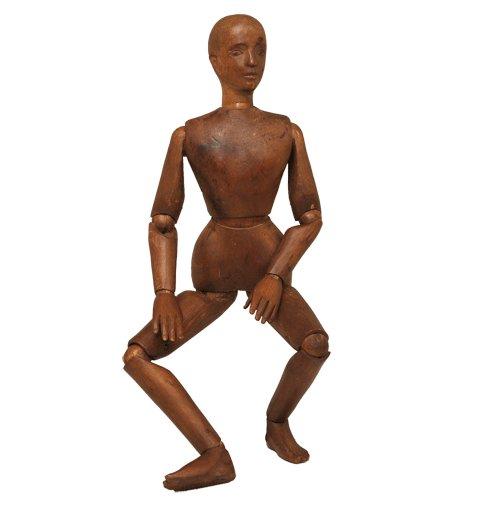
lay figure
artist’s lay figure from the 1860s

“chief literary quality is a flux of words and her dominant characteristic audacity. If we analyse her rushing gorgeous sentences, full of sound and colour as they are, we find only some poor, meagre, little thought as the residuum; and even when her phrases are sentimental, the action of her stories too often appeals to a prurient taste. Her ideas are like an artist’s lay figure, the same thing draped up in a dozen different costumes, but always the same thing underneath, and that thing wooden.”

Ouida couldn’t, according to this witty reviewer,  be bothered to move from the “lay figure” to real people: she remained all pose (as Malcolm Elwin described her in his 1930s book Victorian Wallflowers).

Now when I used  the term defined in an introductory post, “parergic,” to refer to a failed emulation of high culture that did not undermine but supported it, I wanted to get away from the value judgement implied by the terms “pretentious” (or words often used in a similar way, like “imitative” or “derivative”) to help us think about what was at stake: what are the violent hierarchies we participate in, unconsciously or otherwise, when we dismiss a writer as laughably pretentious? Sometimes the violence takes place in the field of culture, at other times of class, gender, race, age, disability and so on. Sometimes consumer identity which may be “horizontal” rather than vertical is at issue, whereby for instance, supporters of one successful pop group will deny the validity of another which is, in the field at large, in a very similar cultural position. At all times the issue is tribal status: “we” are better than the failed “them”. My deployment of the term “parergy” was intended to create an analytic  distance from those struggles, to stand outside them insofar as such is possible (that one cannot stand outside entirely doesn’t mean one shouldn’t try).

Now how far can parergy be related to Ouida’s early work?

Before we get to that, though, we need to note that the critics’ view of Ouida as pretentious only fully emerges after her identity as a woman is revealed. Early comments on her work in periodicals – she had started to contribute to Bentley’s Miscellany in 1859 – suggest that the critics thought “Ouida” a clever gentleman who wrote “brilliant nothings” for pleasure (see e.g. Morning Post, 4 February 1862: 3). They even thought Ouida  had seen military service. So thorough was the deception that the Standard (8 May 1862: 6) wryly interpreted Ouida’s temporary absence from Bentley’s in May 1862 as a possible sign that the author had decided it was too vulgar to write in such a magazine:

“What has become of him? Has he got a notion that it is plebeian to write, or is he only taking a rest from his arduous labours as the chronicler of mythical swelldom?”

Ouida’s morality – but, more, “discretion” – were issues that some papers took issue with: the Morning Post (8 May 1865: 2) didn’t like “his” article on duelling for the Army and Navy Review mainly because “he” dared to voice opinions that should have been kept within “his” set.

By 1866 that the name referred to a woman author was already public: the Sporting Gazette of June 23 that year refers to her as “she” confirming the Pall Mall Gazette‘s outing of Ouida as a woman in its review of Strathmore (4 May), in which it had defined her novel as “the hen book to ‘Guy Livingstone'” (on which novel see below) and proceeded to slash it for, exactly, pretention:

Pall Mall Gazette, 4 May 1866

Soon, Ouida’s real identity becomes more and more public. The Bury and Norwich Post, and Suffolk Herald  (23 October 1866: 4) even relates how “she” had spent her childhood in Bury.

While it’s very easy to close down the argument by concluding that this is just another example of Victorian sexism – it is – yet the second post on Ouida will think through its implications for an understanding of the parergic.

Parergy and the Beginnings of the Mass Market in the 1840s

31 (478x640)
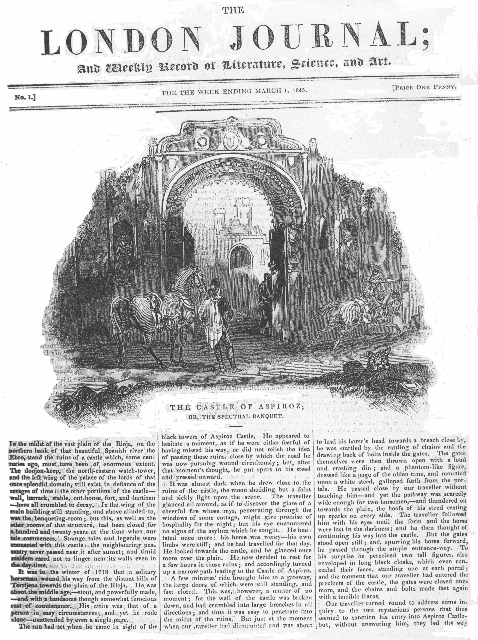
1st page of The London Journal 1845

Two decades after the proofs of my first monograph were submitted for publication it seems an appropriate time now to revisit key concepts I invented to help explain the field of Victorian popular publishing. The book, a version of my PhD thesis, was a study of the first four decades of a Victorian penny weekly fiction magazine, The London Journal 1845-1883. How well do these concepts stand up to the test of time?

One of the key concepts was what I called the parergic after Derrida, though I used the term in a very different way from him. I employed it in an attempt to explain in a serious, non-condescending and intellectually rigorous way the particular position in the literary marketplace of texts right at the beginning of the commercial mass market: what was the relationship of these texts to the more general field?

Here, in this first post revisiting ideas from another age (and indeed I first came up with the idea in the 1990s), is an extract from the original. Later posts will test the concept against other work. Here are a couple on Ouida:

Having provided paragraph-length biographies of several journalists and marked their career paths – they all started aiming for high status and ended writing for money – I came to a conclusion and then sought to explain that conclusion and link it to curious stylistic features characteristic of these texts, features very different from the Edward Lloyd-type serials I had encountered previously which did not seem to care about their status as commodities. The material I was studying from The London Journal seemed worried about being dismissed as merely ‘economic literature’ – how did this worry manifest itself exactly?

*****************************

… The London Journal was thus a precipitate out of surplus labour which would prefer the greater symbolic (and at this stage usually economic) capitals of the up-market magazines. The desire for a unified cultural field that I discussed in Chapter 2 is visible here, supported sociologically by the very limited socio-cultural group that writers in general came from (Altick, 1989). In that sense, the impression gained from Vizetelly’s description of the magazine as staffed by ‘failures’ is correct.

The longing for the high but exclusion from it that such career paths suggest results in what I term the parergic. This comprises a set of specific textual effects and practices, which, while underpinned by sociological narratives, does not inhere in specific bodies or corpora (a writer, artist, a periodical or even an article may display the parergic or not at various points). It is a system whereby texts are based on originals that are invested with greater symbolic capital and authority. Officially respectful and emulative, the parergic is tinged always with a resentment, caused by exclusion from desired cultural areas, that brings about mutation in what is supposedly emulated. The parergic sometimes raids authority aggressively and seems therefore to attack it, but nonetheless paradoxically buttresses cultural boundaries even in the act of transgressing them. Unlike parody, which always in some sense undermines the authority of its original even while being complicit with it, the parergic fully acknowledges and maintains this authority even when it effaces its model. Unlike straightforward imitation of the high, which depends on large cultural capital to judge its value, the parergic does not use the exclusive codes or high prices that cultural authority wraps itself in to keep out the uninitiated.[1]

The weekly ‘Essays’ furnish typical examples of the parergic in terms of that practice which is ‘style’. Essay L [50] on ‘The English Language’, signed by John Wilson Ross ([London Journal] III: 7-8), begins with the commonplace thesis that ‘the progress of language marks the progress of the human mind’, and swiftly interprets this in a nationalist sense. It continues by placing the ‘rise’ of the English language at the Reformation because then ‘men began to argue’ and to do so ‘they [had to] express themselves with precision’. Thereafter,

Addison was unquestionably the first of our writers who introduced elegance of expression into the composition of English prose. He found the writings of his predecessors disfigured by a loose, inaccurate, and clumsy style. He changed all this, and made himself a model for imitation. In his works we find no forced metaphor – no dragging clause – no harsh cadence, – no abrupt close. He is, also, a happy model for the use of figurative language. They seem to spring spontaneously from the subject: and are never detained till the spirit evaporates or the likeness vanishes. They are just like flashes of lightning in a summer’s night – vivid, transient, lustrous, – unexpected but beautiful, – passing over the prospect with a pleasing brightness, and just vanishing before you catch a sight of all the beauties of the scene they gild. The copious and classic mind of that writer gave our language the greatest degree of elegance and accuracy of which it is susceptible. Since his time fine writing has not improved. Simply, because it cannot be. You cannot give the English language a nicer modification of form, or a greater beauty of feature than Addison gave it. But you can give it more nerve and muscle. And subsequent writers have done so.                                                                                                     ([London Journal] III: 7)

It was Johnson, ‘[t]hat Colossus of English literature’, who provided the muscle. Since his time ‘there has occurred no variation in the style of English prose’ except, possibly, by increased use of the ‘Gothic, whence [English] sprung; and that is a feature in language which our readers will agree with us is more deserving of disgust than admiration, and a variation in style more worthy of punishment than praise’ ([London Journal] III: 8).

The essay’s claims to authority depend largely on the assumption of a common standard throughout the literary field…

Andrew King, The London Journal 1845-83: Periodicals, Production and Gender (Routledge, 2004), 57-8.

Annotated edition of Ouida’s Two Little Wooden Shoes Chapter 1.1

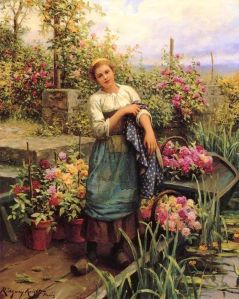
Typical of the romantic versions of peasant life. Daniel Ridgway Knight (American painter, 1839-1924) – “The flower boat”

Ouida

TWO LITTLE WOODEN SHOES

Chapman and Hall, 193 Piccadilly, 1874

CHAPTER I.

Bebee sprang out of bed at daybreak. She was sixteen.

It seemed a very wonderful thing to be as much as that — sixteen — a woman quite.

A cock was crowing under her lattice — he said how old you are! — how old you are! every time that he sounded his clarion.

She opened the lattice and wished him goodday, with a laugh. It was so pleasant to be woken by him and to think that no one in all the world could ever call her a child any more.

There was a kid bleating in the shed. There was a thrush singing in the dusk of the sycamore leaves. There was a calf lowing to its mother away there beyond the fence. There were dreamy  muffled bells ringing in the distance from many steeples and belfries where the city was; they all said one thing: “How good it is to be so old as that — how good, how very good!”

Bebee was very pretty.

No one in all Brabant ever denied that. To look at her it seemed as if she had so lived amongst the flowers that she had grown like them, and only looked a bigger blossom — that was all.

She wore two little wooden shoes and a little cotton cap, and a grey kirtle — linen in summer, serge in winter; but the little feet in the shoes were like rose-leaves, and the cap was as white as a lily, and the grey kirtle was like the bark of the bough that the apple blossom parts when it peeps  out to blush in the sun.

International History of Magazines 6: Australia and New Zealand

AUSTRALIA AND NEW ZEALAND

The small populations of Australia and New Zealand in the nineteenth century meant that there were few market possibilities for magazines until the 1870s. There were certainly magazines before this, but most were shortlived and unsuccessful, notable exceptions being the Melbourne-based Australian Journal (1865-1962), a popular fiction weekly modelled on (and often sharing material with) Britain’s London Journal (1845-1928), and the Brisbane-based Queenslander (1866 – 1939), the entertainment weekly supplement to the Brisbane Courier (1846-).

A decent body of research has been done on the Australian little magazine, a genre that was introduced by Vision in 1923. Despite the fame of some amongst the cognoscenti, until the 1970s the genre never had much success.

Increasing amounts of work are being done on consumer magazines but despite a plethora of article-length studies and volumes on single magazine titles, Greenop remains the only full-length study of the history of Australian magazines as a whole. Day (q.v.) has covered the development of the early newspaper in New Zealand but so far there is no book-length study of the history of the New Zealand magazine.

OVERVIEWS

Bennet, Bruce. 1981. Cross Currents. Magazines and Newspapers in Australian Literature. Melbourne: Longman Cheshire.

The 16 essays (plus one diary extract), mainly by non-academic participants in the area, offer interesting perspectives on individual little magazines (the one exception concerns book reviews in newspapers).

Day, Patrick. 1990. The Making of the New Zealand Press. A Study of the Organizational and Political Concerns of New Zealand Newspaper Controllers. Victoria: Victorian University Press.

While magazines are not mentioned here at all, this volume is included in the bibliography for being one of the very few studies of New Zealand press history. Its account of the organizational difficulties settlers faced is illuminating and in many cases will be applicable to magazine production as well.

Edmonds, Phillip. 2015. Tilting at Windmills. The Literary Magazine in Australia, 1968-2012. Adelaide: University of Adelaide Press.

Theoretically informed and well-written account of the little magazine in Australia at a time when it flourished. Brings the work of Tregenza (q.v.) up to date.

Greenop, Frank.  1947. History of Magazine Publishing in Australia. Sydney:  K. G. Murray Publishing Co.

Still the only book-length history of American magazines, this was written by an insider, the magazine editor-in-chief of the publisher who brought out the book. It is organised chronologically and has good descriptions of individual magazines within the text. The index helpfully lists the magazines mentioned.

Tregenza, John. 1964. Australian Little Magazines 1923-1954: Their Role in Forming and Reflecting Literary Trends. Adelaide: Libraries Board of South Australia.

A slim volume covering 48 little magazines, including the best known, Max Harris’s surrealist Angry Penguins. There is a handy descriptive bibliography of little magazines listing authors, dates, frequency, price and publishers, but most of the text  comprises a discursive history of the magazines.

DATABASES

AustLit   http://www.austlit.edu.au/

This subscription-only database  aims to be the central research tool for all matters related to Australian literature in the widest sense, including magazine history. It is not full text but links out to other archives that are (Trove, q.v.).  Oriented towards content rather than runs of magazines, there is a research project focussing on newspapers and magazines (see  http://www.austlit.edu.au/austlit/page/5960612)

Australian Magazines of the Twentieth Century  http://www.austlit.edu.au/specialistDatasets/BookHistory/AustMag

A subscription service giving full-text searchable access to around 100 Australian magazines and newspapers mainly from the twentieth century from The Booklover (1914-18) and Meanjin (1940-) to the Australian Woman’s Mirror (1924-61).

Australian Periodical Publications 1840-1845 http://www.nla.gov.au/ferg/

A clunky site created in the 1990s that allows PDF downloads of individual articles from periodical titles. Full-text searches are possible of only one of the journals, the Colonial Literary Journal and Weekly Miscellany of Useful Information. It has largely been superseded by Trove.

Index New Zealand http://innz.natlib.govt.nz/webvoy.htm

This is a searchable database of abstracts and descriptions of articles from 1000 New Zealand magazines and newspapers from the early twentieth century onwards. It is content-oriented and it is difficult to trace complete runs of magazines, but can be useful when its limitations are acknowledged.

Papers Past. http://paperspast.natlib.govt.nz/cgi-bin/paperspast

An excellent and easy to use open-access database of 120 newspapers and magazines from 1839 to 1948. 18 Maori publications are included, including some religious magazines.

Trove.  http://trove.nla.gov.au/

An exceptionally well designed open-access database easily searchable through a single interface. Although the subsite Trove Digitised Newspapers and More (https://trove.nla.gov.au/newspaper) highlights newspapers in its title, it in fact allows full text searching of a large number of magazines as well.

International History of Magazines 5: Latin America

LATIN AMERICA

“Latin American” (Iberoamericano) is here defined geographically to refer to those magazines published in South and Central America, Mexico and the West Indies. The diversity of the region and its histories is enormous, but, despite the risks of flattening the very varied historical and geographical terrain, the amount of material to cover is not as large as it might be. In several countries in the twentieth century the press was either nationalised or very carefully state controlled, and it is not therefore surprising that while there are substantial histories of the press covering Latin America in general and its constituent countries, these are almost all exclusively concerned with newspapers and their role as political actors. A few of these histories are referred to below for the purposes of background for the study of magazines. Most of what there in terms of magazine history focuses on the high-status literary: substantial accounts of the popular magazine in Latin America are lacking. With the establishment of associations for media researchers such as Red de historia de la prensa y el periodismo en Iberoamérica at Guadalajara University in 1999 and the Brazilian Associação Brasileira de Pesquisadores de História da Mídia (from 2008, its associated journals is Revista Brasileira de História da Mídia, founded in 2011) more work is already being done in the area.

The press in Latin America, begun in the 1720s by European colonists, mainly comprised newspapers until late in the nineteenth century, though there is the odd exception, such as the Diario literario de México (founded in 1768, its name recalling the Spanish Diario de los literatos de España of three decades earlier) and the equally short-lived El ilustrador mexicano (1823). Brazil had a literary magazine even earlier (As Variedades, 1812). During this period, almost all magazines in Latin America closed after a few issues: the Buenos Aires-based Cosmopolitan (1831-1833), an Anglophone magazine founded by an Englishman, was unusual in lasting over two years. Mention of this magazine reminds us that, just as  British or American publishing history has a vast array of non-Anglophone newspapers and magazines, it should not be thought that in Latin America all magazines were in  Spanish or Portuguese. Late in the century religious periodicals for English-speakers such as the Buenos Aires Scotch Church Magazine was started (1880-), followed by the Falklands Islands Magazine (1889-1933) founded by the Colonial Chaplain.

Magazines in general in Latin America began to take off in the last two decades of the nineteenth century, including modernist ones such as the well-known Mexican Revista azul (1894-1896), but it was only in the twentieth century that magazines, like newspapers, became truly widespread. Their success is especially visible in Brazil where O Cruzeiro (1928-1975), Senhor (1959-1964) and the news magazine Realidade (1966-1976) established circulations of hundreds of thousands. Popular pulp magazines after the American model had appeared in the 1930s at the same time that women’s magazines, sporadic in the nineteenth century and with restricted circulation, achieved longevity and wide readerships spanning the entire region: the Mexican La Familia, begin in 1930, was by the 1960s being published in 25 countries in Latin America and the Philippines, by which time there was a plethora of women’s titles. From the 1970s the globalisation of the market was increasingly evident, as international media conglomerates published local versions of their magazines, but counter to those, indigenous media companies such as the Mexican Publicaciones also thrived.

OVERVIEWS

Calderón, Carola García. 1987. Revistas femininas: La mujer como objeto de consumo. Mexico: Ediciones El Caballito. 3rd edition

Focussing on women’s magazines available in Mexico in the 1970s (and historical for that reason alone), the volume, whose first edition was published in 1980, is one of the earliest Marxist-feminist studies of the media in Latin America. It both analyses texts and examines ownership patterns in an engaging manner that in some ways anticipates Ballaster, Beetham, Frazer and Hebron (q.v.).

Godoy, Antonio Checa. 1993. Historia de la prensa en Iberoamerica. Seville: ediciones Alfar.

A comprehensive account of the press in Latin America from the Gazeta de México in 1722 to 1989. It is broken down into numerous short chapters mainly focussing on brief periods in different countries.  Magazines are referred to but the main thrust of the narrative concerns newspapers and their role in politics. Useful for understanding a general narrative of the press.

Instituto Nacional de Bellas Artes, 1963, 1964. Las Revistas literarias de México (2 volumes). Mexico City: Institituto Nacional de Bellas Artes

Two collections of 8 essays each derived from conferences held the previous years on Mexican literary magazines. The focus is on the relationship of magazines to modernism, though the first essay in volume 1, by Eduardo Enrique Ríos, offers a selective history of Mexican magazines conceived of as carriers of ideas.

Marshall, Oliver. 1996. The English-Language Press in Latin America. London. Institute of Latin American Studies.

A comprehensive dictionary of Anglophone magazines and newspapers from their beginnings in the mid nineteenth, comprising brief descriptions organised alphabetically under country

Palacio Montiel, Celia del. Ed. 2000. Historia de la prensa Iberoamericana. Guadelajara, Mexico: altexto.

36 essays and an Introduction cover mainly the history of the newspaper press and its relation to politics all over Latin America, though magazines are mentioned throughout. In addition there is a chapter on the nineteenth-century Mexican scientific press.

DATABASES

Publicaciones periódicas del Uriguay  http://www.periodicas.edu.uy/index.php

An elegantly designed database of magazines and newspapers starting with the Estrella del Sur/ The Southern Star, a bilingual newspaper in 1807 when Uruguay was under British control. It is still being added to (2015). By no means all numbers of the periodicals are available and the text has not been OCR’d, the search facility being limited to the categories given in the advanced search facility (“busquéda avanzada”), but this remains a remarkable achievement given the parlous state of survival of many magazines available here.

Red de Historiadores de la Prensa y el Periodismo en Iberoamérica  http://www.historiadoresdelaprensa.com.mx/index.shtml

The site for the Network of Press and Journalism Historians in Latin American houses various articles on the Latin American press by its members, including some on magazines (notably women’s). The database is not searchable and the user must scroll through the list of articles. These are available as pdfs or Word documents.

International History of Magazines 4: China and Japan

JAPAN AND CHINA

As one of the most literate countries in the world, Japan has a rich magazine history even if relatively short. That the newspaper and magazine are Western formats is well known, and yet as in other, mainly non-Anglophone, countries the distinction between the two is not always clear. Just two years after Japan was opened to the west in 1859, the Englishman Albert William Hansard began the Nagasaki Shipping List and Advertiser: this became the model for Japanese-language newspapers. The first magazine, which appeared in 1867, was the Seiyo-Zasshi, (“Western Magazine”) featuring articles translated from Dutch. Only six issues were published before it folded in 1869, but its influence is generally considered enormous, not least because it introduced the term “zasshi” into Japanese to mean  “magazine”.

The women’s magazine, initially targeting the wealthy (cf. the history of the women’s magazine in the west), arose in the early years of the twentieth century with Katei-no-Tomo (“The Family Companion”) in 1903. The Fujin Gahō, (“Ladies Pictorial”), first published in 1905 and still published (as of 2015), is significant not only for its aesthetic illustrations but also for its early use of photographs. The women’s magazine market proved lucrative: the Shufu-no-Tomo (“The Housewives’ Companion”), begun in 1916, enabled the founding of a publishing empire named after it (now a subsidiary of Dai Nippon Printing Co. Ltd). In the 1922 two newspapers, the Asahi Shimbun and the Mainichi Shimbun, began to publish weekly news magazines, the Shukan Asahi and the Sunday Mainichi, anticipating the miscellaneous news format of Time Magazine by a year. Despite these innovations, circulations were limited until the 1950s and the growth of consumerism. Women’s magazines were now launched into the mass rather than just restricted market, as did, a decade later, men’s magazines such as Shukan Playboy (1966 – ; not a regional version of the American Playboy). Since then, there has been a proliferation of magazines catering to a very wide range of target readerships. These are almost all produced by large media conglomerates.

***********

Although China had for centuries published a serial state organ (known in English as the Imperial Gazette), magazine publishing was introduced into China in the early nineteenth century by Christian missionaries. One of the earliest was the Chinese-language Chashisu Meiyue Tongjizhuan (“China Monthly Magazine”) started in 1815 by Robert Morrison and William Milne of the London Missionary Society. Around the same time, Anglophone and Portuguese missionary magazines appeared in South China and Southeast Asia. In the 1860s foreign-owned commercial newspapers in treaty ports such as Hong Kong and Shanghai joined the missionary periodicals and provided the models for Chinese-owned publications. After Japan’s defeat of China in 1895, the government stepped up its internal print propaganda and restricted (when not stopped) circulation of papers critical of its policies. As a result many journalists turned away from politics and newspapers to mass entertainment and to magazines and hybrid magazine-newspapers called xiaobao (often defined as similar to Western “tabloids” mixing literary genres, news and fiction).

After the Communist Revolution of 1949 very few periodicals were allowed: the most important was Renmin Huabao (“The People’s Pictorial” 1950-), whose title characters were written by Mao Zedong himself, Jīn Zhōngguó (“China Today” 1949-), Dazhong dianying (“Popular Film” 1950-). In the late 1980s, magazine markets were opened and Chinese-language versions of Western women’s and men’s magazines, such as Elle, Cosmopolitan and Men’s Health, as well as versions of Japanese magazines, competed with local products. Currently (2015) magazines are again the site of a commercial battle for readers and advertising between foreign and domestic media conglomerates.

OVERVIEWS

Bennett, Adrian A. 1983 Missionary Journalist in China: Young J. Allen and his Magazines. Athens, Ga: University of Georgia Press

An early study of Chinese missionary magazines, this focuses on the figure of an American missionary. It offers a comprehensive description of his two Chinese-language magazines, the Chiao-hui hsin-pao (“Church Times” 1868-1874) and the Wan-kuo king-pao (“Chinese Globe Magazine”, 1874-1883), which the author claims to be the most important intellectual periodicals before the Sino-Japanese war.

Frederick Sarah. 2006 Turning Pages: Reading and Writing Women’s Magazines in Interwar Japan. Honolulu: University of Hawai’i Press

Originating in a PhD dissertation at the University of Chicago, this is an accessible yet ground-breaking study of three mass-market Japanese women’s magazines between 1918 and 1940 that convincingly asks us to place these publications far closer to the centre of our understanding of Japanese modernity and literature than hitherto.

Minobu Shiozawa. 1994. Zasshi 100-nen no ayumi, 1874-1990 : jidai to tomoni tanjōshi seisuisuru nagare o yomu (“A Century of Magazines, 1874-1990: its birth, successes and failures”). Tōkyō: Gurīn Arō Shuppansha.

The standard history of Japanese magazines unfortunately not yet translated.

Mittler, Barbara. 2004. A Newspaper for China? Power, Identity and Change in Shanghai’s News Media, 1872-1924. Cambridge, Mass and London: Harvard University Asia Center

An outstanding study of a single publication which, even though it is of a newspaper, is very useful for the study of magazines in China as it devotes attention to the wider publishing context, including, in chapter 4, women’s magazines.

Reed, Christopher A. 2004. Gutenberg in Shanghai: Chinese Print Capitalism, 1876-1937. Honolulu: University of Hawaii Press

Although magazines are incidental to this richly-researched volume — it focuses on commercial book production rather than the periodical press — Reed’s work provides illuminating background information on how the Chinese print industry was a battleground for foreign and domestic ownership and thereby control of information dissemination and propaganda.

Shen, Shuang. 2009. Cosmopolitan Publics: Anglophone Print Culture in Semi-Colonial Shanghai. New Brunswick, New Jersey and London: Rutgers University Press

An intriguing study of “a culture of circulation” of English in China and also of the Chinese diaspora, this has a lot of interesting material on nineteenth- and twentieth-century Chinese and English-language magazines, though the focus is on the twentieth century. Two chapters focus on the China Critic (founded 1928) and on the T’ien Hsia (an English-language Shanghai monthly published 1935-1941), and two more on various international Anglophone magazines about China and on magazines related to the Chinese diaspora.

Wagner, Rudolph G. Ed. 2007 Joining the Global Public: Word, Image and City in Early Chinese Newspapers, 1870-1910. Albany, NY: State University of New York Press

Despite the title of this fascinating and well-researched volume , two chapters of the six (including the introduction) are devoted to magazines, one to the Dianshizhai huabao (Illustrated News from Dianshizhai, 1884-1898) and another to xiaobao (translated as “tabloids” but which recall general interest entertainment magazines).

Zhang, Xiantao. 2007. The Origins of the Modern Chinese Press. The Influence of the Protestant Missionary Press in late Qing China. Oxford: Routledge.

A readable and theoretically informed account of Chinese-language missionary journals with careful attention to their dialogue with local productions consisting of both their contemporaries in the nineteenth century and today’s journalistic practices. Not only concerned with discourse, one chapter describes the interesting impact of missionaries on Chinese print technology.

DATABASES

Magazineplus http://www.nichigai.co.jp/database/mag-plus.html

This vast database, the largest Japanese magazine database,  includes, unusually, trade and professional magazines as well as an ever expanding list of general interest, local and specialist magazines. Well over 27,000 titles have been indexed as of writing (2015).

Meiji Shinbun Zasshi Bunko http://www.meiji.j.u-tokyo.ac.jp/

A major database of newspapers and magazines at the University of Tokyo that is particularly useful. The library collections include 2,030 newspapers and 7,550 periodicals, in addition to original prints and earlier editions from the Meiji era.

Scholarly and Academic Information Navigator (CiNii)  http://ci.nii.ac.jp/info/en/cinii_outline.html

This database includes Japanese articles, books and periodicals, mostly but not exclusively from the natural sciences. Many articles are publicly available.

Shenbao database:   http://shenbao.uni-hd.de/Lasso/Shenbao/searchSimple.lasso

A rather clunky database of the contents of one of the longest lived and most successful of early Chinese newspapers, the Shenbao founded in 1871 by a British merchant, Ernest Major (1841-1908).

Chinese Women’s Magazines in the Late Qing and Early Republican Period: http://womag.uni-hd.de/index.php

An excellent database comprising fully searchable (in Roman characters) copies of four key women’s magazines published between 1904 and 1937: Nïzi shijie (Women’s World, 1904-7), Funü shibao (The Women’s Eastern Times 1911-17), Funü zashi (The Ladies Journal, 1915-1831) and Linglong (Elegance, 1931-1937)

Zasshi kiji sakuin shusei detabesu

Available through some institutions, this database indexes periodical articles published in Japanese from 1868 onwards, including those in former Japanese colonies and local periodicals. It also provides the capability to simultaneously search CiNii (q.v.). It is especially valuable for the late 19th and early 20th centuries.

International History of Magazines 3: Spain and Portugal

IBERIAN PENINSULA: SPAIN AND PORTUGAL

There is no volume-length general history of Spanish of magazines beyond Sánchez Vigil (q.v.), most studies of the press focussing on newpapers. In the Spanish case, however, the instability between newspaper and magazine is especially notable: José Maria Carnereo’s Revista española (1831-1836), for instance, underwent not only several different changes of name and a merger but also frequency and content (weekly to daily, cultural commentary to politics). Such instability means that there is a good deal about what the present-day researcher may regard as “magazines” in what appear to be newspaper histories.

While the Spanish news press began around the same time as elsewhere in Europe (the best-known being the monthly Gaceta de Madrid, 1661-2), it did not spread due to rigorous press censorship. The non-news magazine arrived several decades later than in France or Britain, the first literary magazine being the Diario de los literatos de Espana (1737-1742) which modelled itself on the French Journal des Savants. The Spanish medical magazine, on the other hand, is preceded only by the French, the Semestre Médico Clínico appearing in 1750 (the earlier monthly Efemérides barométrico matritenses 1734-1747, was not only medical but meteorological as well). While the figure of Nipho (1719-1803) is mainly associated with newspapers, inspired by the English Spectator, he also founded magazines such as El Pensador (1762), which in turn led to the founding of the influential promoter of Enlightenment values El Censor (1781-1787).

After the concept of the freedom of the press was enshrined in Spanish law in 1810, the press expanded enormously, and literary magazines flourished in the 1820s. As in Italy, politicians actively used the press to pursue their careers and disseminate their ideas. Later in the century, some notable satiric periodicals were published, including the illustrated La Flaca (1869-1876) which appeared under various titles to avoid the revived censorship laws.

Press histories began to be written late: Manuel Chaves’s Historia y Bibliografia de la prensa sevillana did not appear until 1896. In the twentieth century until Franco’s dictatorship, and in marked contrast to Britain and North America, the most influential figures in journalism were not reporters but intellectuals, such as José Ortega y Gasset.

Portuguese magazine history has been even less mapped than Spanish, and as in Spain the distinction between newspaper and magazine is not always net. While the Gazeta de Lisboa (1715) may be regarded as first Portuguese (news) magazine, and, as in Spain, literary periodicals played an important role in eighteenth-century Portugal (even if they were often quickly suppressed), magazines only thrived (to the extent they did) after liberalisation of press censorship in the 1820s. The similarities of Portuguese magazine history to that of other countries can be misleading however. The profusely illustrated O Panorama (1837-1868) from the Sociedade Propagadora dos Conhecimentis Uteis is, for example, unlike its British analogue the Penny Magazine, considered to be one of the major carriers of Portuguese romanticism. But even by 1892 W.T. Stead (q.v.) was suggesting that the Revista de Portugal  (1889-92) “appears to be almost, if not quite, the only Portuguese magazine of any standing” (p.64), a view of the comparative poverty of Portuguese magazine history supported by Portuguese magazine historians themselves ((Rocha, q.v. pp. 20-21).  The first history of the Portuguese press was Pereira’s O Jornalismo Portuguêz in 1896, after his monumental 12 volume Dicionário Jornalístico Português of the previous year.

In the twentieth century magazine development was hindered by the comparative isolation of Spain and Portugal caused by their dictatorships (Franco in Spain 1939-1975; Salazar in Portugal 1926-1968, followed by Caetano 1968-1974). These imposed strict press regulation and, until the 1960s, kept standards of living lower than in the rest of western Europe. Neither stopped the vigorous production of Little Magazines, however, as attested by Rocha and Pires (q.v.). Since the 1980s, the history of the Iberian magazine  has been much more commercially successful, as witnessed by the global success of the Spanish celebrity magazine ¡Hola! now published in over 100 countries.

REFERENCE TEXTS AND OVERVIEWS

Aparicio, Pedro Gomez. 1967 – 1981 Historia del periodismo español. 4 vols. Madrid: Editora Nacional.

Organised chronologically this is an impressive and still authoritative achievement, covering both newspaper and magazine history. The first volume traces the beginnings of the press in Spain to the 1868; volume 2 to the end of the nineteenth century;  volume 3 to 1923 and volume 4 to the Civil War. Each volume has helpful indexes covering, separately, relevant laws, periodicals, names of people.

Aranda J.J. Sanchez, and Carlos Barrera. 1992. Historia del periodismo español desde sus origenes hasta 1975. Pamplona: Ediciones Universidad de Navarra

A serious study that offers a combined history of magazines and newspapers from their beginnings in Spain to 1975. A useful “Orientacion bibliografica” at the end offers a discursive selective bibliography of secondary sources up to the middle of the 1980s, but the precise sources of nuggets of information is rarely forthcoming.

Barrera, Carlos. 2000. El periodismo espanol en su historia. Barcelona: Editorial Ariel.

While there is a discursive history of journalism in Spain (both newspaper and magazine), most of this pedagogically useful little volume comprises extracts from the Spanish press itself concerning its own history. These are organised chronologically starting from the “Prólogo” to volume 5 of  the Diario de los Literatos de España in 1738 and finishing with an editorial from El Mundo from 1998.

Chorão, Luís Bigotte. 2002. O Periodismo jurídico português do século XIX. Lisboa: Imprensa Nacional-Case da Moeda

An unusual bibliographical study of the legal press in nineteenth-century Portugal, rightly claiming to break new ground in legal historiography after the multi-authored volume on the contemporary Portuguese legal press that had appeared in 1997 (La Revista Jurídica en la Cultura Contemporanea, Buenos Aries: Victor Tau Anzitegui). After methodological introduction and a chapter outlining the history of legal press in Portugal, most of the volume comprises descriptions of legal magazines organised chronologically. Indexes of contributors, magazines and an extensive bibliography complete the volume.

Pires, Daniel. 1996. Dicionário  da Imprensa Periódica Literarária Portuguesa do Século XX (1900-1940). Lisbon: Grifo

This reference text actually covers a longer period than the title suggests, and includes entries organised alphabetically on popular magazines such as O Ocidente (1878-1915) as well as little magazines. Further helpful elements include a chronology covering 1900-1940 of when each magazine mentioned is begun, indexes of where magazines were published and an index of names of people.

Rocha, Clara. 1985. Revistas Literárias do Século XX em Portugal. Lisbon: Imprensa Nacional-Casa da Moeda.

An ambitious and impressive attempt to discuss over 200 magazines from 1900 to 1984 first from a sociological perspective and then from an intertextual (by picking up recurrent themes), this deserves to be more widely known for its methodologically rigorous procedures that are applicable to other kinds of magazines in other countries.

Schulte, H.F. The Spanish Press 1470-1966: Print, Power and Politics. Urbana, Chicago, London: University of Illinois Press, 1968

After 3 chapters discussing the history of press regulation under Franco, the rest of the volume follows a chronological narrative from the introduction of printing into Spain to the start of the Franco dictatorship. A brief final chapter speculates about the effect of the new press law in 1966. While the focus is most definitely on the press as the Fourth Estate, Schulte takes it for granted that magazines played as vital a role as newspapers. But it also means that magazines targetting women, children and fiction readers are not described.

Sousa, Jorge Pedro, Helena Lima, Antonio Hohlfeldt, Marialva Barbosa. A History of the Press in the Portuguese-Speaking Countries. Ramada, Portugal : Editora Media XXI, 2014.

The first book in English on the history of the press in Portuguese-speaking countries, and accordingly valuable, the first four chapters (almost 400 pages) cover the press in Portugal, the following three in Brazil, and the final two in Galicia and in Portuguese Colonies. The volume, excellent as it is as an entry point into the history of the press in Portugal, is unfortunately marred by poor production values and non-standard English.

Tengarrinha, José. 1989. História da Imprensa Periódica Portuguesa, 2nd revised and expanded edition. Lisbib: Caminho.

While focussing almost entirely on the newspaper press in Portugal (though magazines are mentioned, and there is some adversion to the Brazilian press), this remains useful for general background on the regulatory, social and technological background.

Vigil, Juan Miguel Sanchez. 2008. Revistas ilustradas en España: del Romanticismo a la guerra civil. Gijón Trea.

A valuable contribution to the history of illustrated magazines from 1830 to 1838, addressing issues (such as the definition of a magazine) that will be familiar to students of the magazine in the Anglo-American tradition. Much of the work is concerned to map the field through bibliographical description, including graphic artist contributors. There are full-colour reproductions illustrating the range of illustrated magazines.

DATABASES

ARCA: arxiu de Revistas Catalanes Antiques http://www.bnc.cat/digital/arca/index.php?fname=titols/carcajada.htm

Fully text-searchable open access digital facsimiles of (as of September 2015) 363 newspaper and magazines relevant to Catalonia (including material published abroad by Catalonian exiles), put online by the Biblioteca de Catalunya and the Consortium of Catalan University Libraries. The coverage is mainly from 1761 to 1939, though there is some material up to 2006. The interface is in Catalan and English.

Biblioteca Virtual de Prensa Histórica  http://prensahistorica.mcu.es/es/estaticos/contenido.cmd?pagina=estaticos%2Fpresentacion

A fully text-searchable database of almost 2000 historical Spanish newspapers and magazines starting with the 1777 La pensatriz salmantina and reaching 2013 (as of writing in 2015). The search interface is available in English and several Spanish dialects and languages.

Hemeroteca municipal de Lisboa  http://hemerotecadigital.cm-lisboa.pt/index.htm

Published by the Bibliotecas de Lisboa, this offers a different selection from of Portuguese newspapers and magazines in the public domain from Publicações Periódicas, including different issues of same publications and different publications. The text is not searchable.

Hemeroteca Digital. Biblioteca nacional de España  http://hemerotecadigital.bne.es/index.vm?lang=en

Text searchable database of currently 1065 historic Spanish newspapers and magazines in the National library of Spain. As with the Biblioteca Virtual de Prensa Histórica the interface is avialbel in English, Spanish and various Spanish dialects and languages.

Biblioteca nacional digital. Biblioteca nacional de Portugal : Publicações periódicas http://purl.pt/index/per/PT/index.html

A good deal of this collection is available only on the National Library of Portugal’s local network. From elsewhere one can download PDFs of individual numbers of around 300 historic periodicals, searchable only by title, which limits its usefulness unless one knows beforehand the content one is searching for, where and when.