International History of Magazines 2: Italy

ITALY

As in other European countries, magazine publication in Italy was begun in order to disseminate the ideas of elite groups, in the Italian case a process closely allied to the Catholic Church, at least initially. Unlike in France and Britain, there was no single capital city as, like Germany, Italy was divided up into many different states. For this reason magazines tended to be local productions.  In 1668 the quarterly Giornale de’ Letterati was launched by Francesco Nazzari, a professor of philosophy at La Sapienza University, Rome, and also president of the papal college concerned with propagation of the faith, De Propaganda Fide. Very soon other cities set up similar publications. The most activity took place in Venice where there was already a thriving print industry.

While as in the rest of Europe, elite magazines, including ladies’ fashion magazines inspired by French models, were being published in the eighteenth century, the mass-market press took off later than elsewhere largely due to restrictions on the market caused by Italy’s fragmentation into different states, and by low literacy rates. There was huge variation in density of readership: Ottino (1875, p. 11) noted that in 1864 the vast majority of newspapers and magazines were published and circulated in the North East quadrant of Torino, Milano, Firenze and Genova. Undertakings such as Sonzogno’s sumptuous and loss-making L’Illustrazione Universale (1864-1867) and its cheaper and much more popular analogue the Emporio pittoresco (1864-1889) were risky, and only after unification in 1871 did the markets begin to open to magazines in a sustained way, the most successful magazine being Treves’ L’Illustrazione italiana (1875-1962).  Magazines such as the Nuova Antologia (1865-) and the Rassegna nazionale (1879-1952) became influential in seeking to promote the idea of a single Italy, and politicians such as Bonghi steered their contents to suit their policies. The magazine press was never as rich and diverse as in Germany, France, Britain or the USA, not least because until the twentieth century literacy rates and standards of living were comparatively low. Only in the twentieth century did the history of Italian periodicals become more similar to that of the rest of Europe, its family-run businesses gradually undergoing a series of mergers until they were absorbed into huge media conglomerates.

Even less than in France, Germany and Britain, little attention has been paid to the national history of magazines. As so often, the researcher needs to glean what she can from surveys of the national press as a whole. These, as in the rest of Europe, began to appear in the mid nineteenth century (see Ottino below), and in 1894 Piccioni’s ground breaking Giornalismo Letterario appeared (q.v.). But it was only with Castronuovo and Tranfaglia’s work from the 1970s (q.v.) that sustained academic work on press history began. As in other European countries, press directories have been compiled since the nineteenth century: the earliest is probably the Elenco dei giornali che si pubblicano nel Regno d’Italia (Torino-Firenze-Venezia: Bocca-Loescher-Munster). It is undated but the preface declares that it was compiled as a result of the unification of Italy and clues date it almost certainly to 1869. Alternatively, one may turn to  studies of publishing history more broadly, though as late as the 1990s it was possible for Turi (q.v.) to lament the scarcity of more than antiquarian or local studies. Of particular interest for Italian scholars of the press have been early literary magazines (and the literary magazine in general) and the Fascist period. A good deal of work remains to be done on the nineteenth-century magazine, including the trade and professional periodicals which Ottino listed in considerable numbers.

OVERVIEWS

Bertacchini, Renato. 1980. Le riviste del novecento. Introduzione e guida allo studio dei periodici italiani: Storia, Ideologia e Cultura. Firenze: Le Monnier

This useful guide to literary magazines from 1880 to the early 1970s is organised chronologically and offers descriptions of individual publications (some prioritised over others very markedly) along with background context, and bibliographies. There is almost nothing on production history, the focus being on the ideological role of the magazines.

Castronovo, Valerio and Nicola Tranfaglia. Eds. 1976-2002, Storia della stampa italiana, Roma-Bari: Laterza, 10 vols.

The starting point for any detailed historical study of the Italian press must be Castronuovo’s epic project that traces its  history from its beginnings to 2000. Magazines appear repeatedly in this account, but the main focus is on the newspaper press and politics.

Franchini, Silvia. 2002. Editori, lettrici e stampa di moda: giornali di moda e di famiglia a Milano dal Corriere delle dame agli editori dell’Italia unita. Milano: FrancoAngeli [sic]

A readable and well-researched illustrated history of women’s magazines from 1804 to 1870 using a materialist methodology in the Anglo-American tradition. The extensive bibliography, and the methodological introduction, are useful for the historical study of Italian magazines in general.

Hallamore Caesar, Ann, Gabriella Romani, Jennifer Burns. eds. 2011. The Printed Media in Fin-de-siècle Italy. Publishers, Writers and Readers. Oxford. Legenda.

While not all the essays in this collection focus on magazines, several highlight the importance of (especially) high culture, avant-garde magazines, such as the Florentine Il Regno, La Voce, Lacerba and the more famous Futurist Poesia.

Mondello, Elisabetta. Gli anni delle riviste. Le riviste letterarie dal 1945 agli ammi ottanta. Lecce: Millella.

A useful volume, similar in format to those produced by the Greenwood Press. It offers a substantial discursive introductory history followed by descriptive accounts of 172 literary magazines organised alphabetically. Despite the chronological constraints suggested by the title, there are descriptions of magazines from earlier in the century as well.

Mondello, Elisabetta. 2912. L’Avventura delle riviste: Periodicai e giornali letterari del Novecento. Roma: edizioni Robin

While seeming to trace again the work of Bertacchini (q.v.) Mondello offers a newer view by highlighting the role of periodicals directed at women. The volume concentrates on the first half of the century, the remaining 50 years comprised into one relatively brief final chapter (cf Mondello, 1985, q.v) . Again the approach is on ideology rather than on data concerning material production or dissemination.

Ottino, Giuseppe. 1875. La stampa periodica, il commercio dei libri e la tipografia in Italia, Milano, Libreria-Editrice Brigola.

Organised around a list of magazines and newspapers with much the same information as in a contemporary British press directory, this also contains two useful essays on the history and current state of the Italian periodical press, along with a bibliography of relevant works organised by place. The project to map the current condition of the Italian press was originally commissioned by the Associazione tipografica-libreria italiana in 1870.

Piccioni, Luigi. 1894. Il Giornalismo letterario in Italia: Saggio storico-critico. Torino-Roma: Ermanno Loescher

Surprisingly, given its date, this is an accessible place to start a study of early Italian magazines, with useful indexes and bibliographies and brief accounts of a large number of magazines (which, of course, needs to be checked against more recent studies). Projected as the first of a multivolume series, the others never appeared.  Piccioni, however, went on to become one of the most authoritative writers on Italian journalism history, on which he published mainly journal articles.

Turi, Gabriele. ed 1997 Storia dell’editoria nell’Italia contemporanea. Milano: Giunti editore

Inspired by Chartier and Martin’s Histoire de l‘édition française, this is an ambitious multi-authored book that covers Italy’s publishing history from its beginnings to the 1990s in a series of essays. Magazines are often mentioned though the index will need to be used to find specific titles.

DATABASES

Biblioteca Digitale Toscana http://159.213.233.182/TecaRicerca/home.jsp

A clunky database containing 65 magazines and newspapers from various Tuscan libraries. It is not full-text searchable, the searches being restricted to titles and (some) authors. Users need to know in advance of searching the date of what they are looking for and also in what periodical. Searches bring the user to folders organised by year and then date. The user can then download individual issues one by one.

Biblioteca Nazionale di Firenze, di Roma http://www.bncf.firenze.sbn.it/pagina.php?id=47&rigamenu=Periodici; http://www.bncrm.librari.beniculturali.it/index.php?it/32/biblioteca-digitale

The library site claims to have digitised millions of pages since the 1980s, with especial attention to periodicals but most are currently (September 2015) unavailable because of the reorganisation of the site. The Italian National Library of Rome likewise () promises the imminent appearance of digitised periodicals but nothing is yet available.

CIRCE: Catalogo Informatico Riviste Culturali Europee. http://circe.lett.unitn.it/main_page.html

CIRCE is a database of European “cultural magazines” set up and maintained by staff at the University of Trento. It does not offer digital facsimiles as yet so much as descriptions and content indexes of literary, musical and artistic magazines.

International Bibliography for the Study of Magazines 1: France

Recently I’ve been thinking about how hard it is to do transnational comparative research on periodicals, so I’ve started to compile a series of guides to the study of magazines in various countries. Since they’ll all be in one place, it should be easier the follow up lines of enquiry across countries. I have to say I have found the enterprise really fascinating!

Here’s the first, on French Periodicals.

France, along with Britain and Germany, is one of the points of origin of the magazine form and the history of French magazines runs in parallel and dialogue with its two neighbours. It is distinct, however, in its early phase by its centralisation, domination by just three titles and its generally literary orientation: the learned Journal des Savants (1665-), the literary and more gossipy Mercure galant (1672-1825; Mercure de France after 1724) and the (eventually) government-controlled news magazine the Gazette (de France) (1631-1915). In the eighteenth century, the press began to diversify: the Recueil périodique d’observations de médecine, de chirurgie et de pharmacie (1754-1793 ) is the first medical magazine, Courier de la Mode ou Journal du gout (1768-770) was the first women’s magazine and so on. In the nineteenth century French women’s and satirical magazines like Le Moniteur de la mode (1843-1913)  and Le Charivari (1832-1937) especially were global inspirations, though literary journals like the Revue des deux Mondes (1829-) were also extremely influential. The “Golden Age” of magazines is generally considered to occur between the Paris Commune and the First World War (1871-1914), when illustrated news magazines such as the Petit Journal (1863-1944) attained circulations of over a million.  Histories of the French press emerged at the same time as in Britain, in the mid-nineteenth century. Hatin’s Histoire politique et littéraire de la presse en France of 1859 is deservedly famous, but it also signals the course of French press historiography even more than its British analogues by focussing on newspapers and high-status literary magazines: the sustained history of popular French magazine has had to wait to be written until the late twentieth century.


REFERENCE

Devreux, Lise and Philippe Mezzasalma, eds. 2011. Des sources pour l’histoire de la presse: guide. Paris, Bibliothèque Nationale

An authoritative guide to the press holdings of the Bibliothèque Nationale from its earliest journals to the electronic magazines of today, it covers the laws, economy and technology of the (mainly newspaper) press in detail. Of especial value is the very extensive bibliography. Magazine history is much more prominent than in Bellanger (q.v.).

Place, Jean-Michel, and André Vasseur. Bibliographie des revues et journaux littéraires des XIXe et XXe Siècles. 3 vols. Paris: J.M. Place, 1973–77.

Place and Vasseur’s valuable bibliography covers the years 1840–1930 for a select number of both famous and lesser-known French literary periodicals, with facsimiles of cover pages, an introduction to each journal, and full bibliographic descriptions, which include information about the editors, contributors, and physical characteristics of each periodical, along with a table of contents for each issue. It also includes an invaluable index of names.

OVERVIEWS OF PERIODS, GENRES, PLACES

Albert, Pierre. 1970. Histoire de la Presse. Paris: Presses Universitaires de France

This small volume, one of the popular Que-sais-je? series, is useful as a starting point for a press history of France compared with (mainly) England and Germany (the USA has a few pages devoted to it). Though magazines figure hardly at all, and there is little detail, the volume has the virtue of summarising the overarching conditions of the press within which magazines operated.

Bellanger, Claude, Jacques Godechot, Pierre Guiral and Fernand Terrou, eds. 1969. Histoire générale de la presse française. 5 vols. Paris: Presses Universitaires de France.

The standard history of the French press from its beginning to the 1960s. A monumental undertaking, these volumes all freely mix newspapers and magazines, though the stress is on politics and newspapers. While attention is certainly given to technology, circulation and genre, an emphasis characteristic of French press history, is on the development of press law.

Eveno, Patrick. 2012. Histoire de la presse française de Théophraste Renaudot à la revolution numérique. Paris: Flammarion.

A lavishly illustrated volume, this popular history of the French press from its beginnings with Renaudot’s Gazette in 1631 offers a surprising amount of illuminating material. Most of the volume is spent on the late nineteenth and twentieth century press. Magazines play a part in the narrative, but the main utility of the volume is for high-quality background information.

Forsdick, Charles and Andy Stafford, eds. 2013. La Revue: the Twentieth-Century Periodical in French. Oxford, Bern, Berlin, Bruxelles, Frankfurt am Main, New York, Wien Peter Lang.

Acknowledging the dearth of studies of French magazines as magazines, this collection seeks to remedy that with 19 essays, mostly in English but some in French, centred on individual, mainly niche, magazines. Notably, there is a chapter on the history of French-language magazines in Mauritius.

Kalifa, Dominique, Phillipe Régnier, Marie-Ève Thérenty, Allain Vallant, eds. 2011. La Civilisation du journal: Histoire culturelle et littéraire de la presse française au XIXe siècle. Paris: Nouveau Monde.

At almost 1800 pages and with 116 essays (many like long encyclopedia entries) by 60 contributors, this volume is to the study of French periodicals what the Dictionary of Nineteenth-Century Journalism (q.v.) aspired to do for British: push periodical writing to the forefront of nineteenth-century studies. While it is not restricted to magazines, magazines play a very large role here. This is certainly the obvious place to start for a study of the nineteenth-century French magazine, though the emphasis is decidedly literary rather than technological or economic.

Mesche, Rachel. 2013. Having it all in the Belle Epoque: How French Magazines invented the Modern Woman. Stanford, CA: Stanfird University Press.

Despite the sensationalist title, this is a well-researched study of the dialogue between magazines, literary production and feminism, focussing on two photographic magazines aimed at women La Vie Heureuse (The Happy Life, 1902-1917) and Femina (1901-1954)

DATABASES

Bulletin des Bibliothèques de France (BBF), http://bbf.enssib.fr.

The Bulletin provides much useful information on new bibliographies, digital projects, and academic articles about bibliographic issue. The site includes the entire back catalogue of the BBF revue since its beginnings in 1956.

Dictionnaire des journaux 1600-1789 and Dictionnaire des journalistes 1600-1789 http://dictionnaire-journaux.gazettes18e.fr/ and http://dictionnaire-journalistes.gazettes18e.fr/

Two related open-access reference sources, the equivalent of the pay-walled Waterloo Indexes to nineteenth-century British and Irish periodicals, these are updates of paper versions published first in 1974 and subsequently. Links to digital facsimiles are provided where these exist, and there are extremely useful and informative welcome pages outlining the scope of the Dictionnaires. This is an essential resource for the study of early magazines in France.

Gallica, http://gallica.bnf.fr

A massive, user-friendly open-access digitization project sponsored by the Bibliothèque Nationale de France, Gallica includes many periodicals. Usefully, it links up to other digital holdings, such as the Bibliothèque numérique de Roubaix (an online local history archive), and provides brief background information on individual daily newspapers as well as periodical and press history.

Système universitaire de documentation (SUDOC)   http://www.sudoc.abes.fr

SUDOC is the online union catalogue of French university libraries. It includes Myriade, a union catalogue of 250,000 periodical titles in French libraries and archive centres, including 2,000 non-university institutions, such as municipal libraries. Not digitized it is invaluable as a finding aid.

Journaux de la Revolution de 1848

This database, available as part of Gale Cengage’s (q.v.) Archives Unbound, and thus available only to subscribing institutions, offers fully text searchable facsimiles of newspaper and magazine titles published in France 1848-1852.

Persée. http://www.persee.fr/

An open-access site, this offers text-searchable access to over 170 collections comprising some 530,000 documents, including facsimiles of numerous learned journals in French such as the Journal des Savants (from 1910 to today) . The earliest material dates from 1840, though the main focus is on twentieth and twenty-first century materials..


Matrimonial Ads in the Victorian Press: Fantasy, Imagination, Story, Life

“Honest, Thick-Skinned Advertisements for Goods”?

Relationships, relationships… : an illustration to The Will and the Way by J.F. Smith in The London Journal 5 March 1853

W.D. a tall, dark, young man, with £200 per annum, derived from an investment in the funds, would like to have a fair-complexioned young wife; he has just returned from Italy, but does not admire the dark beauties of that land of poetry and song.

MARIA C., of Wavertree, who resides with a cross old aunt, is desirous to join her fate with that of a medical man; she wants a comfortable domestic home; she is a good housekeeper, and not afraid of labour, having kept her late father’s house without a servant; she is not a child but “fat, fair and forty” with a fine complexion, splendid and perfect set of teeth, also beautiful hands and small feet. She has £64-a year now, and will have £500 on the death of her aged aunt.

(both from “Notices to Correspondence,” The London Journal, 5 March 1853, p. 416)

Who of us hasn’t, if we’re honest, scanned what not so long ago were the “Personals” in newspapers? I certainly used to and no doubt would today if I happened to come across them  (now you have to make an effort by going to specialised websites – the pleasures of chance encounters in the press are altogether rarer). Weren’t the personals wonderful invitations to fantasy? What would X be like? Would I like them? Would they like me? Are they like me? What a funny ad! – what kind of person would answer that? etc etc

If the above two quotations from the penny fiction weekly London Journal are anything to go by,  it seems the fantasies of Victorians were rather different from ours. They assume marriage is less about romantic love or sex than comfortable domestic arrangements. The fantasy concerns a better life obtained through the synergistic pooling of resources, whether those resources be money,  labour, or looks. W.D.’s main selling points are his £200 a year and – perhaps for some – commitment to his home country; Maria C. supplements her offer of £64 a year with the prospect of an additional £500, commitment to hard work, experience of managing a household – and, her father being dead, no interfering relatives (remember Lady Audley’s sponging father?).

To read them like that is to read them as  “honest, thick-skinned advertisements for goods” as the Spectator put it in a review of the later (and very successful) magazine entirely devoted to matrimonial ads, the Matrimonial News (1870-1895).

Of course, one can easily weave stories about these two — though, even if imaginary,  I hesitate to call them fantasies.

Perhaps W.D. was on the rebound, jilted by an Italian beauty he had encountered in Florence,  Venice or Naples. £200 is a fair amount to to live on but not enough to keep a carriage or horses: why doesn’t he declare other possibilities of income such as training for the law? He’s probably feckless and superficial, a Shallow Hal who only wants a blonde. Or perhaps he is an Artist who lives only for Beauty. Ah! Now there’s an idea for a novel plot! Ouida might well have used it (except that in 1853 she was only 14 and had six years to go before her first tale was published). Still, one thinks of Folle Farine in 1871 (not one of Ouida’s sunniest – W.D. in this novel would be a heartless monster!)

From “Notices to Correspondents,” The London Journal, 5 March 1853, p. 416.

As for Maria C. from  Wavertree – why does she want a medical man? Is she ill? £64 a year and £500 on the death of an aunt, a father with no servants, based in a Liverpool suburb — not a promising social or financial additional asset for a physician. Despite her fair hair, in no substantive sense is she Rosamond Vincey in George Eliot’s Middlemarch!  But maybe a surgeon would find Maria useful, for surgeons in the 1850s, although they were fighting for status,  were still associated with trade. Or perhaps an apothecary would do? Interestingly, I can’t think of a novel plot in which Maria C.’s story might have appeared in this period. One can imagine a naturalist novel by Gissing where her story could be told, but in the early 1850s the heroines were young and beautiful. A Punch cartoon might feature her as a harridan man-chaser, Dickens might parody her in Pickwick Papers as Rachael Wardle or Mrs Bardell, but Maria C. is just not narratable in fiction of this period, at least not in a way which would give her a decent interior life. She has no voice in print other than what she herself gives it – a remarkable achievement on her part.

I’ve recently been reading Jennifer Phegley’s very entertaining Courtship and Marriage in Victorian England (2011) and (not for the first time) was struck by the imaginative possibilities of these ads that she discusses so well (click here for a fun lecture by by Jennifer delivered in Kansas in February 2012)

While the ads don’t seem to link directly to novels of the period, it’s interesting   that it seems a reflex for us to decode them –  extend them  – flesh them out – by trying (and perhaps failing) to link them to such novels.

I’m reminded of Lisa Zunshine’s contention in Why We Read Fiction: Theory of Mind and the Novel that however we may be trained in academia to treat texts as dead objects, we keep wanting to animate them by ascribing to them a spirit, an identity, a personhood of which they are symptoms. And isn’t  trying to connect the matrimonial ads to novels in some curious way a bizarre instance of that, as if the novels were more alive than the ad? We don’t know W.D.’s or Maria C’s real stories, so we have to turn in a really bizarre way to something we consider the next best thing: the Victorian novel.

This is a far cry from the fantasies inspired by the personals of the late twentieth century: they prompt a different set of questions and today offer different, retrospective solutions, that, however imaginary, are, well, not fantasies so much as wishes that dead words on paper or screen that bore little or no relation to the material lives of real people might, perhaps once, have been the stories and memories instinct with life and breath.

For a light-hearted little video on matrimonial ads from the BBC, see my discussion with the wonderful Lucy Worseley here.

The Army Surgeon – some comments

“The Army Surgeon”

Sydney Dobell

Over that breathing[1] waste of friends and foes,[2]
The wounded and the dying, hour by hour,-
In will a thousand, yet but one in power [3] ,-
He [3] labours thro’ the red and groaning day.
The fearful moorland where the myriads lay
Moved as a moving field of mangled worms. [4]
And as a raw brood, orphaned in the storms,
Thrust up their heads if the wind bend a spray
Above them, but when the bare branch performs
No sweet parental office, sink away
With hopeless chirp of woe, so as he goes
Around his feet in clamorous agony
They rise and fall;[5] and all the seething plain
Bubbles a cauldron vast of many-coloured pain.[6]


[1] This immediate emphasis on breath not only suggests breath as a theme but as a corporeal sensation for the reader – for the poem itself offers various challenges to the reader’s control of her or his own breath: it starts with pretty regular rhythm (iambic pentameter), but especially during the epic simile from line 7 onwards, the convoluted syntax spreading over clever enjambements and caesuras strains the reader’s own breathing as well as the rhythm.

[2] The rhyme scheme gives the impression of being broken, befitting the damaged bodies the poem describes. As with the rhythm, the syntax fights the rhyme scheme, making it difficult to discern. When split into two sestets the scheme seems less awry — abbccd, d[eye rhyme]cdcac [pseudo rhyme], ee — but the rhythms, especially the strong pause at the end of line 4 and the recall of that line’s rhyme at line 8 suggest a tough yet ghostly tension with an organisation of the poem into the more traditional 3 quatrains which is never realised.

[3] Death and its proximity unite all into one undifferentiated nameless mass. This is a particular example of the sublime, as defined by Edmund Burke. Today we might be tempted to regard the use of the sublime here not for aesthetic purposes but for political — in describing and enacting the horrors of war, we might assume the poem is against war. However, other readings are certainly possible: quite what the poem’s politics are depends on how we read the poem. Read in isolation, it is true that its violent sensationalism seems to oppose war. Yet when read as an element of  the whole collection it might be regarded as indicating the depth of sacrifice necessary to make Britain Great. This latter was a reading of the collection certainly made at the time by critics and newspaper editors.

[3] The final line of the first stanza introduces the single character into the undifferentiated mass of humanity. Both are unnamed: neither the mass nor the surgeon are individuals, but effects of their jobs. We might also regard the surgeon as the poet who surveys and dispassionately reports. Given the emphasis of the poem on painful suffering this might be a surprising suggestion, yet we should not forget the sheer skill of the poet’s pen here mirroring the surgeon’s own expertise with the scalpel. In neither case can professional knowledge alleviate suffering (see also below, note [5]). What the poet can do, however, is in a curious way comfort readers by reminding them that, like the surgeon, both he and they have survived. This is quite consonant with the Burkean understanding of the sublime, which was based on the perceiving subject’s realisation that he or she had survived death even though death had been encountered.

[4] The fallen seem already to have become prey to being eaten by worms: time, in this case the future and the present, has been collapsed in ways typical of the sublime. Simultaneously, a point is being made about the unity of living creation, a notion reinforced by the following comparison of the wounded to chicks desperate to be with their mother who will never come, and the surgeon to the tree branch which the chicks believe to be her but which cannot, by its nature, help them. We are all mortal animals dependent on the rhythms and failures of breath.

[5] The suggestion is of a wave – a rhythm – that rises and falls uselessly. The surgeon can do nothing for the dying. Here is the limit of the professional’s ever-increasing pastoral role caring for his flock (cf. King para 31). Scientific rationality cannot have a purchase here: the only language adequate for such suffering is that of flesh itself – the body and its breath, fragile, easily interruptible: in short, corporeal sensation, the spasmodic. This is not representation so much as presentation that produces in the reader the same sensations felt by the described.

[6] The last line shockingly introduces the language of the kitchen, suggesting a parti-coloured stew of boiled meats and vegetables seen from the point of view of the meat rather than the cook (whether the reference is to a witches brew leads to the same conclusion). Suddenly in this line we are presented with a space  where damaging flesh, even if not human, is the norm. This normalisation and naturalisation of suffering, legible in the epic simile too, confirms a preoccupation for how suffering is to be represented (or presented) rather than politically or ethically dealt with. Death is natural and normal, however painful and horrific, and it is the poet’s duty to communicate it. How to communicate death and dying is both the “scientific” and aesthetic point of the poem. Whether the suffering is to be valorised or condemned – that is, read politically and ethically – is, however, for the reader to decide, at least in this poem.


Publication and Reception Note

Sydney Dobell’s sonnet “The Army Surgeon” was originally published in Sonnets on the War, a joint collection with Dobell’s friend Alexander Smith that is now freely available or archive.org.

No manuscript source seems to have survived (see National Archives entry on Dobell). The one contemporary reprinting (see below) offers no variation of the text. While Dobell used only ‘the Author of “Baldur” and “The Roman”‘ on the title page, contemporary reviews show that his name and identity were already well known.

Frontispiece from 1856 edition

Smith and Dobell’s slim volume (of just 48 pages) was published in the first days of January 1855 by Bogue of Fleet Street as a shilling paperback (we can date the publication from a reference to it in a letter from Dobell to one of his sisters dated 5 January in which he says he hopes to send her a copy the next day – Life and Letters of Sydney Dobell, p. 396). Presumably Smith and Dobell’s usual publisher, Smith, Elder and Co (who published Dobell’s later and more expensive hardback collection England in Time of War) was unable to insert publication of the volume into their schedules, whereas the lower-status Bogue was more flexible. The poem was republished without emendment in The Poetical Works of Sydney Dobell (2 vols, Smith, elder & Co, 1875)  on p. 226, where Dobell’s contribution to “Sonnets on the War” are precipitated out from that volume, enabling us to distinguish them from Smith’s. The Poetical Works of Sydney Dobell is also available through archive.org.

Although “The Army Surgeon” can certainly be read as a self-standing commentary on (or description or enactment of) generic horrors of war, it in fact forms part of a narrative sequence that very firmly locks the poem into its historical context. The borders of this particular sequence are porous since the entire volume begs to be read as a whole, but one can see a distinct set of poems centred on the Battle of the Alma (20 September 1854, generally considered the first major battle of the Crimean War), comprising the sonnet “Alma” that immediately precedes “The Army Surgeon”, and the following three, two entitled “Wounded” and the last “After Alma”. Dobell only wrote “The Army Surgeon” amd the two “Wounded” poems but the arrangement of the pages certainly asks the reader to think of the Surgeon at the Alma.

Even though I have been unable to locate specific examples in newspapers before the collection appeared, I nonetheless think it helpful to regard the collection as comprising a specific type of what Natalie Houston has called the “newspaper poem,” that is, occasional poetry responding to or commenting on contemporary events reported in the press. The most famous Victorian example of this is Tennyson’s “Charge of the Light Brigade”  first published in The Examiner on 9 December 1854 in response to a Times article.

Andrew Hobbs has persuasively argued that the provinciual press was a major locus of poetry publishing in the nineteenth century,  and poems from “Sonnets on the War” is no exception. But rather than reprint all of them equally, there is a decided preference by newspapers for some over others. “The Army Surgeon” was not amongst those favoured at the time, perhaps because its imagery was too strong or its sentence structure and long and tortured central metaphor were considered too difficult.  The Aberdeen Journal (10 January 1855, p. 6) reprinted six sonnets: “Alma”, “After Alma”, the two sonnets on “The Cavalry Charge”, “Miss Nightingale” and “Cheer.” This is a selection that offers a reassuring narrative arc and avoids too much horror. The first three are reprinted again by  The Blackburn Standard on 7 February (p. 4) along with “Sebastopol” with a similar effect.

The politically more radical Lloyd’s Weekly, full of praise for the collection (14 January 1855, p.8), offers a different selection. Starting with “Alma” again, it continues with the second “Wounded” poem (a startling choice given the poem’s poetically very new technique of assembling fragments of everyday speech and follows it with “America”, “Freedom” and “Volunteers”. Again, however, despite a selection emphasising the politically and aestehtically radical, the arc remains comforting: for even if poetic novelty is admitted in Lloyd’s pages, the most shocking, visceral poems are omitted.

The volume was greeted with a mixed reception at the time. The lengthy review in the Inverness Courier (1 February 1855, p. 2), the only contemporary newspaper where I have found “The Army Surgeon” reprinted, regarded the collection’s level as of “respectable mediocrity.” But it did praise the the poets for “producing work on a practical subject, which, if its poetry is not of a very high order, contains nothing visionary, absurd or impracticable”. It singles out “The Army Surgeon” as one of the best according to these criteria. The review of the collection in The Sheffield & Rotherham Independent (5 May 1855) is likewise very lukewarm. Its principle bone of contention is that the sonnets are not musical: “In the hands of of a master the sonnet gives exquisite music;but strung by a tyro the sounds will be discordant.”  Ironically, of course, it is precisely the violence the authors of “Sonnets on the War” do to the traditional expectations of the sonnet that today constitutes one of the collection’s main interests. The review ends  by reprinting two of the more conservative poems (both ideologically and formally): “Miss Nightingale” and “Good Night” which they assume to have been written by Smith and Dobell respectively. It thus rescues the collection for patriotism just as the other newspapers had done.

Interestingly the London Lancet (the American edition of the British medical journal Lancet)- which reprinted the poem in 1856 – uses the isolated poem as an example of “all the heroism and self-denying devotion of which we have spoken” (p. 222), suggesting not only a reading of the individual poem through the lens of the self-abnegating professional (cf. King para 34) but also a reading of “The Army Surgeon” through other poems in the volume. Whatever our own views, this is a reading made possible by the poets’ interest in the problems of communication rather than in the politics of the described action.

That said, when the poem became detached from its collection, the alternative anti-war reading became more easily available. This is certainly possible for example in the New Zealand Herald (10 February 1917, p. 1).

The context of the poem in the Crimean War and has been well covered elsewhere: Kathleen Béres Rogers “Embodied Sympathy and Divine Detachment in Crimean War Medical Poetry” is recommended as offering an attentive reading of the poem which places “The Army Surgeon” in a slightly different context from what I have offered here.

Ouida A Dog of Flanders/ Nello e Patrasche

Ouida, “A Dog of Flanders” (1872)/ Nello e Patrasche (1880)

 editions in English and Italian

1893 Giftbook edition of "A Dog of Flanders", Lippincott's (USA)
1893 Giftbook edition of “A Dog of Flanders”, Lippincott’s (USA)

English edition: A Dog of Flanders edited by Andrew King

Italian translation (large file – be patient): nello e patrasche trans T Cibeo Treves 1880

“A Dog of Flanders: a Story of Noel” was originally written as a Christmas tale for the American Lippincott’s Magazine, where it appeared in volume 9, January 1872, pp.79-98.

Later that year it was published in London, Philadelphia and (again in English) in Leipzig as part of a collection of short stories given various titles but which was (in textual terms) virtually the same: A Dog of Flanders and Other Stories (London: Chapman & Hall) with illustrations by Enrico Mazzanti; A Leaf in the Storm, and Other Stories (Philadelphia: Lippincott); A Leaf in the Storm; A Dog of Flanders; and other stories (Leipzig: Tauchnitz).

In 1873 there was a pirated Australian edition – and soon a flood of translations (some pirated and some not) in various languages. Beyond the usual French and German, there were also Russian, Polish, Finnish, and eventually Japanese, Korean and – surprisingly perhaps given its specifically Christian setting – Yiddish, as well as an enormous number of pirated American editions in English. There are at least 11 film and TV versions (the 1999 film can be found in its entirety here ) plus a documentary made in 2007 on the story’s incredible popularity still in Japan.

There was of course an Italian translation (called “Nello e Patrasche”).  It came out in 1880 with the Milanese publisher Fratelli Treves, with whom Ouida published translations of several of her novels as well as collections of stories.  “A Dog of Flanders” was, however, a makeweight in a volume whose principal part – and the only one mentioned on the title page – was Zola’s short novel / long short story “Nantas” (1878). Besides “Nantas” (pages 5- 177), the volume in fact also contained “Storia d’amor sincero” by Dickens (pages 181-196; actually an extract from chapter 17 of Pickwick Papers – the tale of Nathaniel Pipkin); “Nello e Patrasche” (pages 199-238); “Una Strage in Oriente” (pages 241-313) by the Russian journalist and traveller Lidia Paschkoff (or Lydia Pashkoff and other variant spellings in Roman script).

I’ve made an uncorrected PDF of Nello e Patrasche taken directly from this out of copyright edition. It is a very large file as it comprises images of the pages. It you missed it at the top of the page, here it is again:  nello e patrasche trans T Cibeo Treves 1880

"A Dog of Flanders" in 1906 Roycrofters edition - it's covered in suede and very tactile --like the fur of a dog!
“A Dog of Flanders” in 1906 Roycrofters edition – it’s covered in suede and very tactile –like the fur of a dog!

This translation is significantly different from the English not in its plot (though a significant name is changed) but in its lack of interest in sound and rhythm. Several descriptive passages are simplified it seems to me, which is strange as these were one of the key things Ouida was most appreciated for in Italy as elsewhere. This is how “Memini,” the translator of some of Ouida’s short stories as Affreschi ed altri racconti (Milano: Treves, 1888), described her powers of painting the Italian landscape in words:

I suoi paesaggi sono mirabili illustrazioni descrittive; alcune pagine… raggiungono la perfezione del genere e ci obbligano all dolorosa confessione della nostra inferiorità nello studio e nella descrizione letteraria del nostro paesaggio… (pp. xvi-xvii of the “Appunti critici”)

Why therefore did “T. Cibeo”, the translator of “A Dog of Flanders,” choose not to try to aim for similar effects in Italian? Why too is the title changed from a representative animal to the names of the two main characters? It’s a quite common title change in translations of this tale – try searching for “Nello e Patrasche” online – but we must ask what the implications of such a change might be.

And then there’s another curious thing. “Nello e Patrasche” was not reprinted in Italian so often as other Ouida stories. Her children’s story “La stufa di Norimberga” (“The Nurnberg Stove”) is very easy to find, for example, and has been translated several times, whereas the 1880 translation of “Nello e Patrasche,” buried in a  volume whose main attraction was Zola and not even mentioned on the title page, was the only one I could locate really to exist (others turned out to be mistakes). Why was this story not so popular in Italy when it is so popular elsewhere? That is surely a question for investigation. It can’t be just the quality of the 1880 translation but something about the story itself. What values does it suggest that might prove unattractive to the Italian market? That is something that can and should be discussed in dialogue with Italian native speakers.

We’ll never know how many copies and translations of “A Dog of Flanders” were sold or how many people read this story. Certainly many millions in Japan alone beside the many millions in other languages. All we can say is that it was very successful amongst a very wide cross-section of society in many countries, including not only the general public but also amongst the elite. The artist Burne-Jones wrote a letter to a friend telling a lovely story of how he recalled (the influential Victorian art-critic) Ruskin and Cardinal Manning (Archbishop of Westminster and head of the Catholic Church in England from 1865 until his death in 1892) one day grubbing about on the floor desperate to find a copy of this story they both loved.

There are various free online editions of “A Dog of Flanders” available in English though none in Italian besides the one I’m offering you here. Some of the English texts are digital versions with little indication of what the source volume was, though you can find PDFs of actual books containing the texts through the very useful http://archive.org/details/texts site (see for example the beautiful – and certainly pirated – American Christmas gift-book version with lots of illustrations or the equally lavish 1909 Lippincott version illustrated by the famous children’s illustrator Louise M. Kirk).

The edition that I made is based on the Project Gutenberg text version, which claims to be a checked transcript of the 1909 edition from Lippincott.

I have, however, checked the Gutenberg edition against both the 1909 Lippincott version, the original serialisation and the first British edition by Chapman and Hall (no manuscript seems to have survived). I have edited so as to return the spelling to British standard (which Ouida always wrote in) and also adjusted the paragraphing again to the original (the Gutenberg text was in fact very faulty and didn’t even accord fully with the Lippincott edition, let alone the original).

If you missed the link at the top of the page, here it is again. It’s not a large file as it’s a PDF created from Word.

A Dog of Flanders edited by Andrew King

Ouida’s Pascarèl (1873): an Encounter with Italy 3

Corinne title page of 1st edition

consuelo 1842 title page 2
consuelo 1842 title page


 This and the previous two blog posts were originally published as  “The origins of Ouida’s Pascarèl (1873): the  combination novel, myths of the female artist and the commerce of art.” In: Anglistica Pisana. 6.1 (2009) Edizioni ETS, Pisa, Italy, pp. 77-85. ISBN 9788846725967. Please see the first post on the purely visual additions. 

Corinne, as is well known, was “one of the most important documents in the growth of the English Romantic image of Italy” and the favourite guidebook to Italy of the first half of the nineteenth century.[1] Following the pioneering efforts of Ellen Moers in the 1970s, more recent work has reminded us that it offered a way for women to discuss aesthetic matters not only by generating a new myth of a woman artist, but also by providing a transgeneric model in which novel, tourist guide, autobiography and aesthetic tract all intersect.[2] Sand’s Consuelo has been less studied until recently, but was equally influential, offering an alternative model for the female artist as the divinely inspired “sophia” as opposed to the self-expressing, “political sybil” of Corinne.[3] Like the de Staël, Consuelo offers a nationally hybrid, displaced, orphan heroine with traits derived not only from Sand herself but also from Sand’s friend, the operatic diva Pauline Viardot-Garcia; in terms of genre, it is as hybrid as Corinne, mixing gothic, political, religious and aesthetic tract with silver fork (the guide-book element, while present, is much less visible than in Corinne).

Pascarèl follows these texts not only in its transgeneric nature but also in plot elements. Ouida teases us by seeding expectations of Consuelo early on. The donzellina’s singing, references to the opera suggest Sand’s heroine just as ’Ino’s Venetian origins, physical appearance, relationship to the heroine, the way he appears substantially at the beginning, appears to be forgotten by the plot but then returns towards the end as the catalyst for the eventually union of the lovers, links him to Consuelo’s childhood love Anzoleto. Just as Consuelo has an aged and embittered music teacher in Porpora, so does the donzellina in Ambrogio Rufi.

At the point where the heroine recognises Pascarèl, however Corinne is introduced. Just as de Staël’s Lord Nelvil falls in love with a Corinne idolised by the people and learns her name when it is shouted by them, so the donzellina learns the potency of Pascarèl’s name when it is acclaimed by the crowd. Both of course, figure the artist’s ideal audience, but Ouida reverses de Staël’s gendering by making a man’s name allow the heroine to speak. If later Pascarèl speaks in his own voice, he can do so only when he has lost the donzellina: she does not bestow identity upon him. The donzellina may abandon her singing like Consuelo, but unlike in the Sand, the role of artist is decisively taken over by Pascarèl. In place of de Staël’s female improvisatrice who lectures her beloved but rather stupid Lord Nelvil and takes him on a tour of Rome and Naples, Ouida offers a male improvisatore who lectures his beloved donzellina and takes her on a tour of places the English had “discovered” in northern Italy in the 1820s and after. Corinne is masculinized as Pascarel. Insofar as Pascarèl takes on board conventional paradigms of Gothic Italy,[4] then, it does not seek to reconfigure them to present Italy as a figure for a proto-feminist lost matria as Barrett Browning had done. Instead, Ouida energetically puts the lost father at the centre: twenty years older than the heroine, there is never any question that Pascarèl is caringly paternal, the antithesis of the heroine’s (and Ouida’s) biological father.

If Ouida’s Corinne is rewritten as Pascarel then, Consuelo is the donzellina. Consuelo is a female Orpheus who leads her beloved out of the caverns (literal and metaphorical) of his solipsistic madness so that he may be reborn (eventually) as a member of a Saint-Simonian secret society. This is the donzellina’s function: she enables Pascarel to achieve his rightful place in society as social activist.

The national hybridity of the heroine refers to both Consuelo and Corinne. Pamela Gilbert remarked that “racial /cultural hybridity both grants [Ouida’s heroines] more freedom to act, and dooms them as tragic characters for whom no narrative is ultimately possible in the normative social world into which other characters must be integrated”.[5] This is as true of Corinne as it is of those heroines of Ouida that Pamela Gilbert discusses (Folle Farine and Cigarette of Under Two Flags). De Staël indeed was pessimistic about women’s place in the arts, commenting in an essay that the position of the woman genius was ineluctably that of an exile to society.[6] But in mass-market narrative and at the other end of the cultural continuum, Elizabeth Barrett Browning with her decidedly restricted-market Aurora Leigh, a tragic outcome for hybrid women was by no means the only option.[7] Likewise, the donzellina ends her story in the embrace of her beloved and “the paradise of LOVE” (Pascarèl, III: 356).

Essential to this journey towards paradise is, however, the abandonment of the self for both hero and heroine. Pascarèl has to give up the Bohemian life he loves in favour of dedicating his art and his life to social improvement. Having witnessed such selflessness, the donzellina also gives up her new-found wealth and wilfully reduces herself to being “nothing”. While the text emphasises that he has nothing while she is nothing, a balance between them rich in ethical questions for feminism (Pascarèl, III: 349, 354), the real point is that both abandon their possessions and desires to become selfless. Now while de Staël had believed that it was the duty of women to be selfless, for Sand self-sacrifice was a duty for both sexes. She had ended La comtesse de Rudolstadt (1845), the continuation to Consuelo, with the heroine, having given up singing and joined her husband’s secret society in a paradise garden, an analogue of Ouida’s “City of Lilies”. But importantly, in the Sand, the heroine’s beloved Albert has sacrificed everything as well. Pascarèl has in the end preferred Sand’s call for both men and women to give up personal ambitions – Satan’s poisoned arrow ‑ and instead perform their “duty” (Pascarel’s last point in his political speech), It is only then that they truly enter the terrestrial paradise of Florence (an echo of the Comtesse de Rudolstadt finale in a paradise garden).


Pascarel, Chapman and Hall 1873, vol 3 p. 355

pascale chapman and hall 1873 vol 3 p. 356
Pascarel, Chapman and Hall 1873, vol 3 p. 356


This seems a disingenuous conclusion, that the gorgeous envoi (like Sand’s precursor) seeks to conceal: after all, it is Pascarèl who ends as the public social actor and the donzellina merely his support. If one is also reminded of the similar situation at the end of Pascarèl’s contemporary, Middlemarch, Ouida’s regendering of Corinne needs to be seen in a different and specific commercial context. When Corinne was presented as a metonym for Italy it was playing into the Gothic vogue for presenting women in this way. By the early 1870s, however, Italy had came to be figured in Britain as a gentlemanly military hero of the Garibaldi mould.[8] Ouida’s combination and partial regendering of two key female kunstlerromanen can be viewed, thus, as an attempt to meet the demands of the early 1870s British culture industry. She was also, of course, publishing the story in an Italian periodical where political articles were generated by the pens of men. But Ouida’s masculine image of an Italian unity achieved through male artists is contradicted both by the donzellina’s narration of most of the novel and by Ouida’s own signature upon it. In the end, women mediate and so control both the narrative and its politics in a very marked way. What is interesting is that the Nuova Antologia seems to have felt threatened by this, removing the most flagrant declaration of female agency over the narrative act by deleting the entirety of the last section of chapter 2, where the donzellina so shockingly bursts through as a speaking subject in her own right. Its very amputation seems a sign that it was aware that while men may be shown as the public faces of art, women were contesting that. This is tension that Ouida does not explore until Ariadne four years later

That Pascarèl is only the first of several novels to discuss the nature and role of art suggests that its composition made Ouida conscious of problems that she needed to work through. The promotion of nationalist politics she regards as a duty here, like her gendering of the artist, did not remain unchallenged, indeed. In a diary entry for 29 April 1887, Lady Paget would write that Ouida now hated Italy ‑ “which seems extraordinary after Pascarèl and Ariadne”. [9] In 1878, Ouida had started to write protest material for the Whitehall Review and, the following year, a stream of letters to the Times. By the time of A Village Commune (1881), she was denouncing the modern Italian state so ferociously that, along with her letters to the Times, it caused her to be banished from the Italian royal court. While deplored as inaccurate in some quarters, Ruskin recommended it as ‘photographic’ in its veracity. It was immediately translated into Italian – unauthorised –with a preface declaring it so important that all Italians should read it.[10] By this stage, the woman artist for Ouida was a social activist. She had herself become a Pascarèl. If in the result of her first encounter with Italy she did not yet pursue her politics with as little recourse to economic self-interest as she later would, we nonetheless see there how, paradoxically,  the exploitation of commercial combination opened up the possibility for the first time.

Pascarel, Tauchnitz, 1873 frontispiece and title page


[1] Kenneth Churchill, Italy and English Literature 1764-1930, London: Macmillan, 1980, p. 24.

[2] Ellen Moers, Literary Women (The Women’s Press, 1976), pp. 173-210. On Corinne’s hybridity, see Maddalena Pennachia Punzi, Il mito do Corinne: Viaggio in Italia e genio femminile in Anna Jameson, Margaret Fuller and George Eliot, Roma: Carocci, 2001, p. 11.

[3] On this binarism, see Linda M. Lewis, Germaine de Staël, George Sand, and the Victorian Woman Artist, University of Missouri Press, 2003. For a useful related analysis of the female kunstlerroman, see Kari Lokke, Tracing Women’s Romanticism: Gender, History and Transcendence (Routledge, 2004).

[4] Churchill, op. cit., p. 66.

[5] Pamela Gilbert, ‘Ouida and the other New Woman’, Victorian Women Writers and the Woman Question, ed. Nicola Diane Thompson (CUP, 1999), pp. 170-188, p. 173.

[6] See Punzi, op. cit., pp. 16-17.

[7] For key role quadroon women play in mass-market fiction of the 1850s, see Andrew King, The London Journal: Periodicals, Production and Gender (Ashgate, 2004), pp. 203-4.

[8]“Liberty, Equality and Sorority: women’s representations of the Unification of Italy”, Unfolding the South: Nineteenth-century British Women Writers and Artists in Italy, ed. Alison Chapman and Jane Stabler (Manchester University Press, 2003), pp.110-136; Maura O’Connor, The Romance of Italy and the English Imagination (Macmillan, 1998), ch. 5.

[9] Walburga, Lady Paget, The Linings of Life, (Hurst and Blackett, 1928), 2 vols, II, p. 426.

[10] Ruskin, Art of England, 1883, quoted in Lee, op. cit., p. 110. Un Comune rurale in Italia. Racconto di Ouida, trans. by Sofia Fortini-Santarelli (G. Barbera, 1881). This precedes the better-known version by Isabella Ada Spinelli, Il tiranno del villaggio : Delizie dell’Italia rigenerata (Tip. Degli Artigianelli, 1890), based on an earlier French translation, Le Tyran du village, moeurs de l’Italie régénérée, trans by Victor Derély (A. Mame et fils), 1886.

Ouida’s Pascarèl (1873): an Encounter with Italy 2

Frontispiece to 1873 Tauchnitz edition of Pascarel

The previous and the following blog posts were originally published as  “The origins of Ouida’s Pascarèl (1873): the  combination novel, myths of the female artist and the commerce of art.” In: Anglistica Pisana. 6.1 (2009) Edizioni ETS, Pisa, Italy, pp. 77-85. ISBN 9788846725967. Please see the first post on the purely visual additions. This post mainly concerns the plot of the novel.

Pascarèl opens with a third-person description of Carnival in Verona, a place familiar to all the novel’s expected readership through Romeo and Juliet, as the narrator points out (as so many commercial novels do, this one flatters us with what we already know). The heroine and principal narrator is Speronella, usually called the “donzellina”. She is the illegitimate daughter of a male English aristocrat (who abandons her when she is a child) and a female Italian opera singer who dies when the donzellina a little later. She has as a playfellow, ’Ino, a youth with a “pretty, curly, golden, Venetian head” (p.11).The plot begins with the donzellina, now fifteen, needing money to buy bread for her and her sole remaining guardian, an old nurse. What can she do but sing? ’Ino discourages her from singing in the opera, but suggests singing in the street instead. He plays the lute and she sings to the acclamation of an assembled crowd, a shower of coins, and the gift of a ring with a mysterious stone engraved with a pictures of the Fates. Soon after she hears the crowd cry “Pascarèl!” but instead of following the cry, she tries to run back to her nurse to give her money. She finds it hard to run laden with coins and

She sank down upon a flight of steps, her skirts glided from her hands, her treasures rolled to the ground and were scattered. She sobbed as if her heart would break.

‘That is ungrateful to the people, cara mia,’ said [’Ino] softly, ‘Is it that stone with the Fates that has chilled you?

 ‘Nay she is right,’ said a voice above them. ‘Count art by gold, and it fetters the feet it once winged.’

(Pascarèl, I: 22-3)

The voice belongs to the donor of the ring, but he disappears too quickly to be questioned. She realises suddenly that donor is Pascarèl and, immediately and shockingly, in the final paragraphs of chapter 2, the narrative voice becomes first-person, spotlighting in an extreme manner the very act of the story’s narration. The heroine has, through recognising the hero, been enabled to speak in her own voice. In the following six chapters she gives us her history. Returning to the opening time frame in chapter 9 but retaining her narrative voice, the donzellina reaches home. The nurse refuses money made in a shameful way on the streets and dies of starvation in the night, whereupon the donzellina goes in search of her father.

illus from Pascarel opp p. 163
Firenze Panorama: photo from Pascerel opp.p. 163

In Florence, she is found and taken up by Pascarèl. He turns out to be a wandering actor and improvisatore. They slowly fall in love in a curious process which comprises her listening to him rhapsodising over the virtues and beauties of Italy while they tour the towns and villages with his acting troupe. They exercise their art for money – only enough to live ‑ and for their own pleasure. This structure allows for poetic vignettes of specific places and edenic descriptions of natural phenomena which gratuitously interrupt the plot in the same way as the hero’s monologues. Pascarèl is thus able to combine guidebook with improvisations on politics and aesthetics, together with novel and (for those who know) autobiography.

PIsa Panorama dalla Torre della Cittadella, photo opp. p. 310

When the heroine discovers that her beloved has been having an affair with a woman he had claimed was his sister, she flees back to Florence. She is eventually found and acknowledged by her father, who is now fabulously wealthy. Pascarèl, meanwhile, in despair at losing the donzellina, learns the importance of selfless political commitment, goes to fight in the Italian war of independence and returns a hero. To narrate Pascarèl’s adventures the novel finally allows him to speak in his own voice, rather than have it relayed through the donzellina’s consciousness. He has at last, it seems, discovered his own social role and identity. In his adventures he encounters ’Ino, who has developed a talent for drawing, and becomes his patron. ’Ino meets the donzellina in Florence and brings news of her to Pascarèl, having  also informed the donzellina about Pascarèl. She now gives up her new-found wealth and goes to find him, encountering him making a political speech in favour of Italian unification. He begins with a story of how St Michael created the Italian people from a “sunbeam …a mask of velvet, a poniard of steel, the chords of a lute, the heart of a child, the sigh of a poet, the kiss of a lover, a rose out of paradise, and a silver string from an angel’s lyre”, blessed with the smile of God (Pascarèl, III, p. 341). But then Satan in envy fired a poisoned arrow into the heart of this creation:

“Some call this barbed shaft Cruelty; some Superstition; some Ignorance; some Priestcraft; maybe its poison is drawn from all four; be it how it may, it is the duty of all Italians to pluck hard at the arrow of hell, so that the smile of God alone shall remain with their children’s children.

“Yonder in the plains we have done much ; the rest will lie with you, the Freed Nation.”

(Pascarèl, vol. III, p. 342)
 

Pascarèl goes on to urge his audience to think of Italy as a unified nation with a glorious history. “We are Italians,” he concludes with enormous dramatic effect. “Great as the heritage is, so great the duty likewise.” (Pascarèl, vol. III, p. 347).

The donzellina, like the audience, is overcome. Whereas before she had been critical or at most delighted by Pascarel’s power of story-telling, now she “worships” it, not in the uncomprehending way Folle-Farine had adored the art of her sculptor, but because she recognises the great social purpose to which it is being put. Of course, hero and heroine end united in bliss.

It will be evident from the foregoing summary that the narrative progresses from a commercial version of art, where the donzellina is forced to sing for bread, through an enraptured erotic art which is a aesthetic celebration of beauty, to one dedicated to social utility, a view of art consonant with what Diana Maltz has called “missionary aesthetics”.[1] For all that one may decry Pascarèl’s rhetorical commonplaces and sentimental allegory, his political intention is unambiguous.

This seeming political commitment is, however, constructed along commercial lines with the tried and tested formulae of a “combination novel”. Pascarèl has clear relations to several works, including Tricotrin (1869) which prefigures it by presenting as the central characters a waif heroine and an older male wandering genius who refuses to be fettered by convention. The most flagged up source is, however, William Morris’s closet verse drama Love is Enough which provides an epigraph and quotations right at the beginning of the novel and then right at the end. It is difficult to see how Morris’s poem could have informed the whole work, however. Love is Enough appeared in November 1872, while Pascarèl was published in just the February of the following year. The donzellina and Pascarèl may be like the emperor and empress in Morris’s frame narrative in that war separates them and love conquers all, but the dating does not permit more than a superficial deployment of the poem by Ouida. She may have been inspired to quote Morris’s poem at the proof stage, recognising its fit with her novel, but she cannot have known it well enough for it to act as a palimpsest. Rather, I believe the most significant models are two picaresque female kunstlerromanen, both key documents for generating the mythology of the women artist in the early nineteenth century, Madame de Staël’s Corinne and George Sand’s Consuelo.[2]


[1] Diana Maltz, British Aestheticism and the Urban Working Classes, 1870-1900: Beauty for the People, Palgrave, 2005.

[2] A reviewer of the French version (Pascarel, roman imité de l’Anglais, avec l’autorisation de l’auteur, trans. by J. Giraudin (Coulomnier, 1878), reviewed in Polybiblion, Revue Bibliographique Universelle, January 1879, 2nd series, vol. 9, pp. 18-20) remarked en passant on Pascarèl’s connection with Consuelo, but its link with Corinne has remained unobserved to my knowledge.

Ouida’s Pascarèl (1873): an Encounter with Italy 1

The following three blog posts were originally published as  “The origins of Ouida’s Pascarèl (1873): the  combination novel, myths of the female artist and the commerce of art.” In: Anglistica Pisana. 6.1 (2009) Edizioni ETS, Pisa, Italy, pp. 77-85. ISBN 9788846725967.

Since that volume is out of print, I reproduce it her with the kind permission of Giovanni Campolo of Edizioni ETS.

I have added my translations of passages in Italian and also a few images not in the original version from a beautiful version of the 1873 2 volume Tauchnitz  edition. This is bound in white paper with red and gold stampings, illustrated with actual photographs  cut and pasted onto appropriate additional pages. My copy (of only volume 1) has been bound by Giulio Giannini whose business was at the Piazza Pitti in Florence. They are still one of the foremost book binders in Florence (see http://www.giuliogiannini.com/). The date is not given, though there is a dated owner’s signature on the inside – S.M. Schieffelin, 1890. I have also added a few images from the Nuova Antologia,  and, in later  posts, from editions of Corinne and Consuelo  Apart from those visual additions and a bit of colour in the text to help orientate the reader on the screen,  the text is the same as published. 

bound version of 1873 Tauchnitz edition of Pascarel

In musing over the villas of Florence in her Scenes and Memories (Smith, Elder, 1912), Ouida’s friend Walburga, Lady Paget finally comes to the Villa Farinola, where Ouida lived between 1874 and 1888.

 Ouida was certainly a genius; she had a power of language, a love of nature, and, above all, a flair for couleur locale almost unequalled. If you consider that she wrote Pascarel when she had been but three weeks in Italy, you must confess that the achievement is second only to Byron’s lines on the Dying Gladiator, after having seen it for the first time. (pp. 321-2).

Two of Ouida’s biographers go so far as to take the travels and feelings of Pascarel’s heroine as a straightforward transcription of Ouida’s own. [1] This article queries Lady Paget’s hyperbole and asks what Ouida’s first encounter with Italy actually meant. I suggest that it was a new audience and new source material that led her to compose what the Athenaeum recognised as a fresh development in her oeuvre “far in advance of [her] earlier novels”[2]

Soon after its publication in triple-decker form by Chapman & Hall in early 1873, Pascarèl was brought out in a single volume by Lippincott’s in America and in two-volume form by Tauchnitz in Leipzig (Ouida had had a business relationship with these firms since 1865 and 1867 respectively). Such transnational distribution is to be expected for a writer best known for her part in forwarding the popular culture industry: there is nothing new here.

pascarel in nuova antologia
Pascarello, in Nuova Antologia April 1873, vol 22, p. 812

What was novel for Ouida was that Pascarèl was quickly translated into Italian and serialised in the Nuova Antologia.[3] This latter had been started in 1866 by Francesco Protonotari to mark the spiritual and cultural life of the newly emergent Italian nation now that the capital was in Florence. It promoted a new form of writing

con un immediato senso della realtà attuale, con una scioltezza vivace che attraessero il pubblico alla lettura e rendessero possible la trattazione chiara e piacevole di qualsiasi argomento.[4]

[with an immediate sense of current reality, with a lively fluency which would attract the public to reading and render possible the clear and pleasing treatment of every kind of theme]

One of its many interesting features is the role of the woman writer in it: its Indice per autori shows how women were, on the whole, confined to contributing fiction, suggesting a strongly gendered vision of writing in which women had to be contained. As a fiction writer, Ouida fitted in.

But it is also significant that Protonotari must have understood Pascarèl to fit his nationalist agenda and its popular and “immediate sense of current reality”. The nature of Ouida’s arrangements with Protonotari are not clear, though given the speed with which the translation appeared, one can imagine that she had been negotiating with him for some time. It is probable therefore she wrote the novel with one eye on the Italian market and the other on her established Anglophone one. Perhaps Protonotari had urged her to address the issue of national unity early on in the novel’s composition, or she herself realised what its readers wanted. Either would explain why she changed direction and started to think about the social utility of her art. What is clear is that Ouida, for the first time, was understood to have written a novel suitable for a periodical with a specific social programme: Pascarèl is a novel with a political and social agenda.

I want to fit Pascarèl into a story of Ouida’s overall literary development that queries the usual riches to rags narrative of a pathetic grotesque. During her time in Italy Ouida gradually turned towards non-fictional interventions in high-status British and American periodicals. After 1899, however, Ouida published very little at all, though she continued to write politically opinionated letters to her acquaintances along with a handful of political poems. A few of the latter appeared in The Times; others, considered too libellous for print, remained in manuscript form, circulating only amongst her network of correspondents. The poems – when they have been mentioned at all – have uniformly been taken as examples of how little Ouida knew of real political process.[5] Whatever their degree of political sophistication, they demonstrate Ouida’s commitment, at this last stage of her writing career, to art as a political intervention beyond economic exchange. Believing in the paternalist idea that genius had very definite duties to society, Ouida now was using poetry and correspondence, both public and private, as the least commercially profitable modes of writing in order to make political statements, locating her art beyond exchange value into pure, if necessarily limited, utility.

Ouida’s aesthetic trajectory to this point was not straightforward or linear. Yet her move from the purely commercial can be located best in a handful of works from the 1870s set in Italy. Central to all of them is the status of art and artists: Signa (1875), In a Winter City (1876), Ariadne (1877) and Friendship (1878) all deal with the relation of various arts to the market and, more generally, the place and function of art in society. Pascarèl (1873) initiates this series.

In Ouida’s work from the 1860s, the idea that “art” and “genius” might have an ethical or social role had been portrayed as ridiculous. The odd reference to them in Under Two Flags (1866) reduces their social utility to the teaching of etiquette for profit or the making of figurines in imitation of one’s fellows to supplement a meagre income, a metonym for commercial stories that follow formulae already tested in the market. Art is commercially imitative and combinatory. Folle-Farine (1871) portrays the artist as so egotistical as to be heedless of the sacrifices made for him:

He was not cruel. To animals he was humane, to women gentle, to men serene; but his art was before all things with him, and with humanity he had little sympathy. (Folle-Farine, Chatto and Windus reissue, 1883, p. 219).

What the artwork and the artist do is not clear except bring financial reward and fame. The eponymous heroine sells her body so that her beloved sculptor can become famous, but she views what he does in the haziest terms:

This art, which could call life from the dry wastes of wood and paper, and shed perpetual light where all was darkness, was ever to her an alchemy incomprehensible, immeasurable; a thing not to be criticised or questioned, but adored in all its inscrutable and majestic mystery. (Folle-Farine, p. 298).

Tricotrin, the artist hero of Ouida’s next novel, ensures “Art” is kept as his “handmaiden” not his “mistress” by choosing a wandering life of minstrelsy (Tricotrin, 1871, I, p.64). Art generates “treasure” for its possessors (II, p. 357), offers delights both spiritual and sensuous, but is also a place where the artist can “vent” his emotion (I, p. 248), a quiet remove from the tumult of the world, a “tuft of rushes” (II, p. 380). Such “expressive” art is beyond price, of course. There may be a faint echo of Shelley’s notion of the poet – “A statesman rules ay, for a lifetime; but it is only the poet whose sceptre stretches over generations unborn.” (II, p. 438) – but this seems just another aphorism of the kind that Ouida frequently puts in the mouths of conversationally combative characters. Described in utterly conventional ways, the role of art is never seriously debated in Tricotrin. Art is a source of firstly income and secondarily glory in these early works, mirroring Ouida’s own position as a worker in the commercial culture industry.

That Pascarèl was written to sell like its predecessors is beyond doubt. Ouida was not yet at the stage where she was a producer of a pure art for society’s sake. However, it is also the case that, along with her new politically-conscious Italian market, the established sales-generating technique Pascarèl employed – its reworking of well-known narratives in the fashion of a “combination novel”[6] ‑ that opened the way for a more thorough-going questioning of the role of art in society than Ouida had previously essayed.


[1] Yvonne ffrench, Ouida: A Study in Ostentation (Cobden-Sanderson, 1938), p. 81 and Monica Stirling, The Fine and the Wicked: the Life and Times of Ouida, (Gollancz, 1957), pp. 47-8.

[2] Athenaeum, no 2370, March 29 1873, p. 405.

[3] trans. as Pascarello, in Nuova Antologia 1873 April – September, vol 22, fasc. 4, pp. 812-861; vol. 23, pp. 101-147; 400-456; 588-635; 817-881; vol. 24, pp. 61-117. No translater is given.

[4] Indice per autori e per materie della Nuova Antologia dal 1866-1930, a cura di Ludovico Barbieri, La Nuova Antologia, Roma, 1934: xii.

[5] See Elisabeth Lee, Ouida: a Memoir, Fischer Unwin, 1914, pp. 183-5; Eileen Bigland, Ouida, The Passionate Victorian (Jarrold’s, 1950), p. 236. See also ffrench, , op. cit., pp. 159-60 and Stirling, , op. cit., p. 204.

[6] A coinage of Mary Braddon’s in her 1863 serial The Doctor’s Wife: “The combination novel enables a young author to present his public with all the brightest flowers of fiction neatly arranged into every variety of garland. I’m doing a combination novel now – the Heart of Midlothian and the Wandering Jew…” (quoted from Andrew King and John Plunkett, Victorian Print Media (OUP, 2005), p. 310).

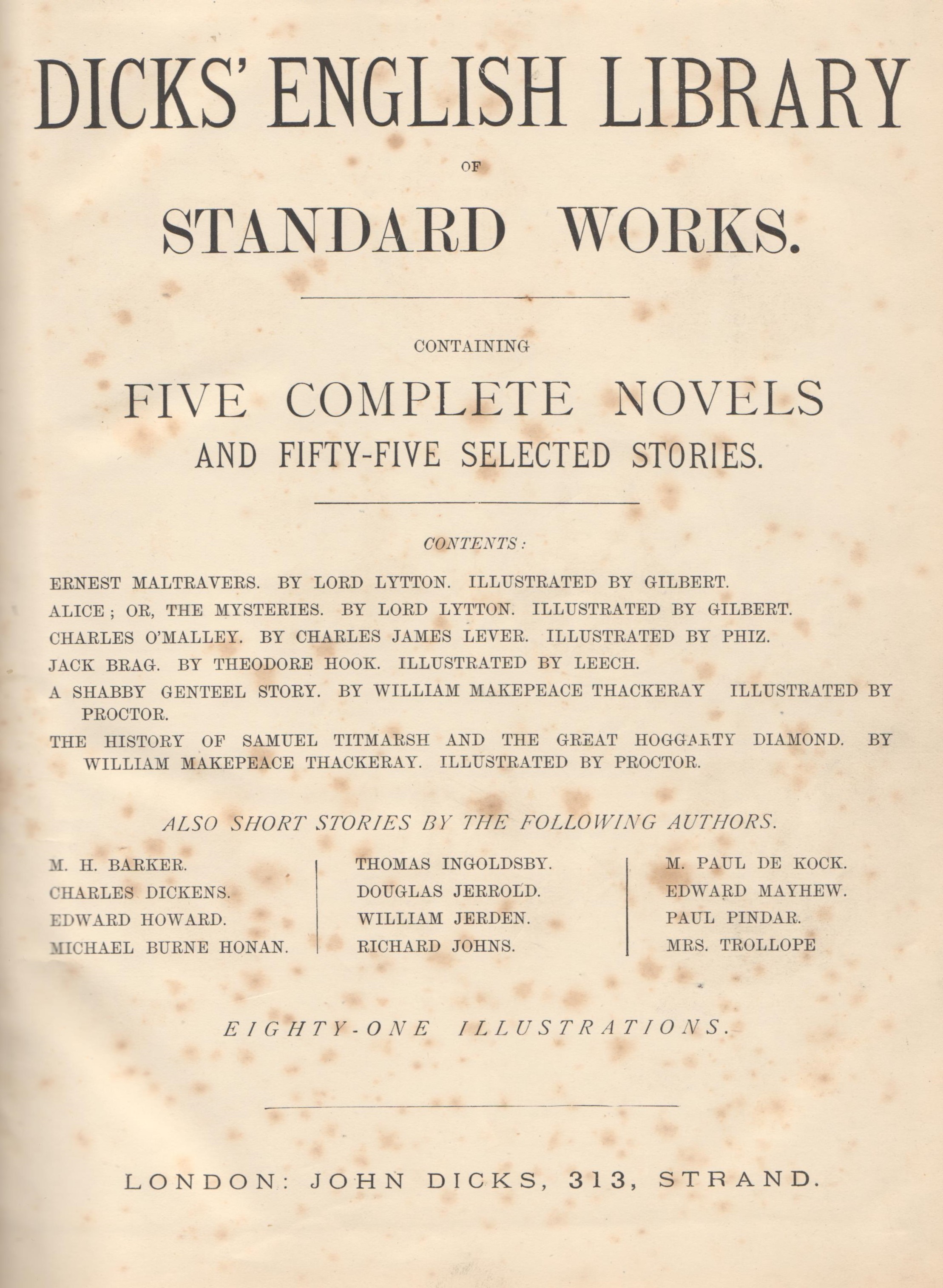
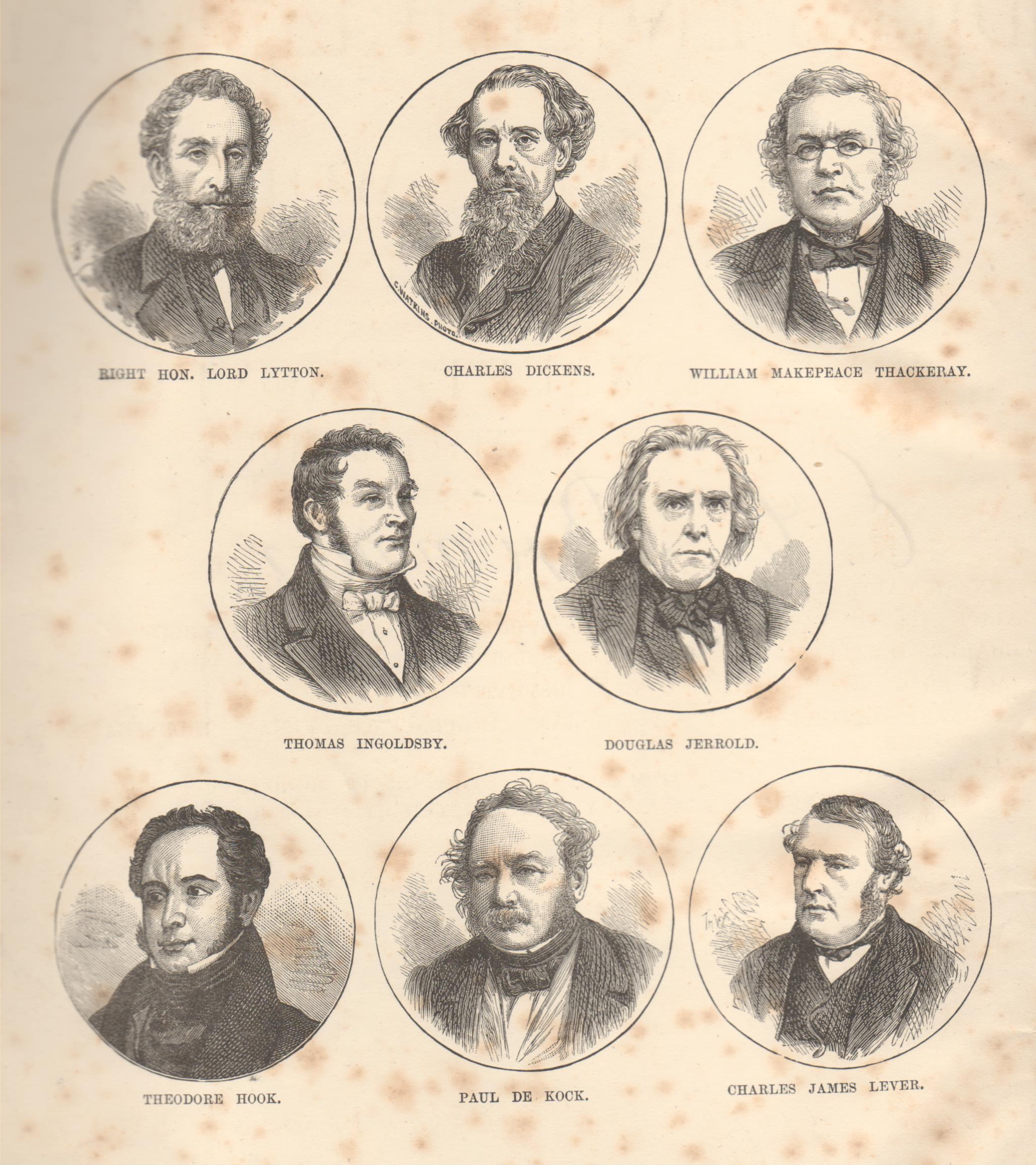
John Dicks, Publisher, and “Dicks’ English Library of Standard Works”

My thanks to Louis James for the gift some time ago of six volumes (bound as 3) plus 10 monthly numbers of Dicks’ English Library of Standard Works and, in anticipation, to Anne Humpherys’ ongoing research on Dicks and reprinting, to which this post is intended as a small contribution.

To both these remarkable scholars this post is dedicated.

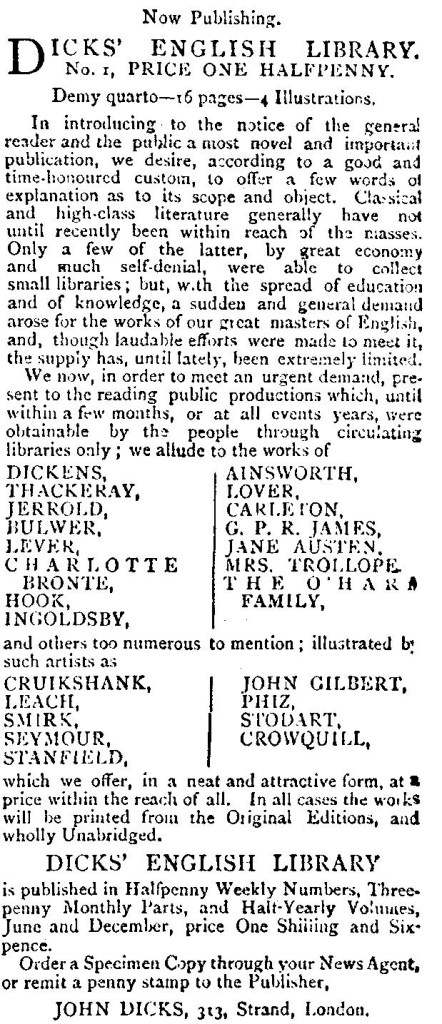
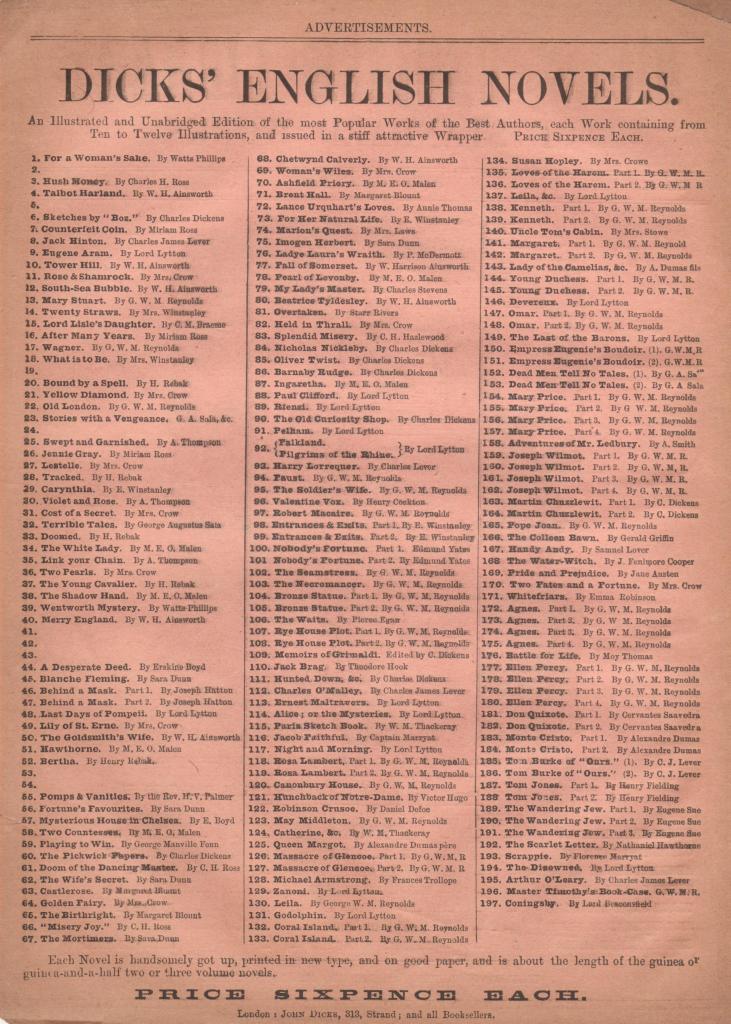
advert of Dicks own reprint series from Dicks English Library March 1884

As William St Claire has assertively reminded us on more than one occasion, the bibliophile connoisseur’s fetishisation of the “original” – the first – edition of texts has often occluded how reprints are actually more valuable in telling us about the cultural penetration of texts. The first edition is always to some extent “experimental” on the market. The publisher may have a good idea of who it will sell to and how how many copies will be shifted but the risk remains that he (for Victorian publishers were overwhelmingly male) may be wrong. Reprint editions still carry this risk of course, but to a lesser extent: the publisher already knows that the first edition or, indeed, the many previous editions, have sold and how quickly, and may even have evidence about who bought it, how the critics understood it, and so on. To that extent the risk is less. But reprints can also be aimed at radically different markets, as when Ouida is repackaged and sold in 6d form at the end of the century. The launch of a text in a new market may meet with considerable success, or it may not, so we cannot say with absolute conviction that reprinting involves less risk than first printing.

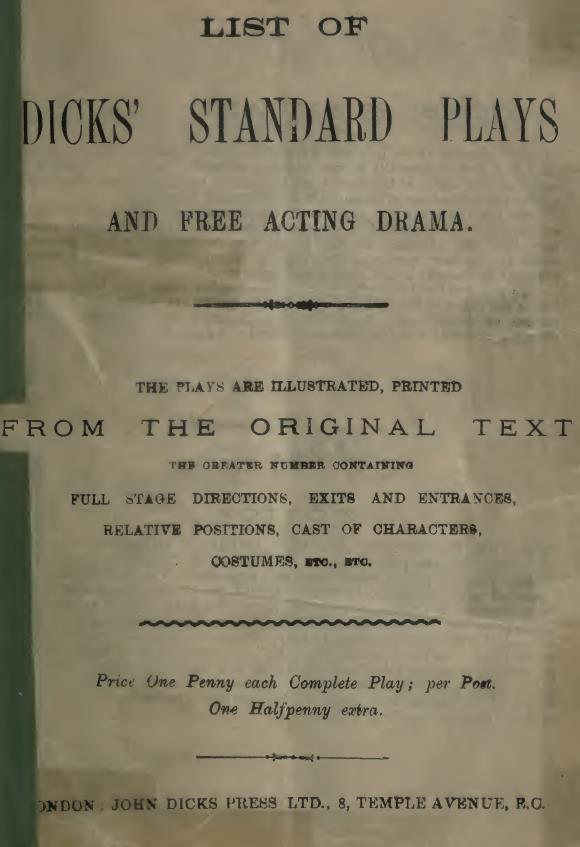
List of Dicks’ Standard Plays, c. 1884

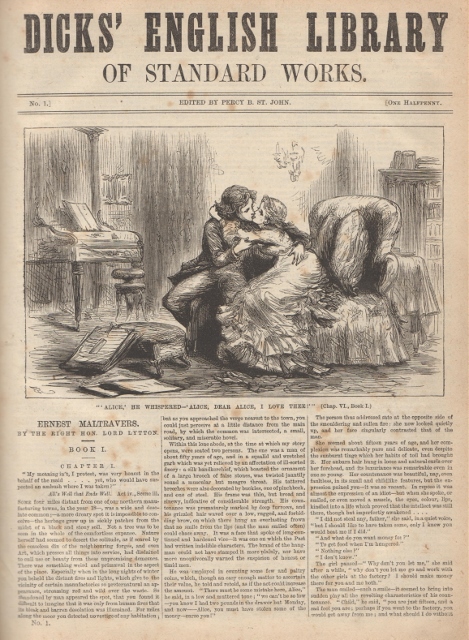
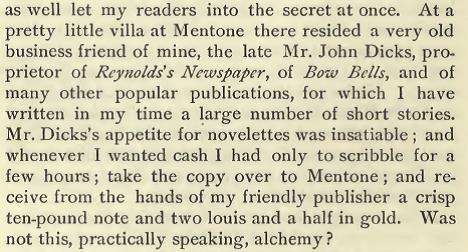
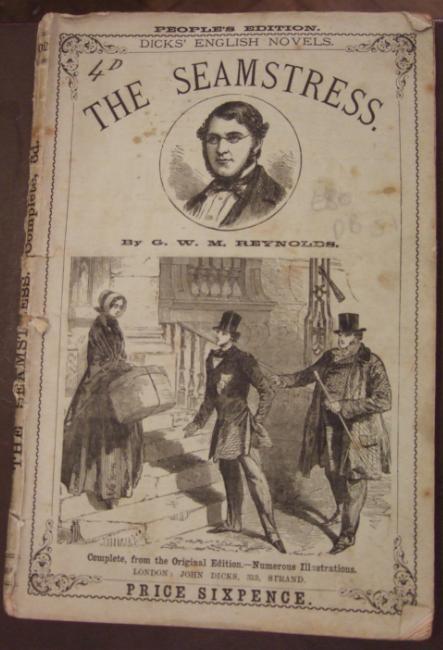
Anecdotally, one of the best selling series of reprints of the latter part of the nineteenth century comprised a periodical entitled Dick’s English Library of Standard Works. This was issued from one of the most successful London publishing houses of cheap fiction, John Dicks, on which there is almost no work at all outside an excellent volume privately published in 2006 by a descendant of the founder (Guy Dicks, The John Dicks Press, Lulu.com). Nonetheless, Dicks is certainly well known as a name not only to students of Victorian popular reading, to whom Bow Bells (1862-1897), Reynolds’s Weekly Newspaper (1850-1967) and Reynolds’s Miscellany (1846-1869) along with Reynolds’s Mysteries of the Court of London  (1849-1856) are all familiar, but also students of the Victorian theatre, for without the over 1,000 “Dicks Standard Plays” (published at a penny each between 1864 and 1907), many theatrical pieces would not be available to us at all.

John Thomas Dicks was born in 1818 and entered the London printing trade aged 14 or 15 “in a very humble capacity” (says the Bookseller in its obituary of Dicks, 3 March 1881). Around 1841 he became “assistant to P. T. Thomas, the Chinese scholar, who at that time was carrying on the business of publisher, printer and stereotyper to the trade on Warwick Square”. In the mid 1840s he started to be associated with  G. W. M. Reynolds and in 1863 seems to have amassed sufficient capital to set up as a printer and publisher at 313, Strand, London, where he entered into formal partnership with Reynolds.  After Reynolds died in 1879, Dicks bought his name and copyrights from his heirs for a very considerable annuity.

A major part of Dicks’ business, however,  already comprised reprinting which he organised into several  series, including “Dicks’ Complete Shakespeare,” and of course “Dicks’ Standard Plays” (see the first illustration in this post).

A measure of Dicks’s commercial acumen is suggested by  his death (in 1881) at his villa in Menton, a resort in the south of France where the European and Russian nobility kept their winter villas. Dicks also had a large house, the Lindens (which no longer survives except in the name of a post-war housing estate), in the exclusive west London suburb of Grove Park, Chiswick (the location was not accidental, for not only does the nearby railway station go to Waterloo, from where Dicks could cross the river easily to his office, but census data reveal that his wife was born in Hammersmith, the next suburb east of Chiswick). His estate, valued at “under £50,000” – a very considerable sum –  was left to his widow Maria Louisa and his sons Henry and John (see Ancestry.com. England & Wales, National Probate Calendar (Index of Wills and Administrations), 1858-1966 [database on-line]. Provo, UT, USA: Ancestry.com Operations Inc, 2010).  Clearly, cheap publishing and reprinting could be a very profitable business indeed.

The indefatigable journalist, gossip and bon viveur George Sala has an amusing anecdote at Dick’s expense, however, suggestive of how despite almost all authors’ interest in money, financial and cultural capitals might be inversely proportional to one another. It’s part of a longer story about his encounter at Nice with a “Captain Cashless”  –“ middle-aged, good-looking, well-preserved…  spent most of his money before he came of age; lived for several years on the credit of his credit; is a widower and spent every penny of his wife’s fortune” (Life and Adventures of George Augustus Sala, volume 2: 293). The Captain cannot understand where Sala gets his money from, but Sala feels he might…

Sala, Life and Adventures, Cassell, 1895, vol 2: 294

Sala lets us know that he can just toss off this profitable magic, turning the lead of his scribbling pencil into financial gold he can spend (and no doubt dispend) in Monte Carlo with his friend the glamorous rake. His methods of income generation and expenditure here seem to mirror one another in their low “real” value: both are fun, light, silly, worthless entertainments; good times, easily come by, easily left; in all Victorian senses, “fast”. In an analogue of the bibliophile connoisseur’s dismissal of the reprint as repetition, Sala dismisses his tales as the result of iterable alchemical formulae or repeated tricks of prestidigitation he has learned in the trade. Yet besides their illustration of the distance between cultural and financial capitals, such stories by their very comedy can hide from us the very serious business sense that lies behind them. It’s not that the fun is deceitful – on the contrary, without it there would be no commercial success – but that it is only one side of the coin.

Dicks English Novels no 102: G.W. M. Reynolds, The Seamstress

 Turning now more specifically to the reprinting side of Dicks’s business, in the 1870s  a series of 6d volume-form reprints under the generic title “Dicks’ English Novels,” began to be published: they cost 6d and seem to have started as reset versions of novels originally serialised in Bow Bells. They also recycled the original illustrations. Many other novels were soon added, including, after the copyrights had been secured, works by G.W.M. Reynolds (see the image on the right for an example). In the end almost 200 titles were published in this series (more of which below). It was so successful a second series was begin in 1894.

After his death, Dicks’s sons developed the reprint with Dicks’ English Library of Standard Works, a periodical consisting entirely of the  serial re-issue of well-known novels. It came out in the usual 3 formats: weekly comprising 16 pages with four illustrations (costing 1/2d); monthly, consisting of the weekly numbers for the month costing 3d, in orange covers comprising mainly adverts; and in volume form of 416 pages plus title page and frontispiece costing 1/6. “Dicks’ English Library” was a quarto – the same size and format as most 1d or 1/2d periodicals such as the London JournalBow Bells or Reynolds’s Miscellany – and was first published on 27 June 1883. It ran for 38 volumes right up to 2 March 1894 whereupon (just as with Dicks’ English Novels”) a new series was started. Percy B. St. John was the editor of the first few volumes.

A typical announcement for the periodical can be seen here, justifying its publication not (of course) in commercial terms but in those of Whig public utility  that could have come from the 1830s. (The following is from the Pall Mall Gazette, but similar adverts were placed all over the press)

The Pall Mall Gazette, 21 June 1881: 15

Besides the  list of authors above and the more obvious suspects in the world of Victorian popular fiction – G.W.M. Reynolds, Bulwer Lytton, Charles Lever, G.P.R James, Captain Marryat, Paul de Kock and Dumas ‑  also included were Mary Shelley’s Frankenstein (and Percy Bysshe’s Zastrozzi, both illustrated by the well-known illustrator Frederick Gilbert – Shelley’s complete “Poetical Works” are published later in the series), Maria Edgeworth’s Belinda, Austen’s Sense and Sensibility, Hawthorn’s Scarlet Letter and Godwin’s Caleb Williams. Most intriguing (not least from the point of view of copyright) is the heavy presence of Dickens, including, later on, Dombey and Son as well as numerous individual tales.

The reissue of these texts cannot be taken to be an unalloyed index of popularity amongst the readers of cheap publications. The Dicks firm is clearly aiming at respectability and the aspirational reader keen to build up that sign of cultural capital, a “library” – the page numbers of each weekly and monthly number are incremental, asking the reader to keep them so as to build up the volume. The Shelley poetry may have been suggested by the revival of interest in him amongst the literati with Rossetti’s Moxon edition in 1870: it is a mark of what the public should aspire to rather than of already extant popular demand. Publication in this form is no indication that any particular author was read unless the author’s other works are also issued, and even then business reasons other than consumer demand may have prevailed – for example, copyrights might have been bought as a job lot in advance, and accordingly had to be exploited, or there were vacant pages that had to be filled with works whose copyright had lapsed. One also has to take into account what other works were serialised with, before and after any particular text, for it may be any or all of those that carried the periodical through rather than the particular text one is looking at.

What one also has to do is try to establish the publishing history of a series. Adverts are always useful for this and one on the monthly cover of “Dicks’ English Library” (October 1888) shows that by then 197 titles had been published in the “Dicks’ English Novels” series for example. The missing titles were presumably exhausted, but they can be identified by reference to other adverts elsewhere, either in other publications or earlier in the series (cf. the following with the first image of this post).

advert of Docks own reprint series from Dicks English Library March 1884

The history of the Dicks reprinting series has yet to be mapped: even a basic bibliography is lacking. After that is done, one of the many questions that can be answered concerns the relations of synergy between the various publication forms: for example, how far did the English Library reprint works previously available in the volume-form English Novels series? More complex questions can also be addressed, including the implications for the history of the canon, its creation, modification and its reception – if any – of the publishing choices of  this financially rich but status-poor house. The use of a garland of portraits of authors as a frontispiece for “Dicks Standard Library” suggests the prioritisiation of some authors over others: this prioritisation needs to be charted and compared to the number and positioning of authors actually published (a front-page author is lent greater prominence than one whose work starts on a middle page, for example).

These, and many other questions about this most interesting publisher, still await answers, and we look forward to them in due course.

Hollywood’s Grandmas Part 3

There is no sustained recent work on either Harriet or Leon Lewis, although there is a brief post on the both at http://www.ulib.niu.edu/badndp/lewis_leon.html and another on Leon (whose real name was Julius Warren Lewis) at John Adcock’s Yesterday’s Papers site.  Harriet has not benefited from the recent revival of Southworth and other American women writers. Most of the information about her in my London Journal book therefore came from the letters in the Bonner file in the New York Public Library. Brief obituaries of Harriet appear on 21 May 1878 in The New York Times (p.1), and The New York Herald (p.5) and a particularly affectionate one in the New York Ledger itself (4 June 1878, p. 4), largely devoted to reproducing extracts from Harriet’s last letter to her editor Robert Bonner, with whom she entertained a very good relationship.

Leon and Harriet had married in 1856 when she was 15 and he 23 with already a very colourful career behind him. Leon was to run off with another 15 year old soon after Harriet died, aged 37, of a botched gynaecological operation). The copious letters from Harriet and Leon suggest that Leon blusteringly carried on the business and squandered their money while she laboured over the novels – including some under his name.

Yet it is a letter from Leon to Bonner that is particularly interesting for its revelations of how American writers dealt with the transatlantic market.

9 April 1873

Dear Mr Bonner

We hasten to return by first mail the London letter and to reply to the question with which you accompany it.

You refused us the proofs 4 years ago, saying (in substance) to Mrs L. that if she were to have them she would be likely to give undue prominence to the thought as to how the stories would suit over there, etc. (which, by the way, was a mistaken estimate of her character).

We or you or all of us have consequently had some $1500 or $2000 yearly less income during the period named than we might have had. Mr Johnson, of the London Journal, and others have repeatedly written to us to this effect, but we never replied to more than one in ten, and then only to say (you having refused us proofs) that they were not at our disposal, etc.

The next thing in order of course were offers for original stories – i.e. for manuscripts – but a like answer was returned, although the offers made exceeded any sums that had ever been paid anywhere by anybody for anything in the line of stories.

And under this state of things it became a question with Sunday English publishers as to which of them would derive the most benefit from republishing from the regular Monday Ledger Mrs L.’s stories.

That is a race of printers of which we do not propose to constitute ourselves the time-keepers. We can do no less, however, than except Mr. Johnson, of the Journal, from the general condemnation. True, he reprinted the stories without authority and without paying for them – (since he could’nt [sic] have them for pay) – but he has done so under certain conditions which command attention from their rarity:

1st – He has given the name of Mrs L. and even given her a standing qualification of “celebrated American authoress”

2nd – The London Journal is of ten times more literary importance and pecuniary value than all the rest of the story papers of the British Empire kingdom [sic] put together. The sum of $3,750,000 (£750,000) has been vainly offered for it to our own certain knowledge. [Here an unidentified extract from a book or magazine is pasted into the letter claiming the excellence of The London Journal. The sum Leon quotes is absurd]

3rd – During our stay in London in ’71, (as we must have told you upon our return) Mr Johnson called upon us at Morley’s [Hotel], offered us every civility, private boxes at theatres, invitations and introductions, etc. and upon the last day of our stay pressed upon Mrs. L a roll of bank [sic] of England notes, as an acknowledgement of the good he had derived from the stories, even in the face of sharing them with everybody else and under all the adverse circumstances – at which time he renewed his offers for proofs, as also for stories written expressly for him.

And now is this Mr Fiske [Amos Kidder Fiske (1842-1921), editor of the American fiction paper, The Boston Globe] more to you than we are that you should “aid and abet” him with the proofs you have so expressly refused to us, and so drag our names into a wretched squawk of a paper that could not possibly last three months, and during this period exist only in obscene contempt? After all you have been to us and we to you – after all we know of your heart and brain – we shall require your written declaration of preference in favour of Mr. F. before we will believe it!

Excuse scratches. We write in haste to catch the mail.

Ever yours,

Leon and Harriet Lewis

For all Leon’s protestations, The London Journal must have been supplied with advance copy of Harriet’s novels since 1869 (when Leon had first asked Bonner for proofs of her novels). Even more consistently than Southworth novels, Harriet’s appear in the New York Ledger and The London Journal at the distance of only a few weeks at most – anyone could work out that for that to happen advance sheets must have been sent across the ocean. No wonder Leon doesn’t want to be a timekeeper in what he calls the “race of printers” – Bonner no doubt had already made his calculations and come to the logical conclusions.

Leon’s also anxious to redefine the tag he claims The London Journal gave to Harriet. This was – he’s right – placed under her name in all of her novels  until Edda’s Birthright, published in The London Journal and the Ledger 3 months after Leon wrote the letter transcribed above. But the tag of “celebrated American authoress” was only part of a longer notice. What the notice actually said was that The London Journal’s was “[t]he only edition in this country sanctioned by this celebrated American authoress”. The full tag was less a celebration of Harriet than an assertion of right.

The tag had been prompted in the first instance by the appearance of Lewis novels in The London Reader, a magazine run by no less than George Stiff, the former owner of The London Journal, from right next door. While almost all London Reader serials are anonymous and with altered titles and sometimes names of principal characters changed, it’s hard to trace the originals, yet it had carried novels with Leon’s signature in 1866-7 (The House of Secrets, 4 August 1866 – 12 January 1867) and in mid-1867, followed by one with Harriet’s, The Golden Hope. More recently, the Reader had somehow published The Hampton Mystery, a version of Harriet’s first novel in The London Journal, The Double Life; Or, The Hampton Mystery a fortnight earlier than the magazine which was published literally next door, The London Journal – which was, it seems, now forced into declaring that it alone had the only sanctioned edition. Since the original had been published in America at exactly the same date as in Reader, it was impossible for Stiff to obtain a copy and put it into print by anything other than advance sheets. Later, Harriet’s Tressilian Court (1871) will likewise appear in The London Reader a week before The London Journal’s version, and Lady Chetwynd’s Spectre (1873) at exactly the same time.

What’s happening here? One possibility is that Stiff was raiding the mail intended for his former magazine and now rival next door. While he’d certainly done this sort of thing before, there are other possibilities too.

It is clear from the Bonner letters that Leon was a spendthrift and a gambler. After Harriet had procured fame and a good deal of money for them both since first appearing in the Ledger in 1862 (aged 15 and already married to Leon), he had sunk very deeply into debt. Bonner, who was clearly very fond of Harriet, kept lending the Lewises money which she would pay back by writing several serials simultaneously for him under both her and Leon’s name (romances under hers, adventure stories under his): eighty-one numbers spread over five novels managed to pay off $6075 at half rates. It seems to me very likely that the Lewises sent The London Journal AND The London Reader – and quite possibly other magazines that I have yet to discover –  advance copies of Harriet’s works to increase their already huge but always insufficient income.

What I’ve hoped to show in this and the previous blog posts is that in the cases of these three women – May Agnes Fleming, E.D.E.N. Southworth and Harriet Lewis – one cannot talk of “piracy” in the sense of a foreign publisher robbing an author. Two of the women had “exclusive” contracts with their American publishers which they broke quite legally by dealing also with publishers in Britain. Even when apparently straight piracy occurred, as with some novels by Southworth and Fleming, the writers still benefited from this in the end.

As we have come to realise more and more, nineteenth-century women writers were by no means all victims of a male publishing establishment. These three indeed, through translation, achieved a global circulation far beyond the transatlantic anglophone axis that I have focussed on here. In that sense they prefigure Hollywood by a good two generations – they are Hollywood’s grandmas indeed. The implications of that must await another set of posts.