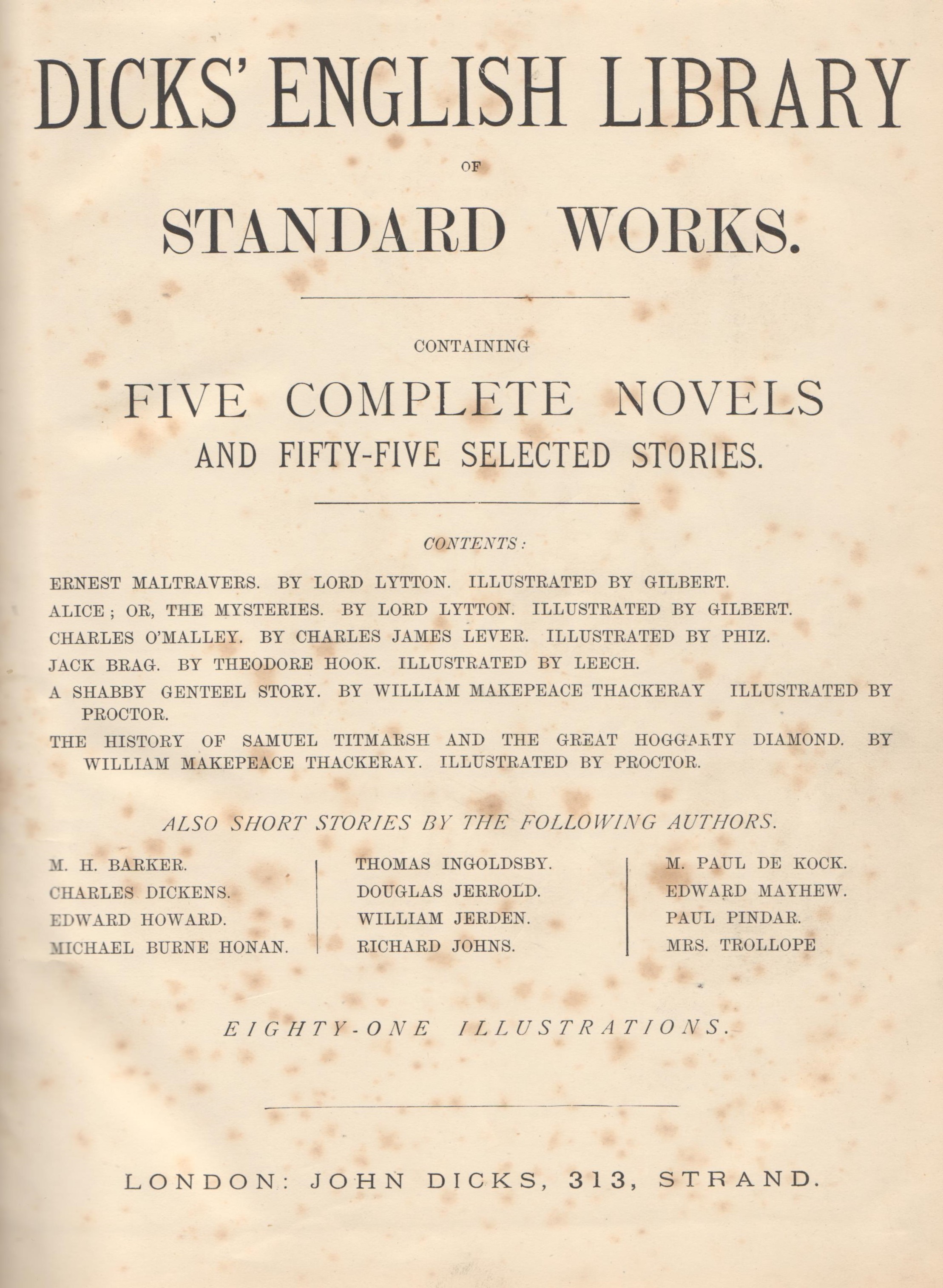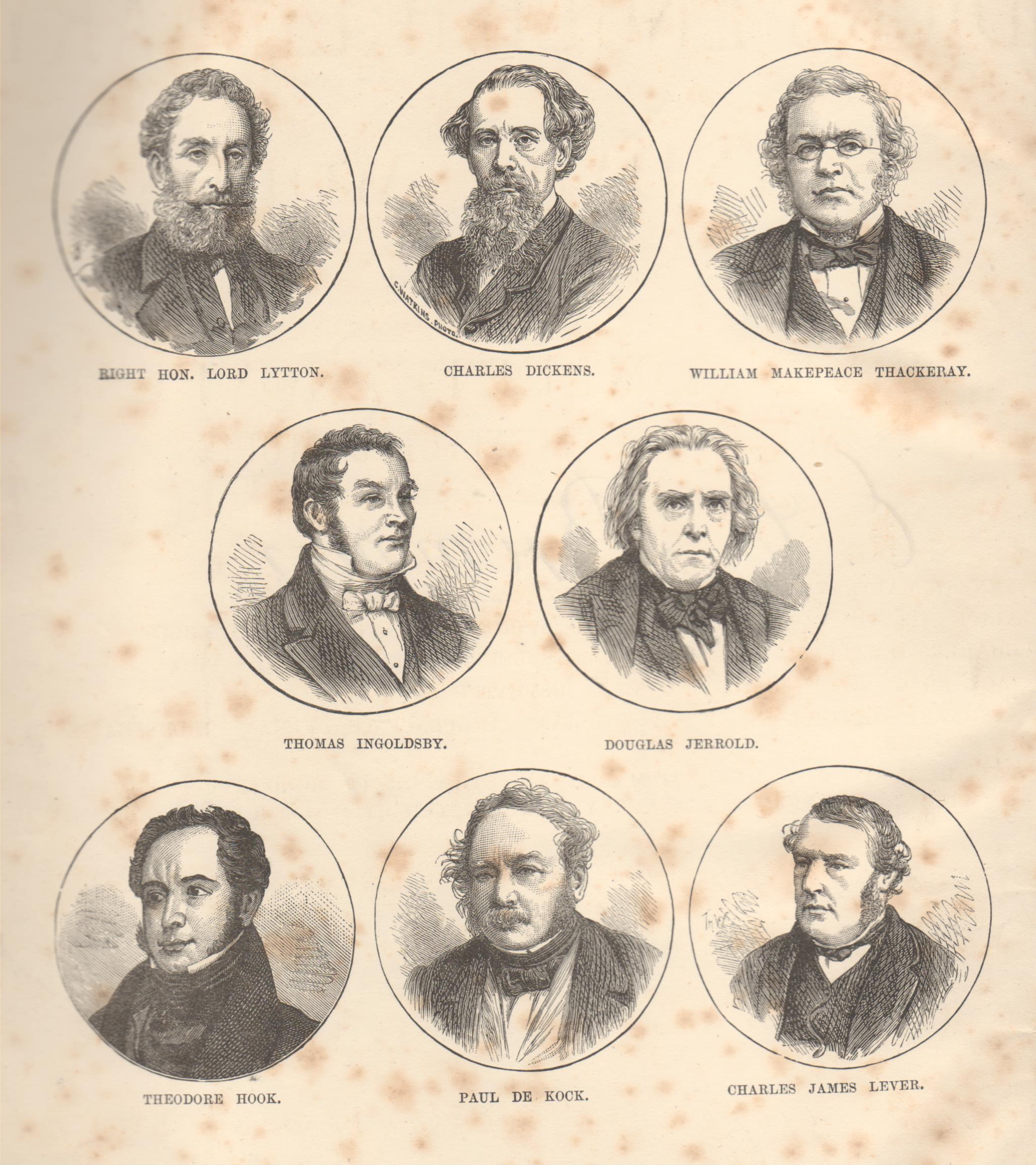
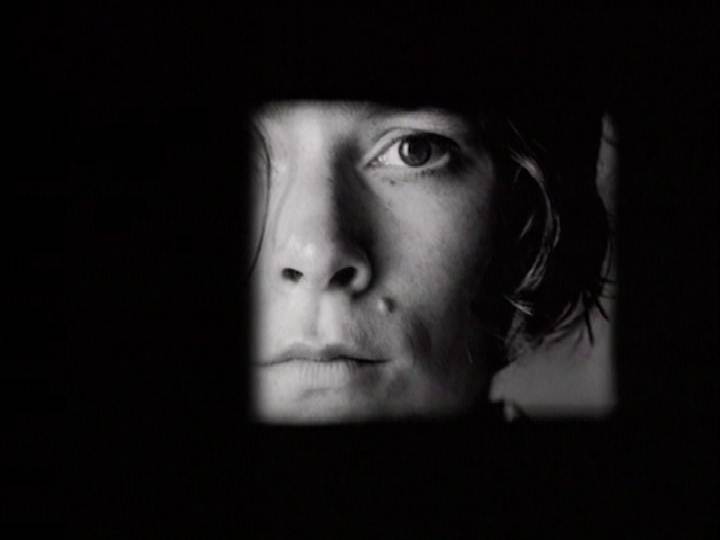
Angels and Demons: Lulu and the Copula Act 1

In 2010 I organised a conference on Angels and Demons at Canterbury Christ Church University. This resulted in a  special number of Critical Survey on the topic in 2011. Keen to promote my colleagues’ work rather than mine in the limited space available, I never expanded and published the paper at the conference that I had only a few days to prepare for when a speaker was forced to withdraw. I had to use what was close to me as a person physically, intellectually and emotionally: that shows!

The other papers looked at the first and last words of the title. Typically for me, I examined the smallest, neglected word: the ‘and’ of the title.

Here it is, more or less as delivered, in three parts.

Angels and Demons: Lulu and the Copula

Act 1

Nothing like beginning at the end, especially the end of Alban Berg’s unfinished opera Lulu, and a double murder by Jack the Ripper of someone we hear described as an “angel” and of the woman in love with her, a personification of the New Woman, the Countess Geschwitz, who plans to leave the garret to go to university to study law and fight for women’s rights.

NB CONTENT WARNING for violence : from the 1979 Chereau production of the completed three-act version

The important point is that this scene, the last from the opera, pretty unequivocally suggests that men really don’t like women!  Men murderers of angels really are devils, aren’t they? 

From the way the countess’s decision to fight for women’s rights is thwarted by her murder, you may have decided already that Jack is a representative figure of something beyond himself, perhaps standing for the general category “misogynistic, conservative, reactionary man”. Certainly the idea that Jack represents the revenge of men  on uppity women is a very common interpretation. For some critics, the work even becomes the tragedy not of Lulu, but of men who are forced to violence by such women (not a conclusion I agree with I should add).

And then the music… this isn’t just any old double murder of women by a man, of course, but a double murder in the 1930s high modernist opera by Alban Berg: Lulu, a work championed (and criticised) by no less an enemy of mass culture than Theodore Adorno.

One might well ask whether the demon is not Jack the casual murderer of would-be liberated New Women, or even women who supposedly make men behave in violent ways,  but exclusive avant-garde texts like Lulu. After all, everyone knows who Jack the Ripper is – he has generated a vast amount of material dedicated to him. We might say he has a vast fan base. We even go on Jack the Ripper tours in London’s East End. Jack is popular.  Berg’s Lulu, by contrast, is hardly the Glaswegian singer who won the 1969 Eurovision  Song Context with “Boom Bang-a-Bang“. It’s “hard”, difficult, unpleasant; this Lulu doesn’t follow the musical rules we are familiar with.

Yet it’s clear just from the inclusion of the figure of Jack that the opera attempts to take on board the violent hierarchy of popular and exclusive. For the conjunction “and” can be used in various senses – inclusion yes, but also to signal (and perhaps interrogate) a hierarchy of difference: good and evil, man and woman, angel and demon. In questioning the hierarchy of popular and exclusive as well as the other binaries I’ve just mentioned, Lulu is like many operas of the period, such as Ernst Krenek’s Johnny spielt auf, or several of Franz Schreker’s operas (perhaps most of all Die Gezeichneten). Certainly in some places it reworks then-popular dance forms, jazz rhythms and instrumental colourings.  Lulu even takes on the film industry – already dominated by Hollywood by the time the opera was being written between 1927 and 1935. A performance of Lulu as Berg wrote it has a film at its very centre, a 3-minute action-packed short very different from Pabst’s lingeringly aesthetic film on the same subject as the opera, Pandora’s Box of 1928, starring the wonderful Louise Brooks. Despite the claims of a few breathless writers, even the Pabst film was never “popular” in any sense. When it premiered in Berlin in January 1929, it was almost entirely ignored in the excitement of the new “talkies” that were grabbing public attention in Europe and America. Brooks herself was slashed by the critics. It took until the 1950s for the film to be appreciated by the cognoscenti in the art house. Unlike the retellings of the tale and figure that Karen Littau and Shelley Berc have detailed for us, the Lulu I’m writing of here has never been popular for all its engagement with elements of the popular. Does that mean that I, as a historian of popular narrative, cannot or should not engage with it? Is it heretical of me to do so?

Like Pabst, Berg based his work on a pair of plays by the fin-de-siècle German playwright Frank Wedekind, Earth Spirit and Pandora’s Box which Wedekind worked on between 1892 and 1913. Many of the music critics who discuss the opera love the music. It is a highly ingenious form of dodecaphony and parades the signs of exclusive distinction that require long training to decode.  But they regard the Wedekind plays as belonging on the junk heap of literature, too low for the sacred realms of opera. What was Berg doing when he chose to set this shabby little shocker that sold out to contemporary bourgeois notions of the femme fatale and comprised a collage of the vulgar misogynistic commonplaces that Otto Weininger systematised in his 1902 Sex and Character? Wedekind’s Lulu plays seem uncannily to agree with Weiniger’s fantasy that Woman has no ethics, logic or soul and therefore can only see with a blank stare, that Woman is totally materialistic and has no spiritual or intellectual side. It’s all wonderfully summed up in a notorious quotation from Weininger, “Man possesses sexual organs, her sexual organs possess Woman.” The New Woman we see murdered at the end, who plans to go to university to study law so that she can fight for women’s rights was, so her beloved Lulu tells her, half a man. Lulu herself can be regarded only too easily as the quintessence of Weinigerian Woman, as a one-sentence narration of her life will demonstrate. Having started as a child prostitute and thief, Lulu goes through three husbands, murders the last of them, escapes from prison through the machinations of her lesbian friend, runs off to Paris with the son of her third husband, and ends in a London garret as a prostitute.

Wedekind wrote his original version as Die Büchse des Pandora, ein Monstretragödie (“Pandora’s Box, a Monster Tragedy”)  between 1892 and 1894 as a single 5-acter, monstrous both in length and subject matter. If you thought the ending in the opera was shocking, in the original Jack the Ripper explicitly knifes out Lulu’s genitals and fantasises about how much the London Medical Club will pay for them. Partly because of this ending, Wedekind’s publisher thought the Monstretragödie would provoke prosecution for obscenity. He therefore persuaded Wedekind to publish just the first three acts of his play which dealt with Lulu’s marriage to each of her three husbands. Subsequent versions of the play which Wedekind wrote (including splitting the original 5 acts into 2 plays) attempted to negotiate a path between the censors and desire for popularity through sensation. Berg condensed his opera from the published two-play version – we know from a surviving seating plan that he went to a private performance of the second play in 1905 and that this performance and its paratexts influenced him. By recombining the two plays, therefore, Berg was returning them to their original structural integrity.

To me just as shocking as the murders is the number of music critics who choose to ignore what they regard as an unworthy text to concentrate instead on analysing the fabulous intricacy of the music – Adorno amongst them. What is at stake in this violent excision of words? This what the other parts of this blog will seek to answer.
(to be continued)

Angels and Demons: Lulu and the Copula Act 3

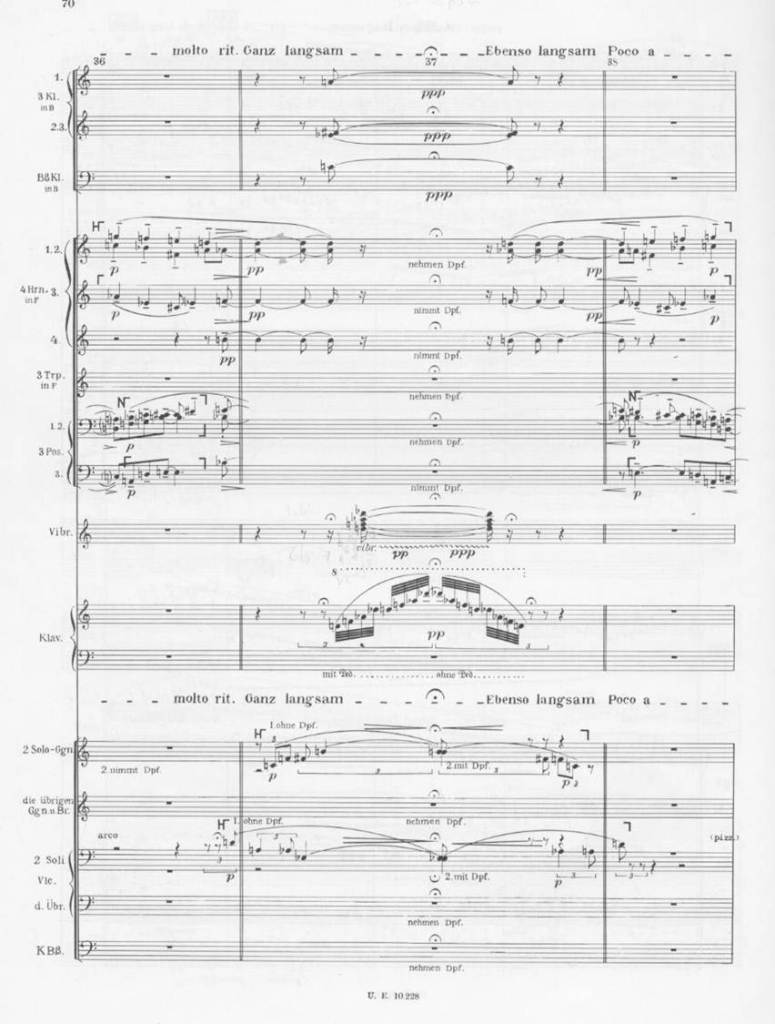
The previous post closed with a perhaps outrageous claim to have noticed something that specialised music critics have not. But the point is not difficult to argue. Let’s look again at the extract from the score I printed in the previous post.

Lulu centre again – but note the direction to the performers to put mutes on their instruments, and the fade of the vibraphone from pp (very quiet) to ppp (extremely quiet)

Notice the directions nehmen Dpf in the middle of the page – put the mutes on. For the music is played backwards with all possible instruments muted. This signals a difference from the first half, an addition subtle on the page but decidedly audible in performance. To an audience listening as opposed to a reader reading, that is, with the remediation of the text through the technologies of musical instruments from the printed visual to the aural, the palindrome does not signal a suspension of the arrow of time. Rather, it emphasises time’s passage by highlighting difference in similarity.

This is certainly the case with the narrative palindrome that Berg creates. By the last scene, when the husbands start returning and taking their revenge, we in the audience have been so well trained by the patterns in the opera that we know the narrative law.  And we are given a choice. Do we simply accept the law as an inevitable given, as part of the human condition, or do we rebel against its violent inflexibility? Do we want this structure to be enacted?

I want the ending to be different. I want Lulu to escape Jack and for the self-sacrificing Countess to study law and fight for women’s rights. I do not want men to take revenge, as by this time I, though a man, have come to see Lulu as a human being. I want transcendence from my own gendered, socialised subject position, I want the cycle of suffering to be broken. My engagement with the performance and its technologies (as opposed to just with the technologies of print) has caused me to distance myself from a community of people who automatically assume the rightness of the lex talionis.

Alternatively, if I do want it – and parts of me do, confiteor – I am encouraged to ask myself about the moral stature of my sadistic misogynistic desire, my conservative desire to remain within a community of vengeance.

Lulu in the final scene puts my progeessive and conservative desires in dialogue with one another.
By listening to and watching, by experiencing a performance on stage, I, already split, have also become linked to Lulu. If the title of the opera follows the tradition of naming a work after the solitary protagonist like Tosca and Fidelio – it’s not Tristan und Isolde, or A Village Romeo and Juliet ‑ I nonetheless supply both the conjunction the missing adjunct: Lulu and me. Who of these is the angel, who the demon? Am I Jack or Lulu or both? The and here is not, as I’ve already explained in a previous post, a simple conjunction: it is an implied copula fot it suggests identity through linkage. Lulu and me suggests that I am Jack or Lulu or both?

In this last part, I turn to one of the many recurrent passages that is never subject to palindromic treatment, the coda to the sonata form associated with Dr Schön,  Lulu’s third husband. This is the music of Lulu’s desire to be loved by Dr Schön, the man she wanted to be married to at the start. She wants him to recognise her as a valid human being. She wants him to recognise that she is. It’s all she’s ever wanted, as she says in one of the terrible quarrels they have. The first time the musical passage appears, she recalls her childhood as a street urchin and thief in spoken words that ensure the audience understands them:

“ ‘My husband’… If I belong to anyone in this world, I belong to you. Without you, I don’t know where I’d be. You took me by the hand, you gave me food and clothes, even though I was trying to steal your watch. Do you think I can forget that?”

Alban Berg, Lulu, vocal score, Universal Edition, 1936: 81 (“Coda der Sonata”)

Memory binds Lulu to Dr Schön: she can’t forget. And indeed, it is the power of memory that binds me to Lulu as I watch that last scene when Schön returns as Jack. I remember her story when this music returns, and that is why I partly become her.
What does Lulu give me in that memory? She does not give food and clothes. Instead she gives me the story of her life, an Other to my own. And then, to complicate the act of generosity that art always involves, the actress who plays Lulu gives me her labour and her skill. If successful, this is a gift beyond price, signalled by the ecstatic applause at the end of a performance which pays the artist beyond her fee, an act of recognition all of us who have performed need and know in our flesh more than in our pockets.
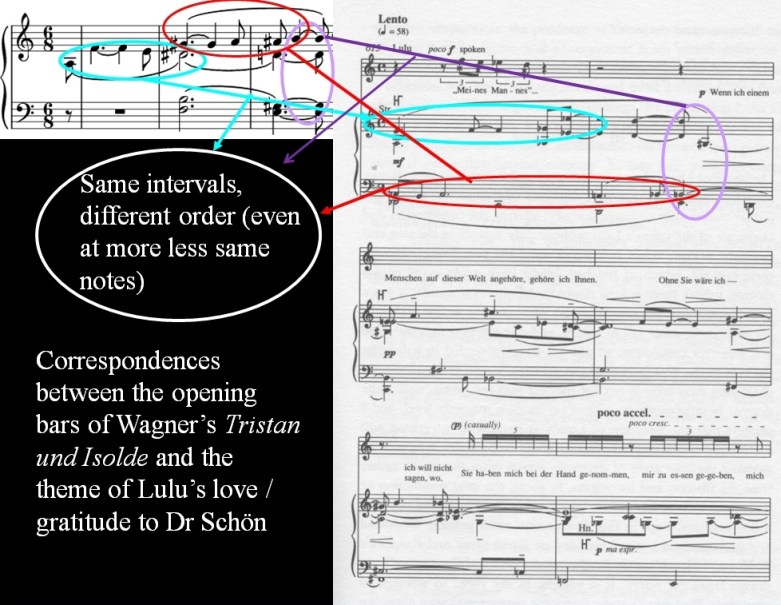
Now, though no previous critic has pointed this out, I think it clear that Lulu’s gratitude  music owes a debt to the very first motif in Wagner’s Tristan und Isolde. The first four notes have the same intervals but are played backwards and upside down, the whole filtered through the emotional and orchestral lens of late Mahler (itself deriving from Wagner).

How the opening bars of Wagner’s Tristan und Isolde become the theme of the heroine’s Gratitude/ Love in Berg’s Lulu

Lulu’s music of gratitude and love is by no means the music of absolute modernity and abstraction from history. Its reworking of Wagner declares itself to be very firmly within tradition, within a historical community of texts: Berg and Wagner, not Berg in splendid isolation. The reworking is a memory and acknowledgement of history, of community, of society — and therefore necessarily of ideology. The music of gratitude can even be said to acknowledge its debt by mirroring back its donor: Wagner is acknowledged as the source. This is exophoric reference, an intertextual repetition. It is not the abstract kind of repetition without ideology that Adorno and his followers have praised. It is an and of textual community.

My point is that repetition, even the retrograde of the palindrome, does not necessarily mean timelessness, the absolute of utter novelty that is the orthodox claim of high modernity, or a refusal of ethical intervention into society that is pure deixis. On the contrary:  repetition of the intertextual kind (and there are many such in Berg) and even palindromic repetition, necessarily imply memory, a coupling of the past to the present that enables future action.

I remember and I am reminded of Lulu’s gratitude to Schön and her desire to be recognised by him every time this music recurs.  Its last appearance is in her conversation with Jack, the reincarnated Schön, when it is conjoined effortlessly with the music of Lulu’s beauty that we first hear when she is presented by an animal tamer in the Prologue. Jack and Lulu discuss money: he, rather than she now, takes more and more in incremental demands, an inversion of her financial dependence on Schön – except that he takes everything. (“Gib mir das ganze” – “Give me everything” –  In Gottes Namen” – “In God’s name” replies she, as if acknowledging the operation of Biblical lex talionis)

When Jack stabs Lulu we have been reminded he is killing a human being who only wants to be loved as she is. When he kills the Countess we have been reminded, and afterwards in her Wagnerian Liebestod will be reminded again, that he is killing a human being who only wants to live for others. Our Weinigerian misogyny at this moment will be pressured by our affective involvement, by our feeling for and with Lulu and the Countess.

That sounds very sentimental. Indeed it is, in the eighteenth- and nineteenth-century sense. This is a political tradition of sentiment that in the nineteenth century was practiced especially by women for the sake of women and other oppressed people – Harriet Beecher Stowe’s Uncle Tom’s Cabin is perhaps the most famous and impactful example of its deployment. Ouida operated within it, as did the American mass-market abolitionist and proto-feminist novelist E.D.E.N. Southworth. Better known today is the political sentimentality of Dickens.

This is not the sentimental tradition of, say, Violetta or Mimi – those archetypal operatic women who are thrown away when used up, who die of consumption literally and metaphorically and whose voluptuous deaths we uncritically enjoy so much, as we are reminded by Catherine Clement in her famous 1979 book on Opera and the Undoing of Women. That is the version of commercial sentimentality that Adorno hated. Instead, we are talking of a use of emotion to stir the audience to political action. Such action may stem from a humanistic ideology that not so long ago it was the fashion to excoriate and altogether repudiate. But at least action is possible (indeed necessary) in that ideology.

We also have to ask if Adorno’s belief in the possibility of escape from ideology and the personal is actually only a blindness to the very material conditions which permit that belief. After all, Universal Edition, Lulu’s publishers, were and remain a very canny publishing house as moiled in capitalism as any Hollywood studio. Adorno’s argument depended on a printed text produced by Universal to  show how Berg was unideological and passive, resistant to action. My main issue with him here is not blindness to the capitalist materiality of what enabled his anti-capitalist praise of inaction and formal perfection, nor his praise for the hard, the difficult, the challenging, the unpopular, but his rejection of the sentimental through praise of the abstracted and neglect of performance.

Sentimentally, I refuse to be either abstracted or mono-media.

To move us to action a link must be made with  us.  And this is the conjunction-copula that binds the work of art to us. Lulu’s escape from ideological constraint, pace Adorno, lies not in its abstraction of structure and a purity of absolute decontextualised modernity. That idea relies on the media technology of printed scores, itself a product of industrial modernity of which Adorno was the salesman of a specific sector. Instead, opera, when it is successful, like theatre in general, offers us the conjunction-copula – the verbal force of and – of Carmen and Don Jose, Lulu and Dr Schön, murdered and murderer, actor and audience, popular and elite, text and performance, even the Angels and Demons with which we began.

I stand with Cixous in her remarks on opera and theatre. A performance of Lulu offers the time of pity in its examination of the uncertain differences coupled and defined by a conjunction, the messy relation of memory, of today and yesterday, of the popular and exclusive, of men and women, of Angels and Demons, of Conservative Communities and New Possibilities, Others and Us.

And is not a simple parataxis devoid of force; it is a part of speech that, when examined, can and should result in calls to action. It is in this sense that and can be a copula (pace Adorno here).

What that action will be depends on the force of both strictly verbal copula and conjunction that our stories, our art, our ethical commitment can generate.

Christine Schafer as Lulu in prison, from the centre of the central film in the 1997 Glyndeborne production,

The Book in the Twentieth Century Part 4: war and competing media

This historical definition of the twentieth century as related to book publishing over the last two posts have covered 6 elements: technology, ownership, regulation and distribution and conglomeration and the paperback format (the first post was an introduction). Before ending this consideration of the book in the twentieth century, I want to cover two more areas: first, the importance of war to publishing, and secondly, and inevitably, the relationship of book publishing to other media, a crucial characteristic of twentieth-century publishing.

We may not like to think this, but war is a time when information storage, retrieval and transmission of all sorts benefit from a lot of additional energy. We can see this in the effects of the Crimean and Peninsular wars in the nineteenth century on demand for newspapers, the effect of WWI on increasing demand for published images of the war and on staff shortages at printing works – which obviously caused its own problems – or what I’m going to write about here, the effect of WWII on the book as we know it.

In many ways, the second world war is just as important as any of the other factors outlined in previous posts.

First, WWII promoted the idea of a national literature which turn had a huge effect on the industry and on education. In America, for instance, it had an enormous impact on the consolidation of the canon of Great American Books. In 1941 was published one of the foundational books that came to define what was to be included in the American canon – and of course excluded from it. This was F.O. Matthiessen’s American Renaissance, a volume that set the syllabus for schools and universities for decades to come.

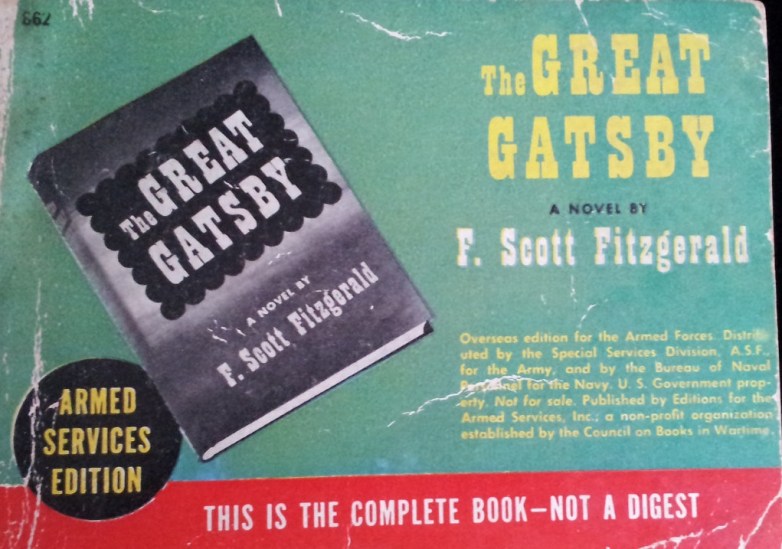
If this was what we may call a top-down effect, there was also some influence of what people were actually reading on what academics decided should be canonised: Fitzgerald’s Great Gatsby had sunk without trace, an utter flop on its appearance in 1925. Chosen for free distribution amongst the American forces during WWII partly because the copyright was very cheap, The Great Gatsby began to be read by large numbers of people for the first time. Following the war, academics who had read it when serving in the forces started to publish on The Great Gatsby and Fitzgerald in general.

More comforting – to me at least – than the idea of war encouraging an idea of a national literature, is the opposite: the idea of a world literature. It was a year after the war that Erich Auerbach’s magisterial Mimesis: Dargestellte Wirklichkeit in der abendländischen Literatur was published in Switzerland by Franke Verlag. Its research project was intended to show the cultural histories many of us share – a rebuttal of the divisions that the war between nations was using to justify itself. In its 1955 English translation the Auerbach became one of the founding texts of comparative literature, rightly praised (in my view) by Edward Said.

During the war there was enormous demand for reading matter: people not only wanted information on specific subjects such as the military – no fewer than 229 new titles were published on military matters in 1943 alone, as opposed to only 62 in 1937 – but military personnel had long empty periods of waiting between scenes of action while civilians had long evenings to kill with not much to do because of blackouts and rationing.

The publishing industry in Britain found that due to the rationing of paper it was unable to meet demand. Fortunately for publishers, it had a ready-made lobbying body in the Publishers Association which succeeded in preventing the imposition of Purchase Tax on books and in negotiating on a national scale the Book Production War Economy Agreement. This latter determined both the quality of paper and the size of type in order to produce savings.

Paper rationing – which came to an end only in 1949 – was instrumental in establishing the dominance of the paperback (which Penguin had already begun), for the production methods used for paperbacks used less paper than their equivalent in hardback. Furthermore, the pared down visual style imposed by wartime printing restrictions was highly influential on later developments in design.

These very brief paragraphs can only open the subject up for discussion rather than explore it in detail, but it is nonetheless important to acknowledge the very obvious fact that historical events, of which war is a very powerful example, impact enormously on the configuration of the book publishing industry. It’s a great area in which students can research individual items for projects.

One that strikes me is the surprising “Services Edition” (No. 481) of Woolf’s A Room of One’s Own that heads this post. As the back cover of the slim volume has it, these editions were “for circulation to the FIGHTING FORCES OF THE ALLIED NATIONS. THIS BOOK MUST NOT BE RESOLD.” By the time of its publication in 1945, Woolf had already committed suicide, though this is masked by a remark that she had “died” in 1941. The note on the author in the inner page defines her in national and canonical terms: “at the time of her death she had won a foremost place in English fiction, but she also ranks high among literary critics and essayists.” Readers need to read Woolf, suggests the note, because she is English and high quality according to sanctioned criteria, not because she has sold a lot (the original 1929 Hogarth Press edition had sold out very quickly as it happens). As with The Great Gatsby, in such framings we see an attempt to formulate the continuation of an illustrious national history, a promotion of “England” as a cultured, civilised and literary nation opposed to the barbarism of the enemy we see so prominent in British and Allied propaganda. This is, for all its endorsement of Woolfian feminism, the result of a carefully controlled (even while apparently librral) propaganda enterprise far removed from Auerbach’s call for unity.

The final element in my analysis of the “twentieth century” in publishing terms is relations between media. Books should never be separated out from other media: even the Gutenberg Bible was meant to recall manuscript rather than declaring itself to be entirely new. For most of the twentieth century we need to consider the relation of books to film, radio and TV – what I’m calling here “electric media” (as opposed to electronic) . I’ve no intention of going into the interaction of books with these media in any detail here, but there are a couple points to make that students find interesting.

Electric media have all interacted in complicated ways with literature: not only is there the obvious phenomenon of the spin-off, the film of the book, the talking book (on radio, tape or CD), the radio play of the book and so on, but also these other, electric, media have all affected literature itself. The influence of film is well documented, especially in the early twentieth century, from Kafka, Thomas Mann, Joyce to Fitzgerald (at the end of the century and at the obvious level of cultural reference, one recalls the importance of Rogers and Hammerstein’s The Sound of Music (1965) in Arundhati Roy’s The God of Small Things (1997)). Students have considered this in their projects and – even more commonly – how books (qua novels) have been adapted for the (cinematic) screen. This is all very familiar to us.

More importantly from my perspective, however, is the dating of the electric  media’s  influence on considerations of what “literature” is. While film had been widely consumed since the early years of the twentieth century, radio from the 1920s, from the 1950s it was TV that proved to be the competing – or perhaps complementary? – medium to the book. It’s important to remember how poor people were in the UK before WWII and before TV. Over the 1920s and 30s leisure accounted for less than 5% of national expenditure. Such poverty unsurprisingly hampered media expansion. It was the post-war boom that saw the greatest changes in media consumption – I’ve already mentioned the importance of the 1950s for the transformation of book production methods and in many ways nineteenth-century media production ended 50 or even 60 years after 1900, as the old production methods were replaced wholescale by the new only after WWII.

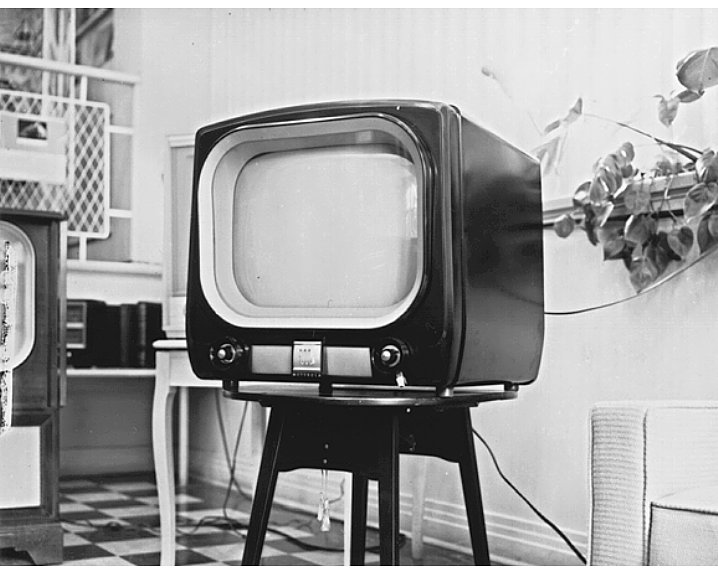
Consumed sitting in the home, TV became a rival not to radio (as is sometimes claimed) but to the book. The similar physical postures involved in the consumption of  TV and the book put them into competition, while the radio could be listened to while involved in other leisure activities or while working. I still remember the BBC radio programme “Music While You Work” which had started during the WWII – in 1940. It ran until 1967. Asa Briggs’s 1970 The History of Broadcasting in the UK(Vol. III: 576–577 perceptively writes about how popular music was broadcast to aid productivity – this wasn’t a secret even to me as a child: it was just “normal.” But to watch TV you had to sit down and dedicate time to the small grainy screen in order to decode what the pictures meant. Today’s giant screens enable us to do the ironing while watching TV (or our phones enable us to watch while commuting). That wasn’t the case in the 1950s.

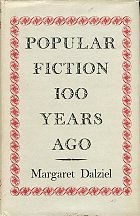
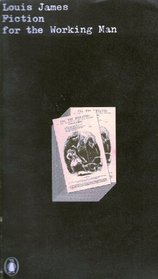
Now at exactly this time – the late 1950s and early 1960s – we see the birth of modern media studies, a birth largely and paradoxically in book form: not only Marshall McLuhan’s The Gutenberg Galaxy of 1962 and his Understanding Media of 2 years later, but work on the history of popular reading by Margaret Dalziel, Richard Altick, Louis James, Mary Noel and others. Richard Hoggart was considering The Uses of Literacy in 1957 just two years after ITV started in London and the BBC killed off Grace Archer in an attempt to prevent the curious tuning in to the upstart channel. Of course, there had been studies of mass or popular reading before – one thinks of Q.D. Leavis’s cantankerous and inaccurate (but very influential) Fiction and the Reading Public of 1932 ‑ but what was new at this time was the extent of interest in and concern over the new media and a corresponding re-evaluation of the old. No longer did “English” and “American Literature” remain with their sights on a few canonical classics, but the field began to widen to include texts not previously considered “literature.” Not only was contemporary popular culture analysed (Barthes’s journalism collected as Mythologies in 1957 remains a key example), but popular fiction and even journalism began to be studied historically. Important for me, this is the period when the Research Society for Victorian Periodicals was born, and when the interdisciplinary Victorian Studies was first published.

Television was not of course the only or even an obviously direct or major propellor of these paradigm shifts in the study of literature – the post-war expansion of higher education and the “reward” of higher education to working-class men who had been promoted to military officers are more direct causes, but the incursion of popular entertainment into the home, once the province of the book, certainly contributed to the gradual (and by no means inevitable or certain) democratisation and broader social study of literature and the transformation of Literature to literature I referred to in the first of this bog series.

What, we may well ask, will the electronic twenty-first century do to the book and to the concept of literature itself? Already there have been many studies and many predictions: which (if any) will become dominant?

When I wrote the first version of these past 4 blogs as a public lecture in 2000, I thought that perhaps we were entering a similar phase to the 1950s and 60s of new technology and new awareness: the world wide web was only 7 years old and everyone was excited about the possibilities for new configurations of meaning. A lot of writing appeared about that.
23 years on and the www has graduated and is thrilled less with new configurations of meaning than new possibilities for consumption. The paper book seems an antiquated medium from which targetted ads are excluded; many of us use electronic versions which offer different affordances. Yet the paper book continues to enjoy status amongst a certain social sector. Will that be sufficient reason for its survival?

History of the Book in the Twentieth Century Part 3: the age of the conglomerate, and the revolution of 1935

In the previous post I covered the first 4 of 8 elements of media history that I’ve found useful for teaching. Here are two more.

If many very small publishers have survived into the twenty-first century (certainly helped by the internet and new digital printing technologies), nevertheless a distinguishing factor of the twentieth century, especially the latter part, concerns the concentration of ownership of the media. I’m thinking here of the sublime growth of international conglomerates and transnational book production in line with just about every other manufacturing industry.

Ever since Paul Hamlyn in the 1950s escaped the restrictions of paper-rationing still in force in Britain by having his books manufactured entirely in Eastern Europe, book production became increasingly international. Even in the long gone 1999, it was quite normal for an author to key in her work in London on a word processor, send it to a publisher whose office might have been in New York who sent it to be typeset in Hong Kong, printed and bound in Singapore, for distribution to an Anglophone but world-wide market. What once were comparatively small publishing houses of perhaps 50 or so staff which carried the name of their founding father whose descendants headed the business are now huge transnational and transpersonal conglomerates.

It was the 1980s, the era of “deregulated” mergers and acquisitions,  that saw the virtual elimination of the “gentleman publishers” and the restructuring of the whole publishing industry. The restructuring was due not only to deregulation, however, but also and not least by how the contemporary decreased funding of education led to a correspondingly decreased (and less seasonally reliable) demand for textbooks and library books within the UK. The demand was not only smaller but less predictable. Then again, the appreciation of sterling against the currencies of countries to which Britain had been exporting in large numbers since the 1950s made exports expensive and difficult.

Macmillan’s is a good example of a firm that illustrates how the industry was restructured in the second half of the twentieth century.

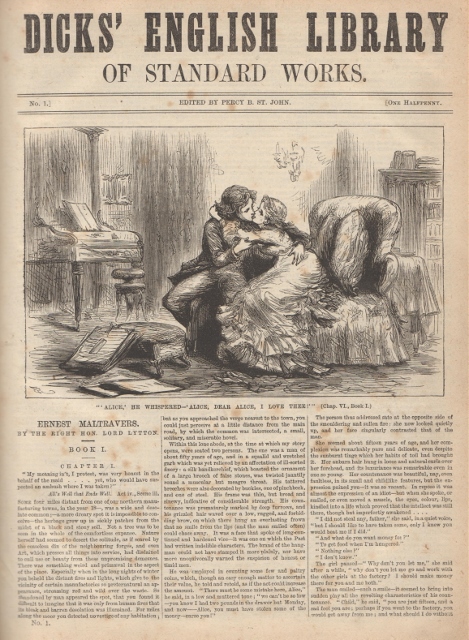
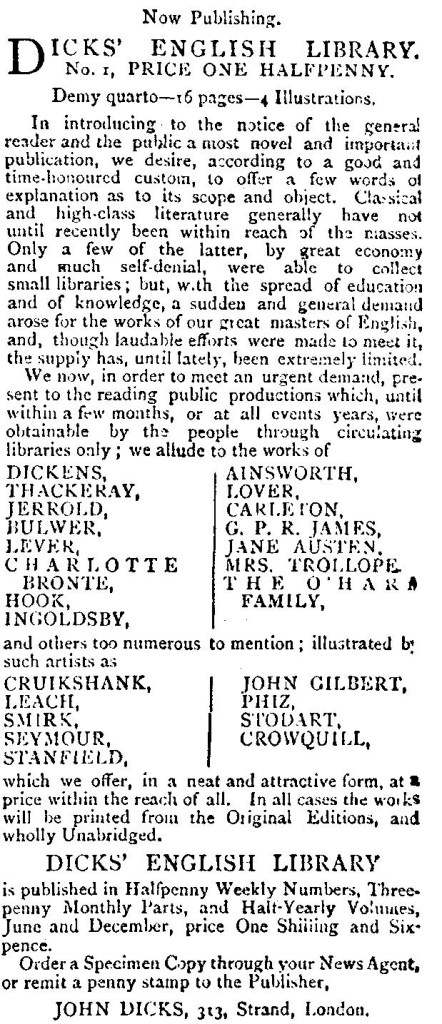
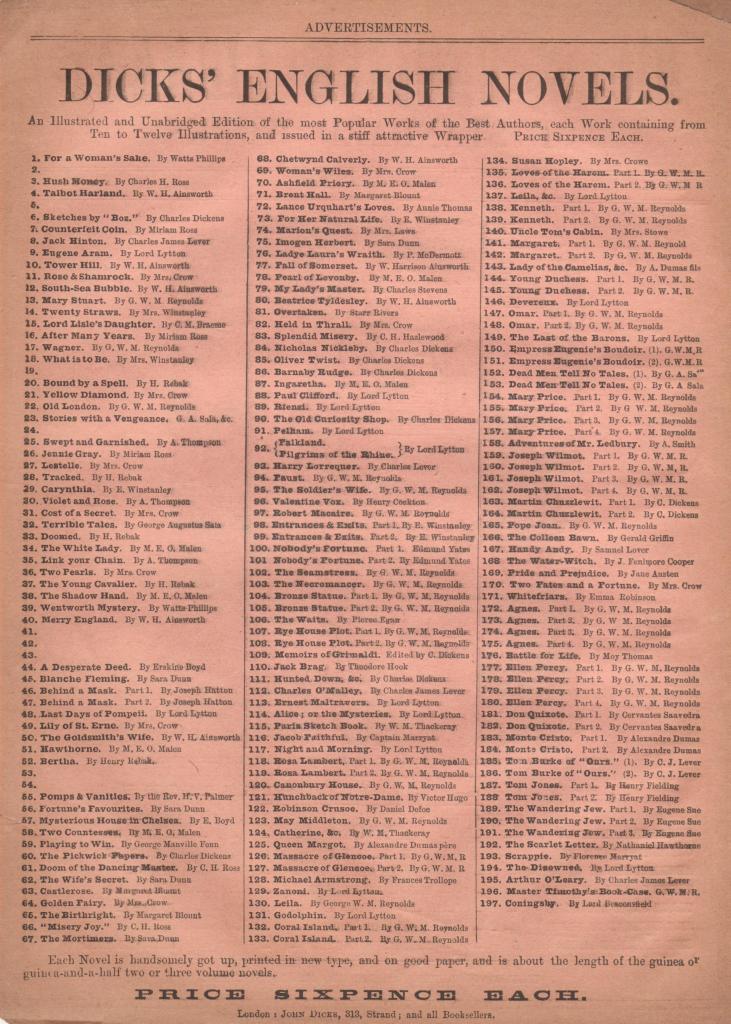
The brothers Alexander and Daniel Macmillan, originally from the Scottish island of Arran, had founded the company in 1843. They aimed mainly for a target audience with a large degree of cultural capital, publishing Charles Kingsley, Thomas Hughes, Lewis Carroll, Tennyson, Henry James, Thomas Hardy, Rudyard Kipling, H.G. Wells and so on. In the twentieth century Macmillan’s published Ouida (to whom they were very generous in her declining years), Yeats, Sean O’Casey, John Maynard Keynes, and many other well-known names. The talent-spotting talent of the Macmillan family, their canny awareness of the coincidence of cultural and financial capitals, were not confined to fiction and poetry: they also published periodicals and reference texts – Grove’s Dictionary of Music was theirs, for instance. The firm increased in size and influence throughout the nineteenth century and most of the twentieth, reaching its apogee in Conservative politician, Harold Macmillan. After having served as Prime Minister between 1957 and 1963, he withdrew from politics and took on (as Macmillan’s website tells me), “a leadership role at the publisher. He instituted an ambitious program that led to international expansion. The Education Division grew significantly and standard reference works and scientific magazines were also added to the list.” (see Macmillan’s interesting inhouse timeline and also Elizabeth James’s Macmillan: A Publishing Tradition 1843-1970, 2002)

Although the family still has a substantial interest, Macmillan’s is now owned by the enormous German media company Verlagsgruppe Georg von Holtzbrink – which owns the German national Die Ziet, which its website tells me is “Germany’s largest opinion forming newspaper”. It also owns Germany’s equivalent of the London Evening Standard the Berlin Der Tagesspiegel, 5 different German fiction imprints, a Swiss fiction imprint and 2 New York based houses Henry Holt and no less than Farrar Straus and Giroux, 8 local newspapers in Germany, 2 companies that make documentaries for TV, shares in a large number of radio stations, and various subsidiaries that publish on the internet and on CD. Macmillan’s itself has numerous subsidiaries in 70 countries, the result of Harold Macmillan’s global expansion plans. Since 2000 it has run an academic imprint called Palgrave, the result of the merger of the US  St Martin’s Press and the UK Macmillan’s.
An even larger conglomerate is Pearson’s. It owns Penguin, Longman and Simon and Schuster; it produced the late twentieth-century hugely successful TV series Baywatch, The Bill and Zena Warrior Princess; it owns the Financial Times, The Economist; it ran Thames TV, has a large stake in Channel 5 and is the world’s largest education publisher. It has for some decades now invested heavily in electronic media, especially the on-line provision of share prices.

There are many issues involved in the creation of these huge conglomerates with their stress on marketability and share prices. One revolves around the value of such industrialisation of knowledge. There was a vigorous resistance already in the nineteenth century: William Morris and the Pre-Raphaelites spring readily to mind. In the 1890s many small scale presses had been set up, but their energy and usually socialist and artisanal ideals had all collapsed by the early 1960s. Does this collapse indicate the dominance of books tailored by market researchers, the heartless triumph of the machine – and offer opportunities for paranoia about who controls the knowledge available to us?

While made-by-committee books based on detailed market research certainly are published, it’s a universal axiom in publishing textbooks and commentaries that the indefinable flair of individual editors and their relationship to individual authors is still key to publishing. As one late twentieth-century textbook on publishing explained, “Good personal contacts are paramount” (Giles Clark, Inside Book Publishing, Routledge 1994: 67 – the site associated with the book is very good). And then one thinks of the disaster that brought Dorling Kindersley to its knees with its manufactured Star Wars book: phantom menace the item indeed was. The company managed to sell only 3 million of the 13 million Star Wars books it had printed. This was the main contributing factor to the heavy losses it posted in May 2000 of £25 million. DK was bought out by Pearson’s who joined it to the Penguin Group.

Then, if we are fearful that such transnational conglomerates might control us like Big Brother, we have to reflect on the issue of how centrally controlled they actually are. I remember being told by an editor for Palgrave that although the von Holtzbrink family owns large numbers of shares in the conglomerate that bears their name, they’re only interested in seeing the balance sheets every 5 years or so. They dont interfere. Individual editors operate independently and are, rather, assessed at the local level on the overall profit distribution of the books they have commissioned. Power is diffuse and capable of many different variations, promoting many different tastes and value systems.

While there are certainly issues of control over what becomes available to us to read – the Assange case is proof of that (and see eg the debate over Canongate’s publication of his unauthorised biography in 2011) –  few readers feel constrained by what is available except by price. Indeed, given the explosion of small independent publushers in the twenty-first century enabled largely by new technology, many voices can be heard. This brings me to my next point.

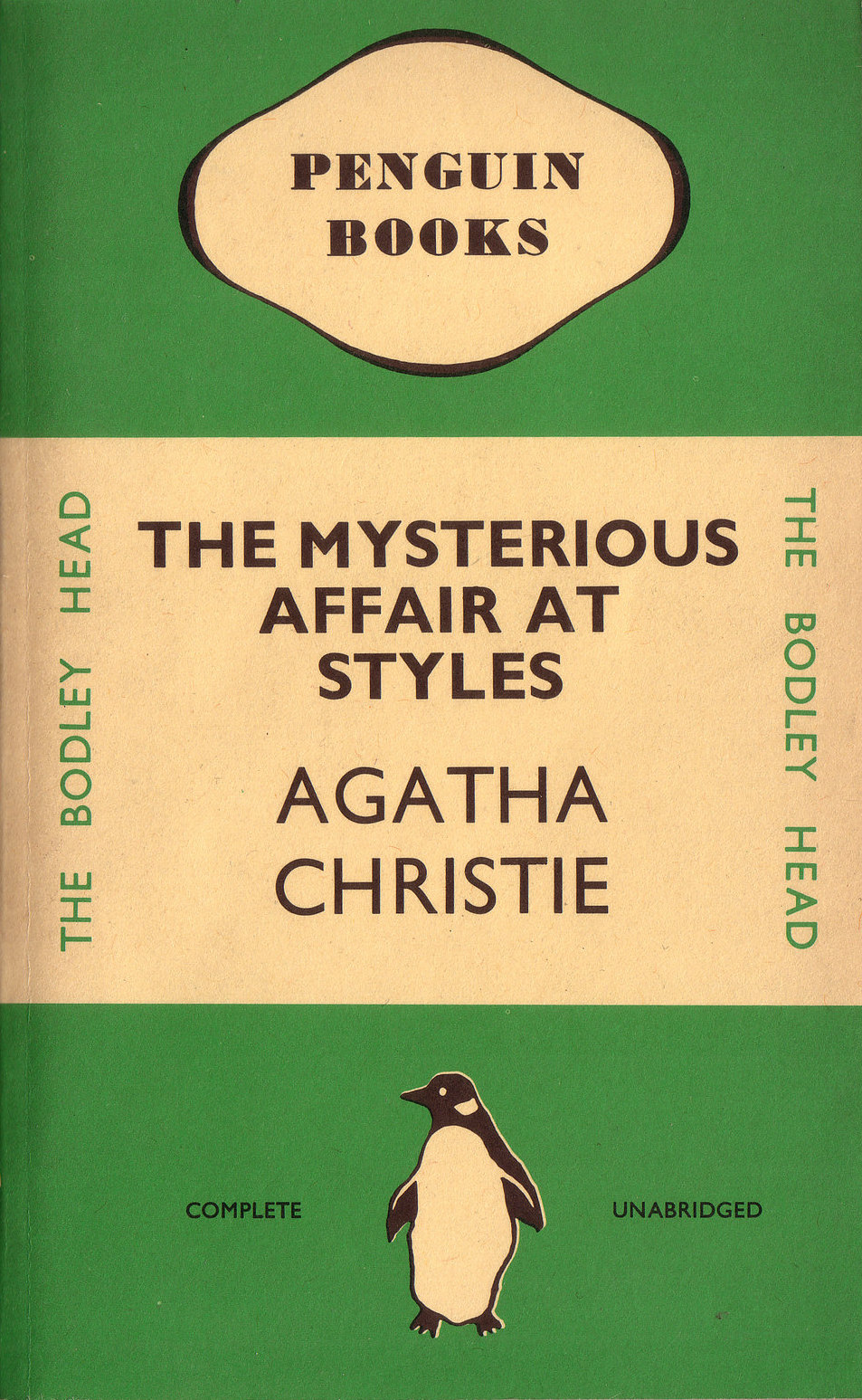
From the point of view of most British users of books,  issues of ownership are less important than the format revolution of 1935. Indeed, for most book readers today the twentieth century really began that year. 1935 was the year that Allen Lane started the Penguin paperback. Taking advantage of the monotype printing I’ve mentioned in a previous post, a  technology that had been commercially developed in the 1920s, Penguin changed the face of publishing for ever.

The idea of the paperback was by no means new – books stitched in paper covers date from the late seventeenth century; in nineteenth century France, most books were published in the form to allow for binding according to the consumer’s choice. What was new was the industrial scale on which paperbacks were produced and marketed.

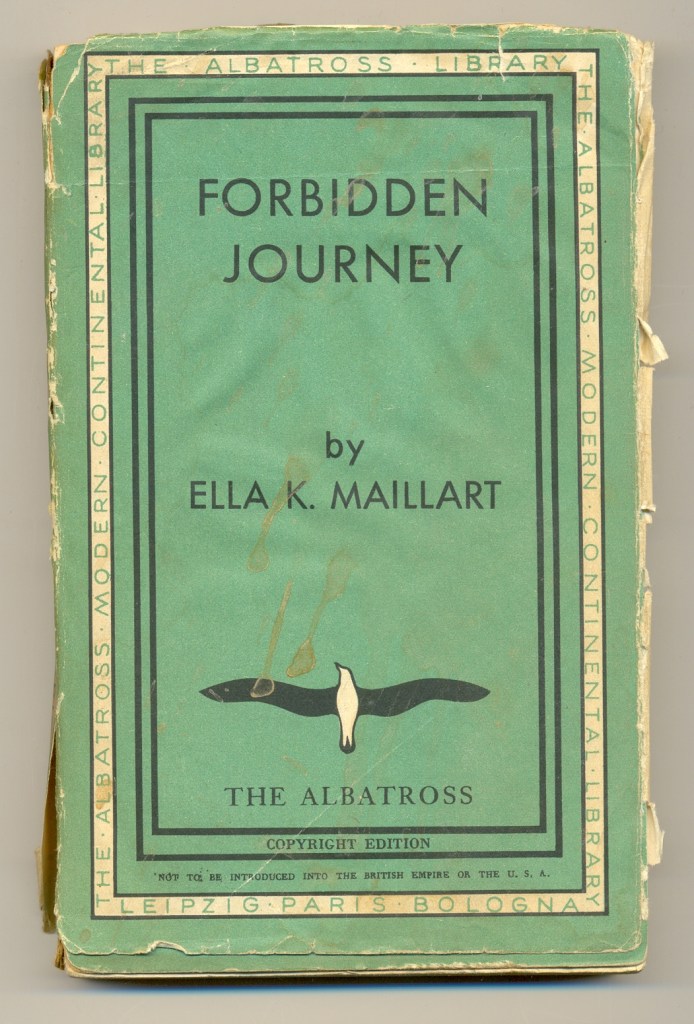
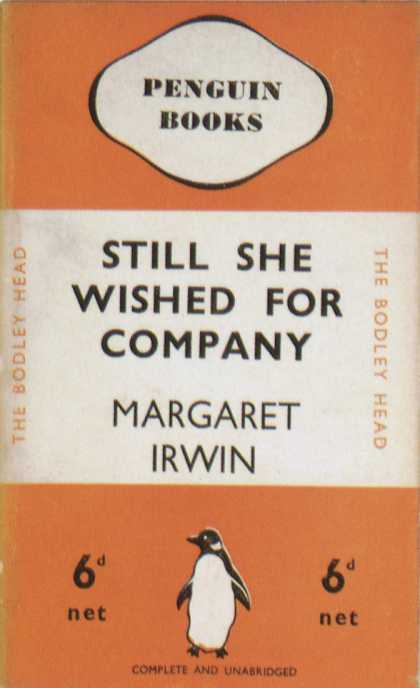
Penguin was born from necessity. Allen Lane was the owner of The Bodley Head Press, which he inherited from his uncle John Lane who had gained a reputation in the 1890s for the avant garde and “advanced” – Lane had published The Yellow Book, the showcase of aestheticism for instance. By the mid 1930s, however, The Bodley Head was in trouble financially: Penguin was a desperate attempt to save it. Allen Lane got the idea of the look for the series from Germany, where a paperback series called The Albatross had been started up by an Englishman named John Holroyd-Reece to rival the old-established firm of Tauchnitz who had been publishing paperback reprints for almost a century. Penguins were, however, by no means straight imitations of Albatross.

While early Penguins, like Albatross, were paperback reprints with visually distinctive covers of works originally published by other forms  – as Phil Baines’s beautiful Penguin by Design: A Cover Story 1935-2005 shows us – Lane planned to sell Penguins very cheap: at 6d. Most revolutionary of all, he distributed them through outlets other than standard bookshops: the cheap department store Woolworth’s played a large role in the success of the Penguin imprint. Penguin’s real revolution lay not in its material identity as a cheap distinctive paperback but  in establishing the book both literally and metaphorically in places in the market it had never before settled in. It paved the way for the supermarket books we know today.

For the next 20 years Penguin dominated the paperback market in the UK and helped normalise the format to such an extent that for most of us now the paperback IS the book.

What once was a technology meant for disposable reading, ephemeral in its structure, transitory in its nature, available for personalisation, came in the twentieth century to represent the quintessence of the book, the repository of (what we like to think of as) non-ephemeral knowledge.

We have now looked very briefly at 6 elements in media history, taking examples twentieth-century book history: here format and conglomeration, previously technology, ownership, regulation and distribution. What have we not discussed yet?

The fourth and last part of this series – on war and competing media forms – will be available here.

History of the Book in the Twentieth Century Part 2 : Technology, Ownership, Regulation, Distribution

In the previous blog I promised to cover 8 routes through which print history and the twentieth century could be connected. Here are the first 4.

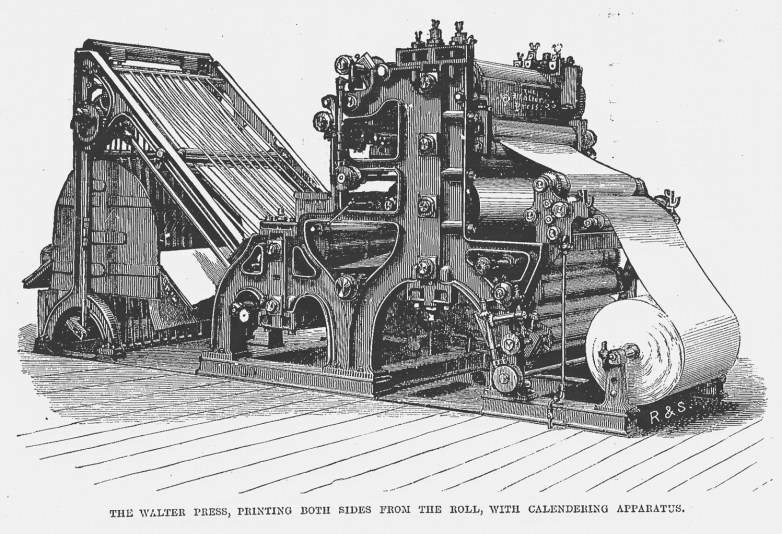
The Walter Press, adopted by The Times in 1866 (from Frank Leslie’s Magazine 1877 – and http://www.ndl.go.jp/exposition/e/data/R/614r.html)

First print technology, that which enables literature to transit from author to reader.

In the 1950s printing machines whose designs dated from the 1850s were still in general use. Yet paradoxically, printing technologies that in some ways are most characteristic of the twentieth century were first developed in the late nineteenth.

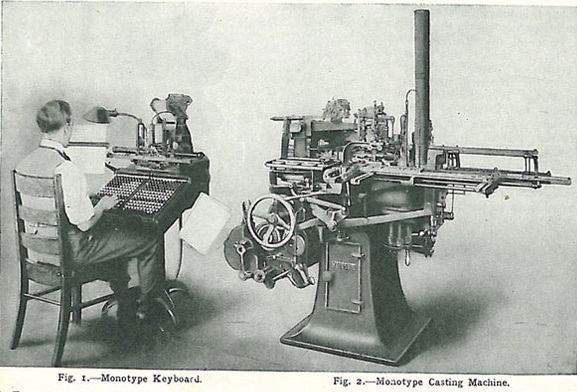
The two great revolutions in printing of the years between 1900 and 1950 were linotype and monotype. The Linotype machine was 1st installed on the New York Tribune in 1886; Monotype was invented 3 years later in 1889 but only commercially established in 1897.

Perhaps you can see from the illustration how monotype employs a paper tape with holes in it as an intermediate storage and transmission technology between the keyboarding and typesetting. The idea derived from looms for weaving cloth interesting enough – the same technology that Charles Babbage used in his mechanical prototype of a computer. These technologies, esp. monotype, tripled the speed at which books could be produced and formed the basis for the revolution that was to happen in the 1930s with Penguin (on which see more later). But even more advanced technologies were invented in the late nineteenth century which were to be used commercially for books only from the 1950s. The 1890s saw patents for devices that set type photographically, but nothing came of them for almost 60 years with the introduction of the Intertype Fotosetter in the USA in 1945. This photographic technology in turn enabled the ever-faster production of books after WWII .

A second way twentieth-century publishing can be said to start in the late nineteenth is not purely technological but concerns conventions of literary property – who owns the text transmitted? I’m referring to the formulation of international copyright, most notably with the Berne Convention of 1885, through which a uniform international system of copyright was initiated. During the course of the twentieth century the convention underwent several modifications, including what is called the Rome revision of 1928 whereby the term of copyright for most types of works became the life of the author plus 50 years. This had in fact already been adopted in 1911 in Britain. In EU countries this has subsequently been modified to 70 years after the death of the author.

Copyright is incredibly important to the publishing industry: it is indeed its cornerstone on which its economics are based, but again with new technologies of the last 60 or so years – starting with photocopying which started to become common in the 1960s – it is undergoing a period of enormous stress. Perhaps in future times the twentieth century  will be characterised as the period of efficient copyright – certainly more efficient than for any time before it, and perhaps after it too.

A third conventional continuity from the nineteenth century concerns censorship, particularly the persistence of the Obscene Publication Act. This dates from 1857 with a famous – or infamous – modification in 1868 that defined obscenity as that which exhibited a tendency to deprave and corrupt those whose minds are open to such immoral influences”. (Justice Cockburn in Regina v. Hicklin, a bookseller in Wolverhampton — see  Victorian Print Media pp. 101-104 for extracts from this and other obscenity  trials). Obviously, this had enormous impact on what could and could not be published in Britain. Lawrence’s open discussion of sex in The Rainbow in 1915 notoriously led to the seizure of 1,011 copies during a police raid on the London offices of the novel’s publisher Methuen. It was banned by Bow Street magistrates after the police solicitor told them that the obscenity in the book “was wrapped up in language which I suppose will be regarded in some quarters as artistic and intellectual effort”.

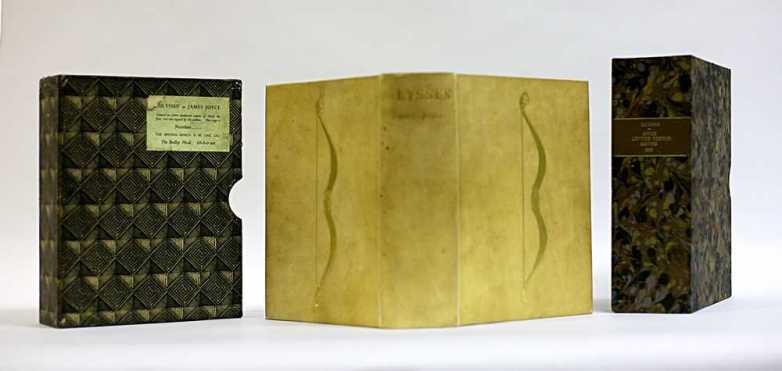
Bodley Head edition of Joyce’s Ulysses, (1936) – from http://antiquesandartireland.com/2010/07/ulysses-first-edition-memorabilia/

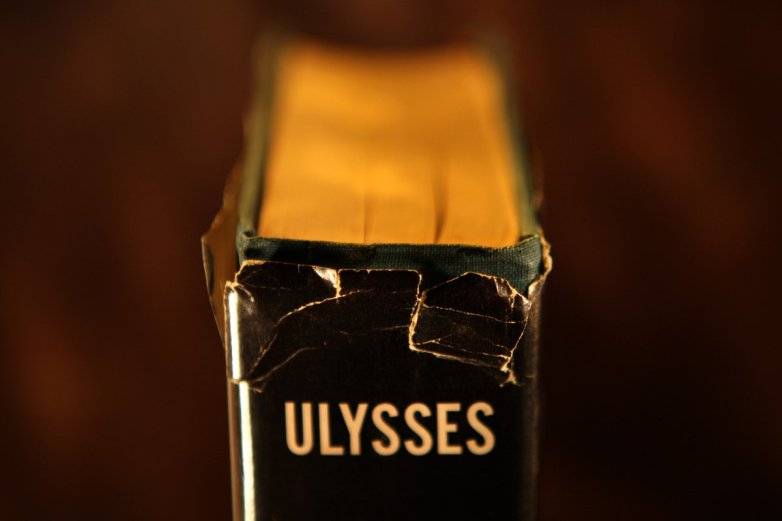
Then there’s Joyce’s Ulysses, published in Paris, which was seized by customs officers when it dared cross the channel into Britain (though curiously Bodley Head didn’t get prosecuted for publishing it in Britain in 1936). Radclyffe Hall’s Well of Loneliness had caused its publisher Jonathan Cape to be brought to court in 1928.

In 1959, there was a further and vital modification to the law of obscenity: now the work in question had to be taken “as a whole” and the interests of “science, literature, art of learning” could be adduced to defend a work from the charge of obscenity – “expert opinion” could be called. The following year the case of Regina v. Penguin Books over the publication of the unexpurgated Lady Chatterley’s Lover was a test case of this new law. Penguin won. Since then the question of obscenity has been continually debated, with concern in Britain at least has been far less over literature, however, than with film and video and, more recently again, the internet (see e.g. a recent article in The Guardian).

If then in three major respects twentieth-century publishing seems a continuation of nineteenth, in another it can be said to start perfectly on time on 1 January 1900 with the Net Book Agreement (NBA), signed by members of the then recently formed Publisher’s Association. The NBA concerns distribution. Again its roots go back to the nineteenth century — but it can also be regarded as a decided rupture with it.

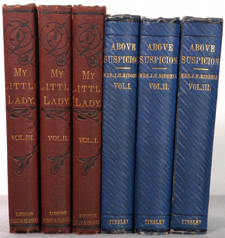
The NBA  was designed to prevent booksellers selling at suicidal discount yet price wars had erupted when in 1894 the lending libraries Mudie’s and W.H. Smith’s rebelled against taking three-volume novels. Publishers were forced to publish novels in one volume and more cheaply. This in turn meant that cheap books flooded the market and booksellers sought to undercut one another. Unsurprisingly, this spelled disaster for many booksellers (as well as publishers). Many booksellers went bankrupt. This in turn meant fewer outlets for the retail of books and the consequent risk of a decline in the market because of distribution problems – for if booksellers closed because they had been trying too hard to undercut their competitors how were publishers to get their wares to the consumer? Hence the need that some publishers felt to save booksellers from bankruptcy. The NBA was one solution. Through the NBA, the publisher allowed a trade discount to the bookseller only on condition that the book was sold to the public at not less than its “net published price” as fixed by the publisher. In Britain, a first attempt to introduce the net price principle by booksellers in the 1850s had been condemned to failure by supporters of Free Trade; but in the 1880s it had  been successfully adopted in Germany. Encouraged by this toward the end of the century some British publishers, led by Alexander Macmillan, began to replace the variable discounts they gave to booksellers by fixed prices. To press for the new system, the Associated Booksellers of Great Britain and Ireland had been formed in 1895, and the Publishers Association was created in 1896. These two organizations then worked out the Net Book Agreement.

If the twentieth-century British book trade can be said to be the century of efficient copyright, it is just as much the century of the NBA – indeed it only collapsed in September 1995 through pressure from a complex of sources including rulings by the European courts about what constituted cartels and pressure from the Office of Fair Trading.

The industry itself had also  changed though. The import of cheaper books from the US via Europe because of the strength of the pound, and not least the enormous growth of bookseller retail chains like Blackwell’s, Dillons, and Waterstones which by 1996 had grown to take over 30% of the U.K. market. These chains – in ever-reduced numbers amongst themselves – became the pacesetters in the new deregulated market that emerged in the 1980s. They were able to launch full-scale retail marketing of the sort that had previously only been seen in UK supermarkets, such as price promotions on certain brands (or imprints, in the case of books), loyalty cards and hence database marketing based on analysis of what specific kinds of customers were buying where and when. Regulation (“deregulation”) encouraged the consolidation of the chains:  complaints to the office of Fair Trading by more than 600 small publishers that Waterstone’s was abusing its (dominant) position in the market by seeking greater discounts from publishers were dismissed.  More recently again, of course, Amazon has increased its market share of literary distribution to previously undreamed of heights. Are monopoly, oligopoly and cartels the inevitable end of a deregulated market as we saw in the Hollywood film industry of the 1930s before the Paramount decrees, where the studios controlled distribution, exhibition and production?

Literature in Transit: Histories of the Book in the Twentieth Century Book. Part 1 – Definitions

This month’s initial series of blogs will concern how we can think of changes in book publishing in the UK over the course of the twentieth century, inspired partly by how I was recently working on a piece on the history of publishing over the course of the nineteenth century, though I wrote the first version a couple of decades ago for teaching purposes.
For this is really a set of pedagogical blogs designed to offer students a framework for how to think through long term changes in the media industries. The eight categories I’ll propose I’ve used successfully as a checklist for students to write their own histories of specific media. I’ve treated publishing as a model case study so that students in groups can produce something on their own chosen medium by following the same set of headings.
It’s worked pretty well: students like the prescriptive structure and group work.
One heading that isn’t here is the changing nature of how publishing (or any other media industry) is financed. I tried to include it once but my undergraduates didn’t get it: they weren’t interested and, after all, it’s just too complicated for an overview such as this. I left financing models out of subsequent frameworks and, perhaps wrongly, it will be omitted from this set of blogs too.
First of all, though, I wanted to explain the importance of paying careful attention to the title of the question, which is why I start with a few basic definitions from which the rest of the “essay” should depend.

This series of blogs will be almost entirely concerned to think through the terms of the title Literature in Transit: Histories of the Book in the Twentieth Century.

For what can we mean by “Literature” in a century that saw Joyce’s Finnegan’s Wake and Barbara Cartland? Why should it be “in transit?” Why are we concerned to look again at the idea of the “book” in this electronic age when “books” are dying out? Perhaps most bizarre of all, I also want to query what we mean by “Twentieth Century“.

Yet defining the terms of my title will enable me to sketch a history of book publishing mainly in Britain in the twentieth century, up to and including the internet revolution. It will also enable me to reflect on what we need to study in any large-scale historical analysis of a communications medium.

First of all then, we need to consider what a book might be.

I’m taking it to be a specific kind of information storage and transmission technology, and in that sense comparable to music recording or film. Of course it’s very different from them as well: it’s a material thing that has a specific and material history. Yet we mustn’t forget that it is fundamentally an earthly avatar with a traceable biography – a life indeed – of a much more intangible and abstract concept. If today we don’t often think of the book as a storage and transmission technology – while we do think of computers in that way – it’s because the book has become naturalised, simply part of our everyday lives, so old it doesn’t need to be thought about except in rare instances like Craig Raine’s famous 1979 poem “A Martian sends a Postcard Home”:

Caxtons are mechanical birds with many wings
and some are treasured for their markings —
 
they cause the eyes to melt
or the body to shriek without pain.
 
I have never seen one fly, but
sometimes they perch on the hand.

Now the very questions we ask do not exist outside of time: history encourages certain questions to be asked and discourages others. So it is with the question of what a “book” is. In the 1990s, the new technologies of information storage and transmission woke us up to the fact that the book is just one manifestation of a more abstract concept. Today these technologies enable a text such as this where the history of the the book avatar is discussed. It’s only when lay people outside the book production industry are compelled to compare the book with other avatars of the same concept that we begin to reflect on the specific technologies of the book, its form, its history and its effects.

Literature I take to be the subset of information that comprises combinations of letters of the alphabet. This is what the original term letteratura meant in Latin – a writing formed of letters of the alphabet. The term applied to Greek or Latin as opposed to the Egyptian hieroglyphic mode of information storage or, as the philosopher Cicero suggests (following Plato), human memory. Literature may be encoded in books that appear on the market all at once or in other avatars of information storage and transmission such as periodicals, newspapers and pamphlets, and indeed now on the internet and in our computers. In defining literature by taking shelter in the etymological, I want to avoid for the moment the difference between high- and low-status information, Literature with a capital L and with a lowercase l. Again I think that it’s the new developments in information technologies that have brought that distinction between high and low to the fore and lend it still a particular urgency, especially for those of us involved in education. It’s been an on-going debate for a long time, but it is certainly not resolved, even in 2023: the question of cultural (and thereby social) status has just become masked under the dominant rhetoric of the free market (I’m thinking of the Jim McGuigan’s 2009 Cool Capitalism here).

Transit derives, of course, from the Latin verb “transire”, to go across, to pass from one state to another. In using it in my title I’m also thinking of the crossing that comprises the notion of the medium through which an author communicates with a reader. But of course “in transit” also suggests that the technology that enables literature is changing, passing from one state to another.

At least since Marshall MacLuhan in the early 1960s we’ve thought about how the medium might be related to the message, how not only the medium itself alters but how this has an effect both on how the message is conceptualised by the author and by the reader – the message changes as the medium does. I won’t be writing about this much, but I will give a simple example – the novel as we commonly think of it depends for its existence upon technologies in paper production, cutting and binding as well as printing, not to mention technologies of distribution that allow publishers to get their wares to the consumer. They also depend upon a set of conventions about what certain kinds of information physically comprise. For most of the nineteenth century novels published in book form were very often in hardback volumes.

Novels for us have become one volume – and not only that but paperbacks. I’ll be describing that particular technological transition from hardback to paperback in a later post. I just want to signal it here as probably the most important development in the twentieth-century material book as far as the reader is concerned.


A second association of “transit” that I want to foreground is the increasing perception of the motility of the written word. Once the dominant notion was “In scripta manent” – things remain through being written down. One thinks of the Ten Commandments carved in stone, immobile, resistant to the gnawing of time and the creativity of memory. The orthodoxy in the early twenty-first century is, however, that the printed word is always and everywhere in a transitional state. Texts are no longer considered self-contained units of meaning; rather we think of that each word as in a constant state of moving towards other words and states. Stasis, like fullness and completeness of meaning, are only illusions; intertextuality and instability are the order of the day.

It may seem rather  absurd to query what an apparently simple term like the “Twentieth Century” means. The terms refers to a simple period of 100 years from 1900-1999. Yet my question derives from a consideration of periodisation in history, a question that anyone familiar with the defintion of, say, “Romanticism” and “Victorian” will know well. What does an arbitrarily defined chronological period mean in relation to events that actually occur? In this case, is the history of the book really to be bound by a hundred cycles of a planet around a star? George Eliot began Daniel Deronda with comments on the “make-believe of a beginning”; so here I began to query the notion that the twentieth century, in book publishing terms at least, lasted the 100 years between 1900 and 1999. As I will be suggesting, it can be argued that the twentieth century in publishing terms began in the late nineteenth, in the 1880s or even the 1850s. Alternatively, we might say that it began as late as the 1950s. It may have ended in 1992 – in which case it might be very short indeed, less than 40 years.

Now there is an enormous number of ways the twentieth century can be related to the other terms in my title. I’ll be looking at just eight of the most important over the next set of blogs.

Ouida and the Parergic 2

Guy_Livingstone frontispiece
US cheap reprint of Guy Livingstone by Routledge (1867) for both US and UK markets

Ouida, of course, from when her first story appeared in Bentley’s (she was just 18), had had to write for money. She knew where the power and money lay, and “mythical swelldom” was one place. In 1857 George Lawrence’s Guy Livingstone had appeared. It went through at least 6 editions by the mid-60s (the image is of an 1867 reprint by Routledge who evidently thought it worthwhile to print – and so establish copyright – in the US as well) and started the cult of the “muscular” hero. Even Dickens had to respond to it  (see Nicholas Shrimpton’s excellent article on Lawrence and the “Muscular School” of heroes in Dickens Quarterly, 29: 2). Lawrence himself was given no less than £1,000 for his novels – a very high sum indeed – by his publisher Tinsley, and Tinsley it was who published in volume form Ouida’s first novel, Held in Bondage in 1863, a novel which combined the dashing muscular school with bigamy and sexual deception, themes newly marketable since Lady Audley’s Secret. Ouida though only managed to get £50 from Tinsley for the rights to publish it (though she did manage to negotiate that he should only keep the copyright for a limited period. Tinsley, rather unpleasantly, wrote that he could have got the complete copyright had he driven a hard bargain). Strathmore followed the same publication pattern, though published, after negotiations, by Chapman and Hall who were now to become Ouida’s regular British publishers. She managed to sell them the short-term copyright for just £75.

Even to get these small sums was an effort. Ouida, a half-foreign woman of 20 from Bury St Edmund’s with no real connections, had to work out a way to make money in the cut-throat male world of London publishing. Hers is in a sense “surplus” labour which has to make itself needed: she is an outsider who has to get in. The solution Ouida seems to have arrived at was to  reflect back to power the image of itself it seemed to like. This is where the concept of parergy starts to become useful.

There is an oft-repeated story that Ouida used the conversations she heard between men at her Langham gatherings for her now most famous novel, Under Two Flags. But, as Jordan demonstrates in her chapter for Ouida and Victorian Popular Culture, Ouida’s knowledge of military life was derived from reading rather than from conversations with military men. Such textual knowledge is legible from her earliest publications, the short stories she had published in Bentley’s in the early 60s, several of which we can read today as devastatingly critiquing male pomposity exemplified by the soldier (e.g. “Little Grand and the Marchioness”). But they can also be read as simply amusing in their accounts of masculinity. That they concern “mythical swelldom” as opposed to what the male critics regarded as reality is key: Ouida doesn’t get it quite “right” i.e. she presents the men from the outside, exposing men’s little blind spots and tricks of evasion. At this stage, that doesn’t matter: for the critics these deviations – these failures to adhere to the powerful norm – are a laugh, “brilliant nothings”.

By the mid 60s Ouida’s prices had risen slightly. Over 186566 she received £6 per monthly instalment for Under Two Flags in the British Army and Navy Review, a monthly to which she had contributed a series of stories and non-fiction articles on military matters since July 1864. Just as Braddon’s Lady Audley’s Secret was left incomplete in its first manifestation as a serial in the twopenny weekly Robin GoodfellowUnder Two Flags was unfinished when the British Army and Navy Review folded in June 1866. Bentley had taken over the Review in December 1865 but failed to save it. He later refused to publish the novel in volume format on the advice of his reader Geraldine Jewsbury who concluded that ‘the story would sell but … you would lower the character of your house if you accept it’.  Ouida wrote to another potential publisher, Frederick Chapman, a few months later claiming that the premature termination of the serial had left ‘military men’ waiting ‘with intense impatience’ to read the end. Her sales pitch to Chapman worked, for he published it as a triple-decker in November the following year. The American publisher Lippincott gave her £300 ‘by trade courtesy’ for his one-volume edition, and the continental publisher Tauchnitz brought it out in 1871. Three years later, Ouida was to sell her copyright outright to Chapman for less than £150.

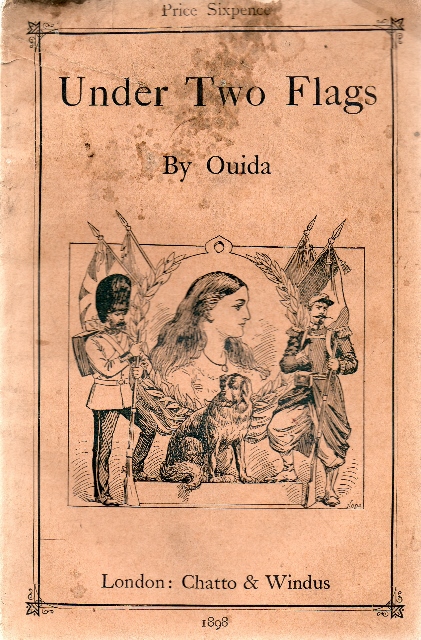
This was to prove a costly mistake for, contrary to what has been claimed, the novel was initially only moderately successful. Its real success came in the 1890s when it sold in enormous numbers in cheap editions: Chatto and Windus, who bought the copyright from Chapman in 1876 as part of their vigorous expansion policy, were to print around 700,000 copies. Ouida got nothing from this. No wonder she was to write to her solictor in November 1884 that “Chatto & Chapman are two rogues who play into each other’s hands to keep down prices like the publisher in ‘Pendennis.’” Men still ruled the publishing industry, as they rule the wider media today.

By the 1890s, then, Ouida’s fiction has migrated downmarket. Interestingly, the penny papers do not treat her with the same attitude as the up-market expensive magazines and newspapers. On the contrary, for them she is “the leading female novelist of England” who has

“no rival in passionate eloquence, and the pathetic, emotional power by which she can change the lowly and the sinning into a glorified humanity, and lift up and ennoble and sanctify even the rudest nature by some one divine gem of supreme manifestation of sacrificial love” .

Bow Bells 17 January 1890

By this time, too, she had herself become comically wicked in that market. Unlike with the negative high-culture reviews of the 1870s and 1880s, this is surely a marketing ploy which positions Ouida as safely transgressive: her eccentricity is part of her scandalous appeal. One can have one’s desires enacted by someone else on the page without ever having to confess them as one’s own. Ouida is contained: once again we don’t have to read her seriously.

To return once again to parergy.

Parergy is not dismissal de haut en bas by critics who claim to know better – it is not a weapon in a cultural war that the powerful wield. It is a wheedling weapon of the disempowered, a demand to be heard which knows it will fail, an attempt to participate in power while knowing that the odds are stacked against it. Is this what Ouida does in her early work?

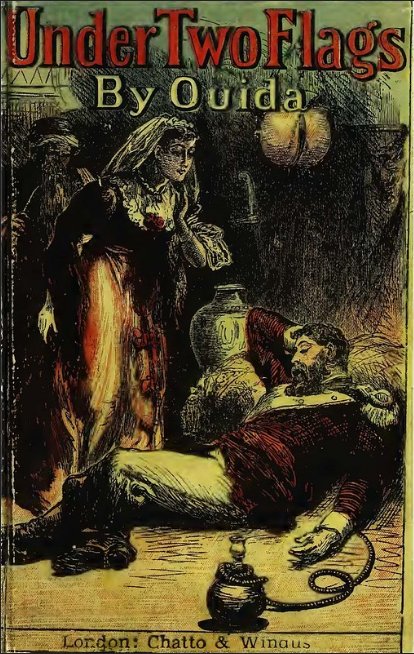
Under Two Flags, Chatto & Windus, 1909 yellowback. Lady Venetia visits Beauty. The viewer looks at a woman looking at a passive man: a popular inversion of the male gaze?

I don’t think Ouida’s imitations of the “Muscular School” fail in an unambiguous way so much as lay that school open to the possibility of ridicule or parody:  they depart from it certainly, exposing its weaknesses and limitations and hidden assumptions. We are never allowed to forget that the hero of Under Two Flags is nicknamed “Beauty” and that he’s much more interested in his horse and his male friend “Angel” than in the heroine Cigarette or the paragon Lady Venetia or the actress he keeps (powerfully objectified as merely “the Zu-Zu” ) or his aristocratic mistress with the absurdly accurate name “Guenevere”. The women Beauty has a relationship with are all part of the appearance of masculinity. Even Beauty’s affair with Lady Guenevere is part of the system of masculine show: everyone knows about it and yet, in that complex game of respectability, at the same time they pretend they don’t. In any case, we are shown how this affair adds a potency to Beauty’s allure.

How are we to take this exposure of the structuring of masculine power and image? Is it a flattering celebration or a merciless critique?

If the parergic can be found in Ouida it is gendered:  excluded from literary-economic power, she mirrors back those representations of masculinity which generate it, while at the same time departing from them by the acuteness of her vision and anxiety as an outsider.

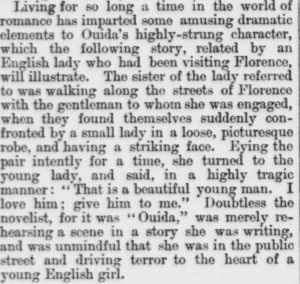
It is very different from the non-gendered, generic parergy I located in the 1840s. If anything, that kind can still be found in the penny paper reviews of the 1890s – think of the rather strained description of Ouida in Bow Bells, with its anxious determination to dazzle with rhetorical devices (most notably a tricolon) at all costs, or the yellowback cover of Under Two Flags, or the anecdote in the London Journal which could be funny were its rhythms more bouncily organised, and were it less determined to excuse its subject as distracted.

London Journal 3 September 1898

Whether Ouida’s vision of men is parergic or parodic depends on whether we read it as undermining or supporting that masculinity. I think her version of muscular literary power in her early work walks a tightrope between parergy and parody: can we say with absolute conviction that her early work parergically supports its models while failing to live up to them or parodically undermines them by exaggerating and revealing? It does both, sometimes simultaneously but mainly, I think, it lurches from one to the other from sentence to sentence, paragraph to paragraph, page to page. The honest reader is left uncertain, while others who prefer certainty are able to take from it what they want. Indeed, the ability of Ouida’s writing to have it both ways in terms of gender is one of the secrets of its success, and why it gives us such scope to write about this author and gender in what seems a mini-Ouida revival in the first few decades of the twenty-first century.

Over a hundred years after her death, and a century after she ceased to be popular, we are perhaps beginning to find ways of reading Ouida again.

Ouida and the Parergic 1.

For perhaps a hundred years the idea that Ouida could ever have a serious relationship with high-status culture would have been laughable. Her contemporary critics thought her merely pretentious: they thought she claimed to be part of respectable culture but she couldn’t manage it; she emulated the high but didn’t get it right.

When the Saturday Review (12 July 1873) reviewed Ouida’s Pascarèl, a novel set in the revolutionary Italy of the 1860s, it began by announcing that Ouida’s

lay figure
artist’s lay figure from the 1860s

“chief literary quality is a flux of words and her dominant characteristic audacity. If we analyse her rushing gorgeous sentences, full of sound and colour as they are, we find only some poor, meagre, little thought as the residuum; and even when her phrases are sentimental, the action of her stories too often appeals to a prurient taste. Her ideas are like an artist’s lay figure, the same thing draped up in a dozen different costumes, but always the same thing underneath, and that thing wooden.”

Ouida couldn’t, according to this witty reviewer,  be bothered to move from the “lay figure” to real people: she remained all pose (as Malcolm Elwin described her in his 1930s book Victorian Wallflowers).

Now when I used  the term defined in an introductory post, “parergic,” to refer to a failed emulation of high culture that did not undermine but supported it, I wanted to get away from the value judgement implied by the terms “pretentious” (or words often used in a similar way, like “imitative” or “derivative”) to help us think about what was at stake: what are the violent hierarchies we participate in, unconsciously or otherwise, when we dismiss a writer as laughably pretentious? Sometimes the violence takes place in the field of culture, at other times of class, gender, race, age, disability and so on. Sometimes consumer identity which may be “horizontal” rather than vertical is at issue, whereby for instance, supporters of one successful pop group will deny the validity of another which is, in the field at large, in a very similar cultural position. At all times the issue is tribal status: “we” are better than the failed “them”. My deployment of the term “parergy” was intended to create an analytic  distance from those struggles, to stand outside them insofar as such is possible (that one cannot stand outside entirely doesn’t mean one shouldn’t try).

Now how far can parergy be related to Ouida’s early work?

Before we get to that, though, we need to note that the critics’ view of Ouida as pretentious only fully emerges after her identity as a woman is revealed. Early comments on her work in periodicals – she had started to contribute to Bentley’s Miscellany in 1859 – suggest that the critics thought “Ouida” a clever gentleman who wrote “brilliant nothings” for pleasure (see e.g. Morning Post, 4 February 1862: 3). They even thought Ouida  had seen military service. So thorough was the deception that the Standard (8 May 1862: 6) wryly interpreted Ouida’s temporary absence from Bentley’s in May 1862 as a possible sign that the author had decided it was too vulgar to write in such a magazine:

“What has become of him? Has he got a notion that it is plebeian to write, or is he only taking a rest from his arduous labours as the chronicler of mythical swelldom?”

Ouida’s morality – but, more, “discretion” – were issues that some papers took issue with: the Morning Post (8 May 1865: 2) didn’t like “his” article on duelling for the Army and Navy Review mainly because “he” dared to voice opinions that should have been kept within “his” set.

By 1866 that the name referred to a woman author was already public: the Sporting Gazette of June 23 that year refers to her as “she” confirming the Pall Mall Gazette‘s outing of Ouida as a woman in its review of Strathmore (4 May), in which it had defined her novel as “the hen book to ‘Guy Livingstone'” (on which novel see below) and proceeded to slash it for, exactly, pretention:

Pall Mall Gazette, 4 May 1866

Soon, Ouida’s real identity becomes more and more public. The Bury and Norwich Post, and Suffolk Herald  (23 October 1866: 4) even relates how “she” had spent her childhood in Bury.

While it’s very easy to close down the argument by concluding that this is just another example of Victorian sexism – it is – yet the second post on Ouida will think through its implications for an understanding of the parergic.

Parergy and the Beginnings of the Mass Market in the 1840s

31 (478x640)
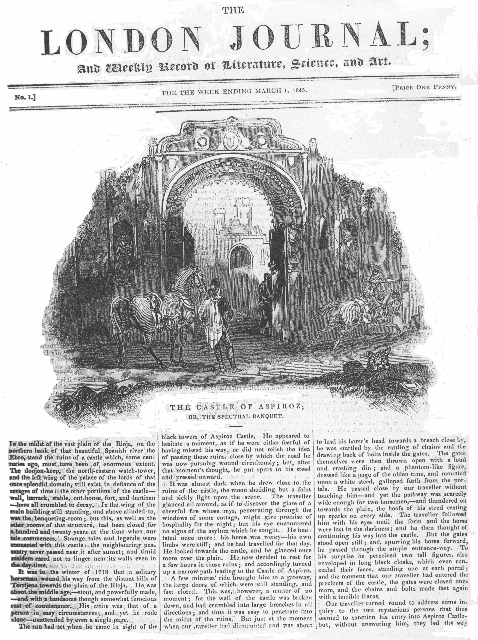
1st page of The London Journal 1845

Two decades after the proofs of my first monograph were submitted for publication it seems an appropriate time now to revisit key concepts I invented to help explain the field of Victorian popular publishing. The book, a version of my PhD thesis, was a study of the first four decades of a Victorian penny weekly fiction magazine, The London Journal 1845-1883. How well do these concepts stand up to the test of time?

One of the key concepts was what I called the parergic after Derrida, though I used the term in a very different way from him. I employed it in an attempt to explain in a serious, non-condescending and intellectually rigorous way the particular position in the literary marketplace of texts right at the beginning of the commercial mass market: what was the relationship of these texts to the more general field?

Here, in this first post revisiting ideas from another age (and indeed I first came up with the idea in the 1990s), is an extract from the original. Later posts will test the concept against other work. Here are a couple on Ouida:

Having provided paragraph-length biographies of several journalists and marked their career paths – they all started aiming for high status and ended writing for money – I came to a conclusion and then sought to explain that conclusion and link it to curious stylistic features characteristic of these texts, features very different from the Edward Lloyd-type serials I had encountered previously which did not seem to care about their status as commodities. The material I was studying from The London Journal seemed worried about being dismissed as merely ‘economic literature’ – how did this worry manifest itself exactly?

*****************************

… The London Journal was thus a precipitate out of surplus labour which would prefer the greater symbolic (and at this stage usually economic) capitals of the up-market magazines. The desire for a unified cultural field that I discussed in Chapter 2 is visible here, supported sociologically by the very limited socio-cultural group that writers in general came from (Altick, 1989). In that sense, the impression gained from Vizetelly’s description of the magazine as staffed by ‘failures’ is correct.

The longing for the high but exclusion from it that such career paths suggest results in what I term the parergic. This comprises a set of specific textual effects and practices, which, while underpinned by sociological narratives, does not inhere in specific bodies or corpora (a writer, artist, a periodical or even an article may display the parergic or not at various points). It is a system whereby texts are based on originals that are invested with greater symbolic capital and authority. Officially respectful and emulative, the parergic is tinged always with a resentment, caused by exclusion from desired cultural areas, that brings about mutation in what is supposedly emulated. The parergic sometimes raids authority aggressively and seems therefore to attack it, but nonetheless paradoxically buttresses cultural boundaries even in the act of transgressing them. Unlike parody, which always in some sense undermines the authority of its original even while being complicit with it, the parergic fully acknowledges and maintains this authority even when it effaces its model. Unlike straightforward imitation of the high, which depends on large cultural capital to judge its value, the parergic does not use the exclusive codes or high prices that cultural authority wraps itself in to keep out the uninitiated.[1]

The weekly ‘Essays’ furnish typical examples of the parergic in terms of that practice which is ‘style’. Essay L [50] on ‘The English Language’, signed by John Wilson Ross ([London Journal] III: 7-8), begins with the commonplace thesis that ‘the progress of language marks the progress of the human mind’, and swiftly interprets this in a nationalist sense. It continues by placing the ‘rise’ of the English language at the Reformation because then ‘men began to argue’ and to do so ‘they [had to] express themselves with precision’. Thereafter,

Addison was unquestionably the first of our writers who introduced elegance of expression into the composition of English prose. He found the writings of his predecessors disfigured by a loose, inaccurate, and clumsy style. He changed all this, and made himself a model for imitation. In his works we find no forced metaphor – no dragging clause – no harsh cadence, – no abrupt close. He is, also, a happy model for the use of figurative language. They seem to spring spontaneously from the subject: and are never detained till the spirit evaporates or the likeness vanishes. They are just like flashes of lightning in a summer’s night – vivid, transient, lustrous, – unexpected but beautiful, – passing over the prospect with a pleasing brightness, and just vanishing before you catch a sight of all the beauties of the scene they gild. The copious and classic mind of that writer gave our language the greatest degree of elegance and accuracy of which it is susceptible. Since his time fine writing has not improved. Simply, because it cannot be. You cannot give the English language a nicer modification of form, or a greater beauty of feature than Addison gave it. But you can give it more nerve and muscle. And subsequent writers have done so.                                                                                                     ([London Journal] III: 7)

It was Johnson, ‘[t]hat Colossus of English literature’, who provided the muscle. Since his time ‘there has occurred no variation in the style of English prose’ except, possibly, by increased use of the ‘Gothic, whence [English] sprung; and that is a feature in language which our readers will agree with us is more deserving of disgust than admiration, and a variation in style more worthy of punishment than praise’ ([London Journal] III: 8).

The essay’s claims to authority depend largely on the assumption of a common standard throughout the literary field…

Andrew King, The London Journal 1845-83: Periodicals, Production and Gender (Routledge, 2004), 57-8.

John Dicks, Publisher, and “Dicks’ English Library of Standard Works”

My thanks to Louis James for the gift some time ago of six volumes (bound as 3) plus 10 monthly numbers of Dicks’ English Library of Standard Works and, in anticipation, to Anne Humpherys’ ongoing research on Dicks and reprinting, to which this post is intended as a small contribution.

To both these remarkable scholars this post is dedicated.

advert of Dicks own reprint series from Dicks English Library March 1884

As William St Claire has assertively reminded us on more than one occasion, the bibliophile connoisseur’s fetishisation of the “original” – the first – edition of texts has often occluded how reprints are actually more valuable in telling us about the cultural penetration of texts. The first edition is always to some extent “experimental” on the market. The publisher may have a good idea of who it will sell to and how how many copies will be shifted but the risk remains that he (for Victorian publishers were overwhelmingly male) may be wrong. Reprint editions still carry this risk of course, but to a lesser extent: the publisher already knows that the first edition or, indeed, the many previous editions, have sold and how quickly, and may even have evidence about who bought it, how the critics understood it, and so on. To that extent the risk is less. But reprints can also be aimed at radically different markets, as when Ouida is repackaged and sold in 6d form at the end of the century. The launch of a text in a new market may meet with considerable success, or it may not, so we cannot say with absolute conviction that reprinting involves less risk than first printing.

List of Dicks’ Standard Plays, c. 1884

Anecdotally, one of the best selling series of reprints of the latter part of the nineteenth century comprised a periodical entitled Dick’s English Library of Standard Works. This was issued from one of the most successful London publishing houses of cheap fiction, John Dicks, on which there is almost no work at all outside an excellent volume privately published in 2006 by a descendant of the founder (Guy Dicks, The John Dicks Press, Lulu.com). Nonetheless, Dicks is certainly well known as a name not only to students of Victorian popular reading, to whom Bow Bells (1862-1897), Reynolds’s Weekly Newspaper (1850-1967) and Reynolds’s Miscellany (1846-1869) along with Reynolds’s Mysteries of the Court of London  (1849-1856) are all familiar, but also students of the Victorian theatre, for without the over 1,000 “Dicks Standard Plays” (published at a penny each between 1864 and 1907), many theatrical pieces would not be available to us at all.

John Thomas Dicks was born in 1818 and entered the London printing trade aged 14 or 15 “in a very humble capacity” (says the Bookseller in its obituary of Dicks, 3 March 1881). Around 1841 he became “assistant to P. T. Thomas, the Chinese scholar, who at that time was carrying on the business of publisher, printer and stereotyper to the trade on Warwick Square”. In the mid 1840s he started to be associated with  G. W. M. Reynolds and in 1863 seems to have amassed sufficient capital to set up as a printer and publisher at 313, Strand, London, where he entered into formal partnership with Reynolds.  After Reynolds died in 1879, Dicks bought his name and copyrights from his heirs for a very considerable annuity.

A major part of Dicks’ business, however,  already comprised reprinting which he organised into several  series, including “Dicks’ Complete Shakespeare,” and of course “Dicks’ Standard Plays” (see the first illustration in this post).

A measure of Dicks’s commercial acumen is suggested by  his death (in 1881) at his villa in Menton, a resort in the south of France where the European and Russian nobility kept their winter villas. Dicks also had a large house, the Lindens (which no longer survives except in the name of a post-war housing estate), in the exclusive west London suburb of Grove Park, Chiswick (the location was not accidental, for not only does the nearby railway station go to Waterloo, from where Dicks could cross the river easily to his office, but census data reveal that his wife was born in Hammersmith, the next suburb east of Chiswick). His estate, valued at “under £50,000” – a very considerable sum –  was left to his widow Maria Louisa and his sons Henry and John (see Ancestry.com. England & Wales, National Probate Calendar (Index of Wills and Administrations), 1858-1966 [database on-line]. Provo, UT, USA: Ancestry.com Operations Inc, 2010).  Clearly, cheap publishing and reprinting could be a very profitable business indeed.

The indefatigable journalist, gossip and bon viveur George Sala has an amusing anecdote at Dick’s expense, however, suggestive of how despite almost all authors’ interest in money, financial and cultural capitals might be inversely proportional to one another. It’s part of a longer story about his encounter at Nice with a “Captain Cashless”  –“ middle-aged, good-looking, well-preserved…  spent most of his money before he came of age; lived for several years on the credit of his credit; is a widower and spent every penny of his wife’s fortune” (Life and Adventures of George Augustus Sala, volume 2: 293). The Captain cannot understand where Sala gets his money from, but Sala feels he might…

Sala, Life and Adventures, Cassell, 1895, vol 2: 294

Sala lets us know that he can just toss off this profitable magic, turning the lead of his scribbling pencil into financial gold he can spend (and no doubt dispend) in Monte Carlo with his friend the glamorous rake. His methods of income generation and expenditure here seem to mirror one another in their low “real” value: both are fun, light, silly, worthless entertainments; good times, easily come by, easily left; in all Victorian senses, “fast”. In an analogue of the bibliophile connoisseur’s dismissal of the reprint as repetition, Sala dismisses his tales as the result of iterable alchemical formulae or repeated tricks of prestidigitation he has learned in the trade. Yet besides their illustration of the distance between cultural and financial capitals, such stories by their very comedy can hide from us the very serious business sense that lies behind them. It’s not that the fun is deceitful – on the contrary, without it there would be no commercial success – but that it is only one side of the coin.

Dicks English Novels no 102: G.W. M. Reynolds, The Seamstress

 Turning now more specifically to the reprinting side of Dicks’s business, in the 1870s  a series of 6d volume-form reprints under the generic title “Dicks’ English Novels,” began to be published: they cost 6d and seem to have started as reset versions of novels originally serialised in Bow Bells. They also recycled the original illustrations. Many other novels were soon added, including, after the copyrights had been secured, works by G.W.M. Reynolds (see the image on the right for an example). In the end almost 200 titles were published in this series (more of which below). It was so successful a second series was begin in 1894.

After his death, Dicks’s sons developed the reprint with Dicks’ English Library of Standard Works, a periodical consisting entirely of the  serial re-issue of well-known novels. It came out in the usual 3 formats: weekly comprising 16 pages with four illustrations (costing 1/2d); monthly, consisting of the weekly numbers for the month costing 3d, in orange covers comprising mainly adverts; and in volume form of 416 pages plus title page and frontispiece costing 1/6. “Dicks’ English Library” was a quarto – the same size and format as most 1d or 1/2d periodicals such as the London JournalBow Bells or Reynolds’s Miscellany – and was first published on 27 June 1883. It ran for 38 volumes right up to 2 March 1894 whereupon (just as with Dicks’ English Novels”) a new series was started. Percy B. St. John was the editor of the first few volumes.

A typical announcement for the periodical can be seen here, justifying its publication not (of course) in commercial terms but in those of Whig public utility  that could have come from the 1830s. (The following is from the Pall Mall Gazette, but similar adverts were placed all over the press)

The Pall Mall Gazette, 21 June 1881: 15

Besides the  list of authors above and the more obvious suspects in the world of Victorian popular fiction – G.W.M. Reynolds, Bulwer Lytton, Charles Lever, G.P.R James, Captain Marryat, Paul de Kock and Dumas ‑  also included were Mary Shelley’s Frankenstein (and Percy Bysshe’s Zastrozzi, both illustrated by the well-known illustrator Frederick Gilbert – Shelley’s complete “Poetical Works” are published later in the series), Maria Edgeworth’s Belinda, Austen’s Sense and Sensibility, Hawthorn’s Scarlet Letter and Godwin’s Caleb Williams. Most intriguing (not least from the point of view of copyright) is the heavy presence of Dickens, including, later on, Dombey and Son as well as numerous individual tales.

The reissue of these texts cannot be taken to be an unalloyed index of popularity amongst the readers of cheap publications. The Dicks firm is clearly aiming at respectability and the aspirational reader keen to build up that sign of cultural capital, a “library” – the page numbers of each weekly and monthly number are incremental, asking the reader to keep them so as to build up the volume. The Shelley poetry may have been suggested by the revival of interest in him amongst the literati with Rossetti’s Moxon edition in 1870: it is a mark of what the public should aspire to rather than of already extant popular demand. Publication in this form is no indication that any particular author was read unless the author’s other works are also issued, and even then business reasons other than consumer demand may have prevailed – for example, copyrights might have been bought as a job lot in advance, and accordingly had to be exploited, or there were vacant pages that had to be filled with works whose copyright had lapsed. One also has to take into account what other works were serialised with, before and after any particular text, for it may be any or all of those that carried the periodical through rather than the particular text one is looking at.

What one also has to do is try to establish the publishing history of a series. Adverts are always useful for this and one on the monthly cover of “Dicks’ English Library” (October 1888) shows that by then 197 titles had been published in the “Dicks’ English Novels” series for example. The missing titles were presumably exhausted, but they can be identified by reference to other adverts elsewhere, either in other publications or earlier in the series (cf. the following with the first image of this post).

advert of Docks own reprint series from Dicks English Library March 1884

The history of the Dicks reprinting series has yet to be mapped: even a basic bibliography is lacking. After that is done, one of the many questions that can be answered concerns the relations of synergy between the various publication forms: for example, how far did the English Library reprint works previously available in the volume-form English Novels series? More complex questions can also be addressed, including the implications for the history of the canon, its creation, modification and its reception – if any – of the publishing choices of  this financially rich but status-poor house. The use of a garland of portraits of authors as a frontispiece for “Dicks Standard Library” suggests the prioritisiation of some authors over others: this prioritisation needs to be charted and compared to the number and positioning of authors actually published (a front-page author is lent greater prominence than one whose work starts on a middle page, for example).

These, and many other questions about this most interesting publisher, still await answers, and we look forward to them in due course.