Exploring the Archive with The Wicked Boy

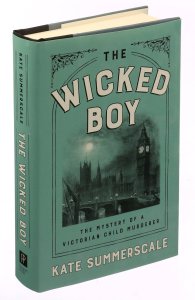
The moment (this is October 2024) when the “Queen of True Crime” , Kate Summerscale, has just published her 7th book, Peepshow, seems an appropriate one to revisit an earlier book of hers, The Wicked Boy: The Mystery of a Victorian Child Murderer (2016).

The Wicked Boy was very successful, garnering great reviews (here’s the Guardian‘s, for example) and winning the 2017 Mystery Writers of America Edgar award for Best Fact Crime. My students used to really like it when we taught it, especially as the murder occurred not too far away from Greenwich, across the river in Plaistow.

The book deals with an 1895 matricide by a 13-year-old boy, Robert Coombes, in the working-class East End of London, along with its context and its aftermath: the squalid city, the discovery and investigation of the crime, its coverage in the press, the possible effects of the boy’s sensational reading, his trial and imprisonment, his eventual release, service in World War I, emigration to Australia and his rescue and nurturing of a boy who was being abused.

It is easy to read as a story of redemption: the subtitle of the Italian translation even suggests it as a Dostoyevsky with a happy end: Il ragazzo cattivo ovvero Delitto, castigo e redenzione di Robert Coombes (“The Wicked Boy; or, crime, punishment and redemption of Robert Coombes”).

I have to say though that my take on the book was very different from the reviewers’ – much more theoretical for a start, and much more concerned with thinking about the emotional effects it had on us readers in the classroom. We read it in the light of crime fiction rather than “true crime,” for while we noted its very clear differences from fiction, we also noted a similarly powerful pull to read it, along with its development of characters and its forensic portrayal of context as a set of clues.

For a start, what does it mean that “Kate Summerscale” is the narrator of The Wicked Boy? Can we be sure that the “I” of the narrator (which emerges strongly only in the last part) is a simple reference to the author? Are we sure the narrator is not a constructed character? The fact that the narrator shares a name with the author might be confusing, but hardly unique, especially in postmodern detective fiction (at one point Paul Auster’s deranged detective-protagonist  meets Paul Auster in The New York Trilogy). The “I” of the narrator seems very carefully constructed throughout, even when – especially when – it does not appear directly but simply as a collector of evidence or as a (sometimes vacillating) point of view. To me, it is as much a character as “Robert Coombes.”

I’m sure you’ll have noticed too if you’ve read The Wicked Boy that not only does the protagonist Robert Coombes change over the course of this “true crime” volume  (it shares that kind of character development with the Bildungsroman)  but the narrator does as well. Her investigations in the archives gradually lead her to discover unexpected secrets – that maybe Robert Coombs was more than just a “wicked boy” defined by the law and then “archived” – arrested, shut away in a lunatic asylum, forgotten. We gradually understand that “Kate Summerscale,” the character/ narrator, wants to get close to the subject of her investigations. She wants to understand him. By p. 197, she can surmise that “To survive the horror of the murder, Robert needed to forget. To recover from it, he would need to remember.”  At the end, she even touches the hand of a man Robert helped survive abuse:

As I stood up to leave, Harry smiled and reached over to clasp my hand. He seemed glad to have told me what Robert had done for him. When I started work on this book, all that I had known about Robert Coombes was that he had stabbed his mother to death in the summer of 1895. It was astonishing to hold the hand of a man whom he had saved from harm. I still couldn’t be sure whether Harry knew about the murder. I hoped that he did, and had loved Robert anyway.

Wicked Boy, (pp. 196-7)

How can we understand this astonishing transformation from the coolness of the investigator we hear first, a narrator who seems to be on the side of forensic investigation and the upholding of due legal process, to the woman story-teller (yes, at the end the narrator is strongly gendered) who proposes a higher justice than the law can offer, a justice that gives us all a right to be loved, to be redeemed?

This doesn’t seem in the end to be a cool investigation of just the true “facts” of a crime: the narrator’s rooting in the archives seems to have changed her as well as her view of her central subject.

“Kate Summerscale” as forensic narrator concerned with weighing up the evidence uses a panoply of primary resources: newspapers and periodicals, books (often in rare or special collections – see for example note to p. 11 (p. 311) Archer Philip Crouch, Silvertown and Neighbourhood: A Retrospect (1900); a note to p. 253 [on p. 343]  lists 3 rare book sources), manuscripts and paper documents in particular locations (E.g. “BRO (= Berkshire Record Office) D/H14/A2/1/1” – note to p. 222 [p. 337]; the diary of Charles Francis Laseron in Mitchell Library, State Library of New South Wales); secondary sources – the included bibliography is extensive and impressive (e.g. a note to p. 11, justifying descriptions of trams refers us to Jerry White, London in the Nineteenth Century: a Human Awful Wonder of God (2007)). The narrator later – when it becomes “I” – even records personal interactions – phonecalls, emails, casual encounters, interviews (see pp. 284-5, 303-7).

Archives are fundamental to Summerscale’s enterprise. But how do they lead to that tremendously affecting moment when she touches the hand that touched the hand… ? What might we mean by an “archive,” then, and what effects might that  “archive” have on our understanding of the text and on the narrator’s relationship with the subject of her research?

Derridean Archives

Reflection on the nature of archives is hardly new. Twenty years ago, Marlene Manoff was able to write that “researchers [have been] proclaiming the centrality of the archive to both the scholarly enterprise and the existence of democratic society” (“Theories of the Archive from Across the Disciplines, Libraries and the Academy, Vol. 4, No. 1 (2004), pp. 9–25, p. 9) and even more has been written since then.

Freud’s couch and desk in the Freud Museum, 20 Maresfield Gardens, London

The turning point in archive studies is usually put at Derrida’s Mal d’archive [“archive sickness/ evil”], a lecture delivered at the Freud Museum in North London in 1994, and published first in French as Mal d’archive: Une impression Freudienne (Éditions Galilée, 1995) and in English the same year in the periodical Diacritics (Jacques Derrida, “Archive Fever: A Freudian Impression” translated by Eric Prenowitz, Diacritics, Vol. 25, No. 2 (Summer, 1995), 9-63).

Derrida had an audience of psychoanalysts and his lecture is very much addressed to them. Yet one of the many fascinating things about Derrida’s essay is how it has been treated by historians and critics. It’s as if they had read only the first few pages in which the archive is defined in historico-political terms. They forget that the lecture is actually about the nature and origin – the archives – of psychoanalysis composed for psychoanalysts in the symbolic “home” of psychoanalysis of the refugee Freud at a particular moment. Nonetheless, let’s follow the historians and literary historians, at least initially, and consider what they have taken from the lecture. 

One of the commonest points that is made concerns how Derrida explains in his opening pages that – in his usual etymological and serious-fun play on words  ‑ an “archive” was originally the building where the written laws of ancient Athens were stored. Only the magistrates of ancient Athens, the archons, were empowered to place them there, to put them in order and to interpret them.

In these introductory pages, the archive is always, according to Derrida, a place of “house arrest”, involving both the law and the idea of an enclosed place from which documents cannot be removed or put into general circulation: indeed, there’s a curious and all-encompassing, circular relationship of the archive and the law – the law proclaims who can access the archive which is itself the repository and authority behind the law. The “archive” is what gives the archons their power and enables them to keep it. It does that by keeping the laws secret. Only the archons can reveal those secrets, and it’s in revealing them – bringing the laws out from the archive and interpreting them – that they most clearly exercise their power.

In typically Derridean logic, without the idea of an archive, neither secrets nor laws could exist. The archive is the guarantor of the law by virtue of keeping it secret (of course Derrida is thinking of the Freudian unconscious and the Oedipal prohibition here).  But then, as soon as an archon outs a secret or a law, it is ready to be archived and forgotten again, becoming again accessible only to a few. It’s just as if an archon (or, we might think, an artwork or therapist) were to show us a scroll on which laws are written only for it to be put back on its dusty shelf again, while we get on with our daily lives as before, having been entertained and distracted by the revelation (and perhaps a legal infringement or temporary escape of the unconscious) for a moment.

Following on from Derrida’s argument, it’s entirely logical that, if we think an equal-opportunities-for-all democracy is a good idea, we who are not archons with power will rebel – we will want to wrest the archons’ power from them. Power in such a democracy, we think, should circulate. Pursuing that logic further, all of us should want to be able to reveal secrets and show how the world “really” operates according to laws hidden from other people but not from us. Knowledge is power – we’ve been taught that since the beginning of school – and we want that power.

While for most of the time we just get on with life, there remains a nagging doubt – more acute for some of us than others – that the archons may give us only one version of ourselves and our history. They may say “you are a Wicked Boy” or “you are nothing but the murderer of your former employer” (Mary Braddon’s Henry Dunbar) or “you are a sexual experimenter and accidental suicide” (P.D. James’s Mark in An Unsuitable Job for a Woman) or a “serial bigamist” (Richard’s Marsh’s Judith Lee story “Matched”) or “a dangerous woman who can blackmail a king and thereby destabilise the whole social order” (the Sherlock Holmes story “A Scandal in Bohemia”).

But is that all there is to the identities of such characters – or of real people?  Maybe we can prove that the archons don’t possess all the secrets as completely as they think, that we can observe and come to logical conclusions better than they. Maybe the Wicked Boy is more than that label. Even if we just want to assert ourselves and show the world that we are not simply as the archons describe us, we will want to show that we are, in short, better archons than the archons, or, this being a democracy, that we are at least as good as them.

We search for a trace that allows us to imagine we are rescuing secrets that the archive has hidden from the world.

Whole infrastructures have grown up according to that logic. Institutions like schools and universities aim to teach us to find things out for ourselves – or at the very least, teach us that there are secrets out there that we need to uncover. They tell us that we can become archons if we work hard enough. Such institutions operate doubly though: they both make a few of us feel like archons with the key to knowledge in our pockets or purses, but also they teach large numbers of us that we can never hope to understand the secrets of the archive. In the latter case, institutions teach us to be “the populace” – the ruled not the rulers, the powerless not the powerful.

Such thinking is what Derrida means when he writes that any “science of the archive must include the theory of [its]  institutionalization, that is to say, at once of the law which begins by inscribing itself there [in the archive] and of the right which authorizes it.” (p. 4) Institutions like schools and universities are gateways to the archive: only a few of us are granted the right to pass inside where we can decode and profess the secret laws of the universe and of texts.

As we’ve understood by this point, the goal for those of us who root around in the archive is, according to Derrida, to find the previously secret. What that secret comprises is closely and inextricably bound up with two presuppositions: first, the idea that we are discovering a unique thing that only we know and, second, a powerful feeling – the magical, mystical moment of enlightenment we experience when we discover the secret, the authentic instant where we neither know nor care if we are the researcher or the researched, the ghost or the haunted, writer or written, archive or archon. We search for evidence where “the trace no longer distinguishes itself from its substrate,” as Derrida puts it on pp. 98-9 of Archive Fever – everything dissolves thrillingly into a feeling of oneness (very Lacanian psychoanalytic that). The past and present fuse, and in that moment death is overcome. To quote Tennyson’s “Break, Break, Break,” we seem to touch a “vanish’d hand” and hear “the sound of a voice that is still.”

Derrida’s way of conceiving the “archive” – at least at the beginning of his lecture –  has not gone unchallenged, even though it has been very influential. Within standard historical and literary historical discourses, his proposal raises questions such as the following in Ed Fulsom’s excellent essay on “Archive” in the collection Literature Now: Key Terms and Methods for Literary History.  

When we read Derrida on the archive, questions proliferate: how much of what we could think of as archives in fact exists outside of official archives and resides instead in garbage heaps or even in lost voices still travelling somewhere on sound waves? How much exists in the endless writings stored on tapes or records or disks or other outmoded technologies that are difficult if not impossible to access? How much of an archive is stored in the deep and inaccessible parts of any single human brain?

Ed Fulsom, “Archive” 23-35 in Sascha Bru, Ben De Bruyn and Michel Delville, Literature Now: Key Terms and Methods for Literary History( (Edinburgh Up, 2016), p.  23

Of course these are sensible questions within the discipline of history, including literary history, and they are central to postmodern writing that deals with the past. The garbage heap that Fulsom regards as a possible repository of secrets is not sealed from us as official archives are; the memories stored in the heads of our loved ones are, in theory at least, accessible to us. How can we claim therefore that these kinds of archive are ruled by the archons of knowledge? History, archaeology and literary history of the last seventy years has indeed raided both rubbish heaps and outmoded technologies as well as oral accounts by the living and the dead. Such sources are (again in theory) freely available to all.

There are two issues here though.

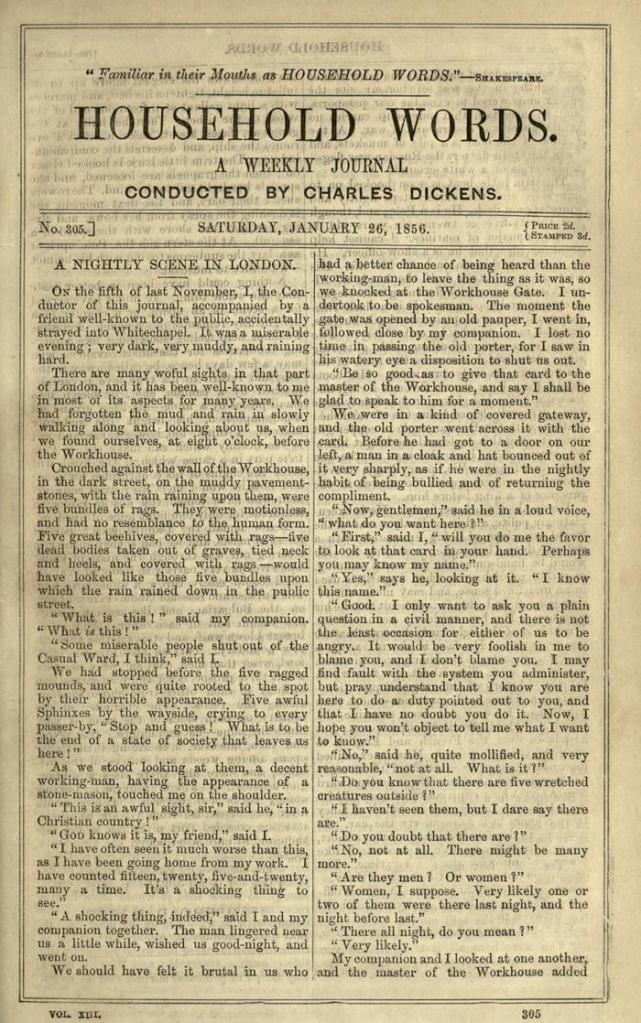
The first is that what is called “garbage” is determined by the powerful. We may not feel powerful when we throw the history of our drinking in the recycling bin, but we are much more powerful than the malnourished person who lights on our bottle in a rubbish dump in China. Texts once regarded as garbage because they didn’t conform to what was thought acceptable literature by the archons of culture may disappear altogether, recycled as note paper or toilet paper, leaving – at best – only the trace of their existence behind in catalogues (we recall how very few copies of the mass-market London Journal survive even thought it was read by 10-12 times more people than Dickens’s Household Words).

Secondly, to raid garbage heaps so that secrets are revealed requires skills – and what those skills are and who has them are determined by archons. So even if material may be freely available, to investigate it so that it yields its valid secrets requires access to the secret laws of the archons. And the loved ones whose own stories we’d like to hear may have understood that they are garbage according to the powerful and so may have deleted or altered them to accord with what they think is acceptable. How can we say in a simple way, then, that such stories are accessible?

(Perhaps indeed the archons, the archives and institutions are not just outside us. They are us. We have at least to negotiate with them to get our “I”s, our speaking selves, to speak at all)

The Forgotten Shelves of Derrida’s Archive: Psychoanalysis and Ethnic Boundaries

So far so good. That kind of institutional thinking is very useful for historians of all sorts. But what historians seems have elided and forgotten – “archived” to use Derrida’s terminology (or maybe “shelved” or, as I’ve done above and am.doing here, “bracketed”) – is that for Derrida psychoanalysis is at the heart of our concepts of the archive, and vice versa, for how we imagine an archive lies at the heart of psychoanalysis. And psychoanalysis is concerned to investigate our identities – who we are inside. It does not conventionally excavate the external power structures and processes that we are constrained and enabled by.

The “theory of psychoanalysis, then, becomes a theory of the archive and not only a theory of memory” writes Derrida at one point (p. 18), challenging a once dominant notion. And then he goes on to ponder the possibilities of an alternative history in which Freud uses a different technology which uses a different archiving mechanism – email, for example: how would psychoanalysis have been conceptualised if Freud had communicated with his friends and colleagues using email instead of pen and paper and the postal service? That too is a famous and oft-quoted point, and directs our attention to the “paratextual” and how technology affects our creation and understanding of texts (something I’ve written about quite a lot elswhere). But the point surely is that identities, in so far as they are an effect of archives, are both personal and institutional.

By far the greatest part of Derrida’s lecture – the part that historians neglect – is taken up with a thoughtful discussion of the claim by Yosef Hayim Yerushalmi in Freud’s Moses : Judaism Terminable and lnterminable (New Haven: Yale UP, 1991) that psychoanalysis is essentially Jewish. Derrida’s lecture is in reality a targetted intervention that needs to be read in its time and place, as a response to a Yarushslmi in the house of the refugee Freud, not as an ahistorical  pronouncement.

Yerushalmi, writes Derrida,  is the exemplary historian, exhibiting

the desire of an admirable historian who wants in sum to be the first archivist, the first to discover the archive, the archaeologist and perhaps the archon of the archive. The first archivist institutes the archive as it should be, that is to say, not only in exhibiting the document, but in establishing it. He reads it, interprets it, classes it.

Derrida, 1995, p. 38

And it is precisely this institutionalised “desire of an admirable historian,” not what has been left out of an archive on the rubbish dump of history or what technology is used to preserve it, that Derrida asks us to question. It is this “desire of an admirable historian” that is “archive fever”, the mal d’archive, the sickness/ evil in the title of his lecture. Desire is the foundation of the archive; the rational institution we see, the home of the Law and secrets, the Archive, is built on something quite other than the rational. And desire in turn is built on lack, on absence (we can’t desire something if we really believe we have it already).

In other words, we search the archive not really for rational knowledge of the secret or the law, but a feeling, an experience – a sensation that something is present when it can’t be. We root around in the dust because we want to encounter something or someone close up – in absolute closeness that fills the absence, the lack, beneath desire. We feel a void in everyday life, a distance from it – we are alienated from ourselves and from others, perhaps – and our investigations into the archive are a search for a way to bridge that gap, fill the void within ourselves, encounter the Other. This sensation generates a feeling of Truth, of access to what Lacanian psychoanalysis calls the Real. We want what Derrida calls elsewhere “presence”, the feeling that someone is right next to us, in communion with us. We know that such “presence” is just a metaphysical, impossible fantasy, but that doesn’t detract from its magnetic pull. This drive for such a sensation is what I tell my students is “the fiction of detection,” the fantasy that we have solved the mystery, revealed The Secret.

This psychoanalytic reading of the archive has little, it seems  to do with the power relations around the archive that the historians are interested in. But Mal d’archive is a psychical drive – and it certainly doesn’t belong to any ethnic group. In fact it’s a universal human drive, claimed Derrida, rightin the home of the refugee Freud.

For Derrida has, it turns out, raised the question of the archive, its institutional violence and evanescent material technological basis, its sickness and fevers, to argue against Yerushalmi’s argument that psychoanalysis is the property of just one ethnic group, and not of the world. Yerushalmi, argues Derrida, is on the side of the archons and institutions who want to keep the secrets for one group. He is policing the archive for reasons he should reflect on.

Such a tactical move is perfectly in line with Derrida’s commitment to an ethics of hospitality that dislikes border controls  and welcomes Others, including refugees like Freud (however problematic he saw that commitment – see Judith Still’s wonderful Derrida and Hospitality, EUP, 2012; and the two volumes of translations of Derrida’s 1995-96 seminars on Hospitality which came out in 2023 and 2024 from Chicago UP). It is also in line with his commitment to acknowledging the role of the irrational in what can seem simply rational, a commitment that itself is an inheritance from psychoanalysis.

Derrida is asking us – and Yerushalmi in particular – to use the insights of psychoanalysis to examine the foundations of  our own stories – the discourses and institutions that govern what we do without our even realising it. In the house of Freud, he’s asking us to welcome truly Freudian thinking.

Archives and The Wicked Boy

So how does all this connect to The Wicked Boy?  First of all, doesn’t “Kate Summerscale” (the narrator) set herself up as an archon of some incredible power? Goodness – all those archival sources! Just look at the notes! All those newspaper articles that she’s used to construct her story!

To impress us with her credentials as an archon in the orthodox institution of knowledge is surely the purpose of the notes and the bibliography. They are a sign that she must have worked for years over crumbling paper copies in dusty libraries and arcane archives. She’s got the skills and the knowledge so she’s closer to The Secret than we could ever be. She’s just like a private investigator at the top of her game, a Cordelia Grey or Margaret Wilmot or – since she narrates in the first person (so it turns out) – a Judith Lee.

Well, let’s dig a bit deeper and excavate “Kate Summerscale”’s own processes of generating secrets – let’s reflect on that character’s archival processes to reveal some secrets ourselves.

First thing, it’s clear to me (as a mini-archon in my own way) that her story is based mostly on online databases – especially the British Newspaper Archive (BNA). Rather than spend years in the paper archive, Summerscale has spent days in the digital archive, using keyword searches. You can do it easily enough yourself – just type for example “Robert Coombes” in the BNA and see what comes up. Other books she cites are freely available online through Google books or archive.org.

She hasn’t admitted any of this, though: her bibliography doesn’t list the BNA or Google books, only individual newspapers. Rather, Summerscale has mystified and glamourised her role as an archon to give us the impression that we are getting real value for money – that we are buying a huge amount of her labour. Of course the author has worked really hard – just not in the way that the creation of “Kate Summerscale” the narrator suggests. This isn’t deception on her part, just a conventional veiling of process that accords with the dominant rules of the knowledge-producing institution: academics still tend to cite the paper versions of primary sources even if we’ve found them online. It’s an unspoken institutional rule that either you know (that proves you are an archon) or not (you’re “populace”).

Second, let’s look at the metamorphosis of “Kate Summerscale” the narrator/ investigator. At first the narrator starts off like a cool police reporter: the tone is reasonable and controlled, a careful and very detailed description of events and environments. We might note the extraordinary emphasis on smell, for example. These days, in our hygienic world, we are so used to things not smelling that this emphasis, noted by several reviewers, comes as something of a shock: the stink of the ship Spain – a mix of “animal flesh, urine and excrement” (p. 12) – the powerful smells of 1890s London – “sour urinous… musty caramel… rotting cow carcasses… simmering oranges and strawberries… boiling bones and offal… bird-droppings… rubber, caustic soda, sulphuric acid, telegraph wire, dyes, creosote, disinfectant, cables, explosives, poisons and varnish…” (p. 13).

Yet all this horror is presented in calm forensic detail, with even rhythms and elegantly composed sentences. We are not surprised when the body is discovered and dispassionately described as if in a police report (see especially p. 41). “Kate Summerscale” here is very much on the side of the law and the reasoned forensic use of the archive. We readers seem to be positioned at this point as the jury deciding the wickedness or otherwise of the murderer. Did he do it? Well, yes, probably. But we are also being asked to judge whether he did it because of his environment (of which the smells, and the brutality of others, are a pungent part) or whether  because he is essentially wicked inside, evil in nature, worthy to be thrown with other rotten characters on the garbage heap of history. The very asking of the question, though, opens us – and, with more certainty, the narrator – to change: which side will the narrator and we plump for?

For “Kate Summerscale” does not stay the same – her relationships to the law and to the archive are not fixed throughout. As I suggested before,  her investigations in the archive gradually lead her to discover unexpected secrets – that maybe Robert Coombs was more than just a “wicked boy” defined by the law and “archived” – arrested, shut away in a lunatic asylum, invisible, secreted. We gradually understand that the narrator has been caught up in her investigations. This suggests, then, that the book is a Bildungsroman not just of the object of research, Robert Coombes, but of “Kate Summerscale” herself. And it’s archive fever that provokes this change.

The Archive is not just evil or repressive, then, for it can also be an engine of transformation: the power of the mal d’archive is not confined to the “desire of an admirable historian” to make the world conform to himself, but can open the possibility to encounter the Other, an Other.

What she’s doing becomes really clear when we find that, because “Kate Summerscale” herself is shut out of the archive relating to the asylum, she keeps padding around its perimeter, treading textual ground that might offer a glimpse of Robert – the descriptions of Broadmoor where he was incarcerated, her hunt for photographs (are they all definitely of Robert Coombes?). We get closer again when she tracks him down to Australia and locates people who knew people who knew him.

We discover that, like the detective Cordelia in P. D. James’s An Unsuitable Job, she wants to get close to the object of her investigations, to understand him, to make him present to herself and to us. She wants to reach out across the void of time, hear his voice and touch his hand. She wants to raise the dead. In so doing she seeks to elide the binaries of past and present, perhaps too of fiction and fact, to touch a “vanish’d hand” and hear “the sound of a voice that is still,” to undo death even while knowing that that is impossible. It is utopian, fantastical, a resource of hope, a reason to change.

That impossible desire to get close is surely the secret of why we continue to read, why we are touched by the two conjoined stories of “Kate” and “Robert” that come together in the end. “Kate” may not be able to touch Robert’s hand, but she can touch the hand of a man who touched him, and she can hope that he feels the same way as she does about Robert. This is the metaphysics of presence in literary and historical action: we know such desire for presence is impossible, but we keep hoping nonetheless. That is a glory, and a tragedy, a source of grief and of pleasure, a hope and an acceptance of defeat.

Archives, then, may always be political, institutional, systemic, but they are also emotional and experiential. They may harbour secrets from the past and try to ensure closure and certainty, but the desire archives excite can also be a driver to the future and to change in politics, institutions, systems and the self. What the narrator of The Wicked Boy  does is show the transformative effect of archive fever so that, in the end, we can welcome what before we feared.

We can, as “Kate Summerscale” models for us, visit the archive not only to become archons who erect and police boundaries, but to become, also, hospitable.
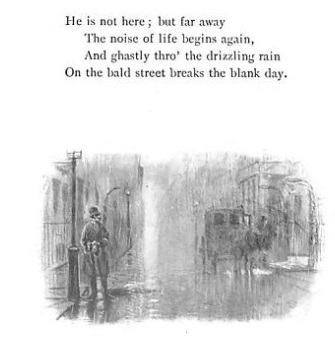
from Poem 7 of 1897 American edition of Tennyson’s In memoriam (orig. 1850), illustrated by Harry Fenn (Fords, Howard and Hulbert, New York)

The Book in the Twentieth Century Part 4: war and competing media

This historical definition of the twentieth century as related to book publishing over the last two posts have covered 6 elements: technology, ownership, regulation and distribution and conglomeration and the paperback format (the first post was an introduction). Before ending this consideration of the book in the twentieth century, I want to cover two more areas: first, the importance of war to publishing, and secondly, and inevitably, the relationship of book publishing to other media, a crucial characteristic of twentieth-century publishing.

We may not like to think this, but war is a time when information storage, retrieval and transmission of all sorts benefit from a lot of additional energy. We can see this in the effects of the Crimean and Peninsular wars in the nineteenth century on demand for newspapers, the effect of WWI on increasing demand for published images of the war and on staff shortages at printing works – which obviously caused its own problems – or what I’m going to write about here, the effect of WWII on the book as we know it.

In many ways, the second world war is just as important as any of the other factors outlined in previous posts.

First, WWII promoted the idea of a national literature which turn had a huge effect on the industry and on education. In America, for instance, it had an enormous impact on the consolidation of the canon of Great American Books. In 1941 was published one of the foundational books that came to define what was to be included in the American canon – and of course excluded from it. This was F.O. Matthiessen’s American Renaissance, a volume that set the syllabus for schools and universities for decades to come.

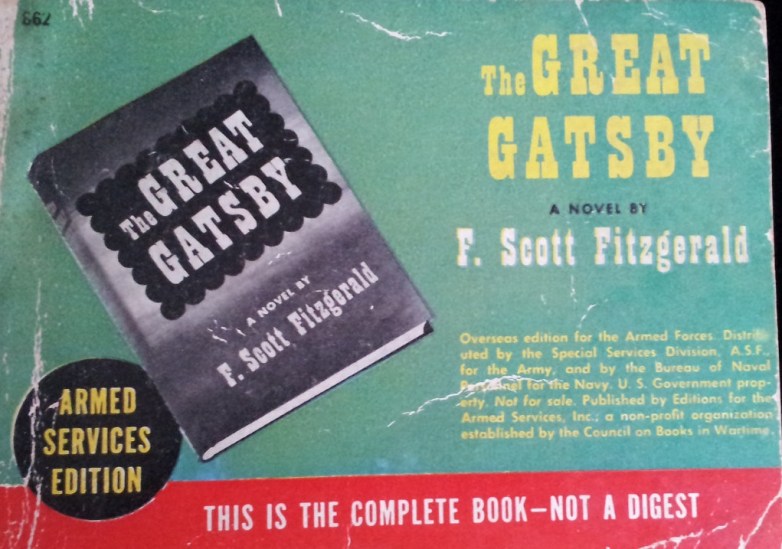
If this was what we may call a top-down effect, there was also some influence of what people were actually reading on what academics decided should be canonised: Fitzgerald’s Great Gatsby had sunk without trace, an utter flop on its appearance in 1925. Chosen for free distribution amongst the American forces during WWII partly because the copyright was very cheap, The Great Gatsby began to be read by large numbers of people for the first time. Following the war, academics who had read it when serving in the forces started to publish on The Great Gatsby and Fitzgerald in general.

More comforting – to me at least – than the idea of war encouraging an idea of a national literature, is the opposite: the idea of a world literature. It was a year after the war that Erich Auerbach’s magisterial Mimesis: Dargestellte Wirklichkeit in der abendländischen Literatur was published in Switzerland by Franke Verlag. Its research project was intended to show the cultural histories many of us share – a rebuttal of the divisions that the war between nations was using to justify itself. In its 1955 English translation the Auerbach became one of the founding texts of comparative literature, rightly praised (in my view) by Edward Said.

During the war there was enormous demand for reading matter: people not only wanted information on specific subjects such as the military – no fewer than 229 new titles were published on military matters in 1943 alone, as opposed to only 62 in 1937 – but military personnel had long empty periods of waiting between scenes of action while civilians had long evenings to kill with not much to do because of blackouts and rationing.

The publishing industry in Britain found that due to the rationing of paper it was unable to meet demand. Fortunately for publishers, it had a ready-made lobbying body in the Publishers Association which succeeded in preventing the imposition of Purchase Tax on books and in negotiating on a national scale the Book Production War Economy Agreement. This latter determined both the quality of paper and the size of type in order to produce savings.

Paper rationing – which came to an end only in 1949 – was instrumental in establishing the dominance of the paperback (which Penguin had already begun), for the production methods used for paperbacks used less paper than their equivalent in hardback. Furthermore, the pared down visual style imposed by wartime printing restrictions was highly influential on later developments in design.

These very brief paragraphs can only open the subject up for discussion rather than explore it in detail, but it is nonetheless important to acknowledge the very obvious fact that historical events, of which war is a very powerful example, impact enormously on the configuration of the book publishing industry. It’s a great area in which students can research individual items for projects.

One that strikes me is the surprising “Services Edition” (No. 481) of Woolf’s A Room of One’s Own that heads this post. As the back cover of the slim volume has it, these editions were “for circulation to the FIGHTING FORCES OF THE ALLIED NATIONS. THIS BOOK MUST NOT BE RESOLD.” By the time of its publication in 1945, Woolf had already committed suicide, though this is masked by a remark that she had “died” in 1941. The note on the author in the inner page defines her in national and canonical terms: “at the time of her death she had won a foremost place in English fiction, but she also ranks high among literary critics and essayists.” Readers need to read Woolf, suggests the note, because she is English and high quality according to sanctioned criteria, not because she has sold a lot (the original 1929 Hogarth Press edition had sold out very quickly as it happens). As with The Great Gatsby, in such framings we see an attempt to formulate the continuation of an illustrious national history, a promotion of “England” as a cultured, civilised and literary nation opposed to the barbarism of the enemy we see so prominent in British and Allied propaganda. This is, for all its endorsement of Woolfian feminism, the result of a carefully controlled (even while apparently librral) propaganda enterprise far removed from Auerbach’s call for unity.

The final element in my analysis of the “twentieth century” in publishing terms is relations between media. Books should never be separated out from other media: even the Gutenberg Bible was meant to recall manuscript rather than declaring itself to be entirely new. For most of the twentieth century we need to consider the relation of books to film, radio and TV – what I’m calling here “electric media” (as opposed to electronic) . I’ve no intention of going into the interaction of books with these media in any detail here, but there are a couple points to make that students find interesting.

Electric media have all interacted in complicated ways with literature: not only is there the obvious phenomenon of the spin-off, the film of the book, the talking book (on radio, tape or CD), the radio play of the book and so on, but also these other, electric, media have all affected literature itself. The influence of film is well documented, especially in the early twentieth century, from Kafka, Thomas Mann, Joyce to Fitzgerald (at the end of the century and at the obvious level of cultural reference, one recalls the importance of Rogers and Hammerstein’s The Sound of Music (1965) in Arundhati Roy’s The God of Small Things (1997)). Students have considered this in their projects and – even more commonly – how books (qua novels) have been adapted for the (cinematic) screen. This is all very familiar to us.

More importantly from my perspective, however, is the dating of the electric  media’s  influence on considerations of what “literature” is. While film had been widely consumed since the early years of the twentieth century, radio from the 1920s, from the 1950s it was TV that proved to be the competing – or perhaps complementary? – medium to the book. It’s important to remember how poor people were in the UK before WWII and before TV. Over the 1920s and 30s leisure accounted for less than 5% of national expenditure. Such poverty unsurprisingly hampered media expansion. It was the post-war boom that saw the greatest changes in media consumption – I’ve already mentioned the importance of the 1950s for the transformation of book production methods and in many ways nineteenth-century media production ended 50 or even 60 years after 1900, as the old production methods were replaced wholescale by the new only after WWII.

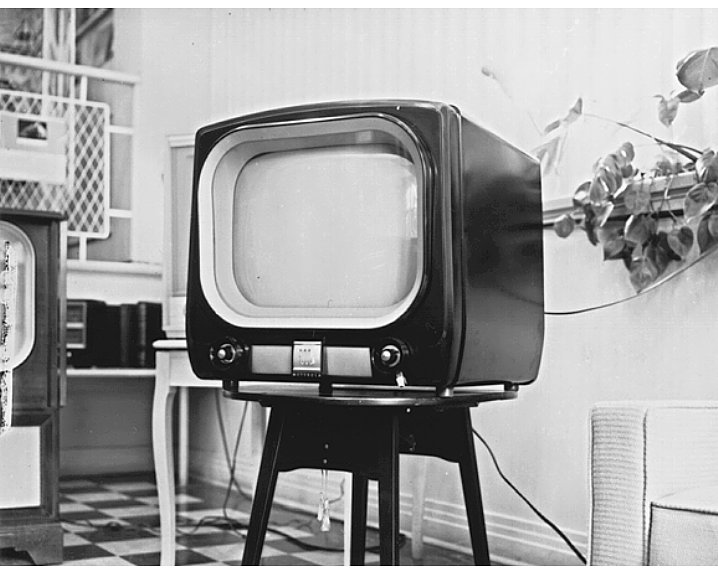
Consumed sitting in the home, TV became a rival not to radio (as is sometimes claimed) but to the book. The similar physical postures involved in the consumption of  TV and the book put them into competition, while the radio could be listened to while involved in other leisure activities or while working. I still remember the BBC radio programme “Music While You Work” which had started during the WWII – in 1940. It ran until 1967. Asa Briggs’s 1970 The History of Broadcasting in the UK(Vol. III: 576–577 perceptively writes about how popular music was broadcast to aid productivity – this wasn’t a secret even to me as a child: it was just “normal.” But to watch TV you had to sit down and dedicate time to the small grainy screen in order to decode what the pictures meant. Today’s giant screens enable us to do the ironing while watching TV (or our phones enable us to watch while commuting). That wasn’t the case in the 1950s.

Now at exactly this time – the late 1950s and early 1960s – we see the birth of modern media studies, a birth largely and paradoxically in book form: not only Marshall McLuhan’s The Gutenberg Galaxy of 1962 and his Understanding Media of 2 years later, but work on the history of popular reading by Margaret Dalziel, Richard Altick, Louis James, Mary Noel and others. Richard Hoggart was considering The Uses of Literacy in 1957 just two years after ITV started in London and the BBC killed off Grace Archer in an attempt to prevent the curious tuning in to the upstart channel. Of course, there had been studies of mass or popular reading before – one thinks of Q.D. Leavis’s cantankerous and inaccurate (but very influential) Fiction and the Reading Public of 1932 ‑ but what was new at this time was the extent of interest in and concern over the new media and a corresponding re-evaluation of the old. No longer did “English” and “American Literature” remain with their sights on a few canonical classics, but the field began to widen to include texts not previously considered “literature.” Not only was contemporary popular culture analysed (Barthes’s journalism collected as Mythologies in 1957 remains a key example), but popular fiction and even journalism began to be studied historically. Important for me, this is the period when the Research Society for Victorian Periodicals was born, and when the interdisciplinary Victorian Studies was first published.

Television was not of course the only or even an obviously direct or major propellor of these paradigm shifts in the study of literature – the post-war expansion of higher education and the “reward” of higher education to working-class men who had been promoted to military officers are more direct causes, but the incursion of popular entertainment into the home, once the province of the book, certainly contributed to the gradual (and by no means inevitable or certain) democratisation and broader social study of literature and the transformation of Literature to literature I referred to in the first of this bog series.

What, we may well ask, will the electronic twenty-first century do to the book and to the concept of literature itself? Already there have been many studies and many predictions: which (if any) will become dominant?

When I wrote the first version of these past 4 blogs as a public lecture in 2000, I thought that perhaps we were entering a similar phase to the 1950s and 60s of new technology and new awareness: the world wide web was only 7 years old and everyone was excited about the possibilities for new configurations of meaning. A lot of writing appeared about that.
23 years on and the www has graduated and is thrilled less with new configurations of meaning than new possibilities for consumption. The paper book seems an antiquated medium from which targetted ads are excluded; many of us use electronic versions which offer different affordances. Yet the paper book continues to enjoy status amongst a certain social sector. Will that be sufficient reason for its survival?

History of the Book in the Twentieth Century Part 2 : Technology, Ownership, Regulation, Distribution

In the previous blog I promised to cover 8 routes through which print history and the twentieth century could be connected. Here are the first 4.

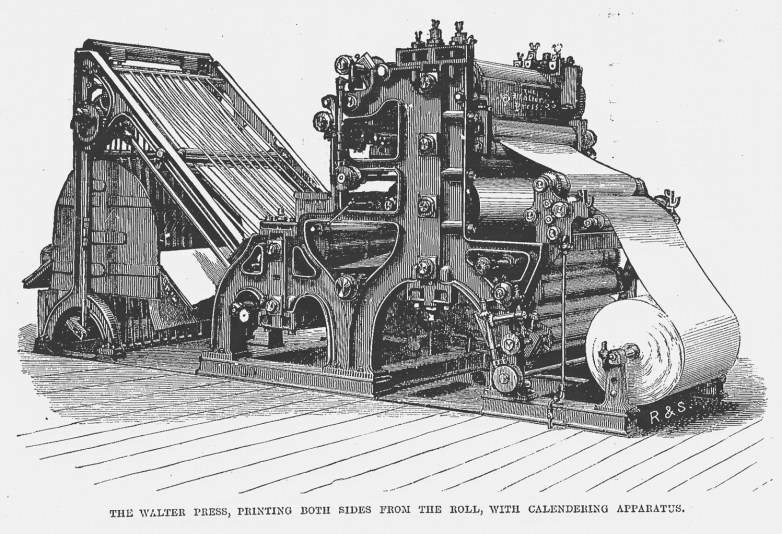
The Walter Press, adopted by The Times in 1866 (from Frank Leslie’s Magazine 1877 – and http://www.ndl.go.jp/exposition/e/data/R/614r.html)

First print technology, that which enables literature to transit from author to reader.

In the 1950s printing machines whose designs dated from the 1850s were still in general use. Yet paradoxically, printing technologies that in some ways are most characteristic of the twentieth century were first developed in the late nineteenth.

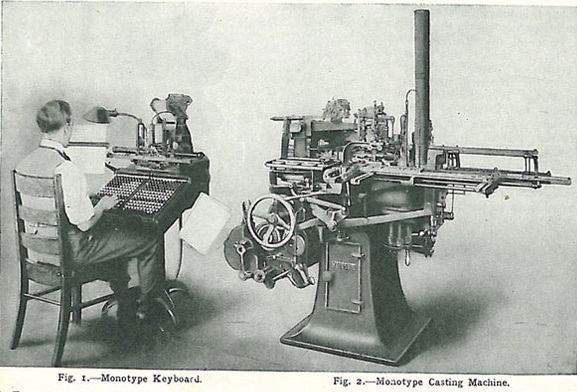
The two great revolutions in printing of the years between 1900 and 1950 were linotype and monotype. The Linotype machine was 1st installed on the New York Tribune in 1886; Monotype was invented 3 years later in 1889 but only commercially established in 1897.

Perhaps you can see from the illustration how monotype employs a paper tape with holes in it as an intermediate storage and transmission technology between the keyboarding and typesetting. The idea derived from looms for weaving cloth interesting enough – the same technology that Charles Babbage used in his mechanical prototype of a computer. These technologies, esp. monotype, tripled the speed at which books could be produced and formed the basis for the revolution that was to happen in the 1930s with Penguin (on which see more later). But even more advanced technologies were invented in the late nineteenth century which were to be used commercially for books only from the 1950s. The 1890s saw patents for devices that set type photographically, but nothing came of them for almost 60 years with the introduction of the Intertype Fotosetter in the USA in 1945. This photographic technology in turn enabled the ever-faster production of books after WWII .

A second way twentieth-century publishing can be said to start in the late nineteenth is not purely technological but concerns conventions of literary property – who owns the text transmitted? I’m referring to the formulation of international copyright, most notably with the Berne Convention of 1885, through which a uniform international system of copyright was initiated. During the course of the twentieth century the convention underwent several modifications, including what is called the Rome revision of 1928 whereby the term of copyright for most types of works became the life of the author plus 50 years. This had in fact already been adopted in 1911 in Britain. In EU countries this has subsequently been modified to 70 years after the death of the author.

Copyright is incredibly important to the publishing industry: it is indeed its cornerstone on which its economics are based, but again with new technologies of the last 60 or so years – starting with photocopying which started to become common in the 1960s – it is undergoing a period of enormous stress. Perhaps in future times the twentieth century  will be characterised as the period of efficient copyright – certainly more efficient than for any time before it, and perhaps after it too.

A third conventional continuity from the nineteenth century concerns censorship, particularly the persistence of the Obscene Publication Act. This dates from 1857 with a famous – or infamous – modification in 1868 that defined obscenity as that which exhibited a tendency to deprave and corrupt those whose minds are open to such immoral influences”. (Justice Cockburn in Regina v. Hicklin, a bookseller in Wolverhampton — see  Victorian Print Media pp. 101-104 for extracts from this and other obscenity  trials). Obviously, this had enormous impact on what could and could not be published in Britain. Lawrence’s open discussion of sex in The Rainbow in 1915 notoriously led to the seizure of 1,011 copies during a police raid on the London offices of the novel’s publisher Methuen. It was banned by Bow Street magistrates after the police solicitor told them that the obscenity in the book “was wrapped up in language which I suppose will be regarded in some quarters as artistic and intellectual effort”.

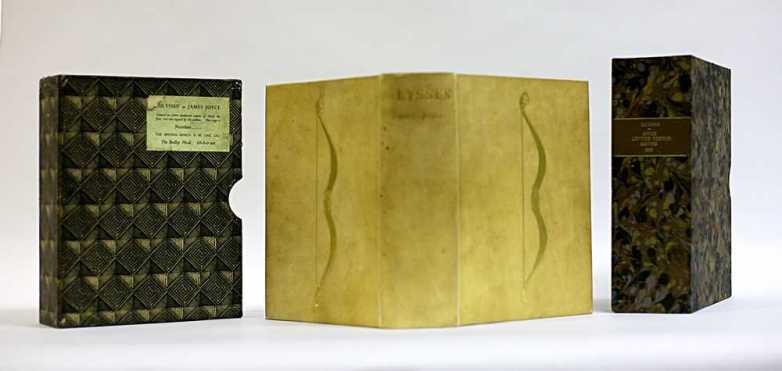
Bodley Head edition of Joyce’s Ulysses, (1936) – from http://antiquesandartireland.com/2010/07/ulysses-first-edition-memorabilia/

Then there’s Joyce’s Ulysses, published in Paris, which was seized by customs officers when it dared cross the channel into Britain (though curiously Bodley Head didn’t get prosecuted for publishing it in Britain in 1936). Radclyffe Hall’s Well of Loneliness had caused its publisher Jonathan Cape to be brought to court in 1928.

In 1959, there was a further and vital modification to the law of obscenity: now the work in question had to be taken “as a whole” and the interests of “science, literature, art of learning” could be adduced to defend a work from the charge of obscenity – “expert opinion” could be called. The following year the case of Regina v. Penguin Books over the publication of the unexpurgated Lady Chatterley’s Lover was a test case of this new law. Penguin won. Since then the question of obscenity has been continually debated, with concern in Britain at least has been far less over literature, however, than with film and video and, more recently again, the internet (see e.g. a recent article in The Guardian).

If then in three major respects twentieth-century publishing seems a continuation of nineteenth, in another it can be said to start perfectly on time on 1 January 1900 with the Net Book Agreement (NBA), signed by members of the then recently formed Publisher’s Association. The NBA concerns distribution. Again its roots go back to the nineteenth century — but it can also be regarded as a decided rupture with it.

The NBA  was designed to prevent booksellers selling at suicidal discount yet price wars had erupted when in 1894 the lending libraries Mudie’s and W.H. Smith’s rebelled against taking three-volume novels. Publishers were forced to publish novels in one volume and more cheaply. This in turn meant that cheap books flooded the market and booksellers sought to undercut one another. Unsurprisingly, this spelled disaster for many booksellers (as well as publishers). Many booksellers went bankrupt. This in turn meant fewer outlets for the retail of books and the consequent risk of a decline in the market because of distribution problems – for if booksellers closed because they had been trying too hard to undercut their competitors how were publishers to get their wares to the consumer? Hence the need that some publishers felt to save booksellers from bankruptcy. The NBA was one solution. Through the NBA, the publisher allowed a trade discount to the bookseller only on condition that the book was sold to the public at not less than its “net published price” as fixed by the publisher. In Britain, a first attempt to introduce the net price principle by booksellers in the 1850s had been condemned to failure by supporters of Free Trade; but in the 1880s it had  been successfully adopted in Germany. Encouraged by this toward the end of the century some British publishers, led by Alexander Macmillan, began to replace the variable discounts they gave to booksellers by fixed prices. To press for the new system, the Associated Booksellers of Great Britain and Ireland had been formed in 1895, and the Publishers Association was created in 1896. These two organizations then worked out the Net Book Agreement.

If the twentieth-century British book trade can be said to be the century of efficient copyright, it is just as much the century of the NBA – indeed it only collapsed in September 1995 through pressure from a complex of sources including rulings by the European courts about what constituted cartels and pressure from the Office of Fair Trading.

The industry itself had also  changed though. The import of cheaper books from the US via Europe because of the strength of the pound, and not least the enormous growth of bookseller retail chains like Blackwell’s, Dillons, and Waterstones which by 1996 had grown to take over 30% of the U.K. market. These chains – in ever-reduced numbers amongst themselves – became the pacesetters in the new deregulated market that emerged in the 1980s. They were able to launch full-scale retail marketing of the sort that had previously only been seen in UK supermarkets, such as price promotions on certain brands (or imprints, in the case of books), loyalty cards and hence database marketing based on analysis of what specific kinds of customers were buying where and when. Regulation (“deregulation”) encouraged the consolidation of the chains:  complaints to the office of Fair Trading by more than 600 small publishers that Waterstone’s was abusing its (dominant) position in the market by seeking greater discounts from publishers were dismissed.  More recently again, of course, Amazon has increased its market share of literary distribution to previously undreamed of heights. Are monopoly, oligopoly and cartels the inevitable end of a deregulated market as we saw in the Hollywood film industry of the 1930s before the Paramount decrees, where the studios controlled distribution, exhibition and production?

Ouida and the Parergic 1.

For perhaps a hundred years the idea that Ouida could ever have a serious relationship with high-status culture would have been laughable. Her contemporary critics thought her merely pretentious: they thought she claimed to be part of respectable culture but she couldn’t manage it; she emulated the high but didn’t get it right.
When the Saturday Review (12 July 1873) reviewed Ouida’s Pascarèl, a novel set in the revolutionary Italy of the 1860s, it began by announcing that Ouida’s

lay figure
artist’s lay figure from the 1860s

“chief literary quality is a flux of words and her dominant characteristic audacity. If we analyse her rushing gorgeous sentences, full of sound and colour as they are, we find only some poor, meagre, little thought as the residuum; and even when her phrases are sentimental, the action of her stories too often appeals to a prurient taste. Her ideas are like an artist’s lay figure, the same thing draped up in a dozen different costumes, but always the same thing underneath, and that thing wooden.”

Ouida couldn’t, according to this witty reviewer,  be bothered to move from the “lay figure” to real people: she remained all pose (as Malcolm Elwin described her in his 1930s book Victorian Wallflowers).

Now when I used  the term defined in an introductory post, “parergic,” to refer to a failed emulation of high culture that did not undermine but supported it, I wanted to get away from the value judgement implied by the terms “pretentious” (or words often used in a similar way, like “imitative” or “derivative”) to help us think about what was at stake: what are the violent hierarchies we participate in, unconsciously or otherwise, when we dismiss a writer as laughably pretentious? Sometimes the violence takes place in the field of culture, at other times of class, gender, race, age, disability and so on. Sometimes consumer identity which may be “horizontal” rather than vertical is at issue, whereby for instance, supporters of one successful pop group will deny the validity of another which is, in the field at large, in a very similar cultural position. At all times the issue is tribal status: “we” are better than the failed “them”. My deployment of the term “parergy” was intended to create an analytic  distance from those struggles, to stand outside them insofar as such is possible (that one cannot stand outside entirely doesn’t mean one shouldn’t try).

Now how far can parergy be related to Ouida’s early work?

Before we get to that, though, we need to note that the critics’ view of Ouida as pretentious only fully emerges after her identity as a woman is revealed. Early comments on her work in periodicals – she had started to contribute to Bentley’s Miscellany in 1859 – suggest that the critics thought “Ouida” a clever gentleman who wrote “brilliant nothings” for pleasure (see e.g. Morning Post, 4 February 1862: 3). They even thought Ouida  had seen military service. So thorough was the deception that the Standard (8 May 1862: 6) wryly interpreted Ouida’s temporary absence from Bentley’s in May 1862 as a possible sign that the author had decided it was too vulgar to write in such a magazine:

“What has become of him? Has he got a notion that it is plebeian to write, or is he only taking a rest from his arduous labours as the chronicler of mythical swelldom?”

Ouida’s morality – but, more, “discretion” – were issues that some papers took issue with: the Morning Post (8 May 1865: 2) didn’t like “his” article on duelling for the Army and Navy Review mainly because “he” dared to voice opinions that should have been kept within “his” set.

By 1866 that the name referred to a woman author was already public: the Sporting Gazette of June 23 that year refers to her as “she” confirming the Pall Mall Gazette‘s outing of Ouida as a woman in its review of Strathmore (4 May), in which it had defined her novel as “the hen book to ‘Guy Livingstone'” (on which novel see below) and proceeded to slash it for, exactly, pretention:

Pall Mall Gazette, 4 May 1866

Soon, Ouida’s real identity becomes more and more public. The Bury and Norwich Post, and Suffolk Herald  (23 October 1866: 4) even relates how “she” had spent her childhood in Bury.

While it’s very easy to close down the argument by concluding that this is just another example of Victorian sexism – it is – yet the second post on Ouida will think through its implications for an understanding of the parergic.

Parergy and the Beginnings of the Mass Market in the 1840s

31 (478x640)
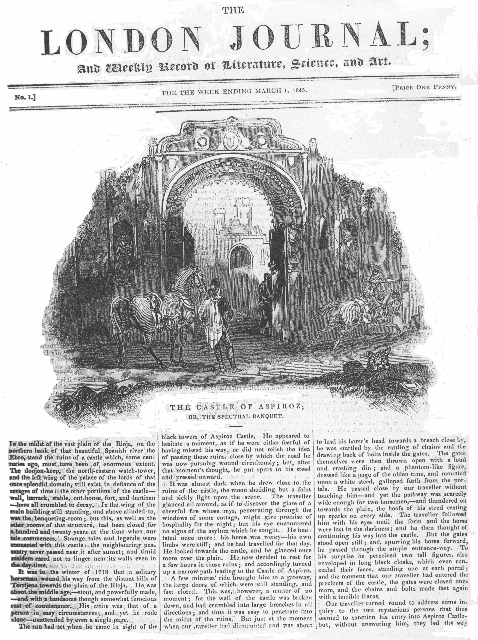
1st page of The London Journal 1845

Two decades after the proofs of my first monograph were submitted for publication it seems an appropriate time now to revisit key concepts I invented to help explain the field of Victorian popular publishing. The book, a version of my PhD thesis, was a study of the first four decades of a Victorian penny weekly fiction magazine, The London Journal 1845-1883. How well do these concepts stand up to the test of time?

One of the key concepts was what I called the parergic after Derrida, though I used the term in a very different way from him. I employed it in an attempt to explain in a serious, non-condescending and intellectually rigorous way the particular position in the literary marketplace of texts right at the beginning of the commercial mass market: what was the relationship of these texts to the more general field?

Here, in this first post revisiting ideas from another age (and indeed I first came up with the idea in the 1990s), is an extract from the original. Later posts will test the concept against other work. Here are a couple on Ouida:

Having provided paragraph-length biographies of several journalists and marked their career paths – they all started aiming for high status and ended writing for money – I came to a conclusion and then sought to explain that conclusion and link it to curious stylistic features characteristic of these texts, features very different from the Edward Lloyd-type serials I had encountered previously which did not seem to care about their status as commodities. The material I was studying from The London Journal seemed worried about being dismissed as merely ‘economic literature’ – how did this worry manifest itself exactly?

*****************************

… The London Journal was thus a precipitate out of surplus labour which would prefer the greater symbolic (and at this stage usually economic) capitals of the up-market magazines. The desire for a unified cultural field that I discussed in Chapter 2 is visible here, supported sociologically by the very limited socio-cultural group that writers in general came from (Altick, 1989). In that sense, the impression gained from Vizetelly’s description of the magazine as staffed by ‘failures’ is correct.

The longing for the high but exclusion from it that such career paths suggest results in what I term the parergic. This comprises a set of specific textual effects and practices, which, while underpinned by sociological narratives, does not inhere in specific bodies or corpora (a writer, artist, a periodical or even an article may display the parergic or not at various points). It is a system whereby texts are based on originals that are invested with greater symbolic capital and authority. Officially respectful and emulative, the parergic is tinged always with a resentment, caused by exclusion from desired cultural areas, that brings about mutation in what is supposedly emulated. The parergic sometimes raids authority aggressively and seems therefore to attack it, but nonetheless paradoxically buttresses cultural boundaries even in the act of transgressing them. Unlike parody, which always in some sense undermines the authority of its original even while being complicit with it, the parergic fully acknowledges and maintains this authority even when it effaces its model. Unlike straightforward imitation of the high, which depends on large cultural capital to judge its value, the parergic does not use the exclusive codes or high prices that cultural authority wraps itself in to keep out the uninitiated.[1]

The weekly ‘Essays’ furnish typical examples of the parergic in terms of that practice which is ‘style’. Essay L [50] on ‘The English Language’, signed by John Wilson Ross ([London Journal] III: 7-8), begins with the commonplace thesis that ‘the progress of language marks the progress of the human mind’, and swiftly interprets this in a nationalist sense. It continues by placing the ‘rise’ of the English language at the Reformation because then ‘men began to argue’ and to do so ‘they [had to] express themselves with precision’. Thereafter,

Addison was unquestionably the first of our writers who introduced elegance of expression into the composition of English prose. He found the writings of his predecessors disfigured by a loose, inaccurate, and clumsy style. He changed all this, and made himself a model for imitation. In his works we find no forced metaphor – no dragging clause – no harsh cadence, – no abrupt close. He is, also, a happy model for the use of figurative language. They seem to spring spontaneously from the subject: and are never detained till the spirit evaporates or the likeness vanishes. They are just like flashes of lightning in a summer’s night – vivid, transient, lustrous, – unexpected but beautiful, – passing over the prospect with a pleasing brightness, and just vanishing before you catch a sight of all the beauties of the scene they gild. The copious and classic mind of that writer gave our language the greatest degree of elegance and accuracy of which it is susceptible. Since his time fine writing has not improved. Simply, because it cannot be. You cannot give the English language a nicer modification of form, or a greater beauty of feature than Addison gave it. But you can give it more nerve and muscle. And subsequent writers have done so.                                                                                                     ([London Journal] III: 7)
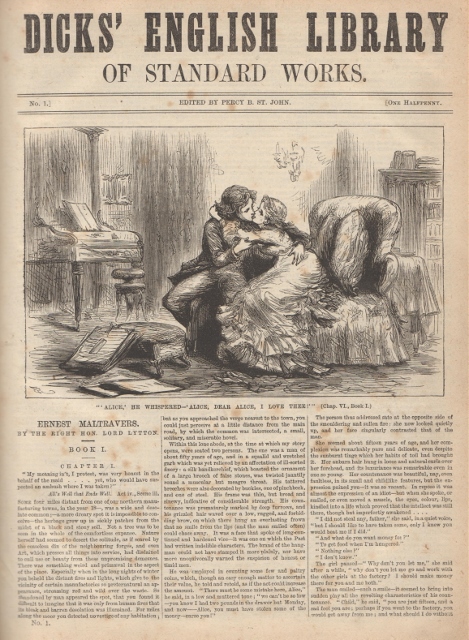
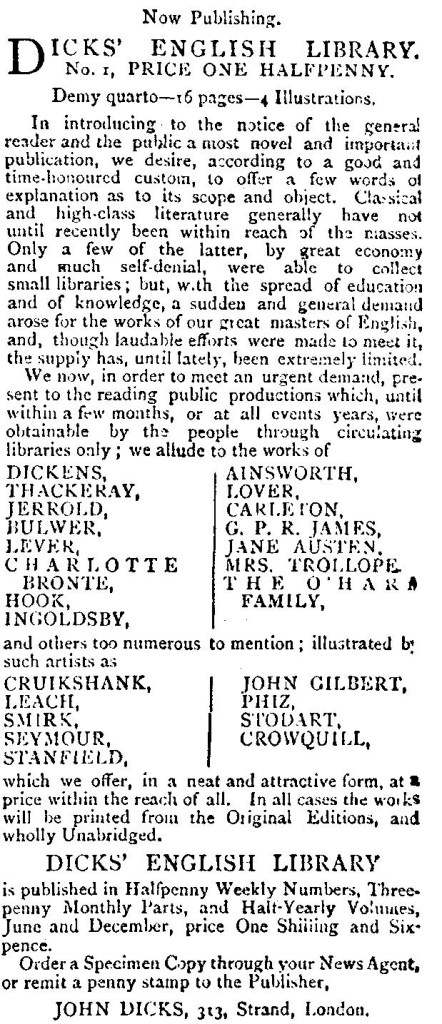
It was Johnson, ‘[t]hat Colossus of English literature’, who provided the muscle. Since his time ‘there has occurred no variation in the style of English prose’ except, possibly, by increased use of the ‘Gothic, whence [English] sprung; and that is a feature in language which our readers will agree with us is more deserving of disgust than admiration, and a variation in style more worthy of punishment than praise’ ([London Journal] III: 8).
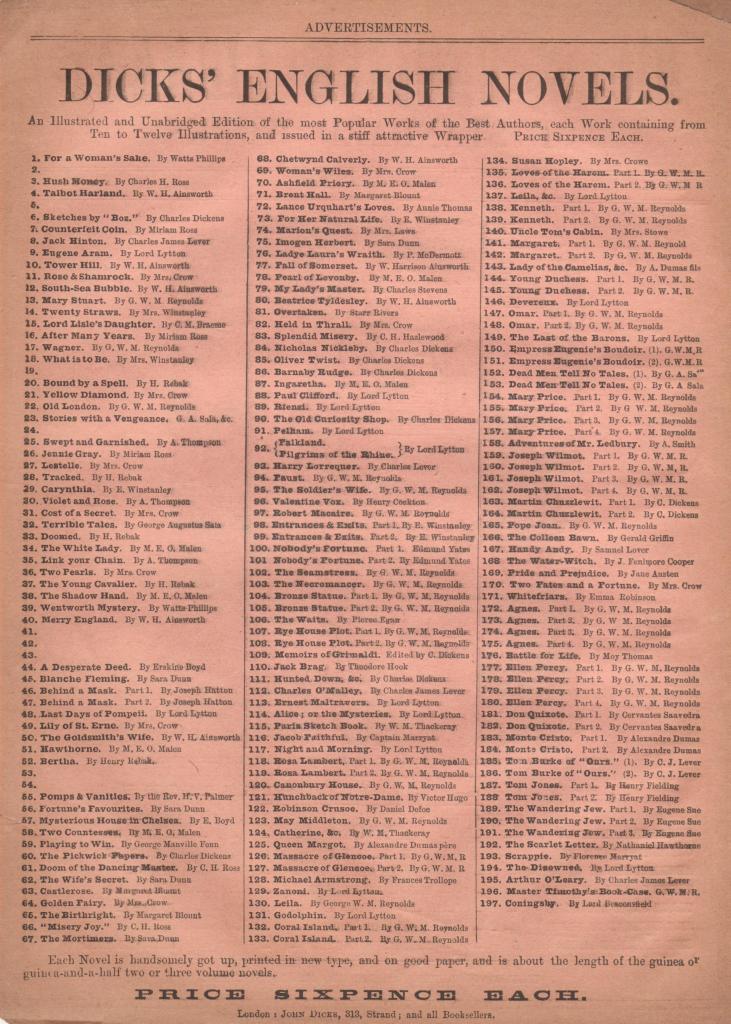
The essay’s claims to authority depend largely on the assumption of a common standard throughout the literary field…

Andrew King, The London Journal 1845-83: Periodicals, Production and Gender (Routledge, 2004), 57-8.

Matrimonial Ads in the Victorian Press: Fantasy, Imagination, Story, Life

“Honest, Thick-Skinned Advertisements for Goods”?

Relationships, relationships… : an illustration to The Will and the Way by J.F. Smith in The London Journal 5 March 1853

W.D. a tall, dark, young man, with £200 per annum, derived from an investment in the funds, would like to have a fair-complexioned young wife; he has just returned from Italy, but does not admire the dark beauties of that land of poetry and song.

MARIA C., of Wavertree, who resides with a cross old aunt, is desirous to join her fate with that of a medical man; she wants a comfortable domestic home; she is a good housekeeper, and not afraid of labour, having kept her late father’s house without a servant; she is not a child but “fat, fair and forty” with a fine complexion, splendid and perfect set of teeth, also beautiful hands and small feet. She has £64-a year now, and will have £500 on the death of her aged aunt.

(both from “Notices to Correspondence,” The London Journal, 5 March 1853, p. 416)

Who of us hasn’t, if we’re honest, scanned what not so long ago were the “Personals” in newspapers? I certainly used to and no doubt would today if I happened to come across them  (now you have to make an effort by going to specialised websites – the pleasures of chance encounters in the press are altogether rarer). Weren’t the personals wonderful invitations to fantasy? What would X be like? Would I like them? Would they like me? Are they like me? What a funny ad! – what kind of person would answer that? etc etc

If the above two quotations from the penny fiction weekly London Journal are anything to go by,  it seems the fantasies of Victorians were rather different from ours. They assume marriage is less about romantic love or sex than comfortable domestic arrangements. The fantasy concerns a better life obtained through the synergistic pooling of resources, whether those resources be money,  labour, or looks. W.D.’s main selling points are his £200 a year and – perhaps for some – commitment to his home country; Maria C. supplements her offer of £64 a year with the prospect of an additional £500, commitment to hard work, experience of managing a household – and, her father being dead, no interfering relatives (remember Lady Audley’s sponging father?).

To read them like that is to read them as  “honest, thick-skinned advertisements for goods” as the Spectator put it in a review of the later (and very successful) magazine entirely devoted to matrimonial ads, the Matrimonial News (1870-1895).

Of course, one can easily weave stories about these two — though, even if imaginary,  I hesitate to call them fantasies.

Perhaps W.D. was on the rebound, jilted by an Italian beauty he had encountered in Florence,  Venice or Naples. £200 is a fair amount to to live on but not enough to keep a carriage or horses: why doesn’t he declare other possibilities of income such as training for the law? He’s probably feckless and superficial, a Shallow Hal who only wants a blonde. Or perhaps he is an Artist who lives only for Beauty. Ah! Now there’s an idea for a novel plot! Ouida might well have used it (except that in 1853 she was only 14 and had six years to go before her first tale was published). Still, one thinks of Folle Farine in 1871 (not one of Ouida’s sunniest – W.D. in this novel would be a heartless monster!)

From “Notices to Correspondents,” The London Journal, 5 March 1853, p. 416.

As for Maria C. from  Wavertree – why does she want a medical man? Is she ill? £64 a year and £500 on the death of an aunt, a father with no servants, based in a Liverpool suburb — not a promising social or financial additional asset for a physician. Despite her fair hair, in no substantive sense is she Rosamond Vincey in George Eliot’s Middlemarch!  But maybe a surgeon would find Maria useful, for surgeons in the 1850s, although they were fighting for status,  were still associated with trade. Or perhaps an apothecary would do? Interestingly, I can’t think of a novel plot in which Maria C.’s story might have appeared in this period. One can imagine a naturalist novel by Gissing where her story could be told, but in the early 1850s the heroines were young and beautiful. A Punch cartoon might feature her as a harridan man-chaser, Dickens might parody her in Pickwick Papers as Rachael Wardle or Mrs Bardell, but Maria C. is just not narratable in fiction of this period, at least not in a way which would give her a decent interior life. She has no voice in print other than what she herself gives it – a remarkable achievement on her part.

I’ve recently been reading Jennifer Phegley’s very entertaining Courtship and Marriage in Victorian England (2011) and (not for the first time) was struck by the imaginative possibilities of these ads that she discusses so well (click here for a fun lecture by by Jennifer delivered in Kansas in February 2012)

While the ads don’t seem to link directly to novels of the period, it’s interesting   that it seems a reflex for us to decode them –  extend them  – flesh them out – by trying (and perhaps failing) to link them to such novels.

I’m reminded of Lisa Zunshine’s contention in Why We Read Fiction: Theory of Mind and the Novel that however we may be trained in academia to treat texts as dead objects, we keep wanting to animate them by ascribing to them a spirit, an identity, a personhood of which they are symptoms. And isn’t  trying to connect the matrimonial ads to novels in some curious way a bizarre instance of that, as if the novels were more alive than the ad? We don’t know W.D.’s or Maria C’s real stories, so we have to turn in a really bizarre way to something we consider the next best thing: the Victorian novel.

This is a far cry from the fantasies inspired by the personals of the late twentieth century: they prompt a different set of questions and today offer different, retrospective solutions, that, however imaginary, are, well, not fantasies so much as wishes that dead words on paper or screen that bore little or no relation to the material lives of real people might, perhaps once, have been the stories and memories instinct with life and breath.

For a light-hearted little video on matrimonial ads from the BBC, see my discussion with the wonderful Lucy Worseley here.

The Army Surgeon – some comments

“The Army Surgeon”

Sydney Dobell

Over that breathing[1] waste of friends and foes,[2]
The wounded and the dying, hour by hour,-
In will a thousand, yet but one in power [3] ,-
He [3] labours thro’ the red and groaning day.
The fearful moorland where the myriads lay
Moved as a moving field of mangled worms. [4]
And as a raw brood, orphaned in the storms,
Thrust up their heads if the wind bend a spray
Above them, but when the bare branch performs
No sweet parental office, sink away
With hopeless chirp of woe, so as he goes
Around his feet in clamorous agony
They rise and fall;[5] and all the seething plain
Bubbles a cauldron vast of many-coloured pain.[6]


[1] This immediate emphasis on breath not only suggests breath as a theme but as a corporeal sensation for the reader – for the poem itself offers various challenges to the reader’s control of her or his own breath: it starts with pretty regular rhythm (iambic pentameter), but especially during the epic simile from line 7 onwards, the convoluted syntax spreading over clever enjambements and caesuras strains the reader’s own breathing as well as the rhythm.

[2] The rhyme scheme gives the impression of being broken, befitting the damaged bodies the poem describes. As with the rhythm, the syntax fights the rhyme scheme, making it difficult to discern. When split into two sestets the scheme seems less awry — abbccd, d[eye rhyme]cdcac [pseudo rhyme], ee — but the rhythms, especially the strong pause at the end of line 4 and the recall of that line’s rhyme at line 8 suggest a tough yet ghostly tension with an organisation of the poem into the more traditional 3 quatrains which is never realised.

[3] Death and its proximity unite all into one undifferentiated nameless mass. This is a particular example of the sublime, as defined by Edmund Burke. Today we might be tempted to regard the use of the sublime here not for aesthetic purposes but for political — in describing and enacting the horrors of war, we might assume the poem is against war. However, other readings are certainly possible: quite what the poem’s politics are depends on how we read the poem. Read in isolation, it is true that its violent sensationalism seems to oppose war. Yet when read as an element of  the whole collection it might be regarded as indicating the depth of sacrifice necessary to make Britain Great. This latter was a reading of the collection certainly made at the time by critics and newspaper editors.

[3] The final line of the first stanza introduces the single character into the undifferentiated mass of humanity. Both are unnamed: neither the mass nor the surgeon are individuals, but effects of their jobs. We might also regard the surgeon as the poet who surveys and dispassionately reports. Given the emphasis of the poem on painful suffering this might be a surprising suggestion, yet we should not forget the sheer skill of the poet’s pen here mirroring the surgeon’s own expertise with the scalpel. In neither case can professional knowledge alleviate suffering (see also below, note [5]). What the poet can do, however, is in a curious way comfort readers by reminding them that, like the surgeon, both he and they have survived. This is quite consonant with the Burkean understanding of the sublime, which was based on the perceiving subject’s realisation that he or she had survived death even though death had been encountered.

[4] The fallen seem already to have become prey to being eaten by worms: time, in this case the future and the present, has been collapsed in ways typical of the sublime. Simultaneously, a point is being made about the unity of living creation, a notion reinforced by the following comparison of the wounded to chicks desperate to be with their mother who will never come, and the surgeon to the tree branch which the chicks believe to be her but which cannot, by its nature, help them. We are all mortal animals dependent on the rhythms and failures of breath.

[5] The suggestion is of a wave – a rhythm – that rises and falls uselessly. The surgeon can do nothing for the dying. Here is the limit of the professional’s ever-increasing pastoral role caring for his flock (cf. King para 31). Scientific rationality cannot have a purchase here: the only language adequate for such suffering is that of flesh itself – the body and its breath, fragile, easily interruptible: in short, corporeal sensation, the spasmodic. This is not representation so much as presentation that produces in the reader the same sensations felt by the described.

[6] The last line shockingly introduces the language of the kitchen, suggesting a parti-coloured stew of boiled meats and vegetables seen from the point of view of the meat rather than the cook (whether the reference is to a witches brew leads to the same conclusion). Suddenly in this line we are presented with a space  where damaging flesh, even if not human, is the norm. This normalisation and naturalisation of suffering, legible in the epic simile too, confirms a preoccupation for how suffering is to be represented (or presented) rather than politically or ethically dealt with. Death is natural and normal, however painful and horrific, and it is the poet’s duty to communicate it. How to communicate death and dying is both the “scientific” and aesthetic point of the poem. Whether the suffering is to be valorised or condemned – that is, read politically and ethically – is, however, for the reader to decide, at least in this poem.


Publication and Reception Note

Sydney Dobell’s sonnet “The Army Surgeon” was originally published in Sonnets on the War, a joint collection with Dobell’s friend Alexander Smith that is now freely available or archive.org.

No manuscript source seems to have survived (see National Archives entry on Dobell). The one contemporary reprinting (see below) offers no variation of the text. While Dobell used only ‘the Author of “Baldur” and “The Roman”‘ on the title page, contemporary reviews show that his name and identity were already well known.

Frontispiece from 1856 edition

Smith and Dobell’s slim volume (of just 48 pages) was published in the first days of January 1855 by Bogue of Fleet Street as a shilling paperback (we can date the publication from a reference to it in a letter from Dobell to one of his sisters dated 5 January in which he says he hopes to send her a copy the next day – Life and Letters of Sydney Dobell, p. 396). Presumably Smith and Dobell’s usual publisher, Smith, Elder and Co (who published Dobell’s later and more expensive hardback collection England in Time of War) was unable to insert publication of the volume into their schedules, whereas the lower-status Bogue was more flexible. The poem was republished without emendment in The Poetical Works of Sydney Dobell (2 vols, Smith, elder & Co, 1875)  on p. 226, where Dobell’s contribution to “Sonnets on the War” are precipitated out from that volume, enabling us to distinguish them from Smith’s. The Poetical Works of Sydney Dobell is also available through archive.org.

Although “The Army Surgeon” can certainly be read as a self-standing commentary on (or description or enactment of) generic horrors of war, it in fact forms part of a narrative sequence that very firmly locks the poem into its historical context. The borders of this particular sequence are porous since the entire volume begs to be read as a whole, but one can see a distinct set of poems centred on the Battle of the Alma (20 September 1854, generally considered the first major battle of the Crimean War), comprising the sonnet “Alma” that immediately precedes “The Army Surgeon”, and the following three, two entitled “Wounded” and the last “After Alma”. Dobell only wrote “The Army Surgeon” amd the two “Wounded” poems but the arrangement of the pages certainly asks the reader to think of the Surgeon at the Alma.

Even though I have been unable to locate specific examples in newspapers before the collection appeared, I nonetheless think it helpful to regard the collection as comprising a specific type of what Natalie Houston has called the “newspaper poem,” that is, occasional poetry responding to or commenting on contemporary events reported in the press. The most famous Victorian example of this is Tennyson’s “Charge of the Light Brigade”  first published in The Examiner on 9 December 1854 in response to a Times article.

Andrew Hobbs has persuasively argued that the provinciual press was a major locus of poetry publishing in the nineteenth century,  and poems from “Sonnets on the War” is no exception. But rather than reprint all of them equally, there is a decided preference by newspapers for some over others. “The Army Surgeon” was not amongst those favoured at the time, perhaps because its imagery was too strong or its sentence structure and long and tortured central metaphor were considered too difficult.  The Aberdeen Journal (10 January 1855, p. 6) reprinted six sonnets: “Alma”, “After Alma”, the two sonnets on “The Cavalry Charge”, “Miss Nightingale” and “Cheer.” This is a selection that offers a reassuring narrative arc and avoids too much horror. The first three are reprinted again by  The Blackburn Standard on 7 February (p. 4) along with “Sebastopol” with a similar effect.

The politically more radical Lloyd’s Weekly, full of praise for the collection (14 January 1855, p.8), offers a different selection. Starting with “Alma” again, it continues with the second “Wounded” poem (a startling choice given the poem’s poetically very new technique of assembling fragments of everyday speech and follows it with “America”, “Freedom” and “Volunteers”. Again, however, despite a selection emphasising the politically and aestehtically radical, the arc remains comforting: for even if poetic novelty is admitted in Lloyd’s pages, the most shocking, visceral poems are omitted.

The volume was greeted with a mixed reception at the time. The lengthy review in the Inverness Courier (1 February 1855, p. 2), the only contemporary newspaper where I have found “The Army Surgeon” reprinted, regarded the collection’s level as of “respectable mediocrity.” But it did praise the the poets for “producing work on a practical subject, which, if its poetry is not of a very high order, contains nothing visionary, absurd or impracticable”. It singles out “The Army Surgeon” as one of the best according to these criteria. The review of the collection in The Sheffield & Rotherham Independent (5 May 1855) is likewise very lukewarm. Its principle bone of contention is that the sonnets are not musical: “In the hands of of a master the sonnet gives exquisite music;but strung by a tyro the sounds will be discordant.”  Ironically, of course, it is precisely the violence the authors of “Sonnets on the War” do to the traditional expectations of the sonnet that today constitutes one of the collection’s main interests. The review ends  by reprinting two of the more conservative poems (both ideologically and formally): “Miss Nightingale” and “Good Night” which they assume to have been written by Smith and Dobell respectively. It thus rescues the collection for patriotism just as the other newspapers had done.

Interestingly the London Lancet (the American edition of the British medical journal Lancet)- which reprinted the poem in 1856 – uses the isolated poem as an example of “all the heroism and self-denying devotion of which we have spoken” (p. 222), suggesting not only a reading of the individual poem through the lens of the self-abnegating professional (cf. King para 34) but also a reading of “The Army Surgeon” through other poems in the volume. Whatever our own views, this is a reading made possible by the poets’ interest in the problems of communication rather than in the politics of the described action.

That said, when the poem became detached from its collection, the alternative anti-war reading became more easily available. This is certainly possible for example in the New Zealand Herald (10 February 1917, p. 1).

The context of the poem in the Crimean War and has been well covered elsewhere: Kathleen Béres Rogers “Embodied Sympathy and Divine Detachment in Crimean War Medical Poetry” is recommended as offering an attentive reading of the poem which places “The Army Surgeon” in a slightly different context from what I have offered here.

Teaching, pasticceria, and the purposes of education.

What is university education?

What is university teaching? What is its purpose? What should it be?

If the questions have preoccupied many of us in the UK even before students started to be conceptualised as customers, they were recently brought back to me anew and with unusual clarity, as for the first time for some years I was privileged to teach, in an unfamiliar setting, students of a kind who had been through a very different education system from my students in the UK.

Over ten days in November I was lucky to teach six 2-hour sessions at the University of Macerata to 1st year undergraduates, and 1st year MA (“magistrale”) students in Languages in the Department of Humanities.

The sessions were divided equally between three longer courses, two on the nineteenth-century novel and one on modernist women’s poetry. Unlike in the UK, there are neither elaborate course booklets nor dedicated virtual learning environments such as Moodle   or Blackboard; rather there are basic directions to the students about what set the set texts are and what the general aims of the course are, as follows:

(1st year MA ) http://docenti.unimc.it/silvana.colella/courses/2014/13256 and http://docenti.unimc.it/marina.camboni/courses/2013/12192

1st year undergraduate http://docenti.unimc.it/silvana.colella/courses/2011/9153

Such elegant indications of course content give the teacher great flexibility and, importantly, the ability to keep absolutely up to date by changing research questions and incorporating new material as it emerges during the teaching year – which of course it will do, produced either by the teacher herself or by other academics. This also means it is easy to insert sessions such as mine even after the course has started.

Naturally, I tried to make connections between what I understood to be the focus of the extant courses and my own concerns and expertise, without risking overlap or duplication of material. Talking to the usual teachers of the courses was helpful. But at the same time, the sessions were (in theory at least) open to the public. The result was inevitably something of a mash-up, and had to offer something attractive. Hence the rather sensationalist titles.

1. IF IT DOESN’T HURT IT ISN’T REAL: REALISM, DICKENS, JOURNALISM

2. SEX AND THE CITY: VICTORIAN WOMEN, POWER, PERIODICALS AND SHOPPING

3. NEW WOMEN, NEW PUBLISHING? WOMEN AND PRINT CULTURE 1890-1914

Example of page 1 of a “preslide”

The fact that the sessions were to be delivered in English to non-native speakers was another issue. I sought to deal with this by making available in advance what I called “preslides” in the “Teaching documents” section of my academia.edu site and /or on the usual professor’s university site: the usual prof informed the students orally in class that they should download the preslides and read them carefully along with the set texts, electronic copies of which I also provided. The preslides were designed to help students take notes. They comprised PDF versions of black and white PowerPoint slides stripped almost entirely of images, 6 slides to a page, and asked questions and provided quotations with gaps where key words should be. They were based on, but certainly not identical to, the much more elaborate PowerPoint slides I showed in class (these were also made available to students after the sessions, again in PDF, 6 slides to a page, on my academia.edu page).

Since I knew the sessions would not be examined, there was no obvious way that I could properly test the effectiveness of my teaching of the class overall (I always think of exams as testing the teaching as much as the learning). As is my wont, I planned abundant interaction from which I would normally be able gauge a class’s understanding, but I also knew that Italian students were not used to this and would probably be shy. I therefore devised a questionnaire for the students to fill in at the end of my time with them (that is, at the end of the second of the two-hour sessions). Such questionnaires are of course always double edged; they not only inform the researcher of the results, but inform the person completing the questionnaire, in this case making the students reflect on what they really had got out of the sessions and how they could get more out of future ones.

I had 35 responses from the 1st year undergraduate class, and 22 from the first MA class, and 9 from the second (31 MA responses in total). It was quite wonderful to see the students take this questionnaire very seriously – it seems, from talking to them afterwards, that they are not used to doing this kind of thing, and that is why they spent so much time thinking about it, no matter how much I insisted it was not a test.

Of course one wants to find out what the students think of one – hence my immediate turn to the question of what I could have done better.  Almost of them were embarrassingly positive in their responses to “What could Andrew have done to help you learn better?”, especially the 1st years. “Involving” (= “coinvolgente”?) occurred in 8 of the 35 1st year responses (28%), “catch our attention” in 3 others, along with numerous generic positives.

“he was very involving, so he couldn’t have done anything more to help me learn better than this”

“it was a fantastic and involving lesson! The slides were useful and the explanation was clear”

“he was very involving and funny in his lesson”

There were just 4 suggestions for improved teaching: more on Dickens (x 2) and talk more slowly (x 2). I was delighted that only two students asked for the latter, as it meant that, for the vast majority, the care I had taken over oral delivery – speed, choice of Latinate vocabulary – had paid off.

The MA students were slightly – but only slightly – less positive on the same question. 11 wrote “nothing” and there were in addition 13 superlatives. There were, however, 8 suggestions for how I could have improved: more history (x 1); more on the concept of satire (x 1) which in retrospect I agree would have very useful (thank you to whoever wrote this – excellent idea!); don’t wait for responses from the class but just give the answer (x 1 – sorry, but my pedagogic tradition wants you to think for yourselves, not be choux buns – beignets – which I stuff with crème Chantilly!). Two wanted more time to discuss the texts, one of these two sensibly suggesting that what turned out to be a 4 hour session be split over two days. One wanted more videos (we saw just one – a Youtube video of the controversial Royal Opera performance of Salome, with Nadja Michaels, naked executioner and very bloody head). I’m a bit sceptical of this given the time constraints and the purpose of the aim of the session, but I take much more seriously the remark of another that “he could have spent more time on some extracts we’ve quickly seen”. This was echoed by another who wanted to concentrate on fewer texts (and indeed by the one who wanted more time in general). For what I had forgotten was the sheer difficulty of nineteenth-century prose and poetry for second-language learners – not only its unfamiliar vocabulary and syntax, but also its cultural references. I was treating them like UK MA students and that was very unfair of me. I really should have put myself in their shoes (as opposed to choux).

What’s the ONE most important thing you’ve learned from Andrew King’s sessions?

“That learning literature is not about studying in books but getting into the text and asking yourself questions and trying to give answers”
“I hadn’t thought it possible to find advertising language in literary works”
“There’s no limit to desire”
“Realism is a contract between author and reader which demands trust”
“Realism is still dominant in Britain today”

The biggest surprise to me, though, was the variety of the responses to the first two questions. Of the 35 1st year responses to the first question “What’s the ONE most important thing you’ve learned,” 28 wrote something about realism (6 were very specific on realism as a contract between reader and text; while 7 more were also specific in a variety of ways; the remainder more generic – e.g. “I’ve learned better realism in a more specific way”). The real delights lay in the 7 alternative responses, two of which are cited above; two others showed a delight in semiotic theory and in the problem of refusing value judgements in literary discussion. A great deal of variety was evinced in the responses to the second question, that concerning what students wanted more of (these don’t add up to 35 as not everyone wrote something – 10 wrote “nothing” while others left a blank; a very few wrote more than one thing). It’s easier to present the results in tabular form:

Household Words
  • Dickens (x 6);
  • historical context of various types (x 6);
  • Victorian art (x 4);
  • literary context (x 3);
  • realism and crime (x 1);
  • theory (x 1);
  • effects of journalism and literature on lower classes (x 1);
  • realism (! x 1);
  • comparison of British realism with Italian verismo (x 1);
  • close reading (x 1)
  • There’s no pleasing a class completely of course. For in response to the question about what the students wanted to study less and why, 9 of the First Years didn’t want Dickens at all as they thought him “boring”; 5 found the theory of realism too hard; 1 wanted less history and 1 didn’t see the relevance of looking at the details of Victorian art. The rest said “nothing” or similar, or left the question blank.

    Rather than look at Dickens journalism then, I should perhaps have looked at some short and simple contemporary newspaper articles, perhaps culled from the British Newspaper Archive. I should certainly have omitted the part of the lecture most interesting to me, the part concerning semiotic theory and realism’s aspirations faithfully to represent the world. Yet the students were perhaps right: I wonder now if that part is just me being clever, playing a kind of cadenza, with surprising trills and scales and leaps over the intellectual keyboard. It may be ingenious and of course it IS thematically integrated  – but removing it won’t weaken the overall argument. The students helped me realise that while it is integrated it is not integral. I shall accordingly drop that section in future.

    Thank you 1st years at Macerata!

    Herod seeks to persuade Salome of the value of his pearls, using techniques derived from contemporary advertising

    Although less effusive in their praise, the 31 MA students also wished to change less: 5 said they wanted less history, 1 wanted less on women in print. This ties in with students’ desire to focus more on the texts (though on individual questionnaires there was not necessarily a correspondence). In short, I concluded that the MA students wanted help with reading strategies. I don’t think it was just a question of not understanding syntax and lexis but of interpretative frameworks and how to test these frameworks against specific texts through close reading. I sought to remedy this in the last session with the MA students, in which I offered a framework and pretty rigorously tried to apply it to texts and historical data. Explicit feedback from 5 of the 9 students in this session suggested that that worked, but of course there is a severe limit on what it is possible to teach in such a short time. Any significant development of reading strategies requires, I think, at least 20 hours of contact time.

    While I am a great believer that questionnaires which indirectly ask students to reflect on their learning have great pedagogic value, perhaps the most valuable of all is the last question: “What could you have done to help you learn better”? The undergraduate class was actually delightfully talkative and responsive, but still 7 wrote that they could have been less shy and talked more. No fewer than 19 confessed that they should have prepared in advance(about 55%) , including printing out the preslides; 10 wrote that they should have paid more attention, including two who said they should have slept the night before and 1 who, with charming candour, admitted that she should have turned off her iphone and not read messages from friends! The MA students were much more tentative and perhaps alarmed by this question: in the first, larger, of the MA classes, a slightly smaller proportion (50%) said they should have prepared for the class, but a larger proportion (25% as opposed to 20%) said they should have talked more in class. One said that the texts couldn’t be unzipped and another said that s/he should have come to both sessions, not just the second. In the second MA class, of the 9 students, no fewer than 8 said they should have come prepared; no-one said they should have talked more as in fact the smaller group did encourage more interaction.

    crostata di castagne (chestnut tart)

    What wasn’t captured by the questionnaire, but which I think very important indeed, was the pleasure I felt as a teacher of such socially skilled and charming students. There was a great deal of social stroking of the teacher. From my shoes, this is a great danger, whose nature is visible in the apparent difficulty students had in arriving at conclusions based on evidence independently of the teacher. I found at times compelled to make ridiculous statements to try to get the students to contradict me, even to the point of confusing the gender of the people they saw on the screen. It was hard to get them to dare to draw their own conclusions without a clear guide from me! This was especially notable amongst the larger MA group, who seemed to have been very thoroughly socialised into agreeing with what they perceive to be authority at the expense of evidence.

    This certainly does NOT occur only in Italy: the rather exasperated account of an American university teacher here shows that. But I do think that it Italy it is performed with an unusual charm and subtlety. Perhaps it is even connected with the form the students’ self-criticism took (I am interpreting “I should have talked more/ prepared better ” as what they thought I as authority figure wanted them to do). It may also be connected with a short but significant discussion with the first years on the differences between the breakfast news shows on television in Italy and the UK, 1Mattina on RAI1 and its UK equivalent, BBC Breakfast. While we agreed that both involved evidence-based reasoning and the maintenance of human relations and, importantly, of social hierarchy, the balance seemed to be in favour of the latter in Italy. In other words, hierarchy determines knowledge more than disinterested reasoning. This leads me on to a speculation about the different social functions of education in Italy and the UK.

    Does the teacher in Italy perform less the part of a model of how to draw conclusions from evidence than that of a master patissier who creates and fills beignets and other delightful pastries? An important role that of the pastry chef. I’m a great fan of beignets as well as crostate and ciambelloni maceratesi – but I do worry about how delightful it is to consume them. My concern is not with my waistline in this context. Rather, if students treat themselves as beignets that teachers fill or bake, my worry is who will use them up, and for what end? Do students perhaps need to be taught to be more rebarbative, less consumable, more overtly and independently critical of authority, more self-moving, rather than taught to sit on a shelf oozing charm and creme Chantilly, resigned to their fate? Do students need careful and phased training in specific skills of independent problem identification and solving rather than stuffing with information?

    But then, putting myself in their shoes, I wonder if such a powerful focus on distanced, rational problem-solving is really a life-skill that is, or will be, useful for students in their cultural context which is very different from mine? Am I fetishising problem-solving too absolutely, too glibly? Perhaps in the lived experience of their day-to-day lives, social skills of a very particular kind are more necessary — charming consumability to ensure cooperation and loyalty from authority and colleagues, and resignation in the face of opposition to one’s needs and demands.

    Is, after all, the best Italian translation of “education” perhaps not what the dictionaries tell us — istruzione or formazione? Maybe, even though we learnt it long ago as a “false friend” meaning “politeness,” it is educazione ?  Is this what teaching as pasticceria would mean?

    That’s not for me to decide. I remain an outsider to Italy, still wearing my battered old British shoes, even while delighting in the many charms of Italian choux. It would be irresponsible of me to do other than raise such questions, not least because, alas, I have to confess that my pastry has always been on the heavy side. Though I’m a bit better at the picante.

    Ouida A Dog of Flanders/ Nello e Patrasche

    Ouida, “A Dog of Flanders” (1872)/ Nello e Patrasche (1880)

     editions in English and Italian

    1893 Giftbook edition of "A Dog of Flanders", Lippincott's (USA)
    1893 Giftbook edition of “A Dog of Flanders”, Lippincott’s (USA)

    English edition: A Dog of Flanders edited by Andrew King

    Italian translation (large file – be patient): nello e patrasche trans T Cibeo Treves 1880

    “A Dog of Flanders: a Story of Noel” was originally written as a Christmas tale for the American Lippincott’s Magazine, where it appeared in volume 9, January 1872, pp.79-98.

    Later that year it was published in London, Philadelphia and (again in English) in Leipzig as part of a collection of short stories given various titles but which was (in textual terms) virtually the same: A Dog of Flanders and Other Stories (London: Chapman & Hall) with illustrations by Enrico Mazzanti; A Leaf in the Storm, and Other Stories (Philadelphia: Lippincott); A Leaf in the Storm; A Dog of Flanders; and other stories (Leipzig: Tauchnitz).

    In 1873 there was a pirated Australian edition – and soon a flood of translations (some pirated and some not) in various languages. Beyond the usual French and German, there were also Russian, Polish, Finnish, and eventually Japanese, Korean and – surprisingly perhaps given its specifically Christian setting – Yiddish, as well as an enormous number of pirated American editions in English. There are at least 11 film and TV versions (the 1999 film can be found in its entirety here ) plus a documentary made in 2007 on the story’s incredible popularity still in Japan.

    There was of course an Italian translation (called “Nello e Patrasche”).  It came out in 1880 with the Milanese publisher Fratelli Treves, with whom Ouida published translations of several of her novels as well as collections of stories.  “A Dog of Flanders” was, however, a makeweight in a volume whose principal part – and the only one mentioned on the title page – was Zola’s short novel / long short story “Nantas” (1878). Besides “Nantas” (pages 5- 177), the volume in fact also contained “Storia d’amor sincero” by Dickens (pages 181-196; actually an extract from chapter 17 of Pickwick Papers – the tale of Nathaniel Pipkin); “Nello e Patrasche” (pages 199-238); “Una Strage in Oriente” (pages 241-313) by the Russian journalist and traveller Lidia Paschkoff (or Lydia Pashkoff and other variant spellings in Roman script).

    I’ve made an uncorrected PDF of Nello e Patrasche taken directly from this out of copyright edition. It is a very large file as it comprises images of the pages. It you missed it at the top of the page, here it is again:  nello e patrasche trans T Cibeo Treves 1880

    "A Dog of Flanders" in 1906 Roycrofters edition - it's covered in suede and very tactile --like the fur of a dog!
    “A Dog of Flanders” in 1906 Roycrofters edition – it’s covered in suede and very tactile –like the fur of a dog!

    This translation is significantly different from the English not in its plot (though a significant name is changed) but in its lack of interest in sound and rhythm. Several descriptive passages are simplified it seems to me, which is strange as these were one of the key things Ouida was most appreciated for in Italy as elsewhere. This is how “Memini,” the translator of some of Ouida’s short stories as Affreschi ed altri racconti (Milano: Treves, 1888), described her powers of painting the Italian landscape in words:

    I suoi paesaggi sono mirabili illustrazioni descrittive; alcune pagine… raggiungono la perfezione del genere e ci obbligano all dolorosa confessione della nostra inferiorità nello studio e nella descrizione letteraria del nostro paesaggio… (pp. xvi-xvii of the “Appunti critici”)

    Why therefore did “T. Cibeo”, the translator of “A Dog of Flanders,” choose not to try to aim for similar effects in Italian? Why too is the title changed from a representative animal to the names of the two main characters? It’s a quite common title change in translations of this tale – try searching for “Nello e Patrasche” online – but we must ask what the implications of such a change might be.

    And then there’s another curious thing. “Nello e Patrasche” was not reprinted in Italian so often as other Ouida stories. Her children’s story “La stufa di Norimberga” (“The Nurnberg Stove”) is very easy to find, for example, and has been translated several times, whereas the 1880 translation of “Nello e Patrasche,” buried in a  volume whose main attraction was Zola and not even mentioned on the title page, was the only one I could locate really to exist (others turned out to be mistakes). Why was this story not so popular in Italy when it is so popular elsewhere? That is surely a question for investigation. It can’t be just the quality of the 1880 translation but something about the story itself. What values does it suggest that might prove unattractive to the Italian market? That is something that can and should be discussed in dialogue with Italian native speakers.

    We’ll never know how many copies and translations of “A Dog of Flanders” were sold or how many people read this story. Certainly many millions in Japan alone beside the many millions in other languages. All we can say is that it was very successful amongst a very wide cross-section of society in many countries, including not only the general public but also amongst the elite. The artist Burne-Jones wrote a letter to a friend telling a lovely story of how he recalled (the influential Victorian art-critic) Ruskin and Cardinal Manning (Archbishop of Westminster and head of the Catholic Church in England from 1865 until his death in 1892) one day grubbing about on the floor desperate to find a copy of this story they both loved.

    There are various free online editions of “A Dog of Flanders” available in English though none in Italian besides the one I’m offering you here. Some of the English texts are digital versions with little indication of what the source volume was, though you can find PDFs of actual books containing the texts through the very useful http://archive.org/details/texts site (see for example the beautiful – and certainly pirated – American Christmas gift-book version with lots of illustrations or the equally lavish 1909 Lippincott version illustrated by the famous children’s illustrator Louise M. Kirk).

    The edition that I made is based on the Project Gutenberg text version, which claims to be a checked transcript of the 1909 edition from Lippincott.

    I have, however, checked the Gutenberg edition against both the 1909 Lippincott version, the original serialisation and the first British edition by Chapman and Hall (no manuscript seems to have survived). I have edited so as to return the spelling to British standard (which Ouida always wrote in) and also adjusted the paragraphing again to the original (the Gutenberg text was in fact very faulty and didn’t even accord fully with the Lippincott edition, let alone the original).

    If you missed the link at the top of the page, here it is again. It’s not a large file as it’s a PDF created from Word.

    A Dog of Flanders edited by Andrew King

    John Dicks, Publisher, and “Dicks’ English Library of Standard Works”

    My thanks to Louis James for the gift some time ago of six volumes (bound as 3) plus 10 monthly numbers of Dicks’ English Library of Standard Works and, in anticipation, to Anne Humpherys’ ongoing research on Dicks and reprinting, to which this post is intended as a small contribution.

    To both these remarkable scholars this post is dedicated.

    advert of Dicks own reprint series from Dicks English Library March 1884

    As William St Claire has assertively reminded us on more than one occasion, the bibliophile connoisseur’s fetishisation of the “original” – the first – edition of texts has often occluded how reprints are actually more valuable in telling us about the cultural penetration of texts. The first edition is always to some extent “experimental” on the market. The publisher may have a good idea of who it will sell to and how how many copies will be shifted but the risk remains that he (for Victorian publishers were overwhelmingly male) may be wrong. Reprint editions still carry this risk of course, but to a lesser extent: the publisher already knows that the first edition or, indeed, the many previous editions, have sold and how quickly, and may even have evidence about who bought it, how the critics understood it, and so on. To that extent the risk is less. But reprints can also be aimed at radically different markets, as when Ouida is repackaged and sold in 6d form at the end of the century. The launch of a text in a new market may meet with considerable success, or it may not, so we cannot say with absolute conviction that reprinting involves less risk than first printing.

    List of Dicks’ Standard Plays, c. 1884

    Anecdotally, one of the best selling series of reprints of the latter part of the nineteenth century comprised a periodical entitled Dick’s English Library of Standard Works. This was issued from one of the most successful London publishing houses of cheap fiction, John Dicks, on which there is almost no work at all outside an excellent volume privately published in 2006 by a descendant of the founder (Guy Dicks, The John Dicks Press, Lulu.com). Nonetheless, Dicks is certainly well known as a name not only to students of Victorian popular reading, to whom Bow Bells (1862-1897), Reynolds’s Weekly Newspaper (1850-1967) and Reynolds’s Miscellany (1846-1869) along with Reynolds’s Mysteries of the Court of London  (1849-1856) are all familiar, but also students of the Victorian theatre, for without the over 1,000 “Dicks Standard Plays” (published at a penny each between 1864 and 1907), many theatrical pieces would not be available to us at all.

    John Thomas Dicks was born in 1818 and entered the London printing trade aged 14 or 15 “in a very humble capacity” (says the Bookseller in its obituary of Dicks, 3 March 1881). Around 1841 he became “assistant to P. T. Thomas, the Chinese scholar, who at that time was carrying on the business of publisher, printer and stereotyper to the trade on Warwick Square”. In the mid 1840s he started to be associated with  G. W. M. Reynolds and in 1863 seems to have amassed sufficient capital to set up as a printer and publisher at 313, Strand, London, where he entered into formal partnership with Reynolds.  After Reynolds died in 1879, Dicks bought his name and copyrights from his heirs for a very considerable annuity.

    A major part of Dicks’ business, however,  already comprised reprinting which he organised into several  series, including “Dicks’ Complete Shakespeare,” and of course “Dicks’ Standard Plays” (see the first illustration in this post).

    A measure of Dicks’s commercial acumen is suggested by  his death (in 1881) at his villa in Menton, a resort in the south of France where the European and Russian nobility kept their winter villas. Dicks also had a large house, the Lindens (which no longer survives except in the name of a post-war housing estate), in the exclusive west London suburb of Grove Park, Chiswick (the location was not accidental, for not only does the nearby railway station go to Waterloo, from where Dicks could cross the river easily to his office, but census data reveal that his wife was born in Hammersmith, the next suburb east of Chiswick). His estate, valued at “under £50,000” – a very considerable sum –  was left to his widow Maria Louisa and his sons Henry and John (see Ancestry.com. England & Wales, National Probate Calendar (Index of Wills and Administrations), 1858-1966 [database on-line]. Provo, UT, USA: Ancestry.com Operations Inc, 2010).  Clearly, cheap publishing and reprinting could be a very profitable business indeed.

    The indefatigable journalist, gossip and bon viveur George Sala has an amusing anecdote at Dick’s expense, however, suggestive of how despite almost all authors’ interest in money, financial and cultural capitals might be inversely proportional to one another. It’s part of a longer story about his encounter at Nice with a “Captain Cashless”  –“ middle-aged, good-looking, well-preserved…  spent most of his money before he came of age; lived for several years on the credit of his credit; is a widower and spent every penny of his wife’s fortune” (Life and Adventures of George Augustus Sala, volume 2: 293). The Captain cannot understand where Sala gets his money from, but Sala feels he might…

    Sala, Life and Adventures, Cassell, 1895, vol 2: 294

    Sala lets us know that he can just toss off this profitable magic, turning the lead of his scribbling pencil into financial gold he can spend (and no doubt dispend) in Monte Carlo with his friend the glamorous rake. His methods of income generation and expenditure here seem to mirror one another in their low “real” value: both are fun, light, silly, worthless entertainments; good times, easily come by, easily left; in all Victorian senses, “fast”. In an analogue of the bibliophile connoisseur’s dismissal of the reprint as repetition, Sala dismisses his tales as the result of iterable alchemical formulae or repeated tricks of prestidigitation he has learned in the trade. Yet besides their illustration of the distance between cultural and financial capitals, such stories by their very comedy can hide from us the very serious business sense that lies behind them. It’s not that the fun is deceitful – on the contrary, without it there would be no commercial success – but that it is only one side of the coin.

    Dicks English Novels no 102: G.W. M. Reynolds, The Seamstress

     Turning now more specifically to the reprinting side of Dicks’s business, in the 1870s  a series of 6d volume-form reprints under the generic title “Dicks’ English Novels,” began to be published: they cost 6d and seem to have started as reset versions of novels originally serialised in Bow Bells. They also recycled the original illustrations. Many other novels were soon added, including, after the copyrights had been secured, works by G.W.M. Reynolds (see the image on the right for an example). In the end almost 200 titles were published in this series (more of which below). It was so successful a second series was begin in 1894.

    After his death, Dicks’s sons developed the reprint with Dicks’ English Library of Standard Works, a periodical consisting entirely of the  serial re-issue of well-known novels. It came out in the usual 3 formats: weekly comprising 16 pages with four illustrations (costing 1/2d); monthly, consisting of the weekly numbers for the month costing 3d, in orange covers comprising mainly adverts; and in volume form of 416 pages plus title page and frontispiece costing 1/6. “Dicks’ English Library” was a quarto – the same size and format as most 1d or 1/2d periodicals such as the London JournalBow Bells or Reynolds’s Miscellany – and was first published on 27 June 1883. It ran for 38 volumes right up to 2 March 1894 whereupon (just as with Dicks’ English Novels”) a new series was started. Percy B. St. John was the editor of the first few volumes.

    A typical announcement for the periodical can be seen here, justifying its publication not (of course) in commercial terms but in those of Whig public utility  that could have come from the 1830s. (The following is from the Pall Mall Gazette, but similar adverts were placed all over the press)

    The Pall Mall Gazette, 21 June 1881: 15

    Besides the  list of authors above and the more obvious suspects in the world of Victorian popular fiction – G.W.M. Reynolds, Bulwer Lytton, Charles Lever, G.P.R James, Captain Marryat, Paul de Kock and Dumas ‑  also included were Mary Shelley’s Frankenstein (and Percy Bysshe’s Zastrozzi, both illustrated by the well-known illustrator Frederick Gilbert – Shelley’s complete “Poetical Works” are published later in the series), Maria Edgeworth’s Belinda, Austen’s Sense and Sensibility, Hawthorn’s Scarlet Letter and Godwin’s Caleb Williams. Most intriguing (not least from the point of view of copyright) is the heavy presence of Dickens, including, later on, Dombey and Son as well as numerous individual tales.

    The reissue of these texts cannot be taken to be an unalloyed index of popularity amongst the readers of cheap publications. The Dicks firm is clearly aiming at respectability and the aspirational reader keen to build up that sign of cultural capital, a “library” – the page numbers of each weekly and monthly number are incremental, asking the reader to keep them so as to build up the volume. The Shelley poetry may have been suggested by the revival of interest in him amongst the literati with Rossetti’s Moxon edition in 1870: it is a mark of what the public should aspire to rather than of already extant popular demand. Publication in this form is no indication that any particular author was read unless the author’s other works are also issued, and even then business reasons other than consumer demand may have prevailed – for example, copyrights might have been bought as a job lot in advance, and accordingly had to be exploited, or there were vacant pages that had to be filled with works whose copyright had lapsed. One also has to take into account what other works were serialised with, before and after any particular text, for it may be any or all of those that carried the periodical through rather than the particular text one is looking at.

    What one also has to do is try to establish the publishing history of a series. Adverts are always useful for this and one on the monthly cover of “Dicks’ English Library” (October 1888) shows that by then 197 titles had been published in the “Dicks’ English Novels” series for example. The missing titles were presumably exhausted, but they can be identified by reference to other adverts elsewhere, either in other publications or earlier in the series (cf. the following with the first image of this post).

    advert of Docks own reprint series from Dicks English Library March 1884

    The history of the Dicks reprinting series has yet to be mapped: even a basic bibliography is lacking. After that is done, one of the many questions that can be answered concerns the relations of synergy between the various publication forms: for example, how far did the English Library reprint works previously available in the volume-form English Novels series? More complex questions can also be addressed, including the implications for the history of the canon, its creation, modification and its reception – if any – of the publishing choices of  this financially rich but status-poor house. The use of a garland of portraits of authors as a frontispiece for “Dicks Standard Library” suggests the prioritisiation of some authors over others: this prioritisation needs to be charted and compared to the number and positioning of authors actually published (a front-page author is lent greater prominence than one whose work starts on a middle page, for example).

    These, and many other questions about this most interesting publisher, still await answers, and we look forward to them in due course.