Angels and Demons: Lulu and the Copula Act 1

In 2010 I organised a conference on Angels and Demons at Canterbury Christ Church University. This resulted in a  special number of Critical Survey on the topic in 2011. Keen to promote my colleagues’ work rather than mine in the limited space available, I never expanded and published the paper at the conference that I had only a few days to prepare for when a speaker was forced to withdraw. I had to use what was close to me as a person physically, intellectually and emotionally: that shows!

The other papers looked at the first and last words of the title. Typically for me, I examined the smallest, neglected word: the ‘and’ of the title.

Here it is, more or less as delivered, in three parts.

Angels and Demons: Lulu and the Copula

Act 1

Nothing like beginning at the end, especially the end of Alban Berg’s unfinished opera Lulu, and a double murder by Jack the Ripper of someone we hear described as an “angel” and of the woman in love with her, a personification of the New Woman, the Countess Geschwitz, who plans to leave the garret to go to university to study law and fight for women’s rights.

NB CONTENT WARNING for violence : from the 1979 Chereau production of the completed three-act version

The important point is that this scene, the last from the opera, pretty unequivocally suggests that men really don’t like women!  Men murderers of angels really are devils, aren’t they? 

From the way the countess’s decision to fight for women’s rights is thwarted by her murder, you may have decided already that Jack is a representative figure of something beyond himself, perhaps standing for the general category “misogynistic, conservative, reactionary man”. Certainly the idea that Jack represents the revenge of men  on uppity women is a very common interpretation. For some critics, the work even becomes the tragedy not of Lulu, but of men who are forced to violence by such women (not a conclusion I agree with I should add).

And then the music… this isn’t just any old double murder of women by a man, of course, but a double murder in the 1930s high modernist opera by Alban Berg: Lulu, a work championed (and criticised) by no less an enemy of mass culture than Theodore Adorno.

One might well ask whether the demon is not Jack the casual murderer of would-be liberated New Women, or even women who supposedly make men behave in violent ways,  but exclusive avant-garde texts like Lulu. After all, everyone knows who Jack the Ripper is – he has generated a vast amount of material dedicated to him. We might say he has a vast fan base. We even go on Jack the Ripper tours in London’s East End. Jack is popular.  Berg’s Lulu, by contrast, is hardly the Glaswegian singer who won the 1969 Eurovision  Song Context with “Boom Bang-a-Bang“. It’s “hard”, difficult, unpleasant; this Lulu doesn’t follow the musical rules we are familiar with.

Yet it’s clear just from the inclusion of the figure of Jack that the opera attempts to take on board the violent hierarchy of popular and exclusive. For the conjunction “and” can be used in various senses – inclusion yes, but also to signal (and perhaps interrogate) a hierarchy of difference: good and evil, man and woman, angel and demon. In questioning the hierarchy of popular and exclusive as well as the other binaries I’ve just mentioned, Lulu is like many operas of the period, such as Ernst Krenek’s Johnny spielt auf, or several of Franz Schreker’s operas (perhaps most of all Die Gezeichneten). Certainly in some places it reworks then-popular dance forms, jazz rhythms and instrumental colourings.  Lulu even takes on the film industry – already dominated by Hollywood by the time the opera was being written between 1927 and 1935. A performance of Lulu as Berg wrote it has a film at its very centre, a 3-minute action-packed short very different from Pabst’s lingeringly aesthetic film on the same subject as the opera, Pandora’s Box of 1928, starring the wonderful Louise Brooks. Despite the claims of a few breathless writers, even the Pabst film was never “popular” in any sense. When it premiered in Berlin in January 1929, it was almost entirely ignored in the excitement of the new “talkies” that were grabbing public attention in Europe and America. Brooks herself was slashed by the critics. It took until the 1950s for the film to be appreciated by the cognoscenti in the art house. Unlike the retellings of the tale and figure that Karen Littau and Shelley Berc have detailed for us, the Lulu I’m writing of here has never been popular for all its engagement with elements of the popular. Does that mean that I, as a historian of popular narrative, cannot or should not engage with it? Is it heretical of me to do so?

Like Pabst, Berg based his work on a pair of plays by the fin-de-siècle German playwright Frank Wedekind, Earth Spirit and Pandora’s Box which Wedekind worked on between 1892 and 1913. Many of the music critics who discuss the opera love the music. It is a highly ingenious form of dodecaphony and parades the signs of exclusive distinction that require long training to decode.  But they regard the Wedekind plays as belonging on the junk heap of literature, too low for the sacred realms of opera. What was Berg doing when he chose to set this shabby little shocker that sold out to contemporary bourgeois notions of the femme fatale and comprised a collage of the vulgar misogynistic commonplaces that Otto Weininger systematised in his 1902 Sex and Character? Wedekind’s Lulu plays seem uncannily to agree with Weiniger’s fantasy that Woman has no ethics, logic or soul and therefore can only see with a blank stare, that Woman is totally materialistic and has no spiritual or intellectual side. It’s all wonderfully summed up in a notorious quotation from Weininger, “Man possesses sexual organs, her sexual organs possess Woman.” The New Woman we see murdered at the end, who plans to go to university to study law so that she can fight for women’s rights was, so her beloved Lulu tells her, half a man. Lulu herself can be regarded only too easily as the quintessence of Weinigerian Woman, as a one-sentence narration of her life will demonstrate. Having started as a child prostitute and thief, Lulu goes through three husbands, murders the last of them, escapes from prison through the machinations of her lesbian friend, runs off to Paris with the son of her third husband, and ends in a London garret as a prostitute.

Wedekind wrote his original version as Die Büchse des Pandora, ein Monstretragödie (“Pandora’s Box, a Monster Tragedy”)  between 1892 and 1894 as a single 5-acter, monstrous both in length and subject matter. If you thought the ending in the opera was shocking, in the original Jack the Ripper explicitly knifes out Lulu’s genitals and fantasises about how much the London Medical Club will pay for them. Partly because of this ending, Wedekind’s publisher thought the Monstretragödie would provoke prosecution for obscenity. He therefore persuaded Wedekind to publish just the first three acts of his play which dealt with Lulu’s marriage to each of her three husbands. Subsequent versions of the play which Wedekind wrote (including splitting the original 5 acts into 2 plays) attempted to negotiate a path between the censors and desire for popularity through sensation. Berg condensed his opera from the published two-play version – we know from a surviving seating plan that he went to a private performance of the second play in 1905 and that this performance and its paratexts influenced him. By recombining the two plays, therefore, Berg was returning them to their original structural integrity.

To me just as shocking as the murders is the number of music critics who choose to ignore what they regard as an unworthy text to concentrate instead on analysing the fabulous intricacy of the music – Adorno amongst them. What is at stake in this violent excision of words? This what the other parts of this blog will seek to answer.

(to be continued)

Thomas Walker’s The Original 1835

Here is the first of an irregular series describing individual Victorian periodicals that have not received much attention (if any).

The title of the first is The Original. A lively, unillustrated 3d weekly 16-page miscellany (though its first issue comprised 12 pages and its last just 4),  it ran 20 May 1835 – 2 December 1835 for 29 numbers, coming out every Wednesday for 3d and also monthly in a wrapper (its last number, the 4-page issue, cost only a penny). It was published by Henry Renshaw, 356 Strand, London and printed by Ibotson & Palmer, Savoy Street. It was republished several times: an 1850 reprint is available on archive.org.

The Original was directed mainly towards the male upper middle classes “aloof from sect and party” (no.1 p.2), concerned, as its “Preliminary Address” states, with “whatever is most interesting and important in Religion and Politics, in Morals and Manners, and in our Habits and Customs”, leavened with anecdotes and autobiography, in an attempt to raise “the national tone in whatever concerns us socially or individually”.

It was written entirely by Thomas Walker, the son of a Manchester manufacturer and Whig reformer. Walker was born in 1784, gained his B.A. and M.A. from Trinity College, Cambridge, in 1808 and 1811 respectively, and was called to the bar in 1812. In 1829, he became a police magistrate in Lambeth court. Six years later, he began The Original for, he claimed, two reasons. Firstly, it would provide “a constant and interesting stimulus to my faculties of observation and reflection” – in other words, it would act as a kind of public diary – and secondly, it would provide for the reader “an alternative diet of sound and comfortable doctrines blended with innoxious amusement” (“Preliminary Address”). Walker was, however, unable to maintain a constant flow of new material and reprinted material from works he had already published, the most substantial of these being the pamphlet Suggestions for a Constitutional and Efficient Reform in Parochial Government (1834).

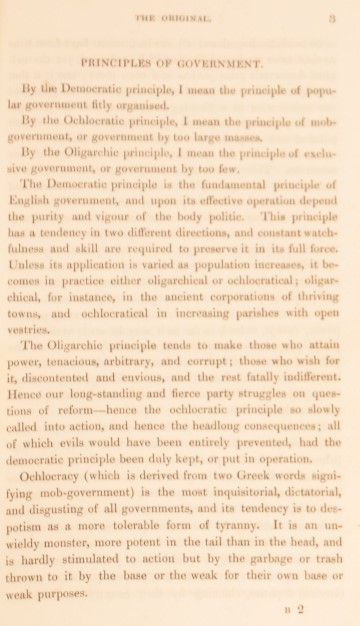
“Principles of Government,” The Original, from issue 1 in the 1850 reprint version

In social and political terms, the periodical criticises both Tories and Whigs in the interest of “Truth”, both being presented as oligarchic at bottom. True democracy, Walker opines, implies attrition of centralised government and devolution to the parish level where future men of state can be trained. Walker is staunchly against the Poor Law and indiscriminate charity of all sorts, positing bad morals on an individual level as the root of poverty in Britain, citing his experience of the courts as evidence. In this sense,  it is a typical Whig/Radical miscellany of the 1830s.

The most famous and influential section of the miscellany in the nineteenth century and beyond was not its political interventions, however,  but a series called (after Walker’s delight in neologisms) “Aristology; or, The Art of Dining”. Beginning in number 13 and continuing until number 22, it received particular favour in the Quarterly Review. It was quickly published separately, starting with a pirate 1837 edition in Philadelphia (The Art of Dining published by E. L Carey and A. Hart). An 1881 British edition is available free online with an introduction by “Felix Summerley” — the pseudonym of no less than Sir Henry Cole, the founder of the Albert Hall, of the Royal College of Music – and of the National School of Cookery — had the rather unlikely suggestion that it become a school textbook. It is possible to see the influence of Brillat-Savarin’s famous Physiologie du Goût (1825) in Walker’s mixture of charming anecdote and pseudo-science. However, recipes are conspicuously lacking: unlike Brillat-Savarin, Walker concentrated on refining the delights of consumption rather than production. His work relates to the gastronomic literature associated with gentlemen’s clubs such as George Vasey’s Illustrations of Eating (1847) and J. Timb’s Hints for the Table (1859) rather than to practical cookbooks such as Esther Copley’s Cottage Comforts (1825), Acton’s Modern Cookery (1845) or Beeton’s Household Management (1861).

To the media historian the most interesting parts of The Original comprise an irregular series of addresses to the reader in which Walker describes in detail his processes of composition in the tone of intimate letters to a friend. This ironic and stylish self-reflexivity is actually, as Walker explains, the result of the pressures of periodical publication: he can’t think of what else to write about except the problem of what to write. Typical of the romantic journalist, this, like the pieces on dining, is a variant of the “subjectified occasionalism” discussed by Carl Schmitt a century ago whereby  “The romantic subject treats the world as an occasion and an opportunity for his romantic productivity” (Schmitt, p. 17). One may disagree with Schmitt’s condemnation that the author may “take any concrete point as a departure and stray into the infinite and incomprehensible – either in an emotionally fervent fashion or in a demonically vicious fashion, depending upon the individuality of the particular romantic” (p. 17) but the widespread attempt to capitalise on – even monetarise – individual bodily experience is certainly characteristic of the time. The political implications of such a valorisation of the individual will be one of the tributaries that feed into individualism (about whose later development in Ouida I have written elsewhere). 

The last issue of The Original comprises mostly an “Address to the Reader” in which Walker begs leave to resume his periodical “the first Wednesday in March”, for “London living and authorship do not go well together”. He had become a celebrity: “My writings have latterly drawn upon me more numerous and cordial invitations than usual.” He was never able to fulfill this promise: after a short illness, he died in Brussels on 20 January the following year.

Relevant Bibliographical resources

Walker, Thomas, The Original, editions 2-4, 1836, 1838, 1850 all published by H. Renshaw. I have not seen the 3rd edition. American editions were published certainly from 1837 e.g. by E.L. Carry & A. Hart in Philadelphia.

Walker, Thomas, The Original, 5th edition, edited and arranged under distinct heads, with additions by William A. Guy, M.B. Cantab, FRS, Renshaw, 1875

Walker, Thomas, Aristology, or The Art of Dining, with Preface and Notes by Felix Summerly (i.e. Sir Henry Cole), G. Bell & Sons: London, 1881 (subsequently, with “The Art of Attaining High Health”, ed. by Philip B. M. Allan, P. Allan & Co.1921; also with a Preface by Brooke Crutchley and illus. by Lynton Lamb, in a limited edition of 500 copies, CUP, 1965)

_______

Brillat-Savarin, Physiologie du gout – 1847 French edition available at Gallica: https://gallica.bnf.fr/ark:/12148/bpt6k1063697 . An 1884 translation can be found at archive.org: https://archive.org/details/b24919494/page/n11/mode/2up

[Hayward, Abraham], review of The Original, Quarterly Review, February 1836 – developed into part of Hayward’s The Art of Dining; or, Gastronomy and Gastronomes, Murray, 1852 (a digital version of the 1883 version is available at here)

Hunter, Lynette, “Proliferating Publications: The Progress of Victorian Cookery Literature”, in Luncheon, Nuncheon and Other Meals: Eating with the Victorians, ed. C. Anne Wilson (Alan Sutton, 1994), 51-70.

Schmitt, Carl, Politische Romantik, 1st edition 1919; 2nd and revised ed. 1925;  trans. as Political Romanticism by Guy Oakes, MIT Press, 1986

Sutton, Charles William, “Walker, Thomas, 1784-1836” in the original DNB: https://en.wikisource.org/wiki/Dictionary_of_National_Biography,1885-1900/Walker,_Thomas(1784-1836) and, in the ODNB [slightly] revised by Mark Clement, at https://doi.org/10.1093/ref:odnb/28513

“The Original 1835-1882” [sic] Waterloo Directory of English Newspapers and Periodicals, vol. V: 3647 (NB information there erroneous, however) (see also online version: https://www.victorianperiodicals.com/series3 )

Ouida and the Parergic 2

Guy_Livingstone frontispiece
US cheap reprint of Guy Livingstone by Routledge (1867) for both US and UK markets

Ouida, of course, from when her first story appeared in Bentley’s (she was just 18), had had to write for money. She knew where the power and money lay, and “mythical swelldom” was one place. In 1857 George Lawrence’s Guy Livingstone had appeared. It went through at least 6 editions by the mid-60s (the image is of an 1867 reprint by Routledge who evidently thought it worthwhile to print – and so establish copyright – in the US as well) and started the cult of the “muscular” hero. Even Dickens had to respond to it  (see Nicholas Shrimpton’s excellent article on Lawrence and the “Muscular School” of heroes in Dickens Quarterly, 29: 2). Lawrence himself was given no less than £1,000 for his novels – a very high sum indeed – by his publisher Tinsley, and Tinsley it was who published in volume form Ouida’s first novel, Held in Bondage in 1863, a novel which combined the dashing muscular school with bigamy and sexual deception, themes newly marketable since Lady Audley’s Secret. Ouida though only managed to get £50 from Tinsley for the rights to publish it (though she did manage to negotiate that he should only keep the copyright for a limited period. Tinsley, rather unpleasantly, wrote that he could have got the complete copyright had he driven a hard bargain). Strathmore followed the same publication pattern, though published, after negotiations, by Chapman and Hall who were now to become Ouida’s regular British publishers. She managed to sell them the short-term copyright for just £75.

Even to get these small sums was an effort. Ouida, a half-foreign woman of 20 from Bury St Edmund’s with no real connections, had to work out a way to make money in the cut-throat male world of London publishing. Hers is in a sense “surplus” labour which has to make itself needed: she is an outsider who has to get in. The solution Ouida seems to have arrived at was to  reflect back to power the image of itself it seemed to like. This is where the concept of parergy starts to become useful.

There is an oft-repeated story that Ouida used the conversations she heard between men at her Langham gatherings for her now most famous novel, Under Two Flags. But, as Jordan demonstrates in her chapter for Ouida and Victorian Popular Culture, Ouida’s knowledge of military life was derived from reading rather than from conversations with military men. Such textual knowledge is legible from her earliest publications, the short stories she had published in Bentley’s in the early 60s, several of which we can read today as devastatingly critiquing male pomposity exemplified by the soldier (e.g. “Little Grand and the Marchioness”). But they can also be read as simply amusing in their accounts of masculinity. That they concern “mythical swelldom” as opposed to what the male critics regarded as reality is key: Ouida doesn’t get it quite “right” i.e. she presents the men from the outside, exposing men’s little blind spots and tricks of evasion. At this stage, that doesn’t matter: for the critics these deviations – these failures to adhere to the powerful norm – are a laugh, “brilliant nothings”.

By the mid 60s Ouida’s prices had risen slightly. Over 186566 she received £6 per monthly instalment for Under Two Flags in the British Army and Navy Review, a monthly to which she had contributed a series of stories and non-fiction articles on military matters since July 1864. Just as Braddon’s Lady Audley’s Secret was left incomplete in its first manifestation as a serial in the twopenny weekly Robin GoodfellowUnder Two Flags was unfinished when the British Army and Navy Review folded in June 1866. Bentley had taken over the Review in December 1865 but failed to save it. He later refused to publish the novel in volume format on the advice of his reader Geraldine Jewsbury who concluded that ‘the story would sell but … you would lower the character of your house if you accept it’.  Ouida wrote to another potential publisher, Frederick Chapman, a few months later claiming that the premature termination of the serial had left ‘military men’ waiting ‘with intense impatience’ to read the end. Her sales pitch to Chapman worked, for he published it as a triple-decker in November the following year. The American publisher Lippincott gave her £300 ‘by trade courtesy’ for his one-volume edition, and the continental publisher Tauchnitz brought it out in 1871. Three years later, Ouida was to sell her copyright outright to Chapman for less than £150.

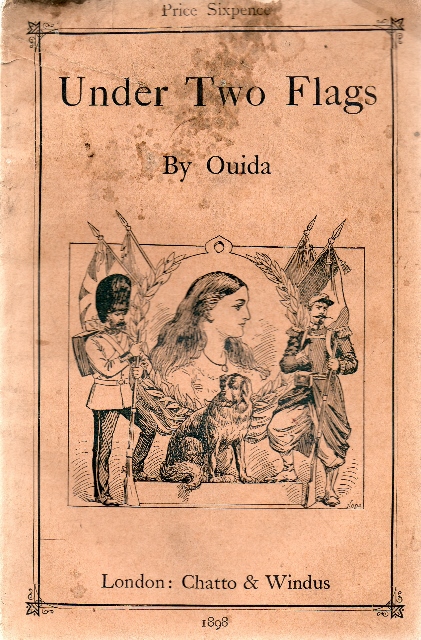
This was to prove a costly mistake for, contrary to what has been claimed, the novel was initially only moderately successful. Its real success came in the 1890s when it sold in enormous numbers in cheap editions: Chatto and Windus, who bought the copyright from Chapman in 1876 as part of their vigorous expansion policy, were to print around 700,000 copies. Ouida got nothing from this. No wonder she was to write to her solictor in November 1884 that “Chatto & Chapman are two rogues who play into each other’s hands to keep down prices like the publisher in ‘Pendennis.’” Men still ruled the publishing industry, as they rule the wider media today.

By the 1890s, then, Ouida’s fiction has migrated downmarket. Interestingly, the penny papers do not treat her with the same attitude as the up-market expensive magazines and newspapers. On the contrary, for them she is “the leading female novelist of England” who has

“no rival in passionate eloquence, and the pathetic, emotional power by which she can change the lowly and the sinning into a glorified humanity, and lift up and ennoble and sanctify even the rudest nature by some one divine gem of supreme manifestation of sacrificial love” .

Bow Bells 17 January 1890

By this time, too, she had herself become comically wicked in that market. Unlike with the negative high-culture reviews of the 1870s and 1880s, this is surely a marketing ploy which positions Ouida as safely transgressive: her eccentricity is part of her scandalous appeal. One can have one’s desires enacted by someone else on the page without ever having to confess them as one’s own. Ouida is contained: once again we don’t have to read her seriously.

To return once again to parergy.

Parergy is not dismissal de haut en bas by critics who claim to know better – it is not a weapon in a cultural war that the powerful wield. It is a wheedling weapon of the disempowered, a demand to be heard which knows it will fail, an attempt to participate in power while knowing that the odds are stacked against it. Is this what Ouida does in her early work?

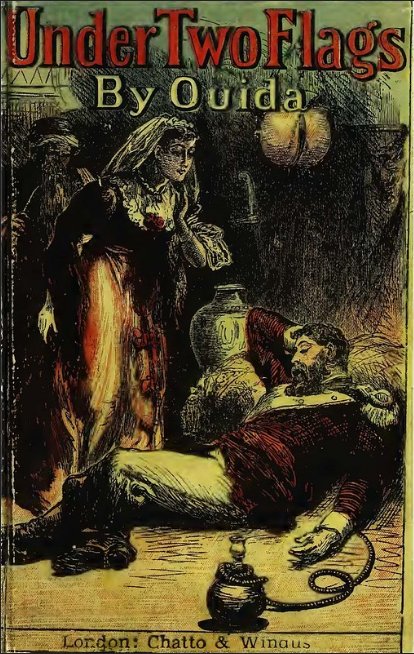
Under Two Flags, Chatto & Windus, 1909 yellowback. Lady Venetia visits Beauty. The viewer looks at a woman looking at a passive man: a popular inversion of the male gaze?

I don’t think Ouida’s imitations of the “Muscular School” fail in an unambiguous way so much as lay that school open to the possibility of ridicule or parody:  they depart from it certainly, exposing its weaknesses and limitations and hidden assumptions. We are never allowed to forget that the hero of Under Two Flags is nicknamed “Beauty” and that he’s much more interested in his horse and his male friend “Angel” than in the heroine Cigarette or the paragon Lady Venetia or the actress he keeps (powerfully objectified as merely “the Zu-Zu” ) or his aristocratic mistress with the absurdly accurate name “Guenevere”. The women Beauty has a relationship with are all part of the appearance of masculinity. Even Beauty’s affair with Lady Guenevere is part of the system of masculine show: everyone knows about it and yet, in that complex game of respectability, at the same time they pretend they don’t. In any case, we are shown how this affair adds a potency to Beauty’s allure.

How are we to take this exposure of the structuring of masculine power and image? Is it a flattering celebration or a merciless critique?

If the parergic can be found in Ouida it is gendered:  excluded from literary-economic power, she mirrors back those representations of masculinity which generate it, while at the same time departing from them by the acuteness of her vision and anxiety as an outsider.

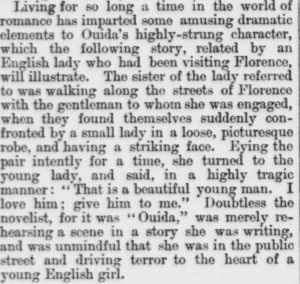
It is very different from the non-gendered, generic parergy I located in the 1840s. If anything, that kind can still be found in the penny paper reviews of the 1890s – think of the rather strained description of Ouida in Bow Bells, with its anxious determination to dazzle with rhetorical devices (most notably a tricolon) at all costs, or the yellowback cover of Under Two Flags, or the anecdote in the London Journal which could be funny were its rhythms more bouncily organised, and were it less determined to excuse its subject as distracted.

London Journal 3 September 1898

Whether Ouida’s vision of men is parergic or parodic depends on whether we read it as undermining or supporting that masculinity. I think her version of muscular literary power in her early work walks a tightrope between parergy and parody: can we say with absolute conviction that her early work parergically supports its models while failing to live up to them or parodically undermines them by exaggerating and revealing? It does both, sometimes simultaneously but mainly, I think, it lurches from one to the other from sentence to sentence, paragraph to paragraph, page to page. The honest reader is left uncertain, while others who prefer certainty are able to take from it what they want. Indeed, the ability of Ouida’s writing to have it both ways in terms of gender is one of the secrets of its success, and why it gives us such scope to write about this author and gender in what seems a mini-Ouida revival in the first few decades of the twenty-first century.

Over a hundred years after her death, and a century after she ceased to be popular, we are perhaps beginning to find ways of reading Ouida again.

Ouida and the Parergic 1.

For perhaps a hundred years the idea that Ouida could ever have a serious relationship with high-status culture would have been laughable. Her contemporary critics thought her merely pretentious: they thought she claimed to be part of respectable culture but she couldn’t manage it; she emulated the high but didn’t get it right.

When the Saturday Review (12 July 1873) reviewed Ouida’s Pascarèl, a novel set in the revolutionary Italy of the 1860s, it began by announcing that Ouida’s

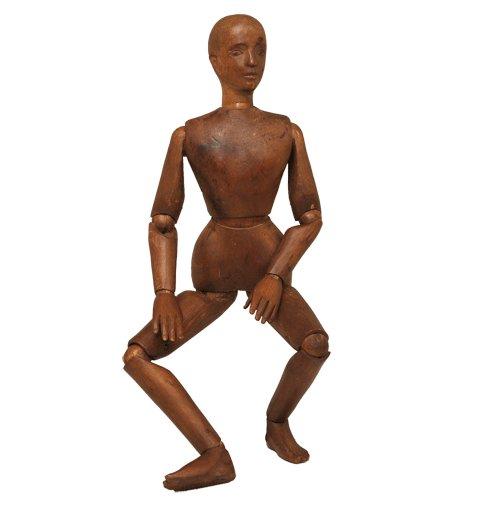
lay figure
artist’s lay figure from the 1860s

“chief literary quality is a flux of words and her dominant characteristic audacity. If we analyse her rushing gorgeous sentences, full of sound and colour as they are, we find only some poor, meagre, little thought as the residuum; and even when her phrases are sentimental, the action of her stories too often appeals to a prurient taste. Her ideas are like an artist’s lay figure, the same thing draped up in a dozen different costumes, but always the same thing underneath, and that thing wooden.”

Ouida couldn’t, according to this witty reviewer,  be bothered to move from the “lay figure” to real people: she remained all pose (as Malcolm Elwin described her in his 1930s book Victorian Wallflowers).

Now when I used  the term defined in an introductory post, “parergic,” to refer to a failed emulation of high culture that did not undermine but supported it, I wanted to get away from the value judgement implied by the terms “pretentious” (or words often used in a similar way, like “imitative” or “derivative”) to help us think about what was at stake: what are the violent hierarchies we participate in, unconsciously or otherwise, when we dismiss a writer as laughably pretentious? Sometimes the violence takes place in the field of culture, at other times of class, gender, race, age, disability and so on. Sometimes consumer identity which may be “horizontal” rather than vertical is at issue, whereby for instance, supporters of one successful pop group will deny the validity of another which is, in the field at large, in a very similar cultural position. At all times the issue is tribal status: “we” are better than the failed “them”. My deployment of the term “parergy” was intended to create an analytic  distance from those struggles, to stand outside them insofar as such is possible (that one cannot stand outside entirely doesn’t mean one shouldn’t try).

Now how far can parergy be related to Ouida’s early work?

Before we get to that, though, we need to note that the critics’ view of Ouida as pretentious only fully emerges after her identity as a woman is revealed. Early comments on her work in periodicals – she had started to contribute to Bentley’s Miscellany in 1859 – suggest that the critics thought “Ouida” a clever gentleman who wrote “brilliant nothings” for pleasure (see e.g. Morning Post, 4 February 1862: 3). They even thought Ouida  had seen military service. So thorough was the deception that the Standard (8 May 1862: 6) wryly interpreted Ouida’s temporary absence from Bentley’s in May 1862 as a possible sign that the author had decided it was too vulgar to write in such a magazine:

“What has become of him? Has he got a notion that it is plebeian to write, or is he only taking a rest from his arduous labours as the chronicler of mythical swelldom?”

Ouida’s morality – but, more, “discretion” – were issues that some papers took issue with: the Morning Post (8 May 1865: 2) didn’t like “his” article on duelling for the Army and Navy Review mainly because “he” dared to voice opinions that should have been kept within “his” set.

By 1866 that the name referred to a woman author was already public: the Sporting Gazette of June 23 that year refers to her as “she” confirming the Pall Mall Gazette‘s outing of Ouida as a woman in its review of Strathmore (4 May), in which it had defined her novel as “the hen book to ‘Guy Livingstone'” (on which novel see below) and proceeded to slash it for, exactly, pretention:

Pall Mall Gazette, 4 May 1866

Soon, Ouida’s real identity becomes more and more public. The Bury and Norwich Post, and Suffolk Herald  (23 October 1866: 4) even relates how “she” had spent her childhood in Bury.

While it’s very easy to close down the argument by concluding that this is just another example of Victorian sexism – it is – yet the second post on Ouida will think through its implications for an understanding of the parergic.

Parergy and the Beginnings of the Mass Market in the 1840s

31 (478x640)
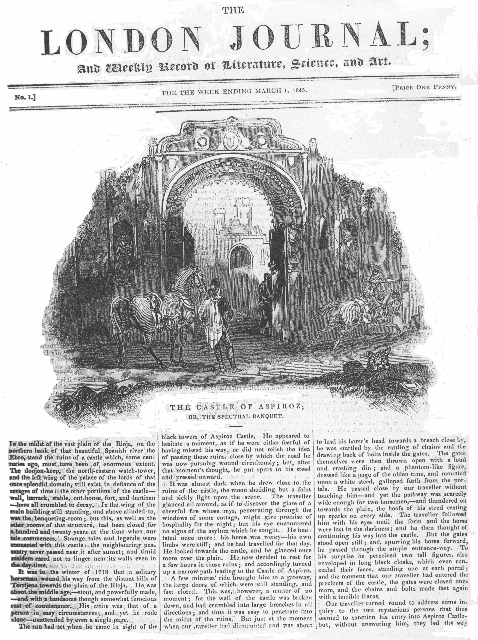
1st page of The London Journal 1845

Two decades after the proofs of my first monograph were submitted for publication it seems an appropriate time now to revisit key concepts I invented to help explain the field of Victorian popular publishing. The book, a version of my PhD thesis, was a study of the first four decades of a Victorian penny weekly fiction magazine, The London Journal 1845-1883. How well do these concepts stand up to the test of time?

One of the key concepts was what I called the parergic after Derrida, though I used the term in a very different way from him. I employed it in an attempt to explain in a serious, non-condescending and intellectually rigorous way the particular position in the literary marketplace of texts right at the beginning of the commercial mass market: what was the relationship of these texts to the more general field?

Here, in this first post revisiting ideas from another age (and indeed I first came up with the idea in the 1990s), is an extract from the original. Later posts will test the concept against other work. Here are a couple on Ouida:

Having provided paragraph-length biographies of several journalists and marked their career paths – they all started aiming for high status and ended writing for money – I came to a conclusion and then sought to explain that conclusion and link it to curious stylistic features characteristic of these texts, features very different from the Edward Lloyd-type serials I had encountered previously which did not seem to care about their status as commodities. The material I was studying from The London Journal seemed worried about being dismissed as merely ‘economic literature’ – how did this worry manifest itself exactly?

*****************************

… The London Journal was thus a precipitate out of surplus labour which would prefer the greater symbolic (and at this stage usually economic) capitals of the up-market magazines. The desire for a unified cultural field that I discussed in Chapter 2 is visible here, supported sociologically by the very limited socio-cultural group that writers in general came from (Altick, 1989). In that sense, the impression gained from Vizetelly’s description of the magazine as staffed by ‘failures’ is correct.

The longing for the high but exclusion from it that such career paths suggest results in what I term the parergic. This comprises a set of specific textual effects and practices, which, while underpinned by sociological narratives, does not inhere in specific bodies or corpora (a writer, artist, a periodical or even an article may display the parergic or not at various points). It is a system whereby texts are based on originals that are invested with greater symbolic capital and authority. Officially respectful and emulative, the parergic is tinged always with a resentment, caused by exclusion from desired cultural areas, that brings about mutation in what is supposedly emulated. The parergic sometimes raids authority aggressively and seems therefore to attack it, but nonetheless paradoxically buttresses cultural boundaries even in the act of transgressing them. Unlike parody, which always in some sense undermines the authority of its original even while being complicit with it, the parergic fully acknowledges and maintains this authority even when it effaces its model. Unlike straightforward imitation of the high, which depends on large cultural capital to judge its value, the parergic does not use the exclusive codes or high prices that cultural authority wraps itself in to keep out the uninitiated.[1]

The weekly ‘Essays’ furnish typical examples of the parergic in terms of that practice which is ‘style’. Essay L [50] on ‘The English Language’, signed by John Wilson Ross ([London Journal] III: 7-8), begins with the commonplace thesis that ‘the progress of language marks the progress of the human mind’, and swiftly interprets this in a nationalist sense. It continues by placing the ‘rise’ of the English language at the Reformation because then ‘men began to argue’ and to do so ‘they [had to] express themselves with precision’. Thereafter,

Addison was unquestionably the first of our writers who introduced elegance of expression into the composition of English prose. He found the writings of his predecessors disfigured by a loose, inaccurate, and clumsy style. He changed all this, and made himself a model for imitation. In his works we find no forced metaphor – no dragging clause – no harsh cadence, – no abrupt close. He is, also, a happy model for the use of figurative language. They seem to spring spontaneously from the subject: and are never detained till the spirit evaporates or the likeness vanishes. They are just like flashes of lightning in a summer’s night – vivid, transient, lustrous, – unexpected but beautiful, – passing over the prospect with a pleasing brightness, and just vanishing before you catch a sight of all the beauties of the scene they gild. The copious and classic mind of that writer gave our language the greatest degree of elegance and accuracy of which it is susceptible. Since his time fine writing has not improved. Simply, because it cannot be. You cannot give the English language a nicer modification of form, or a greater beauty of feature than Addison gave it. But you can give it more nerve and muscle. And subsequent writers have done so.                                                                                                     ([London Journal] III: 7)

It was Johnson, ‘[t]hat Colossus of English literature’, who provided the muscle. Since his time ‘there has occurred no variation in the style of English prose’ except, possibly, by increased use of the ‘Gothic, whence [English] sprung; and that is a feature in language which our readers will agree with us is more deserving of disgust than admiration, and a variation in style more worthy of punishment than praise’ ([London Journal] III: 8).

The essay’s claims to authority depend largely on the assumption of a common standard throughout the literary field…

Andrew King, The London Journal 1845-83: Periodicals, Production and Gender (Routledge, 2004), 57-8.

Annotated edition of Ouida’s Two Little Wooden Shoes Chapter 1.1

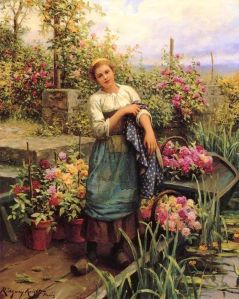
Typical of the romantic versions of peasant life. Daniel Ridgway Knight (American painter, 1839-1924) – “The flower boat”

Ouida

TWO LITTLE WOODEN SHOES

Chapman and Hall, 193 Piccadilly, 1874

CHAPTER I.

Bebee sprang out of bed at daybreak. She was sixteen.

It seemed a very wonderful thing to be as much as that — sixteen — a woman quite.

A cock was crowing under her lattice — he said how old you are! — how old you are! every time that he sounded his clarion.

She opened the lattice and wished him goodday, with a laugh. It was so pleasant to be woken by him and to think that no one in all the world could ever call her a child any more.

There was a kid bleating in the shed. There was a thrush singing in the dusk of the sycamore leaves. There was a calf lowing to its mother away there beyond the fence. There were dreamy  muffled bells ringing in the distance from many steeples and belfries where the city was; they all said one thing: “How good it is to be so old as that — how good, how very good!”

Bebee was very pretty.

No one in all Brabant ever denied that. To look at her it seemed as if she had so lived amongst the flowers that she had grown like them, and only looked a bigger blossom — that was all.

She wore two little wooden shoes and a little cotton cap, and a grey kirtle — linen in summer, serge in winter; but the little feet in the shoes were like rose-leaves, and the cap was as white as a lily, and the grey kirtle was like the bark of the bough that the apple blossom parts when it peeps  out to blush in the sun.

International Bibliography for the Study of Magazines 1: France

Recently I’ve been thinking about how hard it is to do transnational comparative research on periodicals, so I’ve started to compile a series of guides to the study of magazines in various countries. Since they’ll all be in one place, it should be easier the follow up lines of enquiry across countries. I have to say I have found the enterprise really fascinating!

Here’s the first, on French Periodicals.

France, along with Britain and Germany, is one of the points of origin of the magazine form and the history of French magazines runs in parallel and dialogue with its two neighbours. It is distinct, however, in its early phase by its centralisation, domination by just three titles and its generally literary orientation: the learned Journal des Savants (1665-), the literary and more gossipy Mercure galant (1672-1825; Mercure de France after 1724) and the (eventually) government-controlled news magazine the Gazette (de France) (1631-1915). In the eighteenth century, the press began to diversify: the Recueil périodique d’observations de médecine, de chirurgie et de pharmacie (1754-1793 ) is the first medical magazine, Courier de la Mode ou Journal du gout (1768-770) was the first women’s magazine and so on. In the nineteenth century French women’s and satirical magazines like Le Moniteur de la mode (1843-1913)  and Le Charivari (1832-1937) especially were global inspirations, though literary journals like the Revue des deux Mondes (1829-) were also extremely influential. The “Golden Age” of magazines is generally considered to occur between the Paris Commune and the First World War (1871-1914), when illustrated news magazines such as the Petit Journal (1863-1944) attained circulations of over a million.  Histories of the French press emerged at the same time as in Britain, in the mid-nineteenth century. Hatin’s Histoire politique et littéraire de la presse en France of 1859 is deservedly famous, but it also signals the course of French press historiography even more than its British analogues by focussing on newspapers and high-status literary magazines: the sustained history of popular French magazine has had to wait to be written until the late twentieth century.


REFERENCE

Devreux, Lise and Philippe Mezzasalma, eds. 2011. Des sources pour l’histoire de la presse: guide. Paris, Bibliothèque Nationale

An authoritative guide to the press holdings of the Bibliothèque Nationale from its earliest journals to the electronic magazines of today, it covers the laws, economy and technology of the (mainly newspaper) press in detail. Of especial value is the very extensive bibliography. Magazine history is much more prominent than in Bellanger (q.v.).

Place, Jean-Michel, and André Vasseur. Bibliographie des revues et journaux littéraires des XIXe et XXe Siècles. 3 vols. Paris: J.M. Place, 1973–77.

Place and Vasseur’s valuable bibliography covers the years 1840–1930 for a select number of both famous and lesser-known French literary periodicals, with facsimiles of cover pages, an introduction to each journal, and full bibliographic descriptions, which include information about the editors, contributors, and physical characteristics of each periodical, along with a table of contents for each issue. It also includes an invaluable index of names.

OVERVIEWS OF PERIODS, GENRES, PLACES

Albert, Pierre. 1970. Histoire de la Presse. Paris: Presses Universitaires de France

This small volume, one of the popular Que-sais-je? series, is useful as a starting point for a press history of France compared with (mainly) England and Germany (the USA has a few pages devoted to it). Though magazines figure hardly at all, and there is little detail, the volume has the virtue of summarising the overarching conditions of the press within which magazines operated.

Bellanger, Claude, Jacques Godechot, Pierre Guiral and Fernand Terrou, eds. 1969. Histoire générale de la presse française. 5 vols. Paris: Presses Universitaires de France.

The standard history of the French press from its beginning to the 1960s. A monumental undertaking, these volumes all freely mix newspapers and magazines, though the stress is on politics and newspapers. While attention is certainly given to technology, circulation and genre, an emphasis characteristic of French press history, is on the development of press law.

Eveno, Patrick. 2012. Histoire de la presse française de Théophraste Renaudot à la revolution numérique. Paris: Flammarion.

A lavishly illustrated volume, this popular history of the French press from its beginnings with Renaudot’s Gazette in 1631 offers a surprising amount of illuminating material. Most of the volume is spent on the late nineteenth and twentieth century press. Magazines play a part in the narrative, but the main utility of the volume is for high-quality background information.

Forsdick, Charles and Andy Stafford, eds. 2013. La Revue: the Twentieth-Century Periodical in French. Oxford, Bern, Berlin, Bruxelles, Frankfurt am Main, New York, Wien Peter Lang.

Acknowledging the dearth of studies of French magazines as magazines, this collection seeks to remedy that with 19 essays, mostly in English but some in French, centred on individual, mainly niche, magazines. Notably, there is a chapter on the history of French-language magazines in Mauritius.

Kalifa, Dominique, Phillipe Régnier, Marie-Ève Thérenty, Allain Vallant, eds. 2011. La Civilisation du journal: Histoire culturelle et littéraire de la presse française au XIXe siècle. Paris: Nouveau Monde.

At almost 1800 pages and with 116 essays (many like long encyclopedia entries) by 60 contributors, this volume is to the study of French periodicals what the Dictionary of Nineteenth-Century Journalism (q.v.) aspired to do for British: push periodical writing to the forefront of nineteenth-century studies. While it is not restricted to magazines, magazines play a very large role here. This is certainly the obvious place to start for a study of the nineteenth-century French magazine, though the emphasis is decidedly literary rather than technological or economic.

Mesche, Rachel. 2013. Having it all in the Belle Epoque: How French Magazines invented the Modern Woman. Stanford, CA: Stanfird University Press.

Despite the sensationalist title, this is a well-researched study of the dialogue between magazines, literary production and feminism, focussing on two photographic magazines aimed at women La Vie Heureuse (The Happy Life, 1902-1917) and Femina (1901-1954)

DATABASES

Bulletin des Bibliothèques de France (BBF), http://bbf.enssib.fr.

The Bulletin provides much useful information on new bibliographies, digital projects, and academic articles about bibliographic issue. The site includes the entire back catalogue of the BBF revue since its beginnings in 1956.

Dictionnaire des journaux 1600-1789 and Dictionnaire des journalistes 1600-1789 http://dictionnaire-journaux.gazettes18e.fr/ and http://dictionnaire-journalistes.gazettes18e.fr/

Two related open-access reference sources, the equivalent of the pay-walled Waterloo Indexes to nineteenth-century British and Irish periodicals, these are updates of paper versions published first in 1974 and subsequently. Links to digital facsimiles are provided where these exist, and there are extremely useful and informative welcome pages outlining the scope of the Dictionnaires. This is an essential resource for the study of early magazines in France.

Gallica, http://gallica.bnf.fr

A massive, user-friendly open-access digitization project sponsored by the Bibliothèque Nationale de France, Gallica includes many periodicals. Usefully, it links up to other digital holdings, such as the Bibliothèque numérique de Roubaix (an online local history archive), and provides brief background information on individual daily newspapers as well as periodical and press history.

Système universitaire de documentation (SUDOC)   http://www.sudoc.abes.fr

SUDOC is the online union catalogue of French university libraries. It includes Myriade, a union catalogue of 250,000 periodical titles in French libraries and archive centres, including 2,000 non-university institutions, such as municipal libraries. Not digitized it is invaluable as a finding aid.

Journaux de la Revolution de 1848

This database, available as part of Gale Cengage’s (q.v.) Archives Unbound, and thus available only to subscribing institutions, offers fully text searchable facsimiles of newspaper and magazine titles published in France 1848-1852.

Persée. http://www.persee.fr/

An open-access site, this offers text-searchable access to over 170 collections comprising some 530,000 documents, including facsimiles of numerous learned journals in French such as the Journal des Savants (from 1910 to today) . The earliest material dates from 1840, though the main focus is on twentieth and twenty-first century materials..


Matrimonial Ads in the Victorian Press: Fantasy, Imagination, Story, Life

“Honest, Thick-Skinned Advertisements for Goods”?

Relationships, relationships… : an illustration to The Will and the Way by J.F. Smith in The London Journal 5 March 1853

W.D. a tall, dark, young man, with £200 per annum, derived from an investment in the funds, would like to have a fair-complexioned young wife; he has just returned from Italy, but does not admire the dark beauties of that land of poetry and song.

MARIA C., of Wavertree, who resides with a cross old aunt, is desirous to join her fate with that of a medical man; she wants a comfortable domestic home; she is a good housekeeper, and not afraid of labour, having kept her late father’s house without a servant; she is not a child but “fat, fair and forty” with a fine complexion, splendid and perfect set of teeth, also beautiful hands and small feet. She has £64-a year now, and will have £500 on the death of her aged aunt.

(both from “Notices to Correspondence,” The London Journal, 5 March 1853, p. 416)

Who of us hasn’t, if we’re honest, scanned what not so long ago were the “Personals” in newspapers? I certainly used to and no doubt would today if I happened to come across them  (now you have to make an effort by going to specialised websites – the pleasures of chance encounters in the press are altogether rarer). Weren’t the personals wonderful invitations to fantasy? What would X be like? Would I like them? Would they like me? Are they like me? What a funny ad! – what kind of person would answer that? etc etc

If the above two quotations from the penny fiction weekly London Journal are anything to go by,  it seems the fantasies of Victorians were rather different from ours. They assume marriage is less about romantic love or sex than comfortable domestic arrangements. The fantasy concerns a better life obtained through the synergistic pooling of resources, whether those resources be money,  labour, or looks. W.D.’s main selling points are his £200 a year and – perhaps for some – commitment to his home country; Maria C. supplements her offer of £64 a year with the prospect of an additional £500, commitment to hard work, experience of managing a household – and, her father being dead, no interfering relatives (remember Lady Audley’s sponging father?).

To read them like that is to read them as  “honest, thick-skinned advertisements for goods” as the Spectator put it in a review of the later (and very successful) magazine entirely devoted to matrimonial ads, the Matrimonial News (1870-1895).

Of course, one can easily weave stories about these two — though, even if imaginary,  I hesitate to call them fantasies.

Perhaps W.D. was on the rebound, jilted by an Italian beauty he had encountered in Florence,  Venice or Naples. £200 is a fair amount to to live on but not enough to keep a carriage or horses: why doesn’t he declare other possibilities of income such as training for the law? He’s probably feckless and superficial, a Shallow Hal who only wants a blonde. Or perhaps he is an Artist who lives only for Beauty. Ah! Now there’s an idea for a novel plot! Ouida might well have used it (except that in 1853 she was only 14 and had six years to go before her first tale was published). Still, one thinks of Folle Farine in 1871 (not one of Ouida’s sunniest – W.D. in this novel would be a heartless monster!)

From “Notices to Correspondents,” The London Journal, 5 March 1853, p. 416.

As for Maria C. from  Wavertree – why does she want a medical man? Is she ill? £64 a year and £500 on the death of an aunt, a father with no servants, based in a Liverpool suburb — not a promising social or financial additional asset for a physician. Despite her fair hair, in no substantive sense is she Rosamond Vincey in George Eliot’s Middlemarch!  But maybe a surgeon would find Maria useful, for surgeons in the 1850s, although they were fighting for status,  were still associated with trade. Or perhaps an apothecary would do? Interestingly, I can’t think of a novel plot in which Maria C.’s story might have appeared in this period. One can imagine a naturalist novel by Gissing where her story could be told, but in the early 1850s the heroines were young and beautiful. A Punch cartoon might feature her as a harridan man-chaser, Dickens might parody her in Pickwick Papers as Rachael Wardle or Mrs Bardell, but Maria C. is just not narratable in fiction of this period, at least not in a way which would give her a decent interior life. She has no voice in print other than what she herself gives it – a remarkable achievement on her part.

I’ve recently been reading Jennifer Phegley’s very entertaining Courtship and Marriage in Victorian England (2011) and (not for the first time) was struck by the imaginative possibilities of these ads that she discusses so well (click here for a fun lecture by by Jennifer delivered in Kansas in February 2012)

While the ads don’t seem to link directly to novels of the period, it’s interesting   that it seems a reflex for us to decode them –  extend them  – flesh them out – by trying (and perhaps failing) to link them to such novels.

I’m reminded of Lisa Zunshine’s contention in Why We Read Fiction: Theory of Mind and the Novel that however we may be trained in academia to treat texts as dead objects, we keep wanting to animate them by ascribing to them a spirit, an identity, a personhood of which they are symptoms. And isn’t  trying to connect the matrimonial ads to novels in some curious way a bizarre instance of that, as if the novels were more alive than the ad? We don’t know W.D.’s or Maria C’s real stories, so we have to turn in a really bizarre way to something we consider the next best thing: the Victorian novel.

This is a far cry from the fantasies inspired by the personals of the late twentieth century: they prompt a different set of questions and today offer different, retrospective solutions, that, however imaginary, are, well, not fantasies so much as wishes that dead words on paper or screen that bore little or no relation to the material lives of real people might, perhaps once, have been the stories and memories instinct with life and breath.

For a light-hearted little video on matrimonial ads from the BBC, see my discussion with the wonderful Lucy Worseley here.

The Army Surgeon – some comments

“The Army Surgeon”

Sydney Dobell

Over that breathing[1] waste of friends and foes,[2]
The wounded and the dying, hour by hour,-
In will a thousand, yet but one in power [3] ,-
He [3] labours thro’ the red and groaning day.
The fearful moorland where the myriads lay
Moved as a moving field of mangled worms. [4]
And as a raw brood, orphaned in the storms,
Thrust up their heads if the wind bend a spray
Above them, but when the bare branch performs
No sweet parental office, sink away
With hopeless chirp of woe, so as he goes
Around his feet in clamorous agony
They rise and fall;[5] and all the seething plain
Bubbles a cauldron vast of many-coloured pain.[6]


[1] This immediate emphasis on breath not only suggests breath as a theme but as a corporeal sensation for the reader – for the poem itself offers various challenges to the reader’s control of her or his own breath: it starts with pretty regular rhythm (iambic pentameter), but especially during the epic simile from line 7 onwards, the convoluted syntax spreading over clever enjambements and caesuras strains the reader’s own breathing as well as the rhythm.

[2] The rhyme scheme gives the impression of being broken, befitting the damaged bodies the poem describes. As with the rhythm, the syntax fights the rhyme scheme, making it difficult to discern. When split into two sestets the scheme seems less awry — abbccd, d[eye rhyme]cdcac [pseudo rhyme], ee — but the rhythms, especially the strong pause at the end of line 4 and the recall of that line’s rhyme at line 8 suggest a tough yet ghostly tension with an organisation of the poem into the more traditional 3 quatrains which is never realised.

[3] Death and its proximity unite all into one undifferentiated nameless mass. This is a particular example of the sublime, as defined by Edmund Burke. Today we might be tempted to regard the use of the sublime here not for aesthetic purposes but for political — in describing and enacting the horrors of war, we might assume the poem is against war. However, other readings are certainly possible: quite what the poem’s politics are depends on how we read the poem. Read in isolation, it is true that its violent sensationalism seems to oppose war. Yet when read as an element of  the whole collection it might be regarded as indicating the depth of sacrifice necessary to make Britain Great. This latter was a reading of the collection certainly made at the time by critics and newspaper editors.

[3] The final line of the first stanza introduces the single character into the undifferentiated mass of humanity. Both are unnamed: neither the mass nor the surgeon are individuals, but effects of their jobs. We might also regard the surgeon as the poet who surveys and dispassionately reports. Given the emphasis of the poem on painful suffering this might be a surprising suggestion, yet we should not forget the sheer skill of the poet’s pen here mirroring the surgeon’s own expertise with the scalpel. In neither case can professional knowledge alleviate suffering (see also below, note [5]). What the poet can do, however, is in a curious way comfort readers by reminding them that, like the surgeon, both he and they have survived. This is quite consonant with the Burkean understanding of the sublime, which was based on the perceiving subject’s realisation that he or she had survived death even though death had been encountered.

[4] The fallen seem already to have become prey to being eaten by worms: time, in this case the future and the present, has been collapsed in ways typical of the sublime. Simultaneously, a point is being made about the unity of living creation, a notion reinforced by the following comparison of the wounded to chicks desperate to be with their mother who will never come, and the surgeon to the tree branch which the chicks believe to be her but which cannot, by its nature, help them. We are all mortal animals dependent on the rhythms and failures of breath.

[5] The suggestion is of a wave – a rhythm – that rises and falls uselessly. The surgeon can do nothing for the dying. Here is the limit of the professional’s ever-increasing pastoral role caring for his flock (cf. King para 31). Scientific rationality cannot have a purchase here: the only language adequate for such suffering is that of flesh itself – the body and its breath, fragile, easily interruptible: in short, corporeal sensation, the spasmodic. This is not representation so much as presentation that produces in the reader the same sensations felt by the described.

[6] The last line shockingly introduces the language of the kitchen, suggesting a parti-coloured stew of boiled meats and vegetables seen from the point of view of the meat rather than the cook (whether the reference is to a witches brew leads to the same conclusion). Suddenly in this line we are presented with a space  where damaging flesh, even if not human, is the norm. This normalisation and naturalisation of suffering, legible in the epic simile too, confirms a preoccupation for how suffering is to be represented (or presented) rather than politically or ethically dealt with. Death is natural and normal, however painful and horrific, and it is the poet’s duty to communicate it. How to communicate death and dying is both the “scientific” and aesthetic point of the poem. Whether the suffering is to be valorised or condemned – that is, read politically and ethically – is, however, for the reader to decide, at least in this poem.


Publication and Reception Note

Sydney Dobell’s sonnet “The Army Surgeon” was originally published in Sonnets on the War, a joint collection with Dobell’s friend Alexander Smith that is now freely available or archive.org.

No manuscript source seems to have survived (see National Archives entry on Dobell). The one contemporary reprinting (see below) offers no variation of the text. While Dobell used only ‘the Author of “Baldur” and “The Roman”‘ on the title page, contemporary reviews show that his name and identity were already well known.

Frontispiece from 1856 edition

Smith and Dobell’s slim volume (of just 48 pages) was published in the first days of January 1855 by Bogue of Fleet Street as a shilling paperback (we can date the publication from a reference to it in a letter from Dobell to one of his sisters dated 5 January in which he says he hopes to send her a copy the next day – Life and Letters of Sydney Dobell, p. 396). Presumably Smith and Dobell’s usual publisher, Smith, Elder and Co (who published Dobell’s later and more expensive hardback collection England in Time of War) was unable to insert publication of the volume into their schedules, whereas the lower-status Bogue was more flexible. The poem was republished without emendment in The Poetical Works of Sydney Dobell (2 vols, Smith, elder & Co, 1875)  on p. 226, where Dobell’s contribution to “Sonnets on the War” are precipitated out from that volume, enabling us to distinguish them from Smith’s. The Poetical Works of Sydney Dobell is also available through archive.org.

Although “The Army Surgeon” can certainly be read as a self-standing commentary on (or description or enactment of) generic horrors of war, it in fact forms part of a narrative sequence that very firmly locks the poem into its historical context. The borders of this particular sequence are porous since the entire volume begs to be read as a whole, but one can see a distinct set of poems centred on the Battle of the Alma (20 September 1854, generally considered the first major battle of the Crimean War), comprising the sonnet “Alma” that immediately precedes “The Army Surgeon”, and the following three, two entitled “Wounded” and the last “After Alma”. Dobell only wrote “The Army Surgeon” amd the two “Wounded” poems but the arrangement of the pages certainly asks the reader to think of the Surgeon at the Alma.

Even though I have been unable to locate specific examples in newspapers before the collection appeared, I nonetheless think it helpful to regard the collection as comprising a specific type of what Natalie Houston has called the “newspaper poem,” that is, occasional poetry responding to or commenting on contemporary events reported in the press. The most famous Victorian example of this is Tennyson’s “Charge of the Light Brigade”  first published in The Examiner on 9 December 1854 in response to a Times article.

Andrew Hobbs has persuasively argued that the provinciual press was a major locus of poetry publishing in the nineteenth century,  and poems from “Sonnets on the War” is no exception. But rather than reprint all of them equally, there is a decided preference by newspapers for some over others. “The Army Surgeon” was not amongst those favoured at the time, perhaps because its imagery was too strong or its sentence structure and long and tortured central metaphor were considered too difficult.  The Aberdeen Journal (10 January 1855, p. 6) reprinted six sonnets: “Alma”, “After Alma”, the two sonnets on “The Cavalry Charge”, “Miss Nightingale” and “Cheer.” This is a selection that offers a reassuring narrative arc and avoids too much horror. The first three are reprinted again by  The Blackburn Standard on 7 February (p. 4) along with “Sebastopol” with a similar effect.

The politically more radical Lloyd’s Weekly, full of praise for the collection (14 January 1855, p.8), offers a different selection. Starting with “Alma” again, it continues with the second “Wounded” poem (a startling choice given the poem’s poetically very new technique of assembling fragments of everyday speech and follows it with “America”, “Freedom” and “Volunteers”. Again, however, despite a selection emphasising the politically and aestehtically radical, the arc remains comforting: for even if poetic novelty is admitted in Lloyd’s pages, the most shocking, visceral poems are omitted.

The volume was greeted with a mixed reception at the time. The lengthy review in the Inverness Courier (1 February 1855, p. 2), the only contemporary newspaper where I have found “The Army Surgeon” reprinted, regarded the collection’s level as of “respectable mediocrity.” But it did praise the the poets for “producing work on a practical subject, which, if its poetry is not of a very high order, contains nothing visionary, absurd or impracticable”. It singles out “The Army Surgeon” as one of the best according to these criteria. The review of the collection in The Sheffield & Rotherham Independent (5 May 1855) is likewise very lukewarm. Its principle bone of contention is that the sonnets are not musical: “In the hands of of a master the sonnet gives exquisite music;but strung by a tyro the sounds will be discordant.”  Ironically, of course, it is precisely the violence the authors of “Sonnets on the War” do to the traditional expectations of the sonnet that today constitutes one of the collection’s main interests. The review ends  by reprinting two of the more conservative poems (both ideologically and formally): “Miss Nightingale” and “Good Night” which they assume to have been written by Smith and Dobell respectively. It thus rescues the collection for patriotism just as the other newspapers had done.

Interestingly the London Lancet (the American edition of the British medical journal Lancet)- which reprinted the poem in 1856 – uses the isolated poem as an example of “all the heroism and self-denying devotion of which we have spoken” (p. 222), suggesting not only a reading of the individual poem through the lens of the self-abnegating professional (cf. King para 34) but also a reading of “The Army Surgeon” through other poems in the volume. Whatever our own views, this is a reading made possible by the poets’ interest in the problems of communication rather than in the politics of the described action.

That said, when the poem became detached from its collection, the alternative anti-war reading became more easily available. This is certainly possible for example in the New Zealand Herald (10 February 1917, p. 1).

The context of the poem in the Crimean War and has been well covered elsewhere: Kathleen Béres Rogers “Embodied Sympathy and Divine Detachment in Crimean War Medical Poetry” is recommended as offering an attentive reading of the poem which places “The Army Surgeon” in a slightly different context from what I have offered here.

The Vicissitudes of Biography; or, how to welcome an Other

Draft of a talk for the University of Macerata to a general audience at 11am on the 11th of November 2014. The elaborate PowerPoint, contrapuntal with and not duplicative of these words, can be found here, along with a spoken word recording of the presentation.

frontispiece to Elizabeth Lee, Ouida: a Memoir (Methuen, 1914)
opposite p. 89 in Elizabeth Lee, Ouida: a Memoir (Methuen, 1914)

The Vicissitudes of Biography; or, how to welcome an Other

Le vicissitudini del raccontare una vita; o come accogliere un Altro

Almost everyone I meet asks me what I am doing in Macerata. To those in the street I give a simple linear answer: a guest of the new Collegio Matteo Ricci at the University, I’m finishing a biography of the nineteenth-century popular author Ouida,  planning a European networking project with colleagues here, and exchanging ideas about teaching and curriculum design (a reflection on which can be found here) .

But I think you here, kind enough to host me in the University and to welcome me in this splendid nineteenth-century aula, deserve something more than that plain list. And it’s the relation of welcome and biography that I want to spend these few minutes thinking about with you.

In 1908, shortly after Ouida had died in Viareggio after almost 40 years in Tuscany, a woman journalist from New York, a Miss Welch, wrote to an old soldier, now retired and staying in Viareggio, to ask if he could help her with information or letters about this woman author whose works sold by the million all over the world. He replied that, yes, he had known Ouida when he was in the military and, yes, he had renewed her acquaintance recently and exchanged a number of letters with her, and, yes, he would let Miss Welch see these letters. However, he warned, writing the life of Ouida would be very difficult. This wasn’t because of a paucity of information but because of the peculiar qualities the biographer of Ouida would require. Chief amongst these qualities would be what he thought was an already outmoded sense of chivalry towards the subject.

In his next letter to Miss Welch he changed his mind: he wouldn’t let her see the letters after all. Knowing Ouida’s hatred of biographies and the publication of private lives in general, he wanted to respect her wishes. Though he doesn’t say this in so many words, it’s clear that he feared Miss Welch would not treat Ouida chivalrously.

Miss Welch never wrote the biography.1st volume-length biography of Ouida: by Elizabeth Lee (Methuen, 1914) After the many, many obituaries of Ouida after her death on 25 January 1908, the first substantial volume-form biography was published in 1914 by Elizabeth Lee, the sister of the editor of the British Dictionary of National Biography.  This was followed by three more full-length biographies, the most recent of which appeared in 1957.

But the old soldier’s warning still appertains 106 years after it was written. We might regard the term “chivalry” as problematically patronising today, but we can and should think about the moral issues of biography, of writing or telling a life.  To do that, I’m prompted here by something  we have learnt, through what I think of as “Mediterranean” theory, to call over the last 20 years hospitality but which we might well call “welcome” or accoglienza. I’m not going to explore the delightfully tortuous paths of Derrida’s thinking  on hospitality here, now, in this welcoming aula,  or the way it interacts in dialogue with his interlocutor Anne Dufourmantelle, but rather, inspired by his work, to think about the vicissitudes — the perils, pains and transformations — of writing a life.

If we have learnt anything from Derrida, we know that there are many and contradictory ways to write — many ways to approach an Other. I can for example use the life of another to celebrate myself, to parade him or her like a jewel on a breast or on my cuffs or, demonstrating my ouida silver crestacquaintance with her as one of my possessions, to flash her as a claim to my status in a defined community. So, for example, I could write a biography merely to forward my career,  or to claim membership of a specific elite — let’s call them humanities academics — by using the life to promote a specific ideology, or to fulfill a publishing contract. I can do that efficiently, careless of the specific nature of the Other. We’ve all read biographies like that.

We can also “welcome” the Other through biographical rituals, helping them cross the threshold in ways that long use has sanctioned. We can think of these rituals as conventions or characteristics of a genre. I have followed this ritual route myself, as in my chapter last year on the publishing history of Ouida:

Marie Louise Ramé was born on 1 January 1839 to Susan Sutton and Louis Ramé in her maternal grandmother’s house, 1 Union Terrace, in the small provincial English market town of Bury St Edmund’s. Nominally a French teacher, her father was rarely en famille … 

Andrew King, “Ouida 1839-1908: Quantity, Aesthetics, Politics” in Ouida and Victorian Popular Culture, ed. Jane Jordan and Andrew King, Ashgate, 2013: 13-36, p. 13.

But those are both very egocentric welcomes, the first using lives as things, as exchangable commodities (a life in return for a measurable amount of status or pay), the second, ritualistic, incorporating the Other, or perhaps making the life fit our dimensions and rules as Procrustes stretched or chopped the bodies of his guests to make them fit his bed – the biographer as butcher indeed. To those extents, both are problematic. Neither truly welcomes the life of the Other.

How then would we rightly welcome a life?

First of all, it wouldn’t mean the exclusion of the previous parading of the Other I’ve just seemed to reject. How terrible if we were not proud to be seen in the company of the Other! It wouldn’t mean rejecting the Other as jewel, or even as exchangeable object in a social transaction, ideological or commercial. Neither would it mean a refusal of form, though one would hope it not Procrustean.  But it would mean, in addition to and in excess of those, recognising the Other as other — taking the trouble to find out how this person is different from me and from my social groups.

In life, we can ask our guests what they need in ways direct or subtle – and guests can tell us even before we ask; in writing a life of the dead, in welcoming a stranger into our community from not only another place but another time, we cannot ask directly. They not only do not speak the same language as us, they do not speak at all, as Ouida well knew and feared — that was why she hated biography. But we needn’t give up in the face of her opposition. We must, to write a life, learn to read the signs of demand and desire without being able to ask, and without too much imposition. That in turn requires a plan and clear methodology that while organised and strategic, must seek to accommodate, to welcome, to be open to alterity and the unexpected. Without those one cannot expect to see Otherness.  And here lie the vicissitudes: the pains and the transformations.

If these points are relevant to the writing of all lives and all welcomes we give, what are the specific requirements of Ouida’s? Apart from my own short accounts of Ouida of course (!) – the longest just 10, 000 words –  previous biographies have all been problematic.

The best is the first, issued in 1914 by Elizabeth Lee. Since many of the players in Ouida’s life were still alive, both fear of libel and a sense of chivalry to the living as well as dead forced Lee to conceal a good deal. It also meant that she was unclear as to many of her sources, several of which are untraceable, and that she placed Ouida in her context only superficially. Nonetheless, we can see that within the limits of fear and chivalry, Lee did at least try to be responsible to her subject.

The three subsequent major biographies are all, however, examples of treating the other as object—I’ll not name them here because I don’t want to give them the oxygen of publicity. They essentially treat her like this Punch cartoon from 1881.

Punch 28 August 1881

For them Ouida is nothing more than a figure of fun, a bag of bright feathers with no hat to put them on, all extravagance and no substance. The three biographies are very amusing and for that reason have been very influential from the Wikipedia entry on Ouida to the first monograph devoted to Ouida’s novels which came out in 2008. But they mistranscribe letters, misspell key names and alter evidence for comic effect just as the Punch cartoon does (Ouida never smoked for example).  For them Ouida remains a thing, an object of ridicule, a piece of meat, a way of extracting money by amusing audiences. There’s no chivalry and certainly no hospitable treatment of Ouida as a welcomed Other or, to use Derrida’s term in On Hospitality, a  foreigner (starniero, étranger).

Like many of the best known women writers of the nineteenth-century, George Eliot and Mary Braddon for example, Ouida was not pretty or conventional. But unlike most of them, neither was she accommodating or charming. Nor did she have a man to help her transact business. She was very assertive, outspoken, as this quotation from the introduction to an 1888 Italian translation to some of her short stories shows.

Si direbbe che Ouida è invasa dalla mania di proclamare ai quattro venti l’infamia di quella classe [mondana], di palesare che tutto, in essa, è fango, orpello, ignavia, ipocrisia, e che quanto havvi di più cretino ed ingiusto pullula in quelle alte sfere ove  … le tignuole rodono l’ermellino e il mondo bacia il lebbroso sulle due guancie.

“Memini” « Appunti critici » in Affreschi ed altri racconti di Ouida, Milano: Treves, 1888: v-xix, p.xi.

What “Memini” could have said, had s/he written 20 years later, was that Ouida refused to respect money, wrote tirelessly in favour of political individualism, animal rights, and the conservation of old buildings. She mercilessly denounced capitalism, militarism and masculine performance, told political leaders that terrorism was their own fault, complained bitterly that Italy had failed to live up to the ideals of the risorgimento, dared to give voice to the poor and exploited, and had a keen sense of the aesthetic, the creation and conservation of which she held up as a necessary moral alternative to the violences of war and greed. Anticipating Bhutan, she extolled gross national happiness over gross national product.

She wrote the first known novel in which a divorced woman ends happily unmarried living with her lover – Moths curiously is the only novel of her 40 in Macerata libraries.  She wrote in both her published works and private letters of unorthodox sexual preferences and practices from male homosexuality to female masochism, and refused to condemn any except when lack of consent and discretion were involved. She solidified the term ‘New Woman‘ to describe the calls for women’s work, political and artistic representation in the 1890s.

A liberal perhaps like the dominant norm amongst humanities academics in the west? She sounds like one of us.

But then not: Ouida hated the New Woman for her hypocrisy in calling for a freedom that she thought would enslave others. Ouida was also anti-Semitic and often misogynistic. She hated doctors, medical intervention and scientific progress in general; she hated democracy as tending to a dull level of conformity. She championed instead an aristocracy of intellect and land – but only as long as both the landed and intellectual aristocrat was cultured, refined and responsible (rather like the hero in her last, unfinished, novel Helianthus).

Ouida could never have been my friend. I disagree with her solutions to the problems she saw and indeed some of what she saw as problems. And she would have been hell to work with as a colleague. She remains very different from me.

But that doesn’t mean I can’t listen to her carefully and try to understand this very other person, above all seeking the right questions to ask: what do you really need to be understood today, here, now? What do you really want? How can I encourage you to tell me so that I do not silence you with the violence either of my desires or of my parade, or cut you on the butcher’s bed of convention, ritual or ridicule? This attempt to listen through the static of the day for the voices and requirements of the dead, this attempt to become an Echo as opposed to a Narcissus — this certainly invites vicissitudes: misfortunes because the project is inevitably fraught, fated to imperfection and sacrifice on both sides, but also, I dare hope, vicissitudes in the sense of transformations both of the past and of the present, and hence a new path into the future.

So what am I doing at Macerata? Besides writing bids with my esteemed colleagues here, teaching and exchanging ideas, trying to answer these difficult questions, variants of which, despite their vicissitudes, we all answer, consciously or not, every day, in our own ways.