Ouida A Dog of Flanders/ Nello e Patrasche

Ouida, “A Dog of Flanders” (1872)/ Nello e Patrasche (1880)

 editions in English and Italian

1893 Giftbook edition of "A Dog of Flanders", Lippincott's (USA)
1893 Giftbook edition of “A Dog of Flanders”, Lippincott’s (USA)

English edition: A Dog of Flanders edited by Andrew King

Italian translation (large file – be patient): nello e patrasche trans T Cibeo Treves 1880

“A Dog of Flanders: a Story of Noel” was originally written as a Christmas tale for the American Lippincott’s Magazine, where it appeared in volume 9, January 1872, pp.79-98.

Later that year it was published in London, Philadelphia and (again in English) in Leipzig as part of a collection of short stories given various titles but which was (in textual terms) virtually the same: A Dog of Flanders and Other Stories (London: Chapman & Hall) with illustrations by Enrico Mazzanti; A Leaf in the Storm, and Other Stories (Philadelphia: Lippincott); A Leaf in the Storm; A Dog of Flanders; and other stories (Leipzig: Tauchnitz).

In 1873 there was a pirated Australian edition – and soon a flood of translations (some pirated and some not) in various languages. Beyond the usual French and German, there were also Russian, Polish, Finnish, and eventually Japanese, Korean and – surprisingly perhaps given its specifically Christian setting – Yiddish, as well as an enormous number of pirated American editions in English. There are at least 11 film and TV versions (the 1999 film can be found in its entirety here ) plus a documentary made in 2007 on the story’s incredible popularity still in Japan.

There was of course an Italian translation (called “Nello e Patrasche”).  It came out in 1880 with the Milanese publisher Fratelli Treves, with whom Ouida published translations of several of her novels as well as collections of stories.  “A Dog of Flanders” was, however, a makeweight in a volume whose principal part – and the only one mentioned on the title page – was Zola’s short novel / long short story “Nantas” (1878). Besides “Nantas” (pages 5- 177), the volume in fact also contained “Storia d’amor sincero” by Dickens (pages 181-196; actually an extract from chapter 17 of Pickwick Papers – the tale of Nathaniel Pipkin); “Nello e Patrasche” (pages 199-238); “Una Strage in Oriente” (pages 241-313) by the Russian journalist and traveller Lidia Paschkoff (or Lydia Pashkoff and other variant spellings in Roman script).

I’ve made an uncorrected PDF of Nello e Patrasche taken directly from this out of copyright edition. It is a very large file as it comprises images of the pages. It you missed it at the top of the page, here it is again:  nello e patrasche trans T Cibeo Treves 1880

"A Dog of Flanders" in 1906 Roycrofters edition - it's covered in suede and very tactile --like the fur of a dog!
“A Dog of Flanders” in 1906 Roycrofters edition – it’s covered in suede and very tactile –like the fur of a dog!

This translation is significantly different from the English not in its plot (though a significant name is changed) but in its lack of interest in sound and rhythm. Several descriptive passages are simplified it seems to me, which is strange as these were one of the key things Ouida was most appreciated for in Italy as elsewhere. This is how “Memini,” the translator of some of Ouida’s short stories as Affreschi ed altri racconti (Milano: Treves, 1888), described her powers of painting the Italian landscape in words:

I suoi paesaggi sono mirabili illustrazioni descrittive; alcune pagine… raggiungono la perfezione del genere e ci obbligano all dolorosa confessione della nostra inferiorità nello studio e nella descrizione letteraria del nostro paesaggio… (pp. xvi-xvii of the “Appunti critici”)

Why therefore did “T. Cibeo”, the translator of “A Dog of Flanders,” choose not to try to aim for similar effects in Italian? Why too is the title changed from a representative animal to the names of the two main characters? It’s a quite common title change in translations of this tale – try searching for “Nello e Patrasche” online – but we must ask what the implications of such a change might be.

And then there’s another curious thing. “Nello e Patrasche” was not reprinted in Italian so often as other Ouida stories. Her children’s story “La stufa di Norimberga” (“The Nurnberg Stove”) is very easy to find, for example, and has been translated several times, whereas the 1880 translation of “Nello e Patrasche,” buried in a  volume whose main attraction was Zola and not even mentioned on the title page, was the only one I could locate really to exist (others turned out to be mistakes). Why was this story not so popular in Italy when it is so popular elsewhere? That is surely a question for investigation. It can’t be just the quality of the 1880 translation but something about the story itself. What values does it suggest that might prove unattractive to the Italian market? That is something that can and should be discussed in dialogue with Italian native speakers.

We’ll never know how many copies and translations of “A Dog of Flanders” were sold or how many people read this story. Certainly many millions in Japan alone beside the many millions in other languages. All we can say is that it was very successful amongst a very wide cross-section of society in many countries, including not only the general public but also amongst the elite. The artist Burne-Jones wrote a letter to a friend telling a lovely story of how he recalled (the influential Victorian art-critic) Ruskin and Cardinal Manning (Archbishop of Westminster and head of the Catholic Church in England from 1865 until his death in 1892) one day grubbing about on the floor desperate to find a copy of this story they both loved.

There are various free online editions of “A Dog of Flanders” available in English though none in Italian besides the one I’m offering you here. Some of the English texts are digital versions with little indication of what the source volume was, though you can find PDFs of actual books containing the texts through the very useful http://archive.org/details/texts site (see for example the beautiful – and certainly pirated – American Christmas gift-book version with lots of illustrations or the equally lavish 1909 Lippincott version illustrated by the famous children’s illustrator Louise M. Kirk).

The edition that I made is based on the Project Gutenberg text version, which claims to be a checked transcript of the 1909 edition from Lippincott.

I have, however, checked the Gutenberg edition against both the 1909 Lippincott version, the original serialisation and the first British edition by Chapman and Hall (no manuscript seems to have survived). I have edited so as to return the spelling to British standard (which Ouida always wrote in) and also adjusted the paragraphing again to the original (the Gutenberg text was in fact very faulty and didn’t even accord fully with the Lippincott edition, let alone the original).

If you missed the link at the top of the page, here it is again. It’s not a large file as it’s a PDF created from Word.

A Dog of Flanders edited by Andrew King

Ouida’s Pascarèl (1873): an Encounter with Italy 1

The following three blog posts were originally published as  “The origins of Ouida’s Pascarèl (1873): the  combination novel, myths of the female artist and the commerce of art.” In: Anglistica Pisana. 6.1 (2009) Edizioni ETS, Pisa, Italy, pp. 77-85. ISBN 9788846725967.

Since that volume is out of print, I reproduce it her with the kind permission of Giovanni Campolo of Edizioni ETS.

I have added my translations of passages in Italian and also a few images not in the original version from a beautiful version of the 1873 2 volume Tauchnitz  edition. This is bound in white paper with red and gold stampings, illustrated with actual photographs  cut and pasted onto appropriate additional pages. My copy (of only volume 1) has been bound by Giulio Giannini whose business was at the Piazza Pitti in Florence. They are still one of the foremost book binders in Florence (see http://www.giuliogiannini.com/). The date is not given, though there is a dated owner’s signature on the inside – S.M. Schieffelin, 1890. I have also added a few images from the Nuova Antologia,  and, in later  posts, from editions of Corinne and Consuelo  Apart from those visual additions and a bit of colour in the text to help orientate the reader on the screen,  the text is the same as published. 

bound version of 1873 Tauchnitz edition of Pascarel

In musing over the villas of Florence in her Scenes and Memories (Smith, Elder, 1912), Ouida’s friend Walburga, Lady Paget finally comes to the Villa Farinola, where Ouida lived between 1874 and 1888.

 Ouida was certainly a genius; she had a power of language, a love of nature, and, above all, a flair for couleur locale almost unequalled. If you consider that she wrote Pascarel when she had been but three weeks in Italy, you must confess that the achievement is second only to Byron’s lines on the Dying Gladiator, after having seen it for the first time. (pp. 321-2).

Two of Ouida’s biographers go so far as to take the travels and feelings of Pascarel’s heroine as a straightforward transcription of Ouida’s own. [1] This article queries Lady Paget’s hyperbole and asks what Ouida’s first encounter with Italy actually meant. I suggest that it was a new audience and new source material that led her to compose what the Athenaeum recognised as a fresh development in her oeuvre “far in advance of [her] earlier novels”[2]

Soon after its publication in triple-decker form by Chapman & Hall in early 1873, Pascarèl was brought out in a single volume by Lippincott’s in America and in two-volume form by Tauchnitz in Leipzig (Ouida had had a business relationship with these firms since 1865 and 1867 respectively). Such transnational distribution is to be expected for a writer best known for her part in forwarding the popular culture industry: there is nothing new here.

pascarel in nuova antologia
Pascarello, in Nuova Antologia April 1873, vol 22, p. 812

What was novel for Ouida was that Pascarèl was quickly translated into Italian and serialised in the Nuova Antologia.[3] This latter had been started in 1866 by Francesco Protonotari to mark the spiritual and cultural life of the newly emergent Italian nation now that the capital was in Florence. It promoted a new form of writing

con un immediato senso della realtà attuale, con una scioltezza vivace che attraessero il pubblico alla lettura e rendessero possible la trattazione chiara e piacevole di qualsiasi argomento.[4]

[with an immediate sense of current reality, with a lively fluency which would attract the public to reading and render possible the clear and pleasing treatment of every kind of theme]

One of its many interesting features is the role of the woman writer in it: its Indice per autori shows how women were, on the whole, confined to contributing fiction, suggesting a strongly gendered vision of writing in which women had to be contained. As a fiction writer, Ouida fitted in.

But it is also significant that Protonotari must have understood Pascarèl to fit his nationalist agenda and its popular and “immediate sense of current reality”. The nature of Ouida’s arrangements with Protonotari are not clear, though given the speed with which the translation appeared, one can imagine that she had been negotiating with him for some time. It is probable therefore she wrote the novel with one eye on the Italian market and the other on her established Anglophone one. Perhaps Protonotari had urged her to address the issue of national unity early on in the novel’s composition, or she herself realised what its readers wanted. Either would explain why she changed direction and started to think about the social utility of her art. What is clear is that Ouida, for the first time, was understood to have written a novel suitable for a periodical with a specific social programme: Pascarèl is a novel with a political and social agenda.

I want to fit Pascarèl into a story of Ouida’s overall literary development that queries the usual riches to rags narrative of a pathetic grotesque. During her time in Italy Ouida gradually turned towards non-fictional interventions in high-status British and American periodicals. After 1899, however, Ouida published very little at all, though she continued to write politically opinionated letters to her acquaintances along with a handful of political poems. A few of the latter appeared in The Times; others, considered too libellous for print, remained in manuscript form, circulating only amongst her network of correspondents. The poems – when they have been mentioned at all – have uniformly been taken as examples of how little Ouida knew of real political process.[5] Whatever their degree of political sophistication, they demonstrate Ouida’s commitment, at this last stage of her writing career, to art as a political intervention beyond economic exchange. Believing in the paternalist idea that genius had very definite duties to society, Ouida now was using poetry and correspondence, both public and private, as the least commercially profitable modes of writing in order to make political statements, locating her art beyond exchange value into pure, if necessarily limited, utility.

Ouida’s aesthetic trajectory to this point was not straightforward or linear. Yet her move from the purely commercial can be located best in a handful of works from the 1870s set in Italy. Central to all of them is the status of art and artists: Signa (1875), In a Winter City (1876), Ariadne (1877) and Friendship (1878) all deal with the relation of various arts to the market and, more generally, the place and function of art in society. Pascarèl (1873) initiates this series.

In Ouida’s work from the 1860s, the idea that “art” and “genius” might have an ethical or social role had been portrayed as ridiculous. The odd reference to them in Under Two Flags (1866) reduces their social utility to the teaching of etiquette for profit or the making of figurines in imitation of one’s fellows to supplement a meagre income, a metonym for commercial stories that follow formulae already tested in the market. Art is commercially imitative and combinatory. Folle-Farine (1871) portrays the artist as so egotistical as to be heedless of the sacrifices made for him:

He was not cruel. To animals he was humane, to women gentle, to men serene; but his art was before all things with him, and with humanity he had little sympathy. (Folle-Farine, Chatto and Windus reissue, 1883, p. 219).

What the artwork and the artist do is not clear except bring financial reward and fame. The eponymous heroine sells her body so that her beloved sculptor can become famous, but she views what he does in the haziest terms:

This art, which could call life from the dry wastes of wood and paper, and shed perpetual light where all was darkness, was ever to her an alchemy incomprehensible, immeasurable; a thing not to be criticised or questioned, but adored in all its inscrutable and majestic mystery. (Folle-Farine, p. 298).

Tricotrin, the artist hero of Ouida’s next novel, ensures “Art” is kept as his “handmaiden” not his “mistress” by choosing a wandering life of minstrelsy (Tricotrin, 1871, I, p.64). Art generates “treasure” for its possessors (II, p. 357), offers delights both spiritual and sensuous, but is also a place where the artist can “vent” his emotion (I, p. 248), a quiet remove from the tumult of the world, a “tuft of rushes” (II, p. 380). Such “expressive” art is beyond price, of course. There may be a faint echo of Shelley’s notion of the poet – “A statesman rules ay, for a lifetime; but it is only the poet whose sceptre stretches over generations unborn.” (II, p. 438) – but this seems just another aphorism of the kind that Ouida frequently puts in the mouths of conversationally combative characters. Described in utterly conventional ways, the role of art is never seriously debated in Tricotrin. Art is a source of firstly income and secondarily glory in these early works, mirroring Ouida’s own position as a worker in the commercial culture industry.

That Pascarèl was written to sell like its predecessors is beyond doubt. Ouida was not yet at the stage where she was a producer of a pure art for society’s sake. However, it is also the case that, along with her new politically-conscious Italian market, the established sales-generating technique Pascarèl employed – its reworking of well-known narratives in the fashion of a “combination novel”[6] ‑ that opened the way for a more thorough-going questioning of the role of art in society than Ouida had previously essayed.


[1] Yvonne ffrench, Ouida: A Study in Ostentation (Cobden-Sanderson, 1938), p. 81 and Monica Stirling, The Fine and the Wicked: the Life and Times of Ouida, (Gollancz, 1957), pp. 47-8.

[2] Athenaeum, no 2370, March 29 1873, p. 405.

[3] trans. as Pascarello, in Nuova Antologia 1873 April – September, vol 22, fasc. 4, pp. 812-861; vol. 23, pp. 101-147; 400-456; 588-635; 817-881; vol. 24, pp. 61-117. No translater is given.

[4] Indice per autori e per materie della Nuova Antologia dal 1866-1930, a cura di Ludovico Barbieri, La Nuova Antologia, Roma, 1934: xii.

[5] See Elisabeth Lee, Ouida: a Memoir, Fischer Unwin, 1914, pp. 183-5; Eileen Bigland, Ouida, The Passionate Victorian (Jarrold’s, 1950), p. 236. See also ffrench, , op. cit., pp. 159-60 and Stirling, , op. cit., p. 204.

[6] A coinage of Mary Braddon’s in her 1863 serial The Doctor’s Wife: “The combination novel enables a young author to present his public with all the brightest flowers of fiction neatly arranged into every variety of garland. I’m doing a combination novel now – the Heart of Midlothian and the Wandering Jew…” (quoted from Andrew King and John Plunkett, Victorian Print Media (OUP, 2005), p. 310).

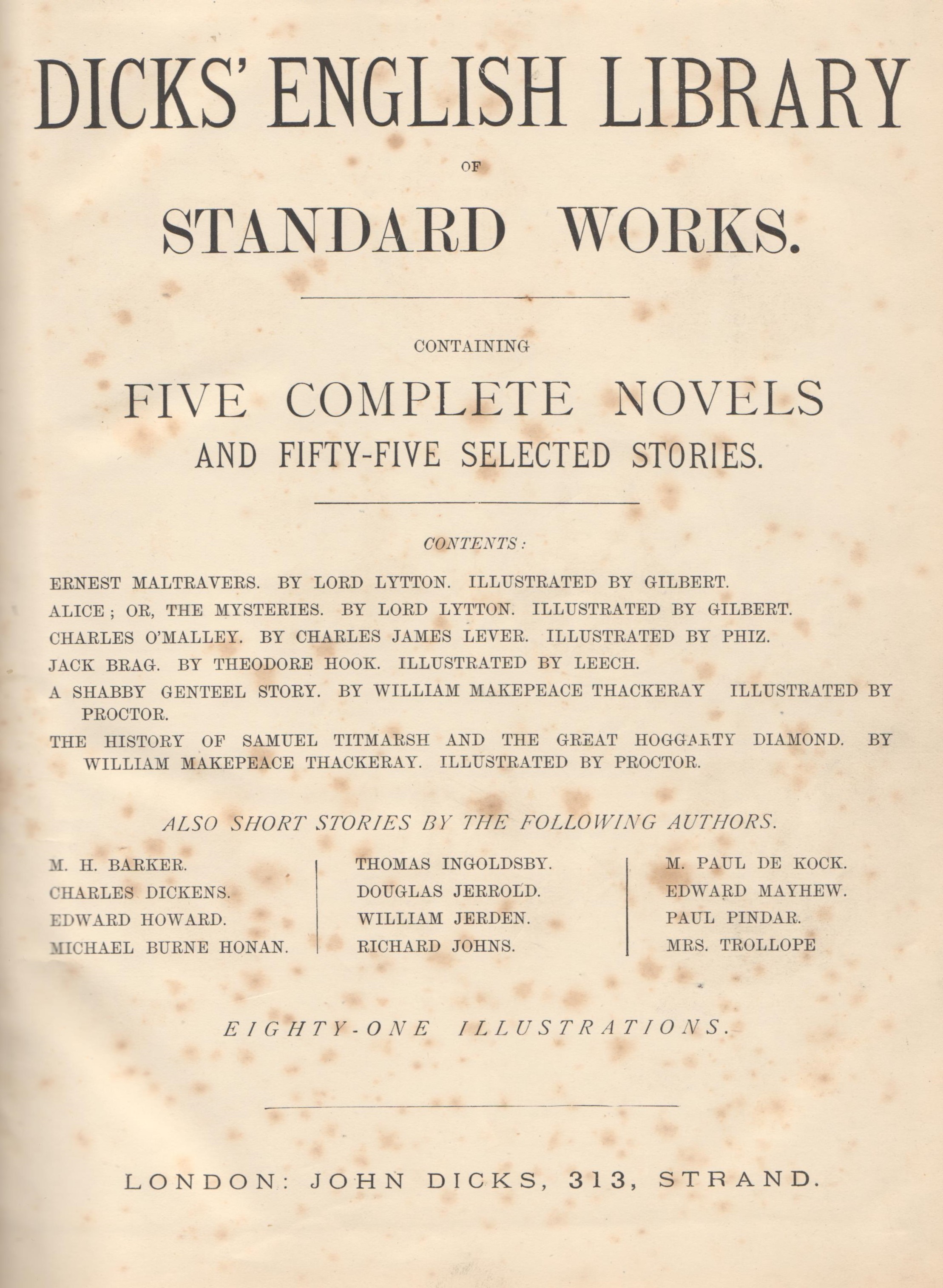
John Dicks, Publisher, and “Dicks’ English Library of Standard Works”

My thanks to Louis James for the gift some time ago of six volumes (bound as 3) plus 10 monthly numbers of Dicks’ English Library of Standard Works and, in anticipation, to Anne Humpherys’ ongoing research on Dicks and reprinting, to which this post is intended as a small contribution.

To both these remarkable scholars this post is dedicated.

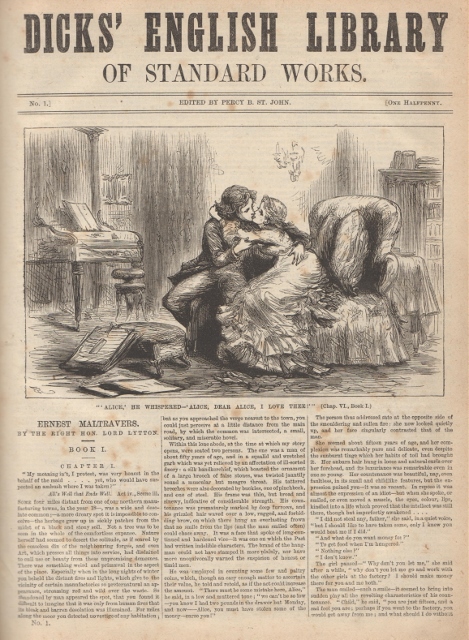
advert of Dicks own reprint series from Dicks English Library March 1884

As William St Claire has assertively reminded us on more than one occasion, the bibliophile connoisseur’s fetishisation of the “original” – the first – edition of texts has often occluded how reprints are actually more valuable in telling us about the cultural penetration of texts. The first edition is always to some extent “experimental” on the market. The publisher may have a good idea of who it will sell to and how how many copies will be shifted but the risk remains that he (for Victorian publishers were overwhelmingly male) may be wrong. Reprint editions still carry this risk of course, but to a lesser extent: the publisher already knows that the first edition or, indeed, the many previous editions, have sold and how quickly, and may even have evidence about who bought it, how the critics understood it, and so on. To that extent the risk is less. But reprints can also be aimed at radically different markets, as when Ouida is repackaged and sold in 6d form at the end of the century. The launch of a text in a new market may meet with considerable success, or it may not, so we cannot say with absolute conviction that reprinting involves less risk than first printing.

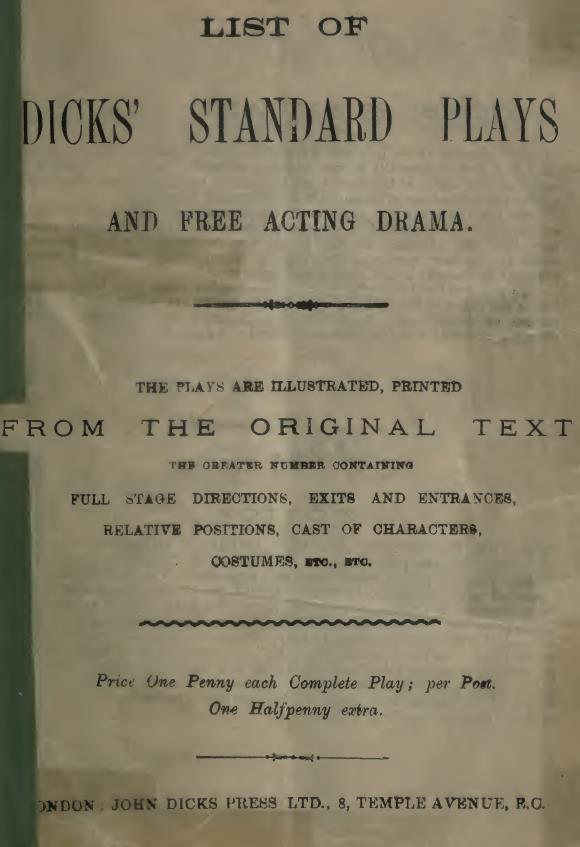
List of Dicks’ Standard Plays, c. 1884

Anecdotally, one of the best selling series of reprints of the latter part of the nineteenth century comprised a periodical entitled Dick’s English Library of Standard Works. This was issued from one of the most successful London publishing houses of cheap fiction, John Dicks, on which there is almost no work at all outside an excellent volume privately published in 2006 by a descendant of the founder (Guy Dicks, The John Dicks Press, Lulu.com). Nonetheless, Dicks is certainly well known as a name not only to students of Victorian popular reading, to whom Bow Bells (1862-1897), Reynolds’s Weekly Newspaper (1850-1967) and Reynolds’s Miscellany (1846-1869) along with Reynolds’s Mysteries of the Court of London  (1849-1856) are all familiar, but also students of the Victorian theatre, for without the over 1,000 “Dicks Standard Plays” (published at a penny each between 1864 and 1907), many theatrical pieces would not be available to us at all.

John Thomas Dicks was born in 1818 and entered the London printing trade aged 14 or 15 “in a very humble capacity” (says the Bookseller in its obituary of Dicks, 3 March 1881). Around 1841 he became “assistant to P. T. Thomas, the Chinese scholar, who at that time was carrying on the business of publisher, printer and stereotyper to the trade on Warwick Square”. In the mid 1840s he started to be associated with  G. W. M. Reynolds and in 1863 seems to have amassed sufficient capital to set up as a printer and publisher at 313, Strand, London, where he entered into formal partnership with Reynolds.  After Reynolds died in 1879, Dicks bought his name and copyrights from his heirs for a very considerable annuity.

A major part of Dicks’ business, however,  already comprised reprinting which he organised into several  series, including “Dicks’ Complete Shakespeare,” and of course “Dicks’ Standard Plays” (see the first illustration in this post).

A measure of Dicks’s commercial acumen is suggested by  his death (in 1881) at his villa in Menton, a resort in the south of France where the European and Russian nobility kept their winter villas. Dicks also had a large house, the Lindens (which no longer survives except in the name of a post-war housing estate), in the exclusive west London suburb of Grove Park, Chiswick (the location was not accidental, for not only does the nearby railway station go to Waterloo, from where Dicks could cross the river easily to his office, but census data reveal that his wife was born in Hammersmith, the next suburb east of Chiswick). His estate, valued at “under £50,000” – a very considerable sum –  was left to his widow Maria Louisa and his sons Henry and John (see Ancestry.com. England & Wales, National Probate Calendar (Index of Wills and Administrations), 1858-1966 [database on-line]. Provo, UT, USA: Ancestry.com Operations Inc, 2010).  Clearly, cheap publishing and reprinting could be a very profitable business indeed.

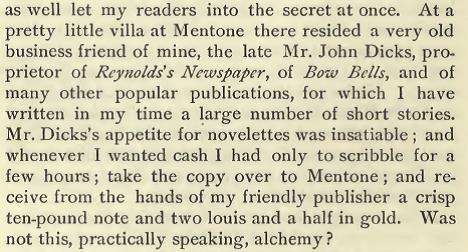
The indefatigable journalist, gossip and bon viveur George Sala has an amusing anecdote at Dick’s expense, however, suggestive of how despite almost all authors’ interest in money, financial and cultural capitals might be inversely proportional to one another. It’s part of a longer story about his encounter at Nice with a “Captain Cashless”  –“ middle-aged, good-looking, well-preserved…  spent most of his money before he came of age; lived for several years on the credit of his credit; is a widower and spent every penny of his wife’s fortune” (Life and Adventures of George Augustus Sala, volume 2: 293). The Captain cannot understand where Sala gets his money from, but Sala feels he might…

Sala, Life and Adventures, Cassell, 1895, vol 2: 294

Sala lets us know that he can just toss off this profitable magic, turning the lead of his scribbling pencil into financial gold he can spend (and no doubt dispend) in Monte Carlo with his friend the glamorous rake. His methods of income generation and expenditure here seem to mirror one another in their low “real” value: both are fun, light, silly, worthless entertainments; good times, easily come by, easily left; in all Victorian senses, “fast”. In an analogue of the bibliophile connoisseur’s dismissal of the reprint as repetition, Sala dismisses his tales as the result of iterable alchemical formulae or repeated tricks of prestidigitation he has learned in the trade. Yet besides their illustration of the distance between cultural and financial capitals, such stories by their very comedy can hide from us the very serious business sense that lies behind them. It’s not that the fun is deceitful – on the contrary, without it there would be no commercial success – but that it is only one side of the coin.

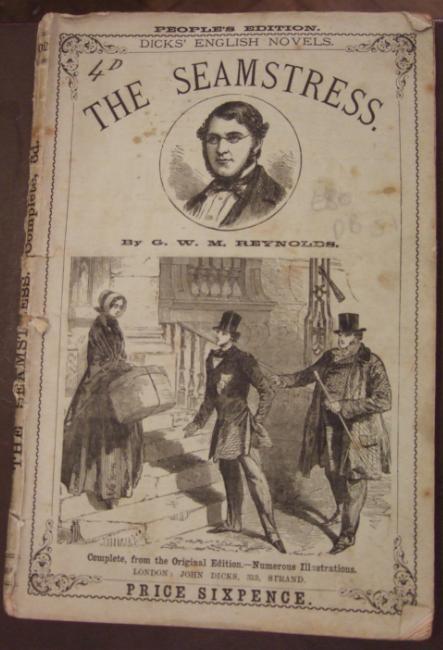
Dicks English Novels no 102: G.W. M. Reynolds, The Seamstress

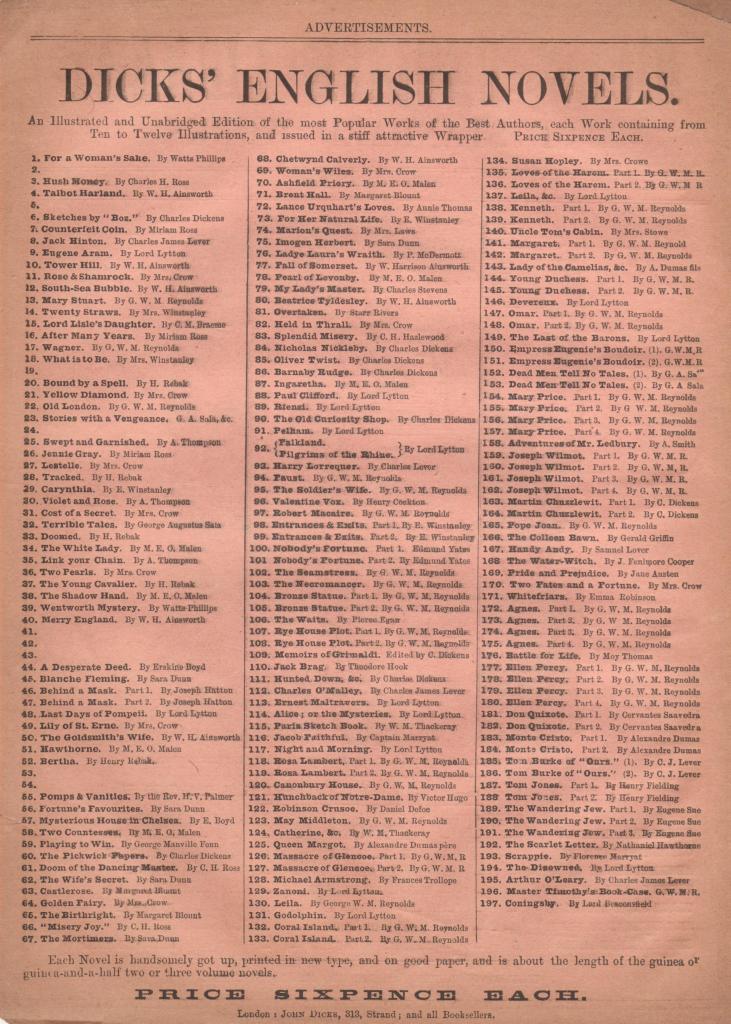
 Turning now more specifically to the reprinting side of Dicks’s business, in the 1870s  a series of 6d volume-form reprints under the generic title “Dicks’ English Novels,” began to be published: they cost 6d and seem to have started as reset versions of novels originally serialised in Bow Bells. They also recycled the original illustrations. Many other novels were soon added, including, after the copyrights had been secured, works by G.W.M. Reynolds (see the image on the right for an example). In the end almost 200 titles were published in this series (more of which below). It was so successful a second series was begin in 1894.

After his death, Dicks’s sons developed the reprint with Dicks’ English Library of Standard Works, a periodical consisting entirely of the  serial re-issue of well-known novels. It came out in the usual 3 formats: weekly comprising 16 pages with four illustrations (costing 1/2d); monthly, consisting of the weekly numbers for the month costing 3d, in orange covers comprising mainly adverts; and in volume form of 416 pages plus title page and frontispiece costing 1/6. “Dicks’ English Library” was a quarto – the same size and format as most 1d or 1/2d periodicals such as the London JournalBow Bells or Reynolds’s Miscellany – and was first published on 27 June 1883. It ran for 38 volumes right up to 2 March 1894 whereupon (just as with Dicks’ English Novels”) a new series was started. Percy B. St. John was the editor of the first few volumes.

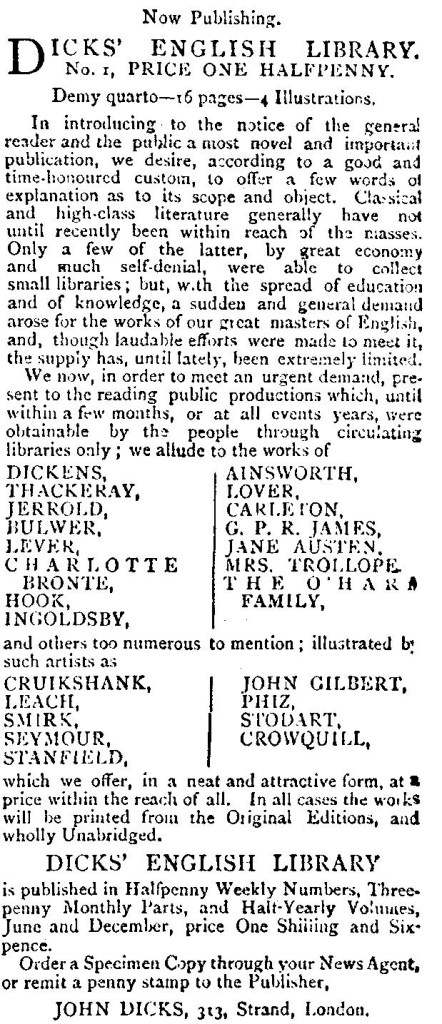
A typical announcement for the periodical can be seen here, justifying its publication not (of course) in commercial terms but in those of Whig public utility  that could have come from the 1830s. (The following is from the Pall Mall Gazette, but similar adverts were placed all over the press)

The Pall Mall Gazette, 21 June 1881: 15

Besides the  list of authors above and the more obvious suspects in the world of Victorian popular fiction – G.W.M. Reynolds, Bulwer Lytton, Charles Lever, G.P.R James, Captain Marryat, Paul de Kock and Dumas ‑  also included were Mary Shelley’s Frankenstein (and Percy Bysshe’s Zastrozzi, both illustrated by the well-known illustrator Frederick Gilbert – Shelley’s complete “Poetical Works” are published later in the series), Maria Edgeworth’s Belinda, Austen’s Sense and Sensibility, Hawthorn’s Scarlet Letter and Godwin’s Caleb Williams. Most intriguing (not least from the point of view of copyright) is the heavy presence of Dickens, including, later on, Dombey and Son as well as numerous individual tales.

The reissue of these texts cannot be taken to be an unalloyed index of popularity amongst the readers of cheap publications. The Dicks firm is clearly aiming at respectability and the aspirational reader keen to build up that sign of cultural capital, a “library” – the page numbers of each weekly and monthly number are incremental, asking the reader to keep them so as to build up the volume. The Shelley poetry may have been suggested by the revival of interest in him amongst the literati with Rossetti’s Moxon edition in 1870: it is a mark of what the public should aspire to rather than of already extant popular demand. Publication in this form is no indication that any particular author was read unless the author’s other works are also issued, and even then business reasons other than consumer demand may have prevailed – for example, copyrights might have been bought as a job lot in advance, and accordingly had to be exploited, or there were vacant pages that had to be filled with works whose copyright had lapsed. One also has to take into account what other works were serialised with, before and after any particular text, for it may be any or all of those that carried the periodical through rather than the particular text one is looking at.

What one also has to do is try to establish the publishing history of a series. Adverts are always useful for this and one on the monthly cover of “Dicks’ English Library” (October 1888) shows that by then 197 titles had been published in the “Dicks’ English Novels” series for example. The missing titles were presumably exhausted, but they can be identified by reference to other adverts elsewhere, either in other publications or earlier in the series (cf. the following with the first image of this post).

advert of Docks own reprint series from Dicks English Library March 1884

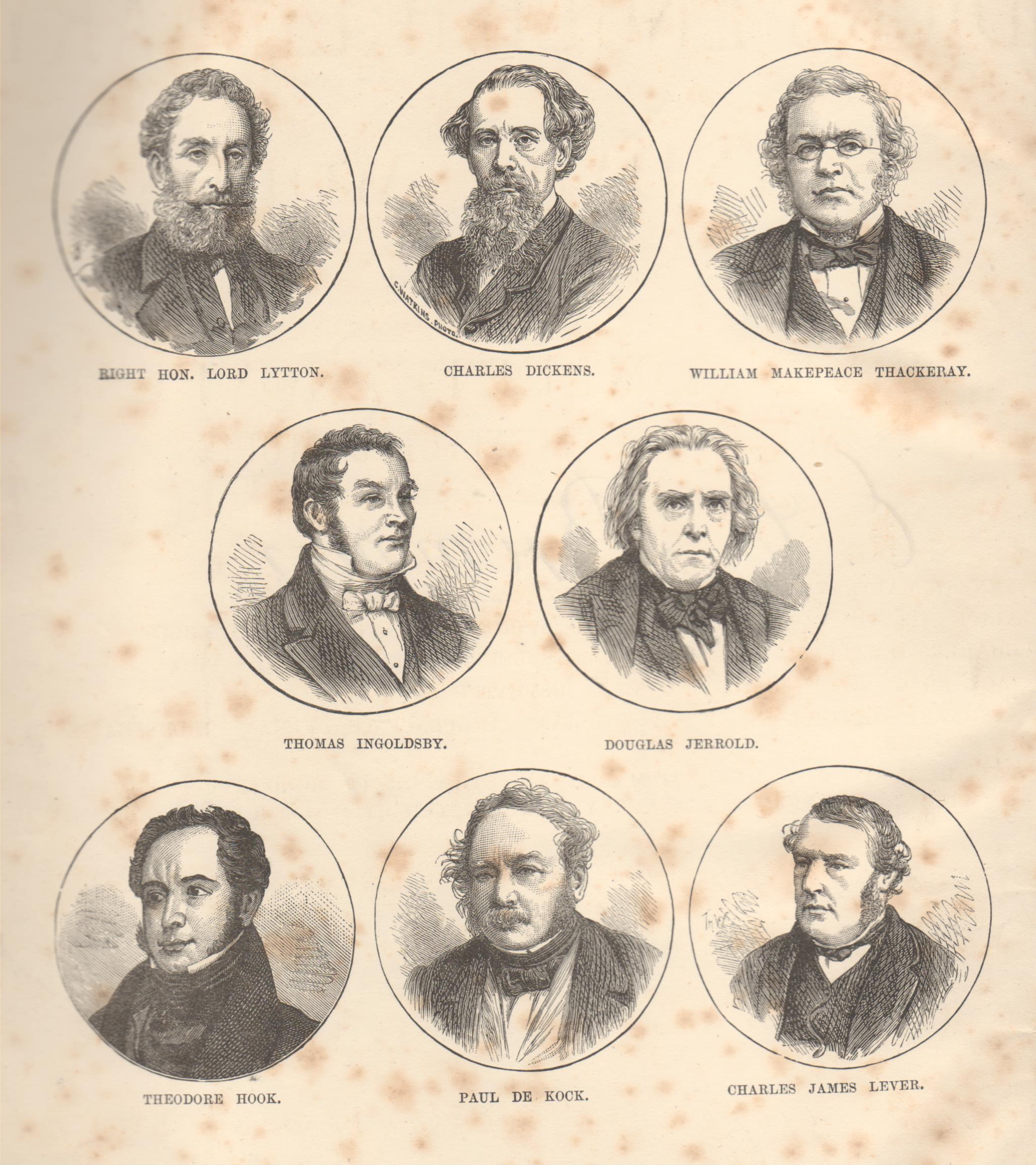
The history of the Dicks reprinting series has yet to be mapped: even a basic bibliography is lacking. After that is done, one of the many questions that can be answered concerns the relations of synergy between the various publication forms: for example, how far did the English Library reprint works previously available in the volume-form English Novels series? More complex questions can also be addressed, including the implications for the history of the canon, its creation, modification and its reception – if any – of the publishing choices of  this financially rich but status-poor house. The use of a garland of portraits of authors as a frontispiece for “Dicks Standard Library” suggests the prioritisiation of some authors over others: this prioritisation needs to be charted and compared to the number and positioning of authors actually published (a front-page author is lent greater prominence than one whose work starts on a middle page, for example).

These, and many other questions about this most interesting publisher, still await answers, and we look forward to them in due course.

Hollywood’s Grandmas Part 3

There is no sustained recent work on either Harriet or Leon Lewis, although there is a brief post on the both at http://www.ulib.niu.edu/badndp/lewis_leon.html and another on Leon (whose real name was Julius Warren Lewis) at John Adcock’s Yesterday’s Papers site.  Harriet has not benefited from the recent revival of Southworth and other American women writers. Most of the information about her in my London Journal book therefore came from the letters in the Bonner file in the New York Public Library. Brief obituaries of Harriet appear on 21 May 1878 in The New York Times (p.1), and The New York Herald (p.5) and a particularly affectionate one in the New York Ledger itself (4 June 1878, p. 4), largely devoted to reproducing extracts from Harriet’s last letter to her editor Robert Bonner, with whom she entertained a very good relationship.

Leon and Harriet had married in 1856 when she was 15 and he 23 with already a very colourful career behind him. Leon was to run off with another 15 year old soon after Harriet died, aged 37, of a botched gynaecological operation). The copious letters from Harriet and Leon suggest that Leon blusteringly carried on the business and squandered their money while she laboured over the novels – including some under his name.

Yet it is a letter from Leon to Bonner that is particularly interesting for its revelations of how American writers dealt with the transatlantic market.

9 April 1873

Dear Mr Bonner

We hasten to return by first mail the London letter and to reply to the question with which you accompany it.

You refused us the proofs 4 years ago, saying (in substance) to Mrs L. that if she were to have them she would be likely to give undue prominence to the thought as to how the stories would suit over there, etc. (which, by the way, was a mistaken estimate of her character).

We or you or all of us have consequently had some $1500 or $2000 yearly less income during the period named than we might have had. Mr Johnson, of the London Journal, and others have repeatedly written to us to this effect, but we never replied to more than one in ten, and then only to say (you having refused us proofs) that they were not at our disposal, etc.

The next thing in order of course were offers for original stories – i.e. for manuscripts – but a like answer was returned, although the offers made exceeded any sums that had ever been paid anywhere by anybody for anything in the line of stories.

And under this state of things it became a question with Sunday English publishers as to which of them would derive the most benefit from republishing from the regular Monday Ledger Mrs L.’s stories.

That is a race of printers of which we do not propose to constitute ourselves the time-keepers. We can do no less, however, than except Mr. Johnson, of the Journal, from the general condemnation. True, he reprinted the stories without authority and without paying for them – (since he could’nt [sic] have them for pay) – but he has done so under certain conditions which command attention from their rarity:

1st – He has given the name of Mrs L. and even given her a standing qualification of “celebrated American authoress”

2nd – The London Journal is of ten times more literary importance and pecuniary value than all the rest of the story papers of the British Empire kingdom [sic] put together. The sum of $3,750,000 (£750,000) has been vainly offered for it to our own certain knowledge. [Here an unidentified extract from a book or magazine is pasted into the letter claiming the excellence of The London Journal. The sum Leon quotes is absurd]

3rd – During our stay in London in ’71, (as we must have told you upon our return) Mr Johnson called upon us at Morley’s [Hotel], offered us every civility, private boxes at theatres, invitations and introductions, etc. and upon the last day of our stay pressed upon Mrs. L a roll of bank [sic] of England notes, as an acknowledgement of the good he had derived from the stories, even in the face of sharing them with everybody else and under all the adverse circumstances – at which time he renewed his offers for proofs, as also for stories written expressly for him.

And now is this Mr Fiske [Amos Kidder Fiske (1842-1921), editor of the American fiction paper, The Boston Globe] more to you than we are that you should “aid and abet” him with the proofs you have so expressly refused to us, and so drag our names into a wretched squawk of a paper that could not possibly last three months, and during this period exist only in obscene contempt? After all you have been to us and we to you – after all we know of your heart and brain – we shall require your written declaration of preference in favour of Mr. F. before we will believe it!

Excuse scratches. We write in haste to catch the mail.

Ever yours,

Leon and Harriet Lewis

For all Leon’s protestations, The London Journal must have been supplied with advance copy of Harriet’s novels since 1869 (when Leon had first asked Bonner for proofs of her novels). Even more consistently than Southworth novels, Harriet’s appear in the New York Ledger and The London Journal at the distance of only a few weeks at most – anyone could work out that for that to happen advance sheets must have been sent across the ocean. No wonder Leon doesn’t want to be a timekeeper in what he calls the “race of printers” – Bonner no doubt had already made his calculations and come to the logical conclusions.

Leon’s also anxious to redefine the tag he claims The London Journal gave to Harriet. This was – he’s right – placed under her name in all of her novels  until Edda’s Birthright, published in The London Journal and the Ledger 3 months after Leon wrote the letter transcribed above. But the tag of “celebrated American authoress” was only part of a longer notice. What the notice actually said was that The London Journal’s was “[t]he only edition in this country sanctioned by this celebrated American authoress”. The full tag was less a celebration of Harriet than an assertion of right.

The tag had been prompted in the first instance by the appearance of Lewis novels in The London Reader, a magazine run by no less than George Stiff, the former owner of The London Journal, from right next door. While almost all London Reader serials are anonymous and with altered titles and sometimes names of principal characters changed, it’s hard to trace the originals, yet it had carried novels with Leon’s signature in 1866-7 (The House of Secrets, 4 August 1866 – 12 January 1867) and in mid-1867, followed by one with Harriet’s, The Golden Hope. More recently, the Reader had somehow published The Hampton Mystery, a version of Harriet’s first novel in The London Journal, The Double Life; Or, The Hampton Mystery a fortnight earlier than the magazine which was published literally next door, The London Journal – which was, it seems, now forced into declaring that it alone had the only sanctioned edition. Since the original had been published in America at exactly the same date as in Reader, it was impossible for Stiff to obtain a copy and put it into print by anything other than advance sheets. Later, Harriet’s Tressilian Court (1871) will likewise appear in The London Reader a week before The London Journal’s version, and Lady Chetwynd’s Spectre (1873) at exactly the same time.

What’s happening here? One possibility is that Stiff was raiding the mail intended for his former magazine and now rival next door. While he’d certainly done this sort of thing before, there are other possibilities too.

It is clear from the Bonner letters that Leon was a spendthrift and a gambler. After Harriet had procured fame and a good deal of money for them both since first appearing in the Ledger in 1862 (aged 15 and already married to Leon), he had sunk very deeply into debt. Bonner, who was clearly very fond of Harriet, kept lending the Lewises money which she would pay back by writing several serials simultaneously for him under both her and Leon’s name (romances under hers, adventure stories under his): eighty-one numbers spread over five novels managed to pay off $6075 at half rates. It seems to me very likely that the Lewises sent The London Journal AND The London Reader – and quite possibly other magazines that I have yet to discover –  advance copies of Harriet’s works to increase their already huge but always insufficient income.

What I’ve hoped to show in this and the previous blog posts is that in the cases of these three women – May Agnes Fleming, E.D.E.N. Southworth and Harriet Lewis – one cannot talk of “piracy” in the sense of a foreign publisher robbing an author. Two of the women had “exclusive” contracts with their American publishers which they broke quite legally by dealing also with publishers in Britain. Even when apparently straight piracy occurred, as with some novels by Southworth and Fleming, the writers still benefited from this in the end.

As we have come to realise more and more, nineteenth-century women writers were by no means all victims of a male publishing establishment. These three indeed, through translation, achieved a global circulation far beyond the transatlantic anglophone axis that I have focussed on here. In that sense they prefigure Hollywood by a good two generations – they are Hollywood’s grandmas indeed. The implications of that must await another set of posts.

Hollywood’s Grandmas Part 2

In 1855, Robert Bonner of the New York Ledger (NYL) started serialising “Fanny Fern” (Sara Payton Willis). He advertised that she was paid  $100 per column so that readers could gauge the exact amount she got paid – and could value her writing accordingly. It was at this point that sales – and the profits – of the NYL rose to unprecedented heights. This sent a clear signal across the Atlantic that America, with whom a copyright agreement still did not exist, could now provide rich and proven fodder for the cheap periodical market. The result was that The Family Herald pirated Fanny Fern’s two serial novels from NYL in 1855-6 and other papers widely plagiarised and imitated her columns.

portrait of Southworth from Sarah J. Hale, ed. Woman’s Record (1853), p. 794; also 1855 ed. from http://www.librarycompany.org/ women/portraits/southworth.htm

The London Journal, The Family Herald’s main rival, didn’t want to publish the same thing at the same time and so researched the American mass market. It discovered a tale called The Lost Heiress that the Saturday Evening Post had just published. The London Journal started running it a month after Fanny Fern’s novel had begun in The Family Herald, having changed the title from The Lost Heiress to The True and False Heiress. It published the serial anonymously until its very last episode, when it revealed the author to be E.D.E.N. Southworth. The serial was apparently very successful.

Back in America, this was noticed by Robert Bonner who invited Southworth to write exclusively for the New York Ledger. She started her series of exclusive” novels for him in 1857 and became one of the most widely read and reprinted authors of the entire nineteenth century. This in turn caused the Ledger’s sales to rise ever higher and The London Journal and other penny periodicals to print more of her stories.

As for why I’ve put 1883 as the terminus of my study you may think that’s curious when copyright plays such an important part in my narrative and the US started regulating international copyright in 1891. But two of the authors I’m focussing on were dead by then – and there are reasons why Southworth appeared in the British mass market periodical much less after 1868. When in 1883 The London Journal made the serious mistake of trying to serialise Zola and lost a large number of readers, they chose to rescue the situation by serialising a Harriet Lewis novel even though she had died 5 years previously. What the original of that novel is I haven’t been able to establish. But I can say that as far as I been able to discover, it hadn’t been published in Britain before and that her name was considered a remedy for the ills of declining circulation. It’s possible of course that she never wrote the London Journal serial: they might have only added her famous name to it. Be that as it may,  what appear in Britain are only reprints of works by these three women. 1883 therefore marks a watershed insofar as works new to the market are concerned.

The above is all background to the question I really want to address in these three blog posts which is whether the literary property of these American women was “pirated” – stolen morally (if even if such action was legal) – by the British periodicals.

To answer the question is actually rather difficult, for it depends partly on the definition of the term “piracy” and partly on information that is lacking. There is little doubt that Uncle Tom’s Cabin and Fanny Fern’s writings were pirated in Britain in the same way that the French novels of Sue and Dumas had been in the 1840s. But the cases of the writers I’m talking of present complications.

While I only want to talk of the three novelists in The London Journal I’ve mentioned, May Agnes Fleming, EDEN Southworth and Harriet Lewis, they will provide varied examples of how American women writers were not simply melodramatic victims of wicked men in Europe. Rather I’ve found that, unlike Isabel Archer in Henry James’s Portrait of a Lady they could actually benefit from and actively manipulate the system of transatlantic cultural exchange.

image from http://content.lib.sfu.ca/cdm/ singleitem/collection/ ceww/id/385/rec/18

First then, May Agnes Fleming. Her first two novels in The London Journal were pirated in a quite straightforward sense, yet this surprisingly worked to her advantage. In 1868, Fleming had signed an exclusive contract with the Philadelphia fiction weekly Saturday Night. The following year The London Journal took from it a novel originally called The Heiress of Glengower, renaming it The Sister’s Crime and publishing it anonymously. Several papers in America pirated it in return, unaware that it was already copyright in America. It was so popular that when it was legally stopped in the American papers, a “bidding war” for the author resulted. The outcome was victory for Fleming: she accepted the offer of the New York Weekly which immediately tripled her income, later signed a contract that gave her 15% royalties on the sales of her novels in volume format, and, from 1872, made an arrangement to send The London Journal advance sheets for £12 per instalment. Altogether, this gave her $10,000 a year. She didn’t do too badly out that initial piracy.

E.D.E.N. Southworth’s relation with The London Journal was even more complicated. Her first three novels in the magazine were pretty certainly pirated and, like Mrs Stowe before her, she came to England to stop this – for residence in Britain gave copyright protection. However, in the year Southworth came, 1859, although she was under exclusive contract to Robert Bonner, she must have arranged to give advance sheets of her most famous novel, The Hidden Hand, to the former owner of The London Journal, George Stiff, as it appeared in another magazine of his, The Guide, only a week after it came out in the New York Ledger. When Stiff rebought The London Journal he continued his relationship with her. The next year, 1860, The London Journal would publish two more novels by Southworth again only a week after their New York appearance. Hypocritically, in an open letter to readers of the Ledger (10 March 1860) Southworth had just complained about being plagiarised in Britain . In 1861, a novel of hers even appeared in London before it came out in New York (Eudora).

Sailing ever closer to the wind, she wrote Captain Rock’s Pet especially for The London Journal. After this, none of her novels appear in it for two years. Stiff had again sold The London Journal and instead, some of her novels appear in his new magazine, the London Reader anonymously. The next Southworth novel in The London Journal, Sylvia (1864), was probably pirated, as it is a version of Hickory Hall, a serial that had appeared in the National Era in 1850. But such is impossible in the case of her next three novels in The London Journal, Left Alone, The Manhater and The Malediction. These again all appear either a week before or a week after they are printed in the Ledger. Southworth’s last novel in The London Journal, The Double Life (1869), is a version of another National Era serial from twenty years previously, which may again suggest piracy. Perhaps Bonner prevented her from sending more advance sheets. Southworth wrote a particularly strong declaration of loyalty to him dated 12 January 1869, which may be read as finally accepting that she really was under exclusive contract to him. Perhaps it is because of this that The London Journal turned to another and younger New York Ledger staple, also under supposedly exclusive contract to Robert Bonner, Harriet Lewis.

Hollywood’s Grandmas Part 1

An enormous amount of work has been done on the global circulation of culture via electric and electronic media, but it’s becoming realised more and more that there was a set of narratives and imagery shared globally in the nineteenth century too. What I want to do over the next few blog posts is to mark the commercial importance of serial novels by American women writers to a specific but huge sector of British mass-market fiction between 1855 and 1883.

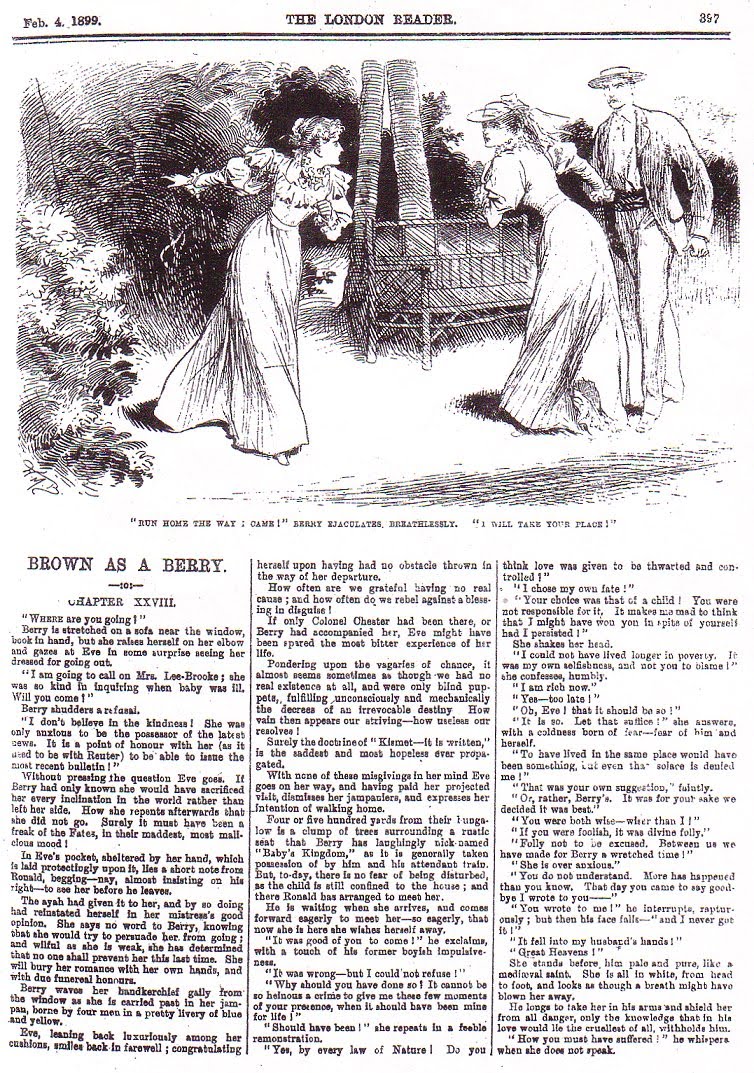
from The London Reader 1899; my thanks to John Adcock's splendid blog for this image

Key to the idea of “commercial importance” is whether the stories these women wrote were pirated or paid for by the British publishing industry. As we know from Dickens, the issue of transatlantic piracy was very important to writers. American publishers waiting at the dockside for new British books could produce an edition almost within hours, as they did in 1823 with Sir Walter Scott’s Peveril of the Peak. In the absence of international copyright agreements, the British author usually received nothing, although Harper Brothers, for instance, paid considerable royalties to Dickens and Macaulay, among others, and later on in the century Lippincott was generous to British authors he published, including Ouida. Accounts of British pirating of American serials commonly refer to how about 1.5 million copies of Uncle Tom’s Cabin were published in Britain without Harriet Beecher Stowe’s consent, but not much else. In fact there was a huge trans-Atlantic exchange.

I’m not going to write about well-known cases here. Furthermore, rather than talking of the piracy of books (quite expensive at the time) , I’ll focus on serials in cheap fiction magazines. Instead of the high-profit-per-unit-sold model which books operated on, penny periodicals made profit through the quantity sold. Most mid-nineteenth-century British mass-market fiction was published according to the latter model in penny weeklies such as The Family Herald, The London Journal, Reynolds’s Miscellany, The London Reader and so forth. America had its analogues in 4 cent weeklies such as the New York Ledger and the Philadelphia-based Saturday Evening Post. The circulation of all these magazines was enormous, with sales in the 1850s and 60s of 500,000 each (Dickens at his most popular, remember, managed 40,000). Given the usual calculations that are used to calculate readership from sales, in 1860 just the three best-selling magazines amounted to a 50% penetration of the entire population of Britain. Given that then the literacy rate in Britain was around 60%, that means that c. 83% of the literate population of Britain was reading one of these three magazines. The analogous American magazines had comparable sales figures, though given the much higher literacy and population of American – some 31 million as opposed to 19 million in 1860 – their percentage penetration was actually rather lower, if still hugely significant.

Example of a typical cover page of The London Journal

If what I’m saying is not as well-known as it should be it’s because, despite a few academic studies (most recently of American women writers), there are no bibliographical guides or descriptions of any of these periodicals. Some are available through ProQuest’s Periodical Archives Online but one still needs a bibliographical map to find one’s way around. Unless one knows what to look for one cannot find it.  Hence the importance of aids such as the Victorian Fiction Research Guides.

The points I am making come out specifically of my bibliographical mapping of primarily the British mass-market: what I found was that I also needed maps of the American and even Australian mass markets too. A focus on one does not give an adequate picture of how the market operated.

That said, in the British market there was a quite strict form of market segmentation along national lines. While some penny periodicals such as Bow Bells, Reynolds’s Miscellany and The Family Herald gave consumers mainly home-grown British fiction, there was another set that from 1855 offered stories written primarily by a mixture of American women and British men. This set comprises three closely related magazines: The London Journal, its offshoot The Guide, and its rival from 1862 The 7 Days Journal renamed in 1863 as The London Reader. These published a very large number of serials by three American women authors: E.D.E.N. Southworth, Harriet Lewis and May Agnes Fleming. The London Journal alone published 237 serials of various lengths – some in fact lasting only a few episodes. At least 50 of these serials, all of them long (and sometimes very long), were by 4 American women: 2 were by Caroline Lee Hentz in the mid 1850s, 13 by Southworth between 1855-1868, at least 22 serials by Harriet Lewis between 1868 and 1883, and at least 13 by May Agnes Fleming over the same period (I say at least as some are not attributed and others which are given signatures I haven’t been able to trace elsewhere).

While Southworth and Fleming have recently become visible again through the work of Nina Baym, Lorraine McMullen and others, it is Lewis in fact who has the largest number of novels published in this market sector as a whole, not just in The London Journal though she is most dominant there. Indeed, there is not a single number of The London Journal without one of her serials for 12 years from 1868, a succession of tales halted only by her death. When I discovered from perusal of her letters that she wrote a large number of serials that appeared under husband’s name Leon and his pseudonym “Illion Costellano”, her market share rose even higher.

The Uncle Tom mania in Britain over 1851-2 is well known and Louis James has pointed out the importance of American fiction in the 1830s British mass market. Susan Warner’s Wide Wide World (December 1850) and later Queechy (1852) had considerable sales on both sides of the Atlantic. Maria Cummins’s The Lamplighter created a sensation in 1854 with sales of 40,000 in its first 8 weeks and 70,000 in its first year. But it’s 1855 that is the key date for the beginning of a sustained massive import of American women writers into the British mass-market periodical. That year Margaret Oliphant realised the potency of American fiction in the “sensation” market and the Saturday Review commented on the popularity of American women writers early the following year.

There are several reasons for stressing 1855.

First, there had been recent changes in the law of copyright in Britain. In the 1840s, France had been seen as leading the way in mass-market periodical fiction, and British publishers mercilessly pirated French serials. The economics of mass-market publishing in Britain meant that there was no money to pay authors much: publishing translations of French works already known to sell well was a much safer speculation than publishing work that was untried in the market. But in 1852, there was a change in the copyright agreement with France. Now no longer could publishers in Britain simply take and translate a French work without paying the author. Fortunately, this was also the period when home-grown British writers such as J.F. Smith, Percy B. St John and Pierce Egan the Younger were selling so well there was enough profit on sales to pay them quite well, but of course it was still more profitable to publish works you didn’t have to pay for – and that would also sell well. The problem was now where to find them.

The Summer of 1871: Ouida and Wiertz

continued from previous blogs on Ouida and Mario and Ouida and Bulwer Lytton

When Ouida stopped in Brussels her encounter with the paintings of the recently deceased Antoine Wiertz provoked her into an explicit and public aesthetic statement. In a previously overlooked article in the shilling monthly London Society, Ouida offers a portrait of Wiertz as ‘the ideal artist … [whose] life was consecrated to one passion, and that passion—Art.’

The major concern for Ouida in this essay is conventionally Ruskinian – an interesting departure from her satirical view of Ruskin and Ruskinianism in her early two-part short tale “Beatrice Boville” . Her target is the deleterious effect on art of industrialisation and commercialisation. Only the artist who gives in to them will gain public acclaim she  says. But public acclaim is by no means the most important criterion of value. Wiertz remains unknown and created no school, says Ouida, because, believing that ‘gold was the murderer of art,’  and ‘a cancer in the breast of humanity’ (‘un cancer [sic] au sein de l’humanité’), he refused to enter the commercial and industrial marketplace. ‘Exalted on the heights of a superhuman purity of purpose and idealism of belief, he had no common bond of connection with the sheer materialism and venal practices of the modern world.’ Wiertz was an anachronistic figure, having more in common, Ouida continues, with the artisanal aims and practices of Italian renaissance artists and of Rubens than with an era in which ‘the colours are bought ready-mixed, the oils are indifferent, the varnishes are adulterated…’  Out of time and out of place, his whole life was a martyrdom. Indeed, Ouida ends her essay with what appears to be a facile comparison of Wiertz to the type of all martyrs, Christ.

They say that when he lay there, lifeless, the peace refused to him throughout his arduous years came on him at the last; and that when the summer sunrise streamed through the ivy shadows of his casement in the glory of the morning, his face was as the face of his Christ ‑ his Christ, who brake asunder the bonds of the grave and rose triumphant in the power of God.

Antoine Wiertz, Triomphe du Christ

Is Ouida simply promoting in commercially commonplace terms an artist who refused to do so himself – in other words treating Wiertz as the very object of commerce that he refused to become in life? She is doing that, of course. She presumably is getting paid for this article (unlike for her letter to the Morning Post  I mentioned in a  previous blog) but she is also imagining a Wiertz that has created himself in the image of his own art.

In Ouida’s vision he has managed to overcome after death the alienation from his labour that he had increasingly felt in the last part of his life: in death he returned to become what Ouida regarded as one of his own best art works, the earlier Triomphe de Christ. To show that, Ouida has drawn for us a word picture of his head that Wiertz himself, the artist of horrible decapitations, might have painted had he stuck to his original principles.

Throughout the second half of her article, Ouida criticises late Wiertz for too great an emphasis on the horrible. Instead, she says, Wiertz should have concentrated on the ‘intrinsically beautiful by proportion, by colouring, and by meaning’ as he had done in his earlier works. It is as if her conclusion were restoring to Wiertz the self Ouida felt he should have been. In some senses too, Ouida’s most famous short story, ‘A Dog of Flanders’ which dates from this time, is also a gift to Wiertz of his lost identity: the underdog hero Nello, like Wiertz, came from a very poor background, was self-taught and, when he came to Antwerp, was ‘entranced and subjugated’ by the Rubens altarpieces in Onze-Lieve-Vrouwekathedraal in Antwerp. In this sense “The Dog of Flanders”, like the article, is an analogue of the ivory cigarette case she threw to Mario. She is trying to interpret and give meaning to powerful feelings that art has aroused.

Ouida is conjuring from the dead an anti-sensationalist, anti-commercial aesthetic of the romantic period, where the pen or brush mediates a sincere relation between body and text, and the individual imagination is given priority and autonomy.  Of course in these “restitutions” she’s thinking about herself and the purpose of her own art. Why write about passion? From the early short stories she had excoriated the use of other people to satisfy  one’s own ends and feelings – a conventional enough condemnation of selfish passion. Real love always means accepting the other for what they are and if necessary standing and holding back.  Hitherto, even in the novel about the revolutionary heroine Idalia, the personal had triumphed over the political.

Yet the three encounters I have outlined in these three posts – with Mario, with Bulwer-Lytton and with Wiertz – combined with our knowledge of what comes next – the political and aesthetic celebration of a unified Italy in her next novel– suggest that  Ouida was turning towards and looking backwards to a political, communitarian romanticism as an alternative to a purely commercial art, seeking to give it the gift of life that the Judas kiss of selfish commercialism had betrayed. Was this one the elements in that complex of factors that guided Ouida towards Italy in 1871?

Oscar Wilde certainly recognised Ouida’s romantic lineage in a review of her novel Guilderoy in 1889:

Ouida is the last of the romantics. She belongs to the school of Bulwer Lytton and George Sand, though she may lack the learning of the one and the sincerity of the other. She tries to make passion, imagination, and poetry part of fiction. She still believes in heroes and in heroines. She is florid and fervent and fanciful. Yet even she, the high priestess of the impossible, is affected by her age….

His attribution to Ouida of affiliation to Sand and Bulwer is certainly correct. Jane Jordan (“The English George Sand? Ouida the French Novel and Late Victorian Literary Censorship”, Anglistica Pisana VI/i (2009): 107-16) has discussed the former, as have I, and the three encounters I have described suggest the latter and more.

But is there also  a fourth encounter in 1871, one with a ghostly revenant that has left only indirect and indistinct traces? All I dare remark for now is that William Rossetti’s edition of the Complete Poetical Works of Shelley had come out with Moxon in 1870 – followed famously by Mathilde Blind’s corrections in the Westminster Review – and that 20 years later Ouida was to publish a long article praising Shelley as the best romantic poet because, according to her, he had “the sentiment and passion of [Italy’s] natural beauty” — and because love underlay his vehement political engagement, just as she was to portray the hero and heroine’s in her next novel, the lyric prose poem in praise of Italy, Pascarel. Did Ouida encounter Shelley too in the Summer of 1871, and was this yet another coal in the steam engine that transported her south?  Just as with her enthusiasm for Mario, Ouida would not have been alone in responding to Shelley’s paeans to the visual and narrative pleasures of Italy such as  Julian and Maddalo, a poem much praised by Rossetti in his preface, for

How beautiful is sunset, when the glow
Of Heaven descends upon a  land like thee,
Thou Paradise of exiles, Italy!

The Summer of 1871: Ouida and Bulwer Lytton

(continuation of earlier post on Ouida and Mario in the Summer of 1871)

What “Art” was and its relation to her writing were very much on Ouida’s mind in mid-1871.

We know from surviving letters that in the early summer Ouida had become concerned with the discussions around a proposed Dogs Act which would give any summary court powers over the destruction of stray, dangerous and rabid dogs. Determined to block the passage of this Act, in early June, having already been told that he liked her work, Ouida contacted Edward Bulwer-Lytton to elicit his support. He wrote her a kindly response and thereupon she invited him to visit her at the Langham Hotel where she had lived with her mother since 1867. He came several times, much to her delight.

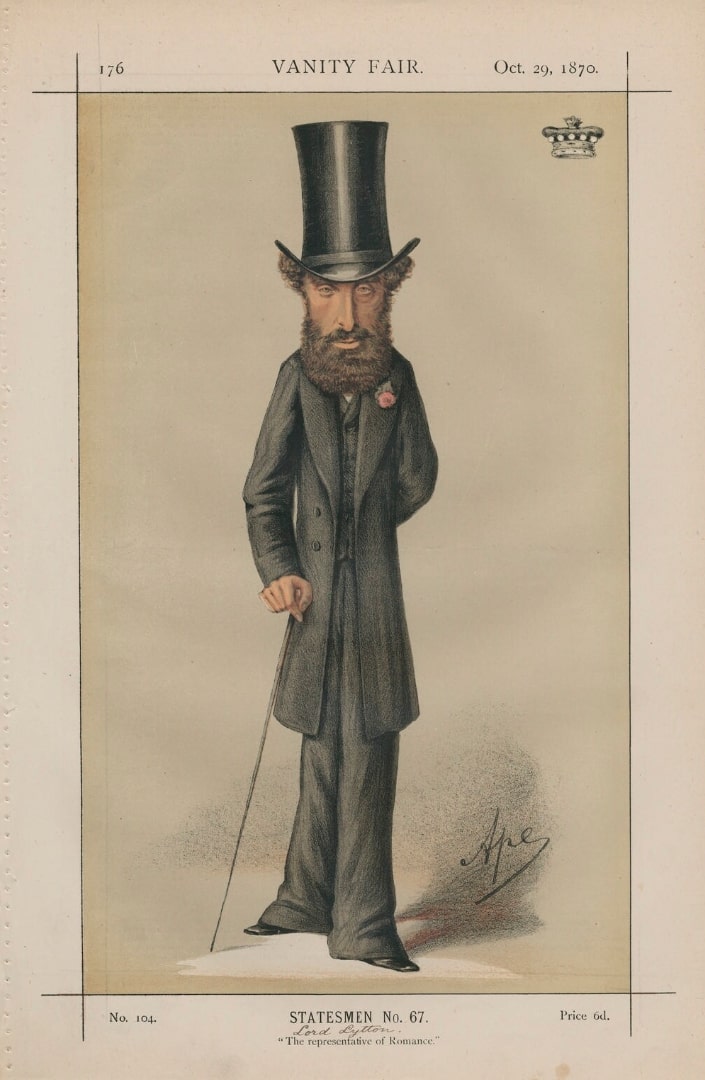
Edward Bulwer Lytton in a Vanity Fair caricature, 1870

Bulwer-Lytton was a key figure in the development of popular fiction. His help to Mary Braddon is well documented, and, though to a much more limited extent, he acted as Ouida’s mentor as well. After she had left London for her tour of the continent, he wrote Ouida a long but positive critique of her latest novel Folle Farine. His letter does not survive, but Ouida’s response to it does. She wrote it at the Hotel de York, Spa (Belgium), the hotel Baedeker and Bradshaw recommended for English visitors to this already faded (though still respectable) resort. Ouida’s letter is keen to associate her novel with ‘Art’ by attributing it aesthetic value through the conventional eighteenth-century criteria of ‘judgement’ and ‘sympathy’ (I always think of Elinor and Marianne in Austen’s 1811 Sense and Sensibility when I think of those). Ouida ends by justifying her exploration of painful emotion and unconventional sexual arrangements as ‘Art’ and the duty of the artist.

It would be terrible to me to think that I had wrought an injury to any Soul, but it always seems to me that the artist has one duty that he must place before all ‑‑ i.e. to seek earnestly for the truth with all his strength & as he beholds it so to endeavour to set it forth.

She was in November to write to Isabel Burton (wife of the explorer, diplomat, orientalist Richard) and, the following year, to the conservative politician, poet and literary patron Lord Houghton that Folle-Farine should indeed be considered primarily as ‘Art’. Whether this was a retrospective judgement supported by the favourable reviews that compared the Folle-Farine‘s ‘art’ to that of ‘our pre-Raphaelite painters’ or whether the novel had been written intentionally as an ‘Art’ (as opposed to commercial) novel remains unclear. Even though an artist figures very prominently as a heartless Lovelacean seducer in the novel, the nature of art  is not substantially discussed in it compared to in Ouida’s novels of the 1870s. Likewise in her response to Bulwer, Ouida doesn’t set out an aesthetic credo beyond saying that in her view the artist should always try to represent the truth  without causing  “injury to any Soul” – an unambitious and generic programme. As mentioned in a previous blog, for Folle-Farine Ouida had managed to get £900 out of her publisher Chapman – considerably more than she had received for her earlier novels. Ouida certainly knew about the hard cash aspects of art, but her letters suggest that she was at this stage just wondering about what other symbolic systems art might be involved in.

There is another letter that needs to be mentioned here too, a previously unnoticed one from Ouida in the press. On 12 June 1871, the Morning Post published a letter to the Editor from her in response to an article supporting the Dogs Act that had appeared in the paper the previous week. Ouida wrote that while the Morning Post’s position was a very reasoned stance, she wished to add that ‘the emotional side of the subject is one which may be most fairly taken into consideration’ – for dogs are friends who can teach us ‘lessons of faith and fealty.’ Ouida must have been proud of this letter for she sent a cutting of it to Bulwer Lytton. The basis of the letter’s argumentation is the binary of  “reason” and “emotion”. It is not too great a leap to match this both to the “judgement” and “sympathy” opposition in Ouida’s later letter to Bulwer and to the sentimental tradition of writing in general whereby the sharing of emotions is regarded as a way to form communities.  The purpose of “Art” in this understanding is indeed to forge communities through “sympathy” – common feeling – with the “truth” arrived at through reason/ judgement. To forge a community is necessarily a political act which involves ethics. Ouida is trying to forge a community around an ethical cause and thereby cause political change.

It is not I think too far to claim that we see in this brief letter to the Post Ouida publishing for the first time with a purpose beyond the commercial, and also beyond the economic interests of herself and her family. She may not have found a reason for her ‘Art’ yet, but she has found, on a miniature scale, a reason for writing: to change society for what she believed was the better by appeal to common emotions without thought of payment. A week before the collective ecstasy of Mario’s last performance, Ouida’s explicit political and economic engagement had begun.

An encounter in Brussels would very soon sharpen the edge of her desire for something in her aesthetic and economic life beyond hard cash.

(concluded here)

A Scandal in Bohemia

Summary of Class Conclusions (I’ll write up a discursive version as soon as possible – I’m only putting this up temporarily to help you compare Conan Doyle’s original “A Scandal in Bohemia” with A Scandal in Belgravia (BBC1, 2011).

Space

•Irene has own space – own house (very different from earlier women) Bryony Lodge, Serpentine Avenue – Garden of Eden – Eve? Serpent? •She manipulates space outside – New Woman – identity not just tied to home •She hides in public space (she inverts the secret spaces) •Fluid – more equal •Sherlock Holmes city not zoned so rigorously as Mysteries of London •Sherlock’s area – the homosocial masculine space of 221B information sharing – he can invade her space but not she his (she can only get to outside the door) •The gendering of space

Gender

•Is Irene’s femininity viewed differently than if SH himself had narrated it (SH has low opinion of women’s wit- until end)?  •Watson’s masculine narrative control •Professional masculinity v aristocratic –Intellectual and goal oriented v. wealth and objectification of the world –Irene chooses professional •Irene likes freedom of dressing as a man •The Woman = her name? What Sherlock believes a woman should be, the only one worth mentioning • The Woman V . women  (contradiction)

Economics

•Opposite of Sweeney Todd –Money is only a means to achieving satisfaction – •Sherlock wants to be paid the picture not money •The price of information is desire [what does this mean? It’s a wonderfully ambiguous phrase!] •Economics also = control of circ of info •Reputation as information •Value depends on satisfaction not the labour that goes into it

The String of Pearls, sentimental romance and moral free trade

illustration for the famous Dibdin-Pitt theatrical version

Another fascinating and very funny class saw us explore the anonymously manufactured but quite delicious pie which contains Sweeney Todd, the Demon Barber of Fleet street (as later theatrical adaptations advertised him). Serialised in Edward Lloyd’s The People’s Periodical in 18 parts over the winter of 1846-7,  it participates in folk culture, urban myth, feeds off other texts (especially Dickens) and very quickly, helped by the theatrical adaptations which rapidly followed its original publication, makes its own urban confection, as Robert Mack has detailed in his The Wonderful and Surprising History of Sweeney Todd: the Life and times of an Urban Legend (Continuum, 2007).

Your initial questions were very revealing of how the text operates. They were very much concerned with how the plot developed, with Sweeney’s motive of particular concern to you.

Unable to identify an author, we started by looking at the context that the story appeared in. Besides focussing on Edward Lloyd (for detail on him turn to the excellent Robert Mack edition entitled Sweeney Todd, the Demon Barber of Fleet Street) and the ever more densely crowded mass market of the 1840s, we also considered how the story should be read. The String of Pearls marks itself out as a “romance” straight away. Now the distinction between the romance and the novel drawn by David Masson, professor of English literature at University College, London, is often cited. He wrote “when we speak of a Romance, we generally mean ‘a fictitious narrative, in prose or verse, the interest of which turns on marvellous or uncommon interests’; and when we speak of a Novel, we generally mean ‘a fictitious narrative differing from a  romance, insomuch as the incidents are accommodated to the ordinary train of events, and the modern state of society’ (British Novelists and their Styles, Macmillan, 1859, p. 36). What’s not then mentioned is that not only does he go on to say that the distinction isn’t really important, but that the romantic elements of the novel are “medicinal” and connected with nature! Counter to “novels of real life” he sets the following:

In these days especially, when so many of us, cooped up in cities, and chained to this part or that of the crowded machinery of complex civilisation, have all but lost our acquaintance with our ancient mother earth, and hardly known even the overhanging sky, except in ribbands over streets, and as giving picturesqueness to chimneys – is it not well, is it not medicinal, that as much as possible, in the page so fur novelists, as in those of our narrative poets, we should be taken away in imagination from our common social haunts, and placed in situations where Nature still exerts upon Humanity the unbroken magnetism of her inanimate bulk, ‑ soothing into peace in the quiet meadows, whispering of the unearthly in the depths of a forest, telling tales of the past in some solitary crumbling ruin, moaning her sorrow in the gusts of a moor at midnight, or dashing the eternal monotone of her many voices against the embattled shore?  (Masson British Novelists and their Styles, 1859, pp. 37-8)

Doesn’t sound like the same kind of romance as The String of Pearls to me! But The String of Pearls  IS a romance in another sense – the “sentimental” sense. I won’t repeat here what we covered apart from the hilarity engendered by someone saying “Love Conquers All” (which wonderfully sums up the sentimental romance) and remind you first of the significance of the dog who has a – key word – sympathetic relation to his master (and in the first illustration, to Johanna)  and of Colonel Jeffery who not only feels for and with Johanna but is also a good friend to Thornhill: “My friendship for Mr Thornhill, and gratitude, as you know, for the great service he has rendered to us all, will induce me to do my utmost to discover him” he says.  For more detail on the values of the “sentimental” I’ll refer you to the chapter on “Literature of the Kitchen”: Cheap Serial Fiction of the 1840s and 1850s” in  the Blackwell Companion to Sensation Fiction edited by Pamela Gilbert. There the development into the nineteenth-century mass market of what had been originally an eighteenth-century upper-class mark of distinction is more fully explored.

Now, here is a summary of your very rich comments on economics, space and gender.

The economic aspects of the story are, as always, complex – but less so than in G.W.M. Reynolds’s Mysteries of London. You very well pointed out that the string of pearls itself which Lieutenant Thornhill is carrying to Johanna from her beloved Mark Ingestrie – which we later find out is worth the enormous sum of £10,000 – comes from a sailor’s successful “voyage to India”. “[W]here he got them I have not the least idea, for they are of immense value” says Colonel Jeffery to Johanna about Mark, as well he might. We can’t imagine that they just fell into his lap: presumably he undertook what in London would be regarded as some dirty dealings. But since these dealings took place in India, the text doesn’t seem to care (what happens in India stays in India – except for the valuable produce!). The pearls in London are merely a symbol of Mark’s financial and imperial success. In gender terms this marks him out as a real man!  Without them his masculinity would be compromised. Sweeney Todd, the strange outsider whose body and its “cachinatory effusions” terrify people, wants to participate in that. The question remains what “that” is though. Is it Mark’s masculinity? Without money Mark is feminised – he becomes a captured Gothic maiden imprisoned in an underground vault. The text thinks that an outrage against nature, and of course rectifies matters in the end. But how far is money merely a sign of masculinity?

For you pointed out how business and the passion for profit underlie the whole text in more ways than simply proof of gender. The String of Pearls doesn’t condemn profit wholesale.  Rather, it points out that there is a good approach to profit and a bad one. Obviously Sweeney Todd’s and Mrs Lovett’s approaches to it are bad. On the other hand, the farmers who have sold their cattle for a profit at Smithfield aren’t morally condemned (just because Sweeney “polishes them off” doesn’t mean they get what they deserve). Mark Ingestrie’s dubious gain of the string of pearls isn’t condemned either. Mrs Lovett is condemned on the other hand because she exploits her worker too much – without sympathy. She is clearly a brilliant business woman whose main profits come from wholesale not the personal retail sales to promote which she flaunts her charms. She is somehow in possession of a marvellous technology whereby one worker can produce thousands of pies a day. She has entered into a very profitable business – not sexual – partnership with her most important supplier. All that is admirable. But, to recall the words, of David Masson, she “coops  up” her worker in the (manu)factory without pity, and “chains” him “ to this part or that of the crowded machinery of complex civilisation.” She and her supplier exploit people mercilessly, use up their bodies and throw them in a heap when they have no more to give (literally)  underneath St Dunstan’s Church without stopping to consider what their victims feel or the emotional consequences of their actions.

And then we had fun reading metaphorically the human flesh stripped from bodies and recycled into pies sold for profit as like the way Lloyd’s authors regularly raided the private property of other texts (most famously Dickens) and recycled them in altered form, served them up as literary confections in Lloyd’s very own literary factory in Salisbury Square – which is situated just off Fleet street, and not far from Smithfield meat market, and near to where Sweeney Todd and Mrs Lovett had their shops.

In the end, we concluded that The String of Pearls was in favour of free trade tempered with sympathy.  This is exactly the position of Adam Smith (1723-1790), often regarded as the apologist, theorist and High Priest of free trade. Some have seen him as the theorist of profit for profit’s sake, but in fact his position was much more sympathetic. His two most famous books, The Wealth of Nations and The Theory of Moral Sentiments, when read together (as they should be), make exactly the point that the drive for profit needs to be balanced against feeling and sympathy for our fellow creatures.

Our discussion of space was almost as complicated — and because this blog is already very long indeed, I’ll postpone discussion of that to the next instalment.